

Every step you take depends on the complex network of joints in your feet and ankles, 33 joints per foot, to be exact. So what is joint health, and why should it matter to you? Put simply, it’s the overall condition and function of the structures that allow your body to move: cartilage, synovial fluid, ligaments, and the bones they connect. When any of these components break down, pain and stiffness follow, often starting where you least expect it, your feet.
At Achilles Foot and Ankle Center, our podiatrists across Central Virginia see firsthand how joint deterioration in the foot and ankle affects everything from a morning walk to athletic performance. Arthritis, stiff big toes, unstable ankles, these aren’t problems you should push through. They’re signals that your joint health needs attention, and the earlier you respond, the better your outcomes.
This article breaks down the basic anatomy of a joint, explains what keeps joints mobile and pain-free, and covers practical steps you can take to protect them long-term. Whether you’re dealing with existing discomfort or trying to stay ahead of it, understanding how your joints work is the foundation of better movement and fewer limitations down the road.
Why joint health matters for mobility and comfort
Your joints do far more than connect bones. They absorb shock, distribute weight, and allow the precise movements your body makes dozens of times every minute. When you ask what is joint health, you’re really asking how well these systems hold up under the demands of daily life. Poor joint health doesn’t just cause pain; it changes how you move, often in ways you don’t notice until the damage is already significant.
How compromised joints change how you move
When a joint loses function, your body compensates. If your ankle is stiff, your knee takes on extra stress. If your big toe joint doesn’t bend correctly, your gait shifts and your hip flexors overwork. These compensatory movement patterns build up over time and cause secondary problems in areas far from the original joint issue. The foot and ankle are particularly vulnerable because they bear the full weight of your body with every step.
A single compromised joint in your foot can trigger a chain reaction of strain through your knee, hip, and lower back.
Research consistently shows that people with joint pain reduce their physical activity levels, which in turn weakens the muscles that support those same joints and accelerates their deterioration. It becomes a cycle that’s harder to break the longer it continues, and the foot is often where that cycle starts.
Why foot and ankle joints face the highest demand
The 33 joints in each foot handle a remarkable workload. During a typical day of walking, your feet absorb forces equal to several times your body weight with every stride. Runners and athletes multiply that load significantly. Even people with sedentary jobs put constant pressure on their feet through standing, climbing stairs, and simply getting from one place to another.
Foot and ankle joint health gets overlooked far too often in conversations about overall mobility, but the consequences show up fast. Conditions like hallux rigidus and ankle arthritis directly reduce your range of motion and make basic tasks, like walking to your car or standing at a counter, genuinely painful.
Joint anatomy basics and how joints stay lubricated
Understanding what is joint health starts with knowing what a joint actually contains. Most of the joints in your feet and ankles are synovial joints, meaning they sit inside a sealed capsule that holds fluid. Inside that capsule, cartilage covers the ends of each bone, acting as a cushion that absorbs impact and reduces friction during movement.
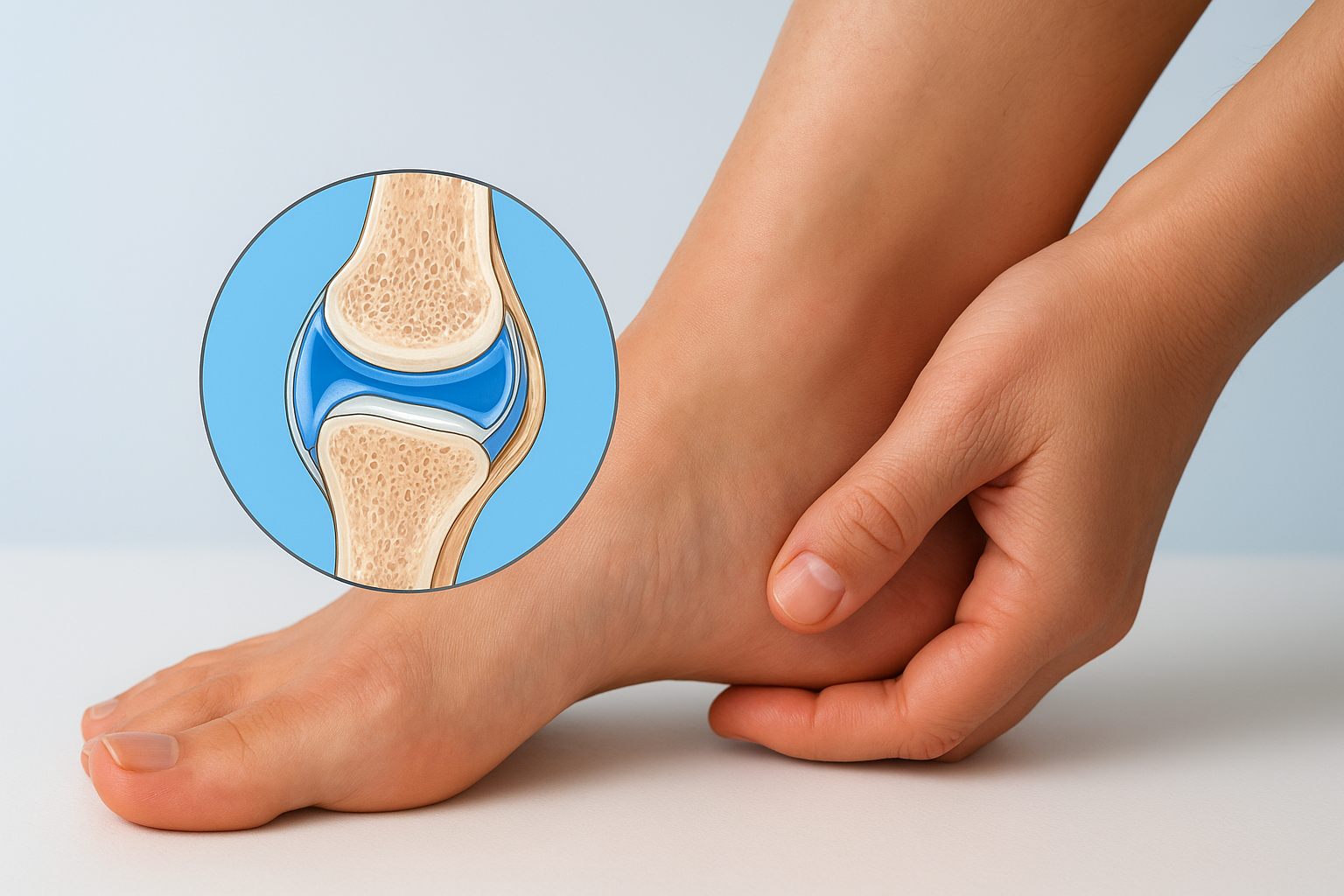
The key structures inside a joint
Three core components do most of the work in keeping your joints stable and functional. Each one plays a specific role:
- Cartilage: Smooth tissue that covers bone ends and allows them to glide against each other
- Ligaments: Tough bands that connect bone to bone and hold the joint in alignment
- Tendons: Connective tissue that attaches muscle to bone and controls joint movement
- Synovial membrane: The inner lining that secretes lubricating fluid into the joint space
When any of these structures takes damage, the whole joint loses efficiency, and you start to feel it during movement.
How synovial fluid keeps joints moving
Your joint capsule produces synovial fluid, a thick liquid that lubricates and nourishes cartilage. Cartilage has no direct blood supply, so it depends entirely on this fluid to stay healthy and resilient.
Staying sedentary starves your cartilage of the nutrients it needs, because synovial fluid only circulates when you move.
Movement drives fluid circulation through the joint, which is why regular physical activity protects your joints rather than wearing them down. Even light daily walking keeps fluid moving through the 33 joints in each foot.
What affects joint health over time
Joint health changes gradually, and by the time most people notice a problem, the underlying cause has often been building for years. Several factors accelerate how fast your joints break down, and recognizing them gives you a real opportunity to slow the process before symptoms become limiting.
Age and cumulative wear
As you get older, your body produces less synovial fluid and your cartilage becomes thinner and less resilient. Years of movement, even normal, healthy movement, gradually wear down the smooth surfaces inside each joint. This is why conditions like hallux rigidus and ankle osteoarthritis become more common after middle age. The process isn’t inevitable to the point of disability, but it does mean that protecting your joints in your 30s and 40s pays off significantly later.
Starting joint-protective habits early reduces the severity of age-related changes, even if it doesn’t eliminate them entirely.
Lifestyle factors that speed up joint damage
Beyond age, your daily habits have a direct and measurable impact on how your joints hold up. Carrying excess body weight increases the load on your foot and ankle joints with every step, accelerating cartilage breakdown. Poor footwear choices, like flat unsupportive shoes or worn-out soles, remove the cushioning your joints rely on. Repetitive high-impact activity without adequate recovery time also stresses cartilage faster than your body can repair it, making rest and recovery just as important as the activity itself.
How to support joint health every day
Understanding what is joint health gives you the information you need to actually protect it. The good news is that several daily habits directly slow cartilage breakdown and keep your joints moving with less resistance and pain.
Movement, weight, and footwear
Regular low-impact movement, such as walking, swimming, or cycling, keeps synovial fluid circulating and your supporting muscles strong. If you carry extra weight, even a modest reduction takes significant pressure off your foot and ankle joints with every step. Wearing supportive, well-fitted footwear is one of the simplest and most overlooked ways to protect the joints in your feet. Worn-out soles and flat shoes remove the cushioning your cartilage depends on daily.

Replacing your footwear before it fully breaks down costs far less than treating the joint damage that follows.
Nutrition and hydration
What you eat directly affects joint tissue quality. Omega-3 fatty acids, found in fatty fish, walnuts, and flaxseed, reduce inflammation in joint tissue. Vitamin D and calcium support the bone structure that holds each joint together, and staying consistently hydrated helps your body produce adequate synovial fluid. Collagen-rich foods and supplements have also shown promise for maintaining cartilage resilience, particularly as you age and natural production slows.
When to see a foot and ankle specialist
Understanding what is joint health helps you recognize when self-care is no longer enough. Mild stiffness after a long walk often resolves with rest and better footwear, but certain symptoms signal that something more significant is happening inside your joints. Waiting too long to address these signs typically means more treatment, longer recovery, and sometimes permanent loss of function.
Pain that doesn’t follow a normal pattern
If your joint pain persists beyond a few days without a clear cause, or if it wakes you up at night, those are signals worth taking seriously. Swelling that doesn’t respond to rest and ice, or pain that worsens progressively rather than improving, suggests structural damage inside the joint that needs professional evaluation.
Catching joint damage early gives you far more treatment options than waiting until the pain becomes constant.
Functional changes in how you walk or stand
When joint problems change your gait, your body compensates in ways that strain your knees, hips, and lower back. If you notice yourself avoiding certain movements, limping, or losing your balance more than usual, those are functional warning signs that go beyond normal soreness.
These changes don’t resolve on their own once structural damage is involved. At Achilles Foot and Ankle Center, our podiatrists across Central Virginia evaluate exactly these patterns and build treatment plans specific to your joint condition, whether that means custom orthotics, physical therapy, or a more advanced intervention.
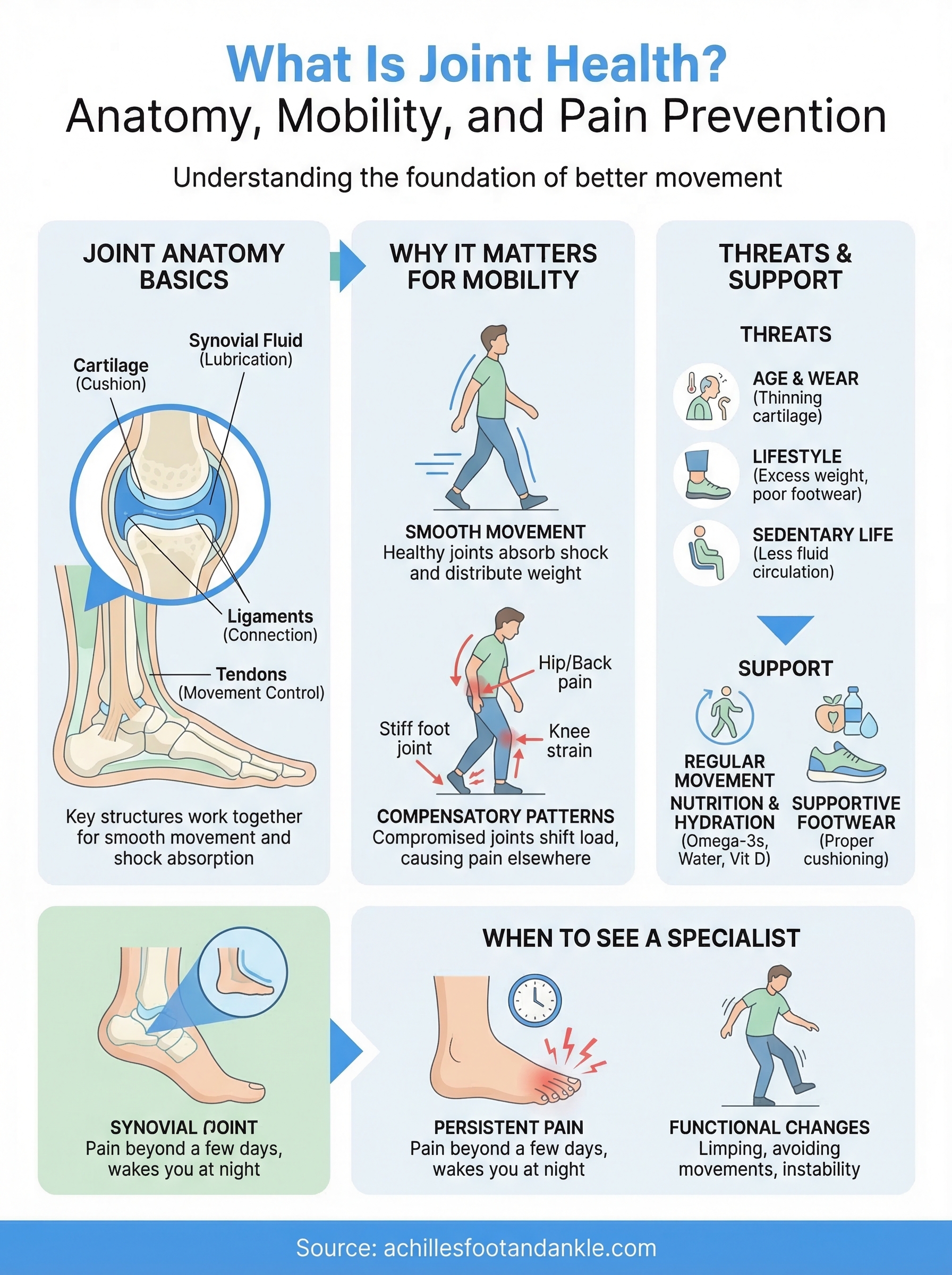
Next steps for healthier joints
Now that you understand what is joint health and how your foot and ankle joints function, the next move is yours. Daily habits like consistent movement, supportive footwear, and proper nutrition add up over time and make a real difference in how your joints hold up through the years. Small changes made consistently produce far better outcomes than reactive treatment after pain becomes limiting.
Your foot and ankle joints carry your full body weight through every activity you do, and they deserve professional attention when something feels off. If you’re experiencing stiffness, swelling, or pain that isn’t resolving on its own, don’t wait for it to get worse. The team at Achilles Foot and Ankle Center works with patients across Central Virginia to diagnose and treat joint conditions at every stage. Schedule a same-day appointment and get a clear picture of what your joints actually need.