

Thick, yellow, crumbling toenails don’t fix themselves. Over-the-counter creams and polishes rarely reach the fungus living under the nail plate, which is why so many people search for a nail fungus foot doctor after months of frustration. If you’ve been hiding your feet in closed shoes and hoping the problem clears up on its own, you already know that approach doesn’t work.
A podiatrist is the right specialist for this job. They can confirm whether it’s actually fungus (not psoriasis, trauma, or another nail condition) and match you with a treatment strong enough to reach the infection, whether that’s prescription oral medication, topical lacquers, or in-office laser treatment. Skipping straight to a foot doctor also saves you months of trial and error with drugstore products that only treat the surface.
This article walks you through when to see a foot doctor for nail fungus, what a diagnostic visit actually involves, and the treatment options a podiatric practice like ours typically offers. By the end, you’ll know what to expect at your appointment and how to get your nails looking healthy again.
Why nail fungus deserves professional attention
Toenail fungus, medically called onychomycosis, is a living infection that grows deeper into the nail bed the longer it sits untreated. It’s not a stain you can scrub off or a texture issue that improves with a pumice stone. The fungus feeds on keratin, the protein that makes up your nail, and it keeps spreading as long as it has a food source and a warm, damp environment to thrive in. That’s why a nail that starts as one small yellow patch can turn into a fully thickened, crumbling nail within a year or two if nothing changes.
It rarely stays contained to one nail
Fungal infections spread. A fungal toenail infection on your big toe can jump to neighboring toes, and it can also move to your fingernails if you’re not careful about hand hygiene after touching your feet. Shoes and socks become reservoirs for fungal spores, so wearing the same sneakers day after day without treatment just reinfects the nail after it starts to clear. Left alone, the infection also makes nails brittle enough to catch on socks and tear, which opens the door to painful splitting and secondary bacterial infections.
A fungal nail infection doesn’t sit still. It spreads to other nails and gets harder to treat the longer you wait.
The stakes are higher for some patients
For most people, fungal nails are an annoying, embarrassing problem. For others, they’re a genuine health risk. Anyone with diabetes or poor circulation needs to take nail fungus seriously because thickened, deformed nails can press into surrounding skin and create pressure sores. Those small breaks in the skin barrier are exactly how diabetic foot infections start, and they can escalate quickly in patients who already have reduced sensation or slow wound healing. This is one of the reasons our practice runs a dedicated diabetic foot care program alongside general podiatry, because we see firsthand how a
How a foot doctor diagnoses nail fungus
Diagnosis starts with a hands-on look at your nail plate, cuticle, and surrounding skin. Podiatrists know that not every discolored or thickened nail is fungal, so they check for ridges, pitting, or brittleness that might point to something else entirely, like psoriasis or a nail injury from years of pressure inside tight shoes. This visual exam takes just a few minutes but tells an experienced foot doctor a lot before any lab work even begins.

Confirming the diagnosis with a lab test
A trained eye can spot fungus most of the time, but guessing wrong means months of wasted treatment. That’s why most podiatric offices, including ours, take a small clipping or scraping from underneath the nail and send it for lab testing before committing to a treatment plan. A few common methods:
- KOH prep: A potassium hydroxide solution dissolves the keratin so fungal elements show up under a microscope. Results often come back within days.
- Fungal culture: Takes longer, sometimes two to three weeks, but identifies the exact species of fungus, which can guide medication choice in stubborn or recurring cases.
- PCR testing: A newer molecular test some practices use for faster, more precise identification, especially when previous treatments have already failed.
Confirming the fungus with a lab test before starting treatment saves you from months of medication that never had a chance of working.
Ruling out look-alikes
Nails that look fungal sometimes aren’t. Psoriasis can pit and thicken nails in a pattern that closely mimics onychomycosis. Trauma from running or ill-fitting shoes can cause a nail to lift and discolor without any infection at all. Lichen planus, nail bed tumors, and even certain medications can also change how a nail looks and grows. Ruling out these conditions matters because treating psoriasis with antifungal medication, or the reverse, wastes months of treatment time and lets the real problem keep progressing underneath.
What you should bring to your appointment
Showing up prepared speeds up the whole process. Carry a list of any medications and supplements you’re taking, since some antifungal prescriptions interact with other drugs, particularly certain cholesterol medications. Note if you’ve already tried over-the-counter treatments, and for how long, because that history helps your foot doctor for toenail fungus decide whether to start conservative or move straight to a more aggressive option. Patients with diabetes or circulation problems should mention it when scheduling, so the visit can be coordinated with any other foot care needed that same day.
What to expect during nail fungus treatment
Once your podiatrist confirms the diagnosis, treatment planning depends on how severe the infection is, how many nails are affected, and your overall health history. Mild cases caught early often respond to topical antifungal lacquers you paint on nightly, while thick, long-standing infections usually need something stronger. Your foot doctor will walk you through the realistic timeline for each option, because fungal nail treatment is measured in months, not days, and setting that expectation upfront prevents frustration halfway through.

The main treatment options
Most podiatric practices, including ours, choose from a handful of proven approaches depending on severity:
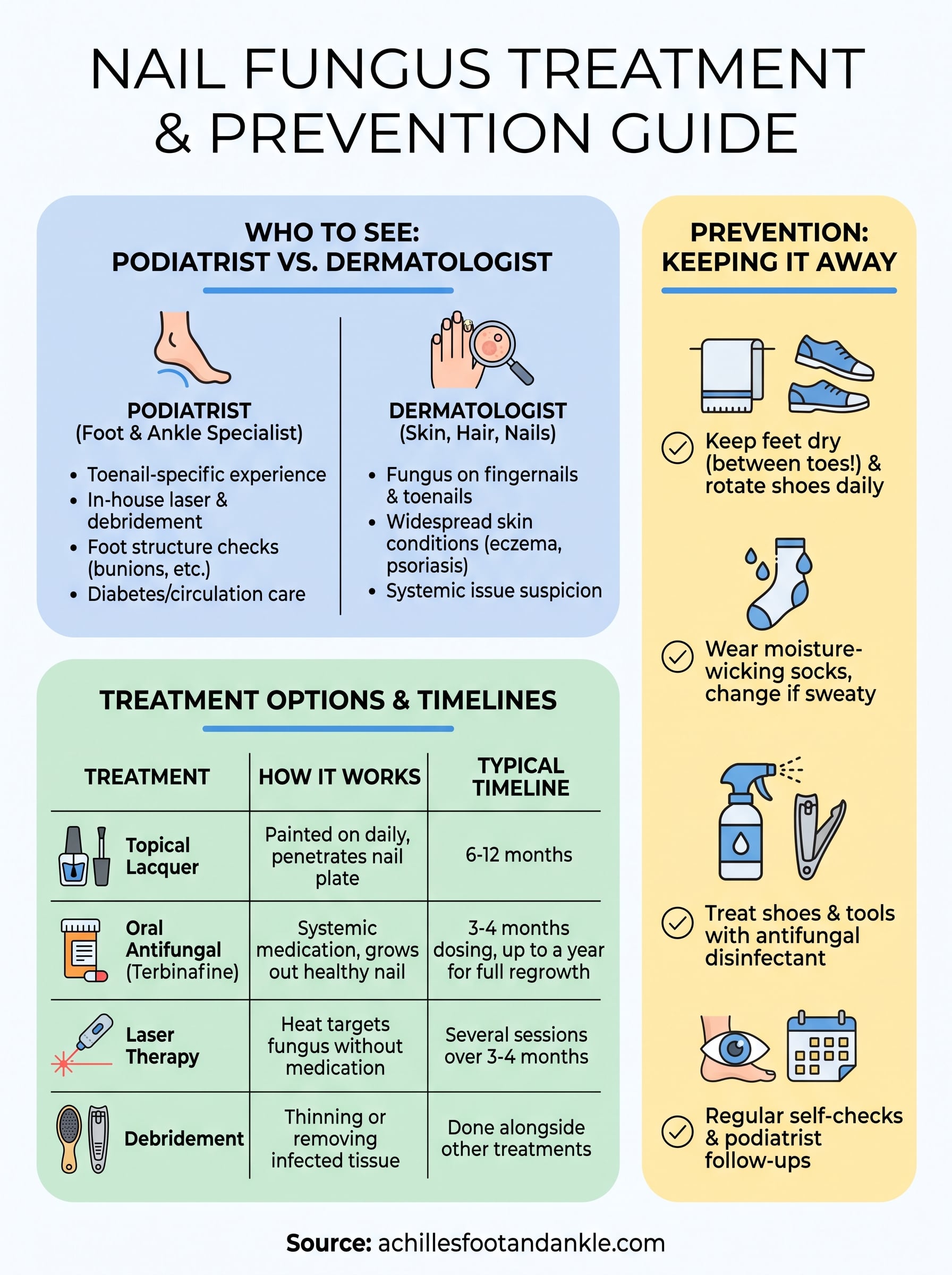
| Treatment | How it works | Typical timeline |
|---|---|---|
| Topical lacquer | Painted on nail daily, penetrates nail plate | 6-12 months |
| Oral antifungal (terbinafine) | Systemic medication, grows out healthy nail | 3-4 months of dosing, up to a year for full regrowth |
| Laser therapy | Heat targets fungus without medication | Several sessions over 3-4 months |
| Debridement | Thinning or removing infected nail tissue | Done alongside other treatments |
Oral medication tends to have the highest cure rates, but it requires liver function bloodwork beforehand and sometimes a follow-up check partway through, since terbinafine is processed through the liver.
Nail fungus treatment works, but it takes months because you’re waiting for a new, healthy nail to grow in, not fixing the old one.
What happens at follow-up visits
Progress checks matter more than people expect going into treatment. Nails grow slowly, roughly a millimeter a month for toenails, so your podiatrist tracks improvement by measuring how far the clear, healthy nail has grown out from the cuticle at each visit. Debridement, which means thinning or trimming away the thickest infected nail tissue, often happens at these same appointments to reduce pressure, discomfort, and the amount of infected material the medication has to work through.
Combining treatments for stubborn cases
Several of our patients need more than one approach layered together. Recurrent or severe infections sometimes call for oral medication plus a topical lacquer, or laser sessions paired with regular debridement to speed visible results. Your treatment plan should adjust if a lab recheck shows the fungus hasn’t cleared after several months, rather than continuing something that isn’t working. Ask your foot doctor directly what percentage of the nail should look clear by each follow-up, so you have a concrete benchmark instead of just hoping it looks better next time you check.
Podiatrist vs dermatologist: who should you see
Both podiatrists and dermatologists can legally diagnose and treat nail fungus, so patients often aren’t sure which one to call first. The honest answer is that foot and ankle specialists see far more toenail cases day to day, simply because feet spend hours a day trapped in warm, damp shoes, the exact environment fungus needs to thrive. A dermatologist trained broadly in skin, hair, and nails might see a handful of fungal toenails a month, while a podiatric practice treats them constantly.
What a podiatrist brings to a nail fungus visit
Experience with volume matters here. A podiatrist for toenail fungus has usually already ruled out the foot-specific look-alikes, like a nail deformed from years of running in the wrong shoe size or a subungual hematoma from an old injury, conditions a general dermatologist may not encounter often. Podiatric offices also tend to have in-house tools built for feet specifically, including laser equipment sized and calibrated for toenails, digital imaging for structural issues, and the ability to handle debridement and nail care in the same visit as diagnosis.
If your fungal infection is limited to your feet, a podiatrist gives you faster access to foot-specific tools and far more hands-on experience treating exactly this condition.
When a dermatologist makes more sense
Sometimes the picture is bigger than one infected nail. If fungus has spread to your fingernails, or if you have a widespread skin condition like eczema or psoriasis happening alongside the nail changes, a dermatologist’s broader training in skin disease becomes genuinely useful. They’re also a good fit if your primary care doctor suspects the nail changes are tied to a systemic issue rather than a straightforward fungal infection.
Quick comparison
| Situation | Better fit |
|---|---|
| Fungus limited to toenails | Podiatrist |
| Fungus plus foot structural issues (bunions, hammertoes) | Podiatrist |
| Fungus spread to fingernails | Dermatologist |
| Nail changes tied to widespread skin disease | Dermatologist |
| Diabetes or circulation concerns alongside nail fungus | Podiatrist |
Generally speaking, if the problem starts and ends at your feet, start with the specialist who spends every day looking at feet. Many patients also appreciate that a podiatric visit can double as a broader foot health check, catching bunions, calluses, or circulation issues that a dermatology visit wouldn’t address. Choosing based on where the infection actually lives, rather than habit, gets you to the right treatment faster.
How to keep nail fungus from coming back
Treating the infection is only half the job. Fungal spores can survive in your shoes, socks, and shower floor long after your nail looks clear, which is why so many patients see the same infection return within a year of finishing treatment. Preventing a fungal toenail infection from coming back means changing a few daily habits, not just finishing a prescription and moving on.
Keep your feet dry and your shoes rotated
Moisture is what lets fungus take hold in the first place, so drying your feet thoroughly after showers and workouts matters more than most people realize. A few habits make a real difference:
- Dry between your toes with a towel every time, not just a quick pass over the top of your foot
- Rotate at least two pairs of shoes so each pair gets a full day to air out before you wear it again
- Choose moisture-wicking socks over cotton, and change them if your feet sweat during the day
- Wear sandals or flip-flops in public showers, gym locker rooms, and pool decks
Fungus needs moisture to survive, so drying your feet and rotating your shoes does more to prevent reinfection than any cream you’ll ever buy.
Treat your shoes, not just your nails
Spraying an antifungal disinfectant inside your shoes, or using a UV shoe sanitizer, kills off spores that would otherwise reinfect a nail that just finished treatment. Old athletic shoes worn during the original infection are often worth replacing entirely, since fabric linings hold onto fungal spores in a way that’s hard to fully clean out. Nail clippers and files should get disinfected after every use too, and it’s worth keeping a separate set for any nail that was infected until you’re confident it’s fully cleared.
Watch for early warning signs
Regular self-checks catch a recurrence early, back when a topical lacquer can handle it, instead of letting it progress to the point where you need oral medication again. Look for a faint yellow streak near the cuticle, since that’s usually the first visible sign the fungus is back before the nail thickens. Scheduling a checkup with your nail fungus foot doctor every few months after treatment, especially if you have diabetes or poor circulation, keeps small issues from turning into bigger ones. Nail salons can also be a source of reinfection, so ask whether their tools are properly sterilized between clients before your next pedicure.
Getting your nails back on track
Thick, discolored toenails aren’t a cosmetic detail you have to live with. A nail fungus foot doctor can confirm what’s actually going on, match you to a treatment strong enough to reach the infection, and help you avoid the months of guesswork that come with drugstore products alone. Whether your case calls for a topical lacquer, oral medication, or laser therapy, the earlier you get a proper diagnosis, the faster you get a clear nail growing back in.
Fungal infections don’t resolve on their own, and they only get harder to treat the longer they sit. If you’re dealing with a yellowing, crumbling, or thickened nail, don’t wait for it to spread to another toe or your fingernails. Our podiatric team at Achilles Foot and Ankle Center treats this exact condition every week, and getting started is simple. Schedule a same-day appointment and let’s get your nails back to healthy.