

Rolled your ankle during a weekend game, or noticed that nagging heel pain won’t go away no matter how much you rest? Searching for a podiatrist sports medicine near me is the right move, but knowing what these specialists actually treat, and why it matters for your recovery, changes how fast you get back on your feet.
A sports medicine podiatrist focuses specifically on the biomechanics of the foot and ankle under athletic stress. That means stress fractures, Achilles tendon injuries, plantar fasciitis, and chronic ankle instability get evaluated by someone who understands how your gait, footwear, and training load contribute to the problem, not just how to treat the symptom in front of them. This distinction matters because a misdiagnosed sports injury can turn a two-week recovery into a season-ending one.
In this article, you’ll learn exactly what conditions fall under foot and ankle sports medicine, what to expect during an evaluation, and how local, experienced podiatrists at practices like ours across Central Virginia combine advanced imaging with both conservative and surgical treatment options to get athletes, weekend warriors, and active kids back to full strength.
Why seeing a sports medicine podiatrist matters
General practitioners and even general orthopedists often treat the foot and ankle as an afterthought, a small piece of the larger musculoskeletal system. A sports medicine podiatrist flips that approach. Your feet and ankles absorb three to four times your body weight with every running stride, and they’re built from 26 bones, 33 joints, and over 100 muscles, tendons, and ligaments working together. When one part of that chain breaks down, whether it’s a stress fracture in the metatarsal or a partial tear in the Achilles tendon, a specialist who studies foot mechanics daily catches details a generalist might miss.
Foot and ankle injuries need specialized biomechanical expertise
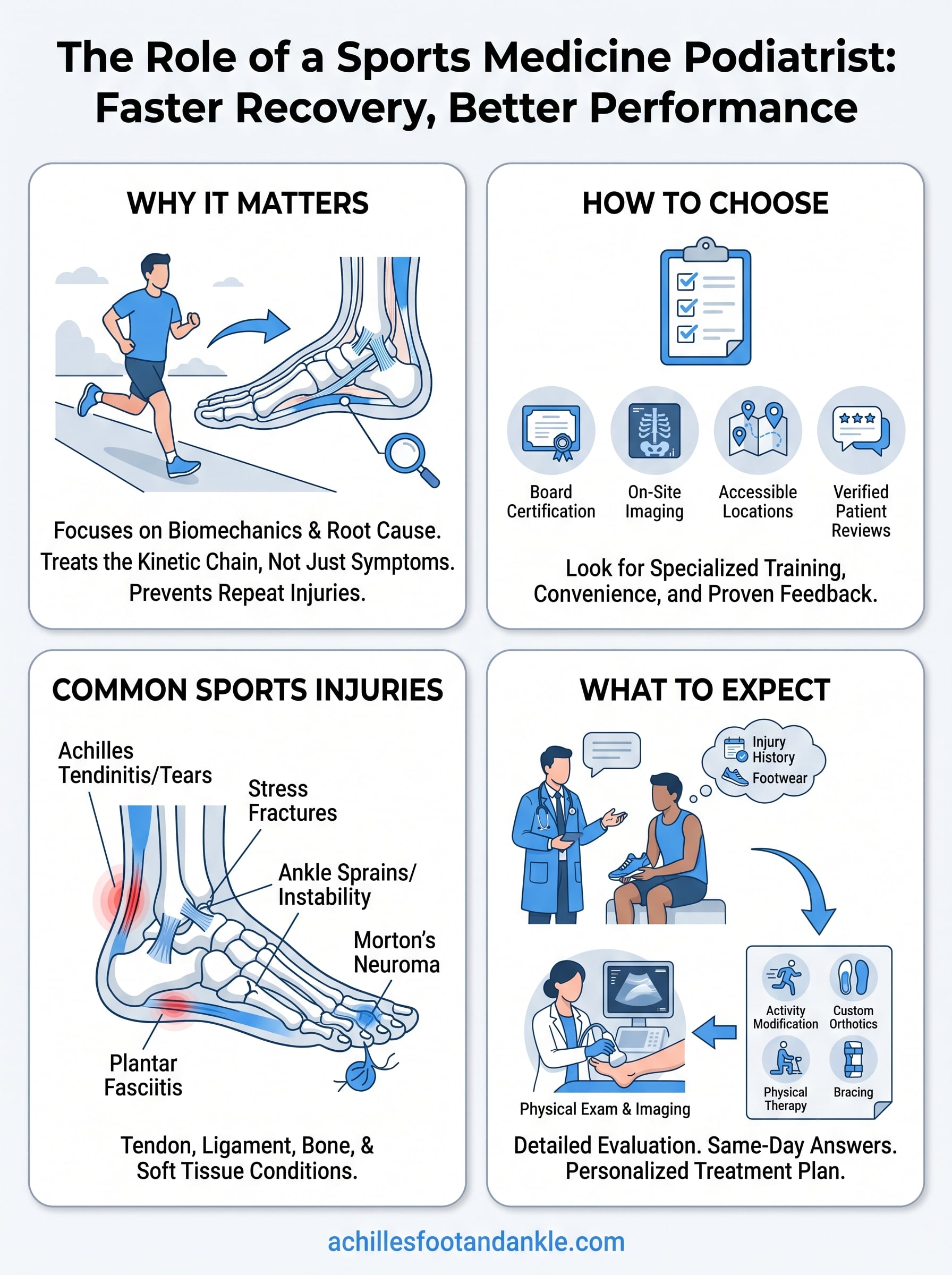
Running form, footwear wear patterns, arch type, and even how you push off the ground all factor into diagnosing a sports injury correctly. A podiatrist trained in sports medicine looks at your entire kinetic chain, not just the sore spot, because a tight calf or a collapsed arch can be the real source of heel or knee pain. This kind of first-hand biomechanical assessment is something a walk-in urgent care clinic simply isn’t equipped to provide.
The risk of ignoring or misdiagnosing sports injuries
Delaying proper care, or getting the wrong diagnosis, is where most athletes get into trouble. A plantar fasciitis flare-up treated with rest alone, without addressing the underlying tightness or gait issue, tends to come right back once you resume training. A stress fracture mistaken for a simple sprain can worsen into a complete break if you keep running on it.
Treating the symptom instead of the cause is why so many sports injuries turn into repeat injuries.
That’s the core value of finding a qualified local podiatrist: they catch the root cause early, before a minor issue becomes a months-long setback.
Podiatrists vs. general practitioners for sports injuries
Here’s a quick comparison of what each type of provider typically offers when you’re dealing with a foot or ankle sports injury:
| Provider Type | Foot/Ankle Imaging On-Site | Custom Orthotics | Surgical Options | Biomechanical Gait Analysis |
|---|---|---|---|---|
| Primary Care Physician | Rarely | No | No | No |
| Urgent Care Clinic | Sometimes (X-ray only) | No | No | No |
| General Orthopedist | Often | Sometimes | Yes | Rarely |
| Sports Medicine Podiatrist | Yes | Yes | Yes | Yes |
Seeing the right specialist from the start saves you appointments, time off your feet, and often money, since you’re not bouncing between referrals before landing on someone equipped to actually solve the problem. For athletes especially, where every week of downtime affects conditioning and competition schedules, that efficiency matters just as much as the treatment itself.
How to find and choose the right podiatrist near you
Starting your search with "podiatrist sports medicine near me" gets you a list of names, but narrowing that list down takes a little more digging. Look for board certification through the American Board of Foot and Ankle Surgery, which confirms the doctor has completed rigorous training beyond podiatry school. Check whether the practice treats athletes regularly, not just diabetic foot care or routine nail issues, since sports injuries require a different diagnostic approach and a faster treatment timeline.
What to check before booking
Use this quick checklist when comparing local practices:
- Board certification in foot and ankle surgery, not just a general podiatry license
- On-site imaging (X-ray, ultrasound, sometimes MRI referral) so you’re not waiting weeks for answers
- Same-day or urgent appointment slots for acute injuries like sprains or suspected fractures
- Experience with your specific sport, since a runner’s injury pattern differs from a soccer player’s
- Insurance acceptance, confirmed directly with the office before your visit
Gathering this information upfront saves you from switching providers mid-treatment, which only delays recovery further.
Location and accessibility matter more than you’d think
Proximity affects whether you actually follow through with physical therapy visits, follow-up scans, and post-surgical checkups. A sports medicine podiatrist near me search should factor in how many locations a practice runs across your area. Practices with multiple clinic sites, like Achilles Foot and Ankle Center’s thirteen locations throughout Central Virginia, make it easier to schedule appointments around work, school, or training without losing a half-day to travel.
The best podiatrist on paper isn’t the right one if getting there stops you from keeping appointments.
Reading patient reviews rounds out your research. Verified reviews on Google or Healthgrades tell you how a practice handles communication, wait times, and follow-through, details that matter just as much as the doctor’s resume. Combining credentials, accessibility, and real patient feedback gives you a much clearer picture than a single search result ever could.
Common sports injuries a podiatrist can treat
Athletes and weekend runners alike show up with a familiar cluster of complaints, but the treatment path differs depending on the tissue involved and how long the injury has been ignored. A local sports medicine podiatrist typically manages the following conditions, often combining conservative therapy first with surgical repair reserved for cases that don’t respond.

Tendon and ligament injuries
Achilles tendinitis and tears rank among the most common reasons athletes search for a podiatrist near me for sports injuries. Overuse from sprinting, jumping, or sudden increases in training volume inflames or partially tears the tendon, causing stiffness that’s worse in the morning and pain that builds during activity. Ankle sprains fall into this category too, and repeated sprains without proper rehab lead to chronic ankle instability, where the joint gives out unpredictably during cutting or pivoting movements.
Bone stress and structural issues
Stress fractures develop when repetitive impact outpaces the bone’s ability to repair itself, most commonly in the metatarsals and heel. Left untreated, a hairline stress fracture can progress to a complete break within weeks.
A stress fracture ignored for two more weeks of training can turn into a break that sidelines you for two more months.
Soft tissue and nerve conditions
Plantar fasciitis, heel spurs, and Morton’s neuroma round out the list, each causing pain that flares with activity and eases with rest, at least initially.
- Plantar fasciitis: sharp heel pain, worst with the first steps out of bed
- Achilles tendinitis/tears: pain and swelling along the back of the ankle
- Ankle sprains and instability: repeated "giving way" during play
- Stress fractures: localized, pinpoint pain that worsens with weight-bearing
- Morton’s neuroma: burning or numbness between the toes
Each condition responds differently to treatment, which is exactly why an accurate diagnosis, not a guess, determines whether you’re back to training in weeks or months.
What to expect during your first appointment
Walking into your first visit with a sports medicine podiatrist looks different from a routine checkup. Expect a detailed conversation about how the injury happened, what activities aggravate it, and any prior injuries to the same foot or ankle, since old damage often predicts new problems. Bringing your running shoes, cleats, or whatever footwear you train in gives the doctor real information about wear patterns that a description alone can’t capture.

The physical exam and imaging
After the history, the doctor examines your gait, range of motion, and strength, often watching you walk or stand on one leg to spot compensations you might not notice yourself. Most practices equipped for sports injuries offer on-site digital X-ray, and some use diagnostic ultrasound to look directly at tendons and ligaments in real time. This is where searching for a podiatrist sports medicine near me with in-house imaging pays off. You get answers the same day instead of waiting a week for a referral to open up.
A same-day diagnosis means a same-week treatment plan, instead of another week of guessing.
Building your treatment plan
Depending on what the exam and imaging show, your provider maps out a plan that usually starts conservative. That might mean:
- Activity modification and a specific return-to-play timeline
- Bracing or taping to stabilize the joint during healing
- Physical therapy referral targeting strength and flexibility gaps
- Custom orthotics if biomechanics are driving the problem
- Follow-up imaging scheduled to track healing progress
Questions matter here too. Don’t leave without asking how long recovery typically takes for your specific injury, what activities to avoid, and what warning signs would mean you need to come back sooner. Good practices welcome this back-and-forth rather than rushing you out the door, because a treatment plan you understand is one you’re far more likely to actually follow through on.
Taking the next step toward pain-free movement
Foot and ankle pain rarely fixes itself once you’re pushing through training or competition. Getting an accurate diagnosis early, whether it’s a stress fracture, Achilles tear, or stubborn plantar fasciitis, is what separates a two-week recovery from a season lost on the sidelines. Knowing what a sports medicine podiatrist actually treats, and what to look for when choosing one, puts you in control of that timeline instead of leaving it to guesswork.
Momentum matters here. Every day spent training on an untreated injury adds time to your eventual recovery, so acting quickly is part of the treatment itself. If you’re dealing with ankle pain, heel pain, or a nagging injury that hasn’t improved with rest, don’t wait for it to get worse. Book a same-day appointment with our Central Virginia team and get a real diagnosis, not another guess, before your next practice or game.