
That burning, tingling, or electric-shock sensation across the top of your foot doesn’t just show up for no reason. Nerve pain on top of foot causes range from tight shoelaces and ill-fitting shoes to pinched nerves, past ankle sprains, and underlying conditions like diabetes. Figuring out which one applies to you matters, because the wrong treatment can leave you dealing with the same discomfort months from now.
If you’re searching for answers, you want to know two things: what’s triggering the pain, and how to make it stop. The most common culprit is a condition called superficial peroneal neuropathy, often caused by compression from footwear, swelling, or trauma. Other cases trace back to tarsal tunnel syndrome, nerve entrapment after an injury, or a bone spur pressing on a nearby nerve.
In this article, we walk through the specific causes behind top-of-foot nerve pain, how our podiatrists diagnose the source using tools like ultrasound and digital imaging, and the treatment options available, from custom orthotics and footwear changes to fluoroscopy-guided injections and, when needed, surgical intervention.
Why nerve pain on top of the foot matters
Ignoring tingling or burning across the top of your foot rarely makes it disappear. Nerve pain almost always points to a mechanical or medical problem that needs attention, whether that’s a compressed nerve from tight shoes or an early sign of peripheral neuropathy tied to diabetes. Waiting it out often means the underlying issue keeps progressing while you lose function you didn’t expect to lose.
A warning sign, not just a symptom
Nerves don’t misfire randomly. When you feel a sharp, electric sensation on the top of your foot, it usually means a specific nerve is being compressed, stretched, or damaged somewhere along its path. Common triggers include swelling after an ankle sprain, a bone spur pressing against soft tissue, or repetitive pressure from footwear that sits too low across the midfoot. Left unaddressed, that irritation can shift from occasional discomfort into constant pain or numbness as the nerve sustains more damage.
Nerve pain is your body’s early warning system, not background noise to push through.
The everyday impact of foot nerve pain
Foot nerve pain doesn’t stay contained to your foot. It changes how you walk, which puts extra strain on your knees, hips, and lower back as you unconsciously compensate. Patients we see often describe a cascade of smaller problems that build on each other:
- Trouble wearing regular shoes without pain flaring up
- Disrupted sleep from burning or tingling at night
- Reduced activity levels, which can worsen circulation problems
- Difficulty standing for long periods at work
- Anxiety about the pain signaling something more serious
These effects compound over weeks and months, especially if the original cause, like a pinched nerve or unstable ankle, keeps getting re-aggravated by daily movement.
Untreated nerve pain can escalate
Here’s the part that catches people off guard: nerve damage is often progressive, not static. A nerve that’s mildly irritated today can become permanently damaged if the compression or trauma continues unchecked. This is especially true for patients with diabetes, where nerve pain frequently signals diabetic peripheral neuropathy, a condition the CDC notes affects roughly half of people with diabetes at some point. Once nerve fibers deteriorate significantly, some of that damage becomes irreversible, which is why catching the cause early changes the entire treatment picture.
Understanding why this pain deserves real attention sets up the next step: figuring out exactly which nerve, structure, or condition is behind your specific symptoms. That diagnostic work is what separates a treatment plan that actually resolves the problem from one that just masks it for a few weeks.
How to identify what’s causing your foot pain
Pinpointing the exact source of nerve pain on top of your foot starts with paying attention to patterns. When does the pain flare? What makes it better or worse? These details matter more than you’d think, because different causes produce different symptom patterns that a trained eye can spot quickly.
Start with a symptom check
Before you ever sit in an exam chair, track what your foot is telling you. Location, timing, and triggers all narrow down the possibilities:
- Burning or tingling that worsens with tight lace-up shoes points toward superficial peroneal neuropathy
- Numbness spreading to the toes after an old ankle sprain suggests nerve entrapment from scar tissue
- Pain that’s worse at night or affects both feet symmetrically often signals peripheral neuropathy
- Sharp pain over a bony bump usually means a bone spur is irritating the nerve directly
- Pain triggered by specific activities like running or standing for hours points to repetitive stress on the nerve
Where your pain lives, and when it shows up, often tells you more than the pain itself.
What a podiatric exam actually involves
Once you’re in front of a specialist, the diagnostic process gets more precise. A thorough exam includes a physical assessment of the foot and ankle, checking for swelling, tenderness, and reduced sensation along specific nerve pathways. We also test how you walk, since altered gait patterns often reveal where the compression originates. From there, imaging fills in the gaps that a physical exam alone can’t answer.
Tools that confirm the diagnosis
At Achilles Foot and Ankle Center, we rely on digital imaging and ultrasound to visualize soft tissue, nerve swelling, and bone spurs that might be pressing on a nerve. Ultrasound is particularly useful here because it shows nerves in real time as you move your foot, something static X-rays can’t capture. For cases where diabetes or a broader neurological issue is suspected, nerve conduction studies or blood work may also come into play. Combining these findings, symptom history, physical exam, and imaging, gives us a clear picture of exactly which structure is causing your foot pain, which is the only real starting point for a treatment plan that works.

How to treat nerve pain on top of the foot
Once we know what’s compressing or irritating the nerve, treatment usually starts conservative and escalates only if you need it to. Most patients see real improvement without surgery, especially when the cause is caught early and the treatment plan matches the actual source of the problem rather than just numbing the symptom.
Conservative options that work first
For mild to moderate cases, a combination of these approaches often resolves the pain within weeks:
- Footwear changes: switching to shoes with a wider, higher toe box and looser lacing across the midfoot
- Custom orthotics: redistributing pressure away from the compressed nerve pathway
- Physical therapy: restoring normal gait mechanics so the nerve stops getting re-irritated with every step
- Bracing: stabilizing an unstable ankle that’s stretching or pinching the nerve
- Anti-inflammatory medication: reducing swelling around the nerve short-term
Most nerve pain responds to removing the pressure that’s causing it, not to masking the sensation.
When injections make sense
If conservative steps stall out, fluoroscopy-guided injections target the exact spot where a nerve is trapped or inflamed. Guided imaging matters here because injecting blind near a nerve risks missing the target entirely or hitting the wrong structure. We use this approach for cases involving scar tissue entrapment, bone spur irritation, or stubborn inflammation that hasn’t responded to orthotics or bracing after several weeks.
Surgical intervention for persistent cases
Surgery becomes the right call when a structural problem, like a bone spur, thickened scar tissue, or an entrapped nerve, won’t resolve without physically releasing the pressure. At our Foot and Ankle Surgery Center, we perform minimally invasive nerve decompression and related reconstructive procedures for patients who’ve exhausted conservative care. Recovery timelines vary depending on the procedure, but most patients return to normal footwear and activity within six to eight weeks. The goal isn’t to jump to surgery early; it’s to have it ready as an option once we’ve confirmed conservative care won’t fix the underlying structural issue causing your nerve pain.
Steps to prevent nerve pain from coming back
Treating the current flare-up only solves half the problem. Once your nerve pain calms down, the real work is making sure the same compression, swelling, or repetitive stress doesn’t build back up over the next few months. Prevention matters just as much as treatment because nerves that have been irritated once are more sensitive to a repeat injury.
Rethink your footwear habits
Shoes are the number one repeat offender we see in patients who come back with the same complaint six months later. If your laces sit directly over the midfoot, that pressure point is exactly where superficial peroneal neuropathy tends to develop. Swap tight lace-up styles for shoes with a wider toe box, a lower-profile tongue, or looser lacing patterns that skip the midfoot entirely. Rotating between two or three pairs also helps, since no single shoe compresses the same spot every single day.
Nerve pain rarely returns because of bad luck. It returns because the original pressure point never got removed.
Build habits that protect nerve health long-term
Beyond footwear, a few consistent habits keep pressure and inflammation from creeping back:
- Wear custom orthotics as prescribed, even after symptoms fade, to keep pressure distributed evenly
- Stretch and strengthen the ankle and lower leg to maintain stable gait mechanics
- Monitor blood sugar closely if you have diabetes, since uncontrolled glucose accelerates nerve damage
- Avoid re-wrapping old ankle sprains too tightly, which can re-compress a healing nerve
- Check your feet daily for swelling, redness, or numbness, especially if you have reduced sensation already
Schedule periodic check-ins
Questions worth asking every few months: has your weight changed, are your shoes wearing unevenly, has your activity level shifted? Small changes like these quietly reintroduce pressure on a nerve that’s still healing. Scheduling a follow-up visit every six to twelve months, particularly if you have diabetes or a history of ankle instability, gives your podiatrist a chance to catch early irritation before it turns into another full-blown flare. Consistent follow-through beats waiting for pain to reappear before acting.
When to see a podiatrist for foot nerve pain
Deciding when to stop self-treating and call a specialist trips up a lot of people, because nerve pain can ebb and flow before it gets worse. A general rule works well here: if home adjustments like new shoes or rest haven’t改changed anything after two to three weeks, that’s your signal to get evaluated rather than keep guessing.
Red flags that need prompt attention
Certain symptoms shouldn’t wait out the two-week window at all. Numbness that spreads rather than stays put, pain that wakes you up at night, or any sign of infection around an old wound means you need to be seen right away, not after trying another round of new insoles. Here’s a quick checklist for when to skip the wait-and-see approach:

- Numbness or tingling that’s getting worse week over week
- Pain plus visible swelling, redness, or warmth over the top of the foot
- A history of diabetes combined with any new sensation changes
- Weakness when lifting your foot or toes (foot drop)
- Pain following a recent ankle sprain that hasn’t settled after a few days
If numbness is spreading or you’re having trouble lifting your foot, that’s not a wait-and-see symptom.
Why timing changes your treatment options
Early evaluation genuinely changes what’s on the table. Catching nerve compression before it causes lasting damage usually means conservative care works, while waiting months often pushes you toward injections or surgery simply because the nerve has sustained more damage by then. Diabetic patients carry extra urgency here, since the American Diabetes Association notes that nerve damage combined with reduced circulation raises the risk of complications that are far harder to reverse than to prevent.
Getting checked isn’t an overreaction. A same-day or next-week visit with a podiatrist who has access to imaging and a clear diagnostic process beats months of guessing which shoe, insole, or stretch might finally fix things on your own.
Getting relief and moving forward
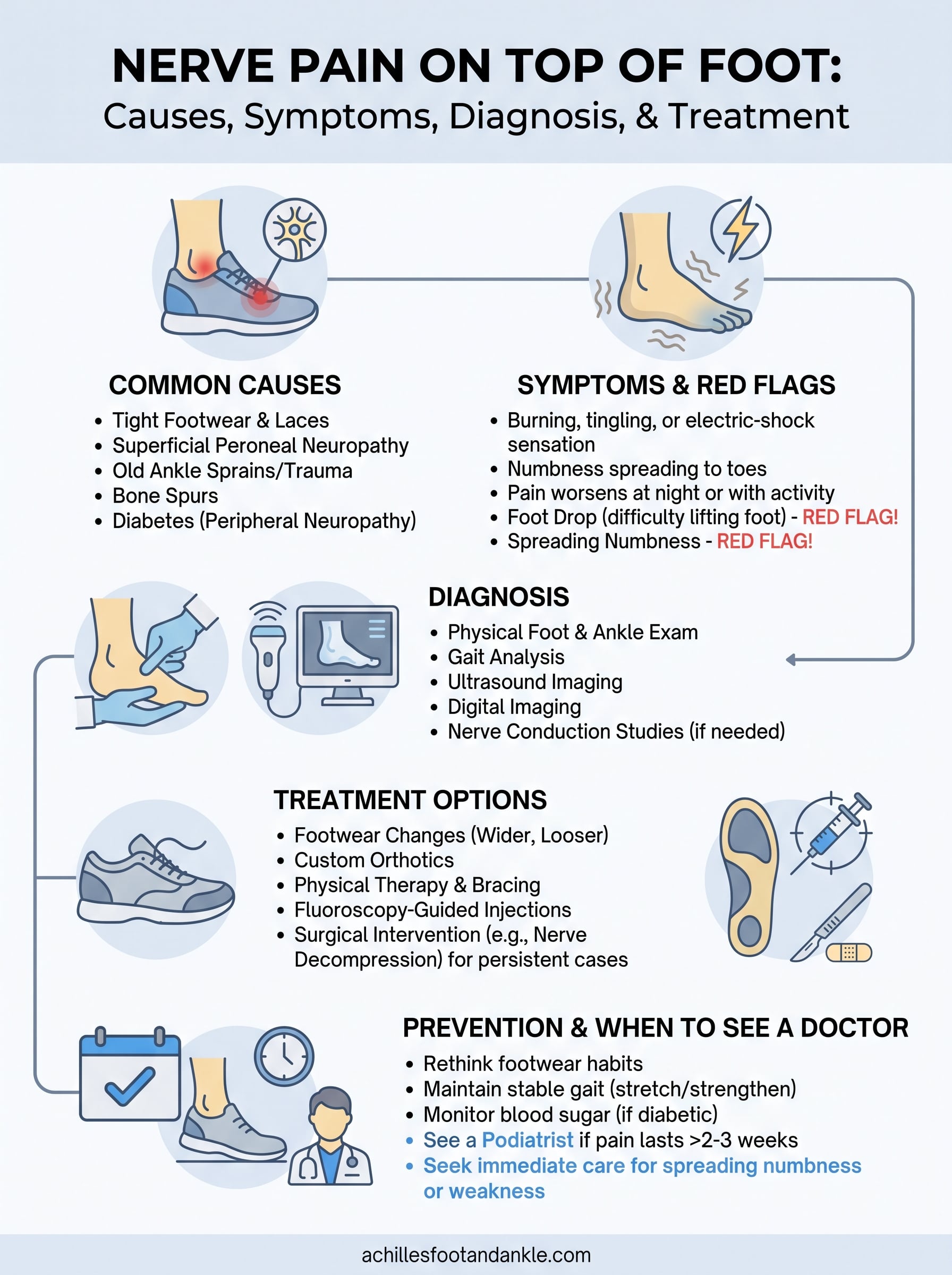
Nerve pain on top of your foot almost always traces back to something specific: tight footwear, an old ankle sprain, a bone spur, or a nerve condition tied to diabetes. Identifying the exact cause is what separates lasting relief from months of guessing with new insoles and hoping for the best. Once you know what’s compressing or irritating the nerve, treatment ranges from simple footwear changes to guided injections or, when necessary, surgery.
You don’t have to keep pushing through burning, tingling, or numbness that’s disrupting your sleep or your walk. The sooner a podiatrist maps out what’s actually happening in your foot, the sooner you get a plan that fixes the problem instead of masking it. If your symptoms have lasted more than a couple weeks, schedule a same-day appointment and get answers instead of more waiting.