
Shopping for diabetic shoes for women online sounds simple until you start scrolling. Dozens of brands claim to be "diabetic-approved," prices swing from $40 to $200, and none of them let you try the shoe on before you buy. Meanwhile, the wrong pair can rub a blister you can’t feel forming, and for a diabetic foot, that small mistake can turn into a wound that takes months to heal.
Here’s what actually matters: seamless interiors, a wide and deep toe box, non-binding uppers, and a rigid rocker sole that reduces pressure on your forefoot. Any shoe missing these features isn’t built for diabetic feet, no matter what the listing says. You also need to know your Medicare coverage options and who qualifies for diabetic shoes, since diabetic shoes are often reimbursable with a doctor’s prescription.
This article walks through exactly what to check before you click
Why proper footwear matters for diabetic foot health
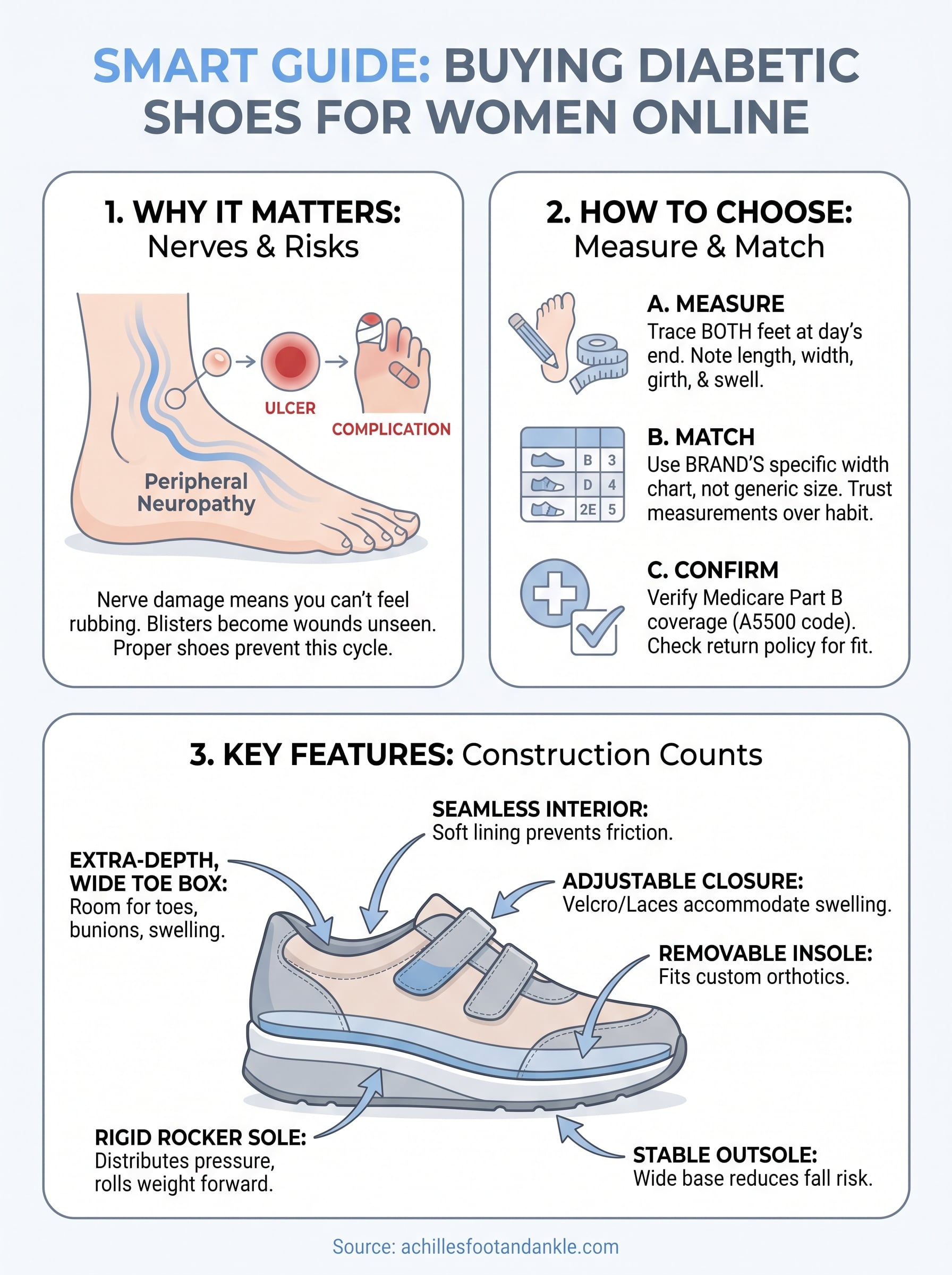
Diabetes changes how your feet work long before you notice any symptoms. High blood sugar damages small nerves over time, a condition called peripheral neuropathy, and it often starts in the feet. Once that damage sets in, you lose the early warning signals that would normally tell you a shoe is rubbing, pinching, or pressing too hard in one spot. That’s the entire reason diabetic footwear exists as its own category rather than just being "comfortable shoes." A shoe that feels fine to someone with healthy nerves can quietly injure a diabetic foot within a single afternoon.
How diabetic neuropathy changes the rules
Nerve damage doesn’t announce itself. Roughly half of people with diabetes develop some degree of peripheral neuropathy, according to the Centers for Disease Control and Prevention, and many don’t realize it until a foot exam catches it. Without normal sensation, you can walk around all day on a seam that’s cutting into your skin or a stitch that’s creating friction with every step, and feel nothing. That’s why generic sneakers, no matter how cushioned they look, aren’t built for this. Diabetic shoes are engineered around the assumption that you can’t rely on pain to protect you, so the shoe itself has to do that job.
The path from blister to amputation
A blister on a non-diabetic foot is an annoyance. On a diabetic foot with reduced circulation, that same blister can become an ulcer, and an ulcer that goes untreated can lead to infection, hospitalization, and in serious cases, amputation. Diabetic foot complications account for a large share of non-traumatic lower-limb amputations in the United States, and poor circulation combined with numbness is usually the underlying cause. Poor circulation slows healing, so wounds that would close in a week for most people can linger for months in a diabetic foot, which is why daily care habits that prevent ulcers matter so much. This is the exact chain of events that proper footwear is designed to interrupt before it ever starts.
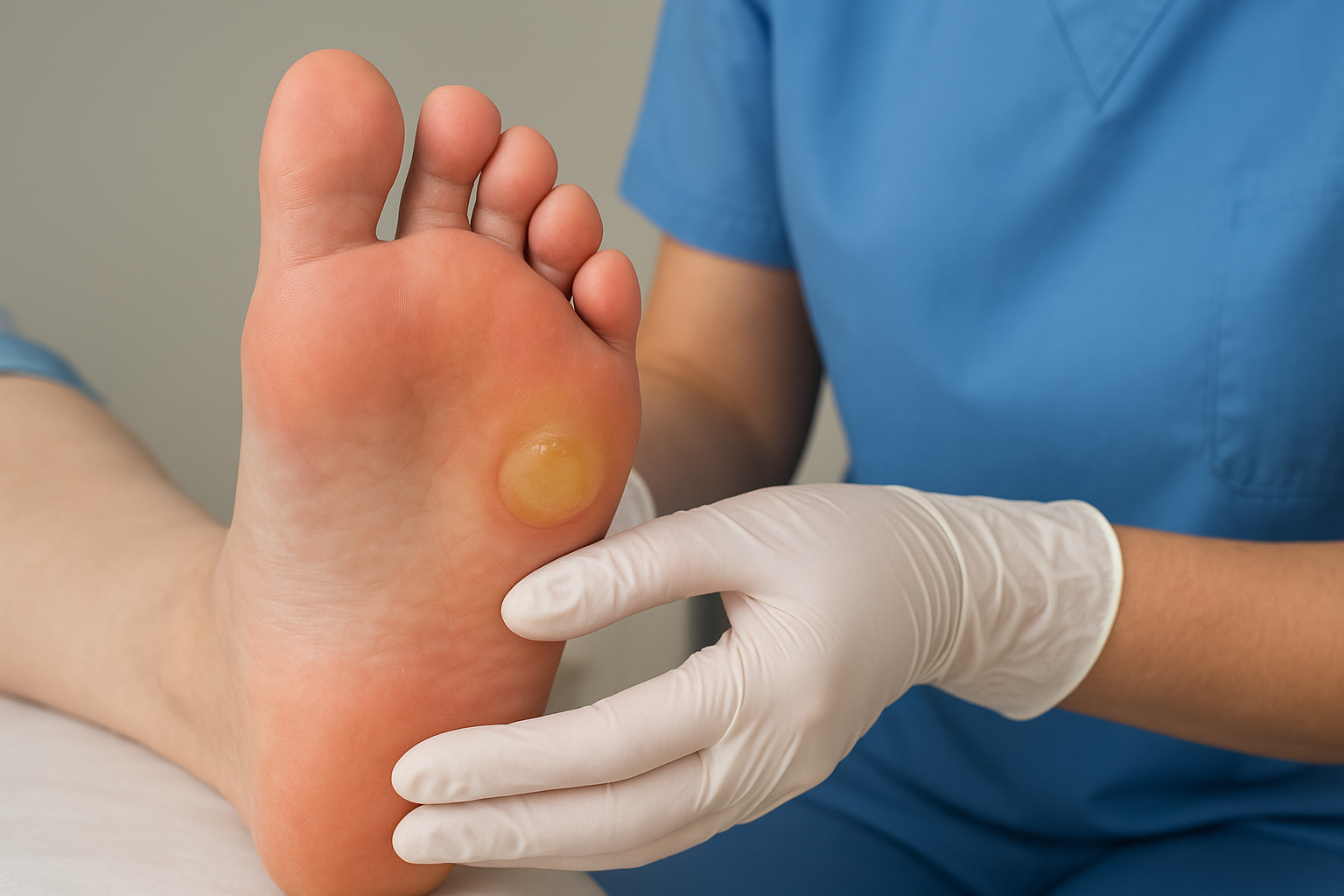
A shoe you can’t feel rubbing is the most dangerous shoe in your closet.
What proper shoes actually prevent
Good diabetic shoes aren’t a luxury add-on, they’re a preventive medical tool. When you’re comparing diabetic shoes for women online, you’re really shopping for a device that reduces pressure, eliminates friction points, and gives your foot room to move without contact with a hard edge. Here’s what the right shoe construction actually does for a diabetic foot:
- Distributes weight evenly across the sole instead of concentrating it under the ball of the foot or heel
- Removes internal seams that would otherwise rub against toes and the sides of the foot
- Accommodates swelling, bunions, hammertoes, or a wider forefoot without squeezing
- Reduces shear force during walking, which is a major driver of skin breakdown
- Provides a stable base that lowers the risk of an ankle roll or fall
Each of these functions matters more for women specifically, since women’s feet tend to have a narrower heel paired with a wider forefoot than standard shoe lasts account for, which is why women’s-specific diabetic shoe lines exist rather than unisex sizing alone.
Why this matters more than style or price
Regular shoppers weigh style, price, and brand name. Diabetic shoppers need to weigh those factors against something bigger: whether the shoe will keep their skin intact. Style still matters, and today’s diabetic shoe lines look far closer to regular sneakers and flats than the bulky orthopedic shoes of a decade ago, but it can’t come at the expense of a seamless interior or proper depth. Underneath the marketing language, the real question is always the same one your podiatrist would ask: does this shoe protect the foot you actually have, including any bunions, calluses, or neuropathy you’re managing right now? If a listing can’t answer that clearly, keep scrolling. Our team at Achilles Foot and Ankle Center works with patients on exactly this decision every week through our diabetic foot care options in Richmond, fitting shoes to the foot rather than expecting the foot to adjust to the shoe.
How to choose diabetic shoes for women online
Buying diabetic shoes for women online works best when you treat it like filling a prescription rather than picking out sneakers for a weekend. You need accurate foot measurements, a clear picture of your specific foot conditions, and a seller who actually specializes in diabetic footwear instead of one who slapped the label onto a regular walking shoe. Skip any of these steps and you risk ending up with a shoe that looks perfect in the product photos but doesn’t fit the foot you actually have.
Measure both feet before you shop
Start by measuring both feet separately, since most people have one foot slightly larger than the other, and diabetic feet in particular can swell unevenly. Trace each foot on paper at the end of the day, when swelling is at its worst, then measure:
- Length from heel to longest toe
- Width at the widest point of the forefoot
- Girth around the instep if you have swelling or a high arch
- Any bunion or hammertoe bulge that needs extra room
Without these numbers, you’re guessing, and a guess is exactly what a diabetic foot can’t afford.
Match measurements to the brand’s actual sizing chart
Never assume your usual shoe size carries over between brands. Sizing charts vary enough between manufacturers that a size 8 in one line can fit like a 7.5 or an 8.5 in another, and diabetic shoe brands often run in half sizes and multiple widths that regular shoe brands skip entirely. Pull up the brand’s specific width chart, not a generic size guide, and compare it directly against the measurements you just took.
Trust your own measurements over the size printed on your last pair of shoes.
Confirm Medicare and insurance coverage before checkout
Medicare Part B covers one pair of diabetic therapeutic shoes and inserts per year for patients who qualify, but only when a doctor documents the diagnosis and writes a prescription using the correct A5500 billing code. Check whether the online seller bills Medicare directly or requires you to pay upfront and submit a claim yourself, because that difference affects both your out-of-pocket cost and how quickly you get reimbursed. Our diabetic foot care team at Achilles Foot and Ankle Center handles this documentation for patients regularly, and you can review what qualifies through our diabetic shoes and inserts program before you order anything.
Choose a seller who supports you after the sale
Finally, read the return and exchange policy before you add anything to your cart. Legitimate diabetic shoe retailers expect a percentage of first-time buyers to need a size or width exchange, since online fitting is never perfect, so they build free exchanges into their process. Reject any seller charging restocking fees or refusing exchanges on medical footwear. That policy alone tells you whether the company understands who it’s actually selling to.
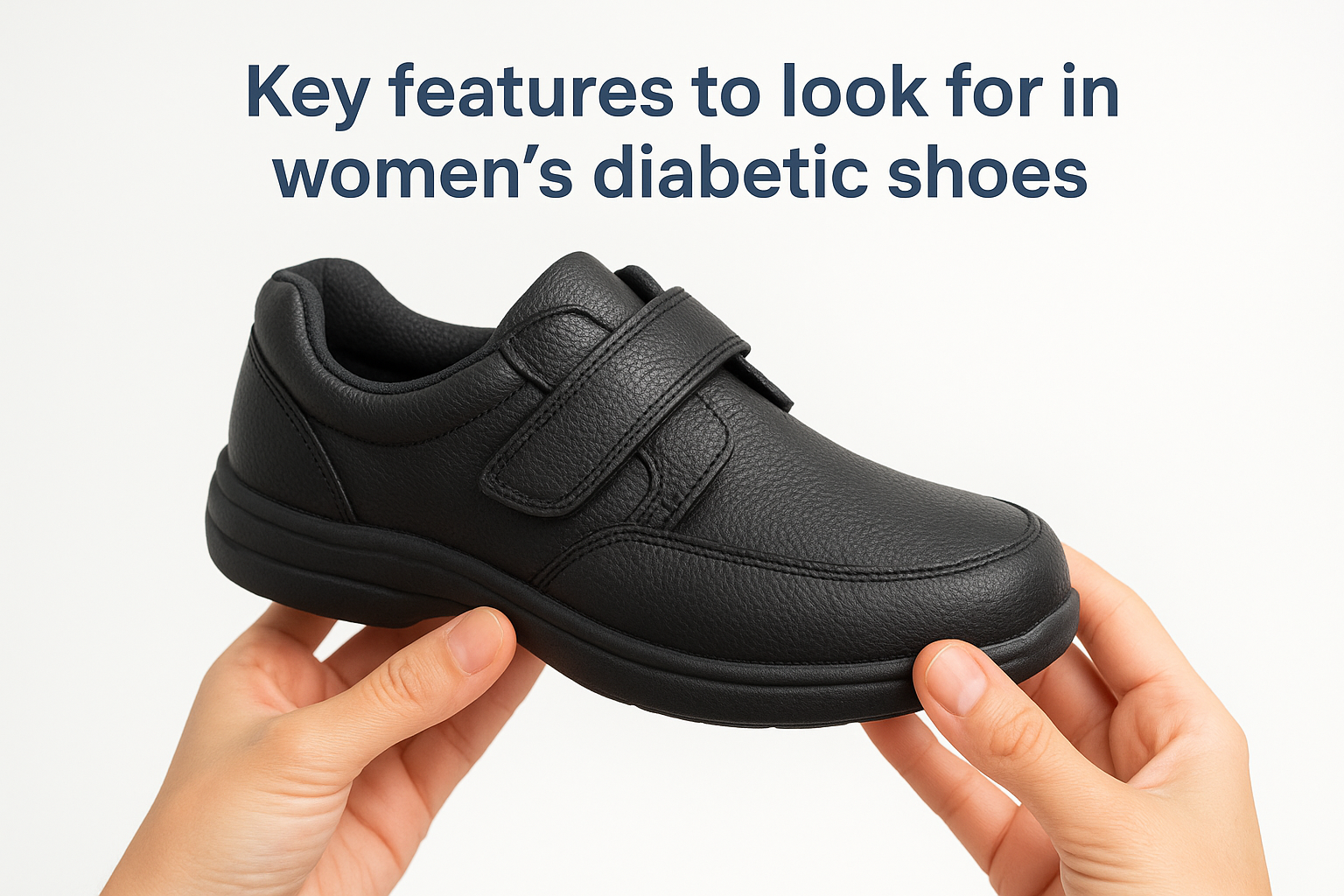
Key features to look for in women’s diabetic shoes
Once you’ve got accurate measurements and a Medicare plan in place, the next step is knowing exactly what construction details separate real diabetic footwear brands from a regular sneaker with a marketing label slapped on it. A women’s diabetic shoe built correctly protects your feet in ways that aren’t always visible in a product photo, so you have to read the fine print or ask the seller directly. Below is a quick reference for what to check before you buy.
| Feature | Why it matters |
|---|---|
| Seamless interior lining | Eliminates friction points that cause blisters you can’t feel |
| Extra-depth, wide toe box | Accommodates hammertoes, bunions, and swelling without pressure |
| Rigid rocker sole | Shifts weight off the forefoot and reduces shear force with each step |
| Adjustable closures (velcro or laces) | Lets you fine-tune fit as swelling changes through the day |
| Removable insole | Makes room for custom orthotics your podiatrist prescribes |
| Breathable, moisture-wicking upper | Keeps skin dry, since damp skin breaks down faster |
Seamless interiors and soft linings
Grab the shoe and run a finger along the inside before you trust any listing photo. Seamless construction means the manufacturer either eliminated internal stitching entirely or covered every seam with soft padding so nothing rubs against your skin. Regular athletic shoes hide seams right where your toes bend or where the heel counter meets your Achilles, and those spots are exactly where diabetic feet develop pressure sores.
Wide and deep toe boxes
Most women’s diabetic shoe lines come in multiple widths, often labeled narrow through extra-wide, along with an extra-depth option that adds vertical room for toes that curl or claw. Check the listing for both a width letter and a depth designation, since a shoe can be wide enough side to side but still too shallow for a hammertoe to sit comfortably.
A toe box that pinches even slightly is a toe box that’s already too small.
Rocker soles and stable outsoles
Soles designed for diabetic feet roll your weight forward instead of forcing your forefoot to push off flat against the ground. This rocker design cuts down on the repeated pressure that leads to calluses and ulcers under the ball of the foot. Pair that with a wide, non-slip outsole base, and you also lower your risk of an ankle roll, which matters more if neuropathy has already affected your balance.
Adjustable closures and removable insoles
Velcro straps beat laces for most diabetic shoppers with swollen feet, since they let you loosen or tighten the fit as your feet swell throughout the day without retying anything. Removable insoles matter just as much, because they give you room to swap in the custom shoe inserts your podiatrist may have prescribed through a program like our diabetic foot care services, rather than forcing you to size up an entire shoe just to fit an insert.
Mistakes to avoid when buying diabetic shoes online
Even careful shoppers trip over the same handful of errors when buying diabetic shoes for women online, and most of them stem from treating the purchase like a regular sneaker order instead of a medical fitting. Knowing these mistakes ahead of time saves you a return shipment, a wasted co-pay, or worse, weeks of foot pain from a shoe that never should have shipped in the first place.
Trusting the word "diabetic" without checking construction
Just because a listing slaps "diabetic-friendly" on the title doesn’t mean the shoe meets any real standard. Retailers use that phrase loosely, sometimes on shoes that are just wide sneakers without a seamless lining or rocker sole. Look past the label and check the actual specs: seamless interior, extra depth, removable insole, and a non-binding upper. If the listing doesn’t mention these details, assume the shoe doesn’t have them.
If the listing can’t name its seamless lining or depth rating, it’s not a diabetic shoe, it’s a regular shoe with a sticker on it.
Ordering your regular size out of habit
Sizing charts differ enough between diabetic shoe brands that your usual size in one line can run a full size off in another. Skipping remeasurement is one of the most common mistakes online shoppers make, since it’s tempting to just reorder whatever size you’ve worn for years. Measure your feet again every time you switch brands, and check the width chart specifically, not just the length.
Ignoring width and depth ratings
A shoe can list the correct length and still fail you completely if the width or depth is wrong. Many buyers focus only on length because that’s the number they’re used to, then end up with a shoe that pinches across the forefoot or leaves no room for a bunion, which is where bunion-friendly shoe picks help. Always cross-check both the width letter (B, D, 2E, 4E) and any extra-depth designation before adding a pair to your cart.
Skipping the return policy
Buying from a seller with a strict no-returns policy on medical footwear is a gamble you shouldn’t take, since online fit is never guaranteed. Confirm the exchange window, whether it covers both size and width swaps, and whether you pay return shipping, before you check out, not after the shoe arrives and doesn’t fit.
Choosing price over documentation
Cheap diabetic-labeled shoes that skip Medicare paperwork often cost you more in the long run, since you lose the chance at reimbursement and may end up with a shoe that lacks the depth or seamless construction your feet need. Verify that the seller can provide documentation compatible with the A5500 billing code, especially if you plan to submit a Medicare claim.
Buying without a current foot exam
Underlying issues like a new bunion, a healing wound, or shifting arch support can change what shoe you need almost overnight. Purchasing shoes without a recent exam means you’re fitting a shoe to an outdated picture of your foot. Our diabetic foot care program at Achilles Foot and Ankle Center includes exactly this kind of check before we recommend footwear, since guessing at what your foot needs right now is how most bad purchases happen.
Choosing shoes that support your feet
Buying diabetic shoes online doesn’t have to be a gamble. Measure both feet, match those numbers against the brand’s actual width chart, and confirm the shoe has a seamless interior and rocker sole before you check out. Skip listings that use "diabetic" as a marketing word instead of a construction standard, and never buy a pair without a recent foot exam backing up your decision.
Getting this right protects more than your comfort. It protects the skin you can’t always feel getting damaged in the first place, and that’s worth more than any discount code. If you’re unsure what your feet need right now, a bunion that’s changed, numbness that’s new, or swelling that’s throwing off your usual size, don’t guess with an online order. Schedule a same-day podiatry visit with our team, and we’ll get you fitted with shoes built for the feet you actually have.