
If your arches have flattened out over the years, or you were born without much of an arch at all, you already know the ache that shows up by mid-afternoon. Understanding flat foot pain causes matters because not all flat feet hurt, and the ones that do usually have a specific mechanical reason behind it. That reason usually traces back to how your foot handles weight with each step.
Flat feet hurt when the arch can no longer absorb shock or support your body weight the way it should. This puts extra strain on the plantar fascia, the posterior tibial tendon, and the joints along the inside of your foot. Over time, that strain can radiate into your ankles, knees, hips, and lower back, since a collapsed arch changes how your entire leg aligns with each stride.
In this article, we break down the specific structural and biomechanical reasons fallen arches lead to pain, from tendon overload to nerve compression. We will also cover which symptoms suggest a minor annoyance versus a condition that needs a podiatrist’s evaluation, so you know when at-home care is enough and when it is time to get your feet checked.
Why flat feet lead to pain throughout your body
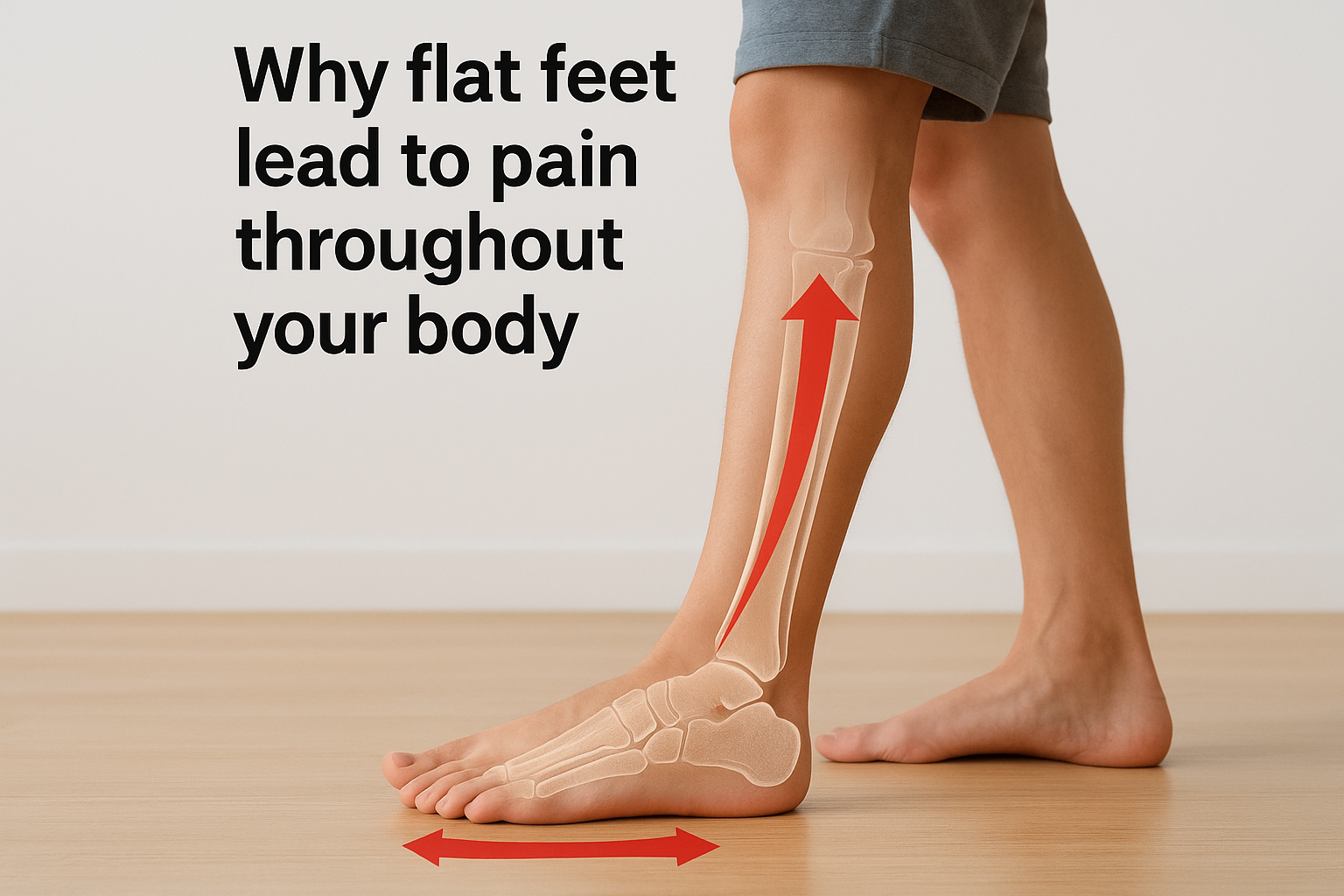
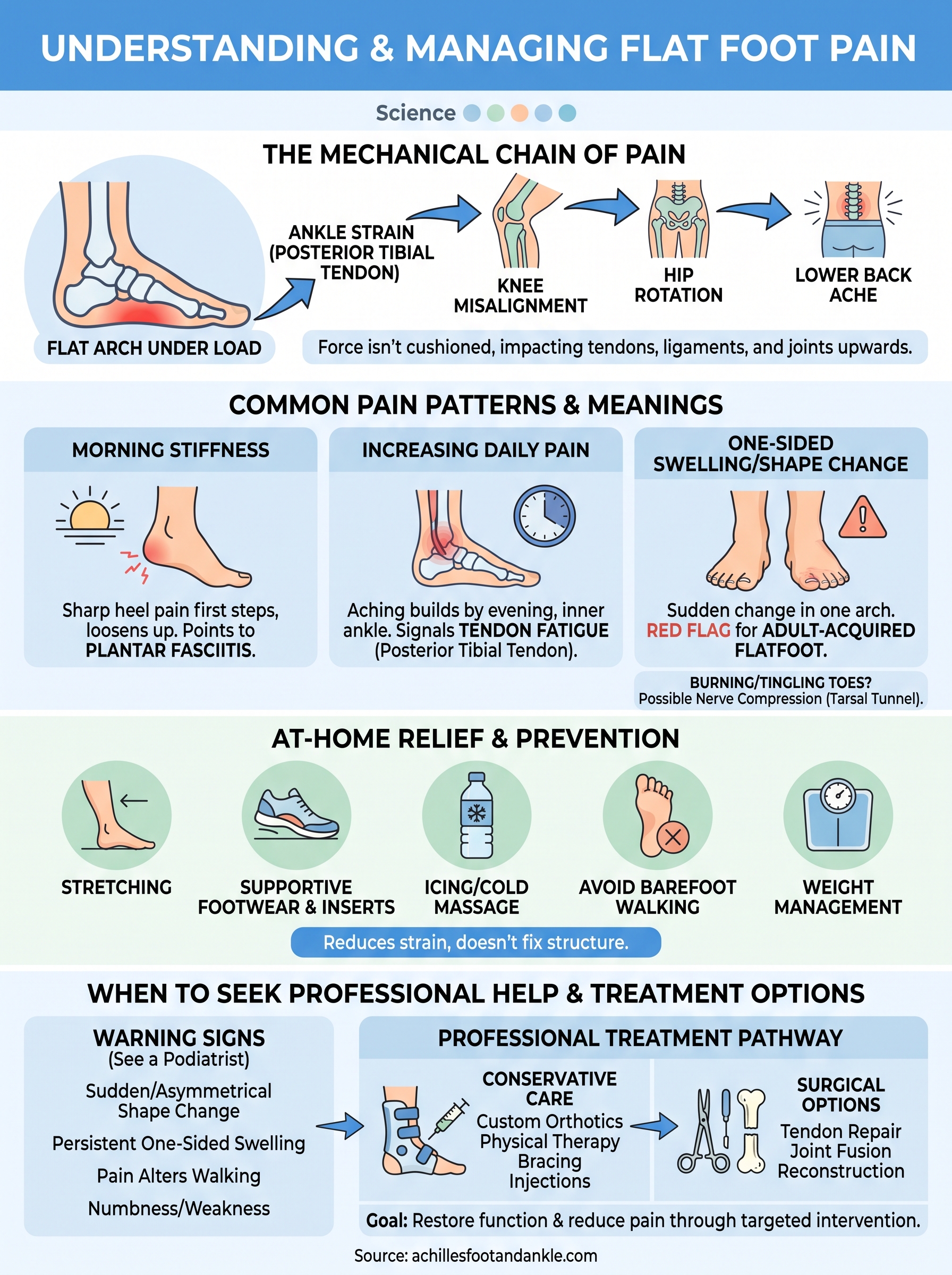
When your arch flattens under load, it stops acting like a spring and starts acting like a flat plank. Every step transmits force straight up through your bones and soft tissue instead of being cushioned by the natural curve of a healthy arch. That extra force has to go somewhere, and it usually lands on the tendons and ligaments that were never built to carry it.
The tendon and ligament overload
Most of the strain lands on the posterior tibial tendon, the structure that runs along the inside of your ankle and holds your arch in place. As it stretches and weakens over years of overuse, the arch drops even further, which creates a cycle podiatrists call adult-acquired flatfoot. The plantar fascia along the bottom of your foot takes a similar beating, stretching with every step until it becomes inflamed and tender near the heel.
A flattened arch doesn’t just fail to support your foot, it actively pulls surrounding tendons and joints out of their normal working position.
How the misalignment climbs upward
Overpronation, or the inward rolling of your foot with each step, doesn’t stay contained at the ankle. It rotates your shinbone inward, which tilts your knee, which shifts your hip alignment, which changes how your lower back absorbs impact. This is why flat foot pain causes often show up as knee soreness or hip stiffness with no obvious foot complaint at all. Patients frequently tell us their feet feel fine, yet their lower back aches after standing all day, and the connection surprises them until we explain the chain reaction.
Where the pain actually shows up
| Structure affected | Where you feel it |
|---|---|
| Posterior tibial tendon | Inner ankle, arch |
| Plantar fascia | Heel, bottom of foot |
| Knee alignment | Front or inner knee |
| Hip rotation | Outer hip, lower back |
| Nerve compression | Tingling, burning in toes |
Nerve involvement adds another layer. A collapsed arch can compress the tibial nerve as it passes through the tarsal tunnel near your ankle, producing burning or tingling that mimics nerve pain unrelated to your feet at all. Understanding these mechanical dominoes is exactly why our team looks at your gait, not just your arch, when we evaluate heel and arch pain during an exam.
Common pain patterns and what they mean
Most patients describe their discomfort in one of three ways, and each pattern points to a different underlying issue. Recognizing which pattern matches your symptoms helps you understand whether you’re dealing with simple fatigue or a tendon that’s starting to fail. We walk through these patterns with almost every patient who comes in for fallen arches, because the timing and location of pain tell us more than the arch itself does.
Morning stiffness that eases with movement
Sharp heel pain during your first steps out of bed, then gradual loosening, usually signals plantar fasciitis. The tissue tightens overnight and tears slightly with the first stretch of the day.
Pain that’s worst in the morning and improves with walking almost always points to the plantar fascia, not the arch itself.
Pain that builds as the day goes on
Aching that starts mild and worsens by evening, especially along the inner ankle, often means your posterior tibial tendon is fatiguing under repeated load. This pattern tends to show up in people who stand for long shifts or walk long distances without support.
One-sided pain or sudden swelling
Discomfort in only one foot, paired with visible swelling or a change in your arch’s shape, is a red flag for adult-acquired flatfoot rather than ordinary fatigue. Symmetrical, mild aching in both feet is far less concerning than a single foot that suddenly looks flatter than it did a year ago.
Burning or tingling toes
Toes that burn, tingle, or feel numb point toward nerve compression from the collapsed arch pressing on the tibial nerve, a pattern worth mentioning at your next visit.
How to relieve flat foot pain at home
Stretching your calves and plantar fascia every morning before you stand up can cut the sharp first-step pain almost in half. Consistent stretching loosens the tissue that tightened overnight, so a few minutes on a towel stretch or wall lean makes a real difference before you ever put weight on the foot.
Supportive footwear and inserts
Swapping flip-flops and worn-out sneakers for shoes with a firm heel counter and built-in arch support addresses one of the most common flat foot pain causes we see: shoes that offer zero structure. Over-the-counter arch supports work for mild cases, though custom orthotics are worth discussing with a podiatrist once off-the-shelf inserts stop helping.
Relief starts with giving your arch the support it can no longer give itself.
Simple habits that reduce daily strain
Taking a few practical steps at home often keeps mild flat foot pain from becoming a daily problem:
- Ice the arch or heel for 15 minutes after long periods on your feet
- Roll a frozen water bottle under your foot to combine massage with cold therapy
- Avoid barefoot walking on hard floors, even at home
- Rotate between two supportive shoe pairs so cushioning doesn’t break down unevenly
- Elevate your feet at night if swelling shows up by evening
Managing your weight also matters more than most patients expect, since every extra pound adds proportional force through an arch that’s already struggling to support you. None of these steps fix a structurally collapsed arch, but they buy real relief while you decide whether it’s time to see someone about the deeper cause.
When flat foot pain signals a bigger problem
Some symptoms cross the line from mild discomfort into something a podiatrist needs to see soon. Warning signs like a foot that visibly changes shape, pain that stops you from walking normally, or swelling that doesn’t go down overnight mean the tissue involved may already be tearing rather than just fatiguing. Waiting these out at home usually makes the underlying damage worse, not better.
Signs that call for a same-week appointment
A short list helps you decide quickly whether your symptoms qualify as urgent:
- Sudden flattening of one arch compared to the other
- Swelling along the inner ankle that stays puffy for days
- Pain sharp enough to change how you walk
- Numbness or persistent tingling that doesn’t fade
- A foot that feels weak or gives out when you push off
When one foot changes shape faster than the other, that’s your body telling you the tendon is losing the fight, not winning it slowly.
Why diabetic patients need extra caution
Anyone managing diabetes should treat new foot pain differently than the general population, since reduced sensation can hide a problem until it’s already serious. A blister or pressure sore from a poorly fitted shoe can go unnoticed for days when nerve damage blunts the usual warning signals, and that delay raises the risk of infection. Our diabetic foot care team specifically watches for the combination of flat feet and neuropathy, because that pairing is where small problems turn into limb-threatening ones fastest.
Children also deserve a closer look than adults sometimes assume. A child who avoids running, complains of leg pain, or walks with an unusual gait may have a flexible flatfoot that needs monitoring before growth plates close, rather than a phase they’ll simply outgrow.
Treatment options when home care isn’t enough
When stretching, better shoes, and ice stop moving the needle, it’s time to bring in medical treatment aimed at the actual structure that’s failing. A podiatrist can identify which tendon or joint is driving your pain and target treatment there instead of guessing with generic remedies. This is usually the point where patients realize their fallen arches treatment needs more than a drugstore insert.

Conservative medical care
Most cases respond well to a combination of approaches before surgery ever enters the conversation:
- Custom orthotics molded to your specific foot shape
- Physical therapy to strengthen the posterior tibial tendon
- Bracing or ankle-foot orthoses for moderate collapse
- Anti-inflammatory injections guided by ultrasound for stubborn heel pain
Most flat foot pain resolves without surgery once the right combination of support and strengthening is in place.
We build these plans around imaging and a full gait assessment, because two patients with the same diagnosis often need different fixes depending on how far the arch has already dropped.
Surgical options for advanced cases
Surgery becomes the right call when the tendon has torn significantly, the arch has rigidly collapsed, or arthritis has set into the joints from years of misalignment. Options range from tendon repair and lengthening to joint fusion or reconstructive procedures that restore the arch’s natural shape. Reaching this stage doesn’t mean you waited too long, it usually just means the mechanical damage outpaced conservative care.
Our Foot and Ankle Surgery Center handles these procedures in-house, including minimally invasive techniques that shorten recovery compared to traditional open surgery. Patients who reach this point still walk out with a functional, pain-reduced foot, just on a longer timeline than bracing or orthotics alone would have offered.
Living comfortably with flat feet
Flat feet don’t have to mean a lifetime of aching knees and sore heels. Once you understand the mechanical chain behind the pain, from tendon overload to nerve compression, the discomfort stops feeling random and starts feeling manageable. Most people find real relief through the right combination of stretching, supportive shoes, and, when needed, orthotics or targeted therapy aimed at the specific structure that’s struggling.
Watching for the warning signs we covered, sudden shape changes, one-sided swelling, numbness that won’t quit, keeps small problems from turning into surgical ones. The earlier a podiatrist sees what’s happening in your gait, the more options you have for fixing it without an operating room.
If your arches have been talking to you louder than usual lately, don’t wait for the pain to make the decision for you. Schedule a same-day appointment and let our team figure out exactly what your feet need.