

When conservative treatments like padding, orthotics, and roomier shoes no longer provide relief, it may be time to consider hammertoe surgery options. A hammertoe that has progressed from flexible to rigid can cause persistent pain, difficulty wearing shoes, and ongoing discomfort that limits your daily activities.
At Achilles Foot and Ankle Center, our podiatric surgeons perform hammertoe corrections regularly at our state-of-the-art Foot and Ankle Surgery Center in Central Virginia. We know that choosing surgery is a significant decision, and understanding what procedures exist helps you have informed conversations with your doctor about what’s right for your situation.
This article breaks down the main surgical approaches, tendon procedures, arthroplasty (joint resection), and fusion, along with minimally invasive techniques that may reduce recovery time. By the end, you’ll understand how each option works and which situations call for specific procedures.
When hammertoe surgery makes sense
You’ve likely tried conservative treatments for months before considering surgery. Padding and toe spacers might have provided temporary relief, and switching to wider shoes may have helped initially. However, when your hammertoe becomes rigid and fixed in a bent position, non-surgical options stop working because the joint can no longer straighten on its own.
Surgery becomes a reasonable option when pain interferes with your ability to walk comfortably, exercise, or wear the shoes you need for work or daily activities. Corns and calluses that develop on top of the bent toe can become increasingly painful, and if the toe rubs constantly against your footwear, you face a higher risk of open sores or ulcers, especially if you have diabetes or circulation issues.
Signs conservative treatment isn’t working
Your doctor will likely recommend surgical intervention if you experience persistent pain that limits your mobility, even after trying orthotics, physical therapy, and anti-inflammatory medications for several months. Difficulty finding shoes that fit without causing discomfort is another clear indicator that conservative measures have reached their limit.
If your hammertoe prevents you from participating in activities you enjoy or causes pain even at rest, surgery may offer the lasting relief you need.
Additional signs include visible progression of the deformity, where the toe bends further despite your efforts to manage it. Recurring infections or skin breakdown around the affected toe also signal that hammertoe surgery options should be explored with your podiatrist.
What to expect from surgical correction
The goal of any hammertoe procedure is to straighten the toe, relieve pain, and restore your ability to wear standard footwear comfortably. Your surgeon will choose the specific technique based on whether your hammertoe is flexible or rigid and which joints need correction. Most patients see significant improvement in both appearance and function once they complete the recovery process.
Tendon procedures for flexible hammertoes
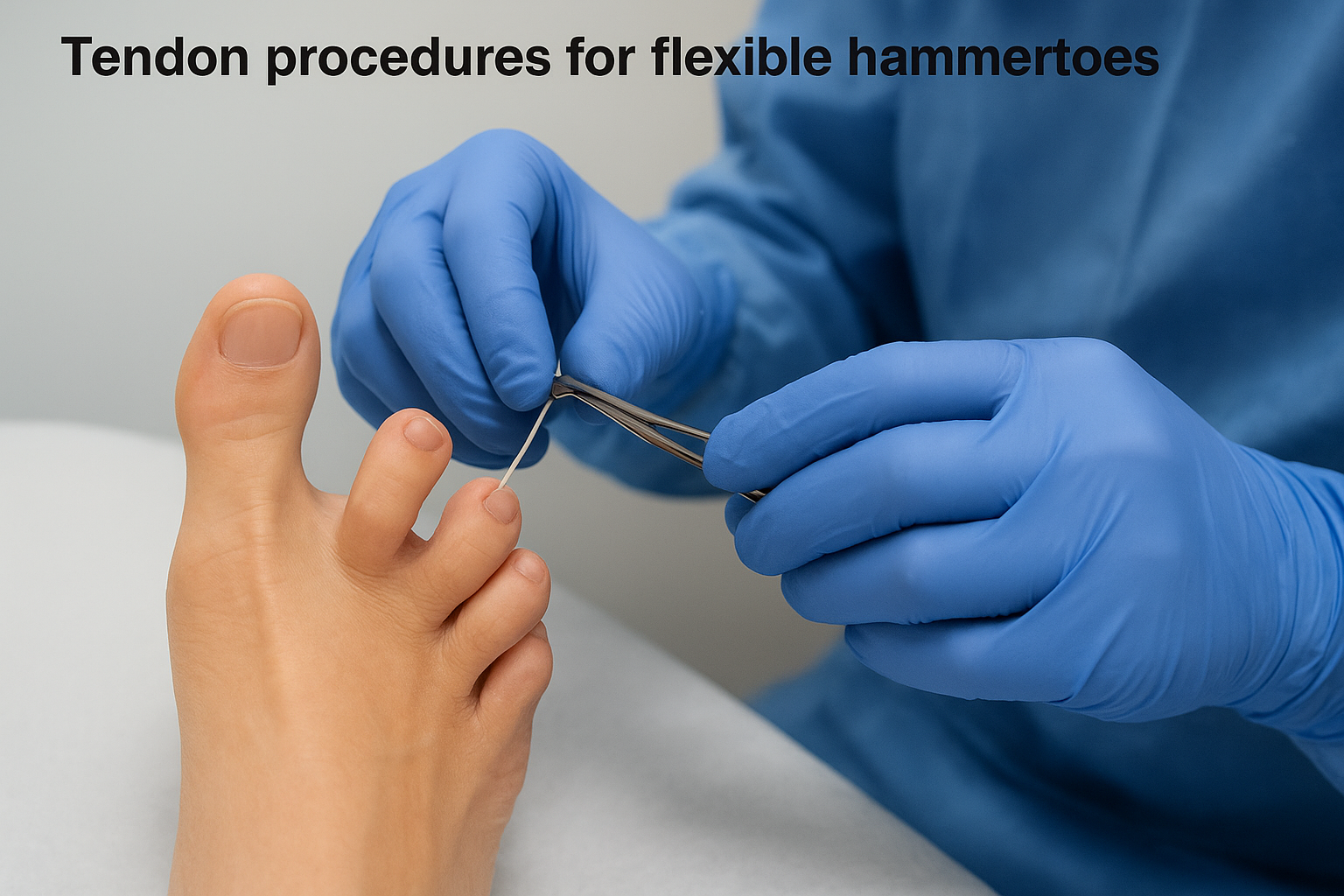
When your hammertoe still retains some flexibility, meaning you can manually straighten the toe with your hand, tendon procedures often provide excellent results. These surgical techniques work by rebalancing the muscles and tendons that control toe movement, addressing the underlying mechanical problem rather than altering bone structure. Your surgeon can typically perform these procedures on an outpatient basis with local anesthesia.
Tendon transfer explained
During a tendon transfer, your surgeon redirects a tendon from the bottom of your toe to the top, which helps pull the toe back into proper alignment. This procedure works because it changes the direction of force acting on your toe joint, correcting the muscle imbalance that caused the hammertoe to develop in the first place. The transferred tendon becomes a straightening force rather than a bending one.
Tendon transfer procedures preserve your natural joint anatomy while correcting the deformity, which often means faster healing and better long-term function.
Recovery and outcomes
Most patients walk immediately after surgery in a protective surgical shoe, and you can typically return to regular footwear within four to six weeks. Your toe will require physical therapy exercises to maintain flexibility and strength as it heals. Among hammertoe surgery options for flexible deformities, tendon procedures have high success rates because they address the cause while preserving joint motion and stability.
Arthroplasty and joint resection options
When your hammertoe has progressed beyond flexibility and simple tendon procedures won’t provide adequate correction, arthroplasty becomes one of the viable hammertoe surgery options to consider. This procedure involves removing a small section of bone from the affected toe joint, which creates space for the toe to straighten and eliminates the source of pain caused by the rigid deformity. Your surgeon performs this technique when the joint itself has become arthritic or severely contracted.
How joint resection works
During an arthroplasty procedure, your surgeon removes the head of the middle bone in your toe, called the proximal phalanx. This removal creates enough space for your toe to realign into a straighter position without the bone ends grinding together. The surrounding soft tissues and remaining bone ends stabilize naturally over time, though your toe may be slightly shorter after the procedure.
Joint resection offers effective pain relief by eliminating the bone-on-bone contact that causes discomfort when walking or wearing shoes.
Expected results and function
Most patients experience significant pain reduction within weeks of surgery, and the toe maintains adequate function for daily activities. Your toe will have limited joint motion compared to tendon procedures, but you can walk normally and wear standard footwear comfortably. This approach works particularly well for older patients or those with arthritis in the affected joint.
Fusion and hardware options for rigid toes
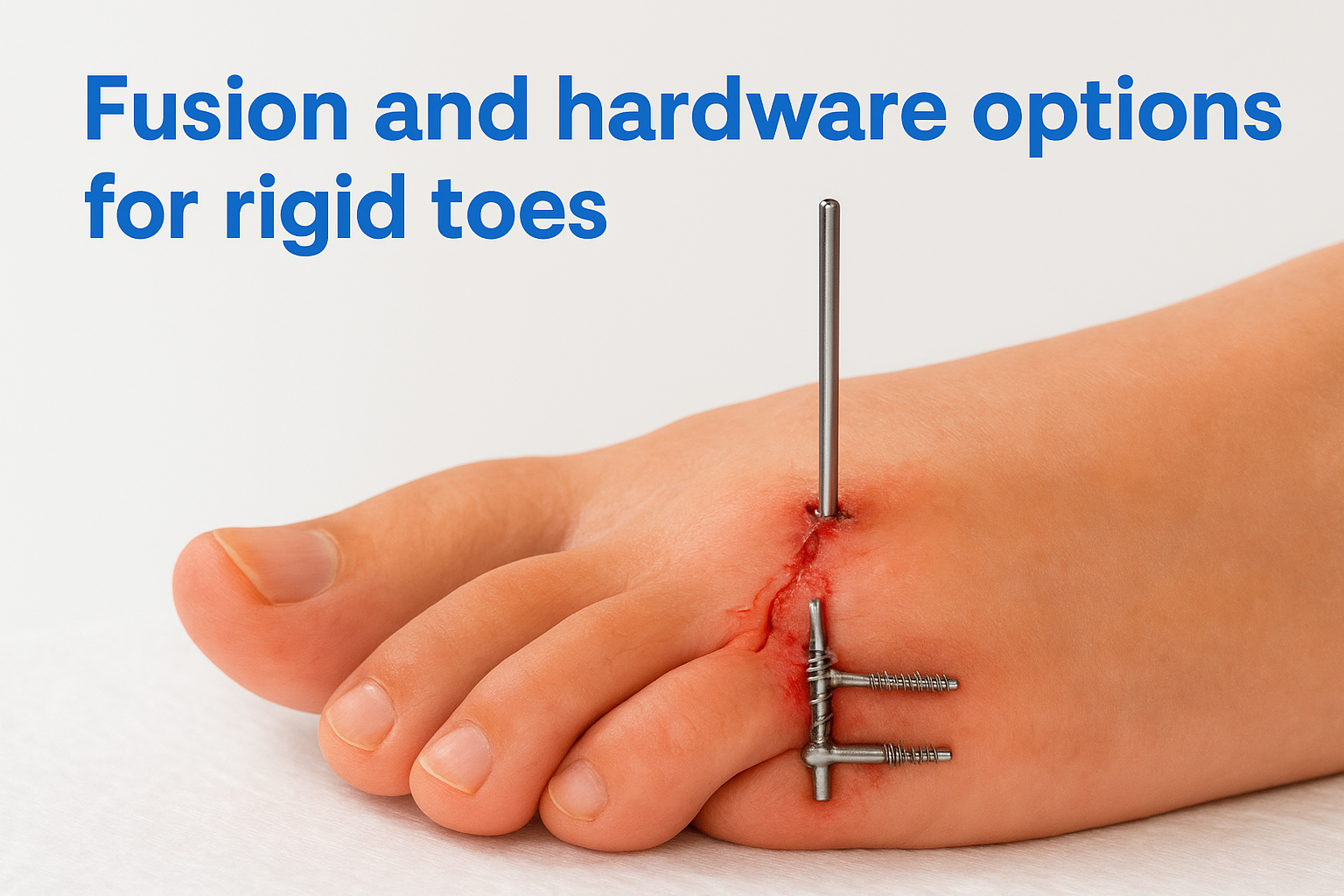
When your hammertoe remains completely rigid and arthroplasty won’t provide enough stability, fusion surgery offers the most permanent correction among hammertoe surgery options for severe deformities. This procedure, called arthrodesis, permanently straightens your toe by fusing the affected joint, eliminating motion at that specific joint while creating a stable, pain-free position. Your surgeon chooses this approach when you have significant arthritis or when previous surgeries have failed.
The fusion procedure and joint elimination
During fusion surgery, your surgeon removes the damaged cartilage from both sides of the affected joint and positions the bones in a straight alignment. The bone ends then grow together over several weeks, creating one continuous bone where the joint previously existed. This process eliminates the source of pain by removing the arthritic joint entirely while giving you a permanently straight toe.
Fusion provides the strongest long-term correction for rigid hammertoes, though you’ll lose the natural bending motion at that joint.
Hardware placement and stabilization
Your surgeon uses pins, wires, or small screws to hold your toe bones in the correct position while they fuse together. These devices remain in place until the bones heal solid, typically six to eight weeks, and some hardware stays permanently if it doesn’t cause discomfort. You’ll wear a protective surgical shoe during healing to prevent movement that could disrupt the fusion process.
Minimally invasive options and recovery basics
Recent advances in foot surgery have introduced percutaneous techniques that use smaller incisions, typically measuring just a few millimeters. These procedures allow your surgeon to release tendons, shave bone, or reposition joints through tiny openings in your skin, reducing tissue trauma and potentially speeding your recovery. Not every hammertoe qualifies for minimally invasive treatment, but when appropriate, these techniques offer distinct advantages over traditional open surgery.
Percutaneous surgery techniques
Your surgeon makes small puncture incisions instead of longer cuts, then uses specialized instruments to perform the necessary corrections. The procedure works well for mild to moderate deformities where extensive bone removal or hardware placement isn’t required. You’ll still need anesthesia and proper post-operative care, but the smaller wounds typically heal faster and leave less noticeable scarring.
Minimally invasive hammertoe surgery options can reduce swelling and discomfort compared to traditional approaches, though not every deformity can be corrected this way.
What recovery looks like
Regardless of which surgical approach your surgeon chooses, you’ll wear a protective surgical shoe for several weeks after your procedure. Most patients walk immediately with weight-bearing restrictions, gradually increasing activity as healing progresses. Swelling remains common for two to three months, and returning to athletic shoes typically takes six to eight weeks depending on your specific procedure.
Getting back on your feet
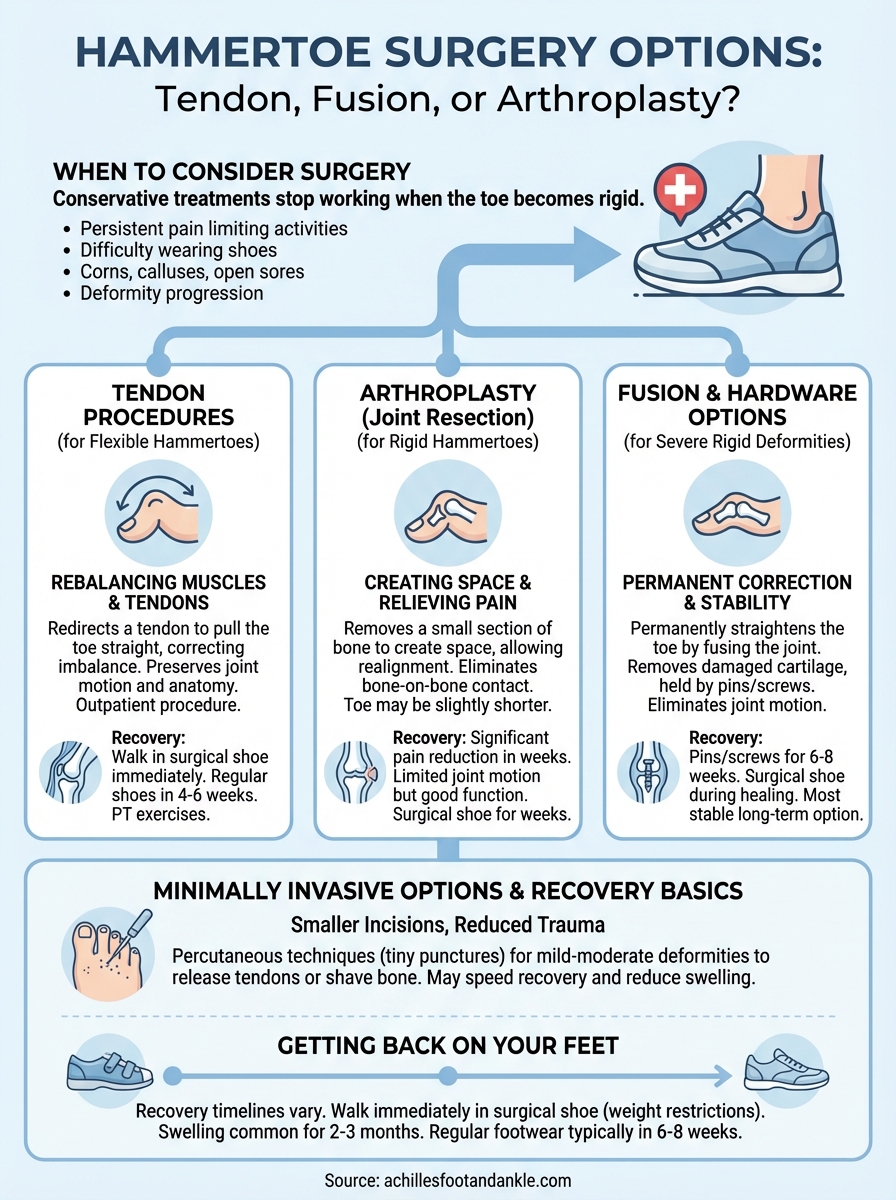
Understanding the full range of hammertoe surgery options helps you have productive conversations with your podiatrist about which approach fits your specific situation. Tendon procedures work well for flexible deformities, while arthroplasty and fusion techniques address rigid hammertoes that no longer respond to conservative treatment. Minimally invasive methods may reduce your recovery time when your anatomy and deformity severity allow these approaches.
Your surgeon will evaluate your toe’s flexibility, deformity severity, and activity goals to recommend the most appropriate procedure. Recovery timelines vary based on which technique you need, but most patients return to regular footwear within six to eight weeks and see significant pain relief within the first month.
If you’re experiencing persistent hammertoe pain that limits your daily activities, schedule a same-day appointment at Achilles Foot and Ankle Center. Our experienced podiatric surgeons will assess your condition and help you determine the best path forward for lasting relief.