

Understanding how a patient walks, or struggles to walk, can change the entire course of their treatment. That’s why objective motion data matters so much in foot and ankle care. The Vicon gait analysis system is one of the most widely used motion capture platforms in clinical and research settings, giving practitioners frame-by-frame insight into how the body moves during walking, running, and other functional tasks. For clinicians evaluating biomechanical dysfunction, it offers a level of precision that visual observation alone simply can’t match.
At Achilles Foot and Ankle Center, we treat a full spectrum of foot and ankle conditions across Central Virginia, from sports injuries and chronic pain to complex reconstructive cases. Advanced diagnostic technology plays a direct role in how we assess movement patterns, plan treatments, and measure patient progress. Gait analysis systems like Vicon represent the kind of tools that help practices like ours move beyond guesswork and toward evidence-based decision-making.
This article breaks down how the Vicon system works, what software and hardware it relies on, and where it fits in clinical care and biomechanics research. Whether you’re a clinician considering it for your practice, a researcher comparing motion capture platforms, or a patient curious about how gait analysis shapes treatment, you’ll find a clear and thorough explanation here. We’ll cover its technical specifications, real-world applications, and what sets it apart from other systems on the market.
Why clinical gait analysis matters for foot and ankle care
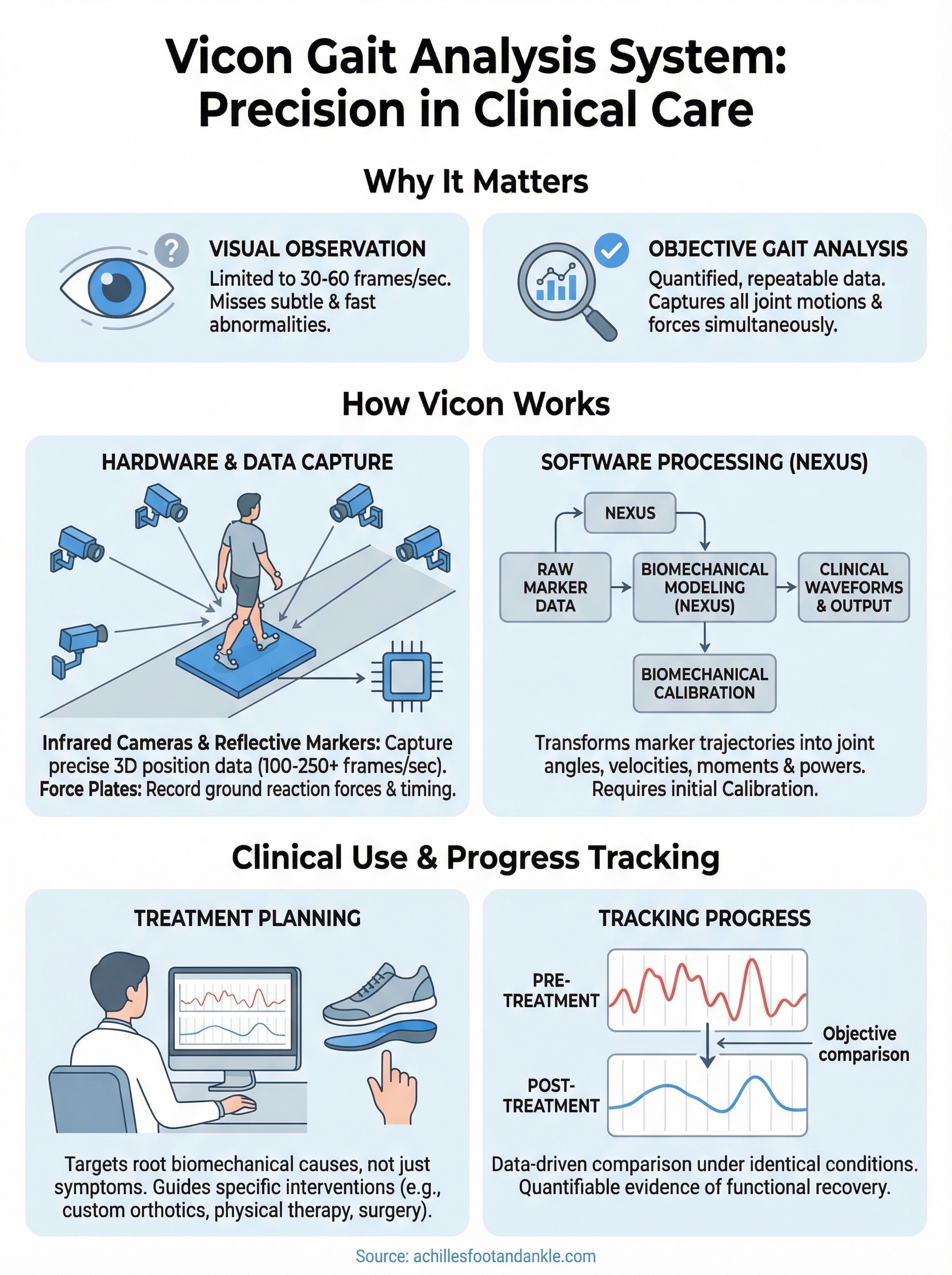
Watching a patient walk down a hallway gives a clinician useful information, but it leaves out far more than it reveals. Human eyes process motion at roughly 30 to 60 frames per second, and most gait abnormalities happen faster than that, or are too subtle to detect without measurement tools. For foot and ankle specialists, missing those details can mean treating symptoms rather than causes, which leads to slower recoveries and recurring problems. Objective gait analysis closes that gap by giving clinicians quantified, repeatable data tied directly to how a patient’s body actually moves.
What visual observation misses
Even experienced clinicians routinely underestimate the extent of certain movement compensations when relying on observation alone. A patient with chronic heel pain might shift load to the lateral forefoot without either the patient or the clinician noticing during a standard exam. A child with a foot deformity might develop a hip hike or trunk lean to compensate, and those secondary patterns often go undetected until they cause their own problems. Gait analysis captures joint angles, ground reaction forces, and muscle timing simultaneously, so nothing slips through.
Compensation patterns that go unmeasured tend to get undertreated, which is why objective data matters at every stage of care.
Here are the core movement variables that objective gait analysis measures that visual observation cannot reliably capture:
- Ankle dorsiflexion angle during midstance and terminal stance
- Peak ground reaction force and timing across the gait cycle
- Step length asymmetry between the left and right side
- Cadence and walking speed under standardized conditions
- Subtalar joint motion and forefoot-to-rearfoot alignment during loading
How gait data changes treatment outcomes
When you have precise kinematic data, treatment decisions become more targeted. A clinician looking at plantar pressure maps and joint moment curves can determine whether a patient needs a custom orthotic that offloads a specific region, or whether a surgical correction is necessary to address the root biomechanical problem. That distinction matters enormously for the patient’s long-term outcome and recovery timeline.
Gait data also gives you a baseline to measure against. After treatment, whether that’s surgery, physical therapy, or orthotics, you can retest the patient under the same conditions and compare the numbers directly. That kind of before-and-after comparison removes subjectivity from follow-up assessments and helps you demonstrate measurable improvement to both the patient and referring providers. For complex cases involving multiple joints or systemic conditions like diabetes, that level of documentation is not optional; it’s essential.
How the Vicon gait analysis system works
The Vicon gait analysis system combines high-speed cameras, reflective markers, and force plates to build a precise three-dimensional picture of how a patient moves. You place small reflective markers on specific anatomical landmarks, such as the knee, ankle, and heel. As the patient walks through the capture volume, multiple cameras track every marker simultaneously, recording position data at rates typically between 100 and 250 frames per second. That raw positional data then feeds into Vicon’s software, where it becomes joint angles, velocity curves, and moment calculations.
The hardware that captures movement
Each Vicon camera emits infrared light and detects the reflection bouncing back from the markers on the patient’s body. You need a minimum of six to eight cameras arranged around the walkway to eliminate blind spots and ensure full coverage throughout the gait cycle. Force plates embedded in the floor record ground reaction forces at the same time, so you get both kinematic data (how segments move) and kinetic data (what forces drive that movement) in a single pass.
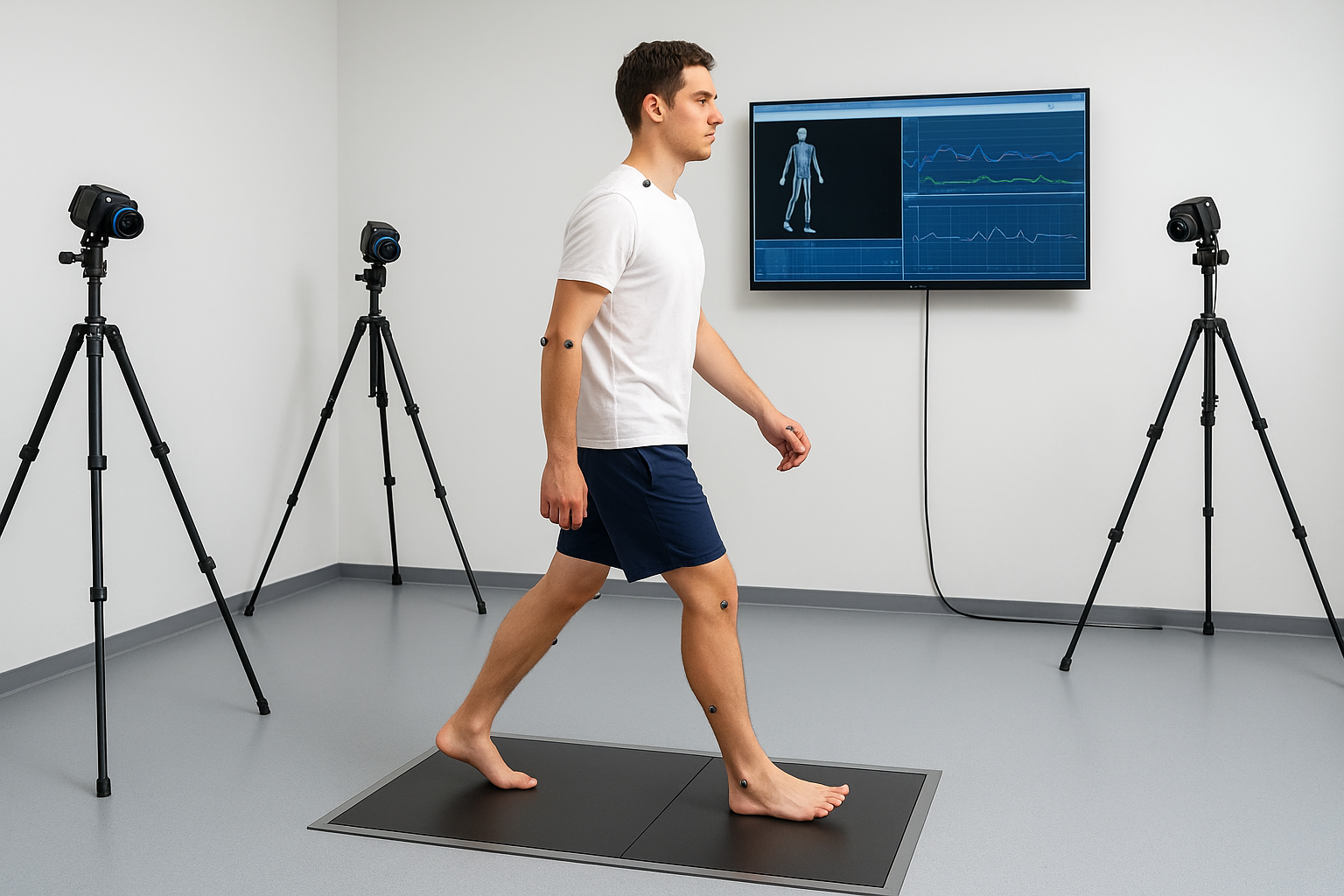
Getting the force plate placement right is critical; if a patient misses the plate or steps awkwardly to hit it, the kinetic data for that trial is unusable.
How marker data becomes clinical information
Once the system captures raw marker trajectories, Vicon Nexus software applies a biomechanical model to those trajectories. You assign each marker to its corresponding body segment, and the software calculates joint centers and segment orientations frame by frame. From there, it outputs time-normalized waveforms covering the full gait cycle, from initial contact through toe-off, so you can compare your patient’s movement patterns directly against normative reference data. That comparison is where clinical interpretation begins.
How to capture and process gait data in Nexus
Vicon Nexus is the software hub where raw marker data becomes usable clinical output. Before you walk a patient through the capture volume, you need to complete a calibration sequence that defines the lab’s coordinate system and verifies each camera’s accuracy. Skipping or rushing calibration introduces systematic error into every trial you collect that session, so treat it as a fixed part of your workflow, not something you cut short when schedules run tight.
Setting up a patient session
You start by creating a patient profile in Nexus and selecting the appropriate biomechanical model, typically the Plug-in Gait model for standard lower limb assessments. After placing markers on the patient’s anatomical landmarks, you run a static trial with the patient standing still. Nexus uses that static trial to establish each segment’s neutral alignment, which becomes the reference frame for all dynamic trials collected afterward.
If a marker falls off mid-trial or gets occluded by clothing, Nexus flags the gap and lets you fill it using trajectory reconstruction tools, but frequent gaps degrade your data quality significantly.
Processing and reviewing trial output
Once you collect your walking trials, Nexus runs the biomechanical model pipeline automatically, calculating joint angles, moments, and powers across the full gait cycle. You review each trial’s waveforms in the graphing panel, checking for marker dropout, asymmetrical force plate strikes, and any spikes that suggest a bad step. After accepting clean trials, you export the processed data to a report format or external analysis software for clinical interpretation. The vicon gait analysis system gives you full control over which trials enter the final dataset, so your results reflect genuine movement rather than measurement artifacts.
How clinicians use Vicon results in treatment planning
The processed output from the vicon gait analysis system gives you something that clinical judgment alone cannot provide: a precise, objective description of what is actually happening at each joint during every phase of the gait cycle. You use that description to build a treatment plan around the actual mechanics driving the patient’s problem, not just the symptom they presented with. When a patient comes in with anterior knee pain, for example, the Vicon data might reveal excessive foot pronation and reduced ankle dorsiflexion as the upstream contributors, which shifts your intervention focus entirely.
Matching data to specific interventions
Once you have clean waveforms and force data in hand, you can map each abnormal finding to a targeted intervention. Reduced ankle push-off power during terminal stance often indicates calf weakness or restricted joint mobility, pointing you toward physical therapy, heel lift orthotics, or both. A patient showing asymmetric ground reaction forces between limbs after ankle reconstruction gives you a clear, measurable indicator that they are not yet loading the surgical side normally, which affects your return-to-activity clearance decision directly.
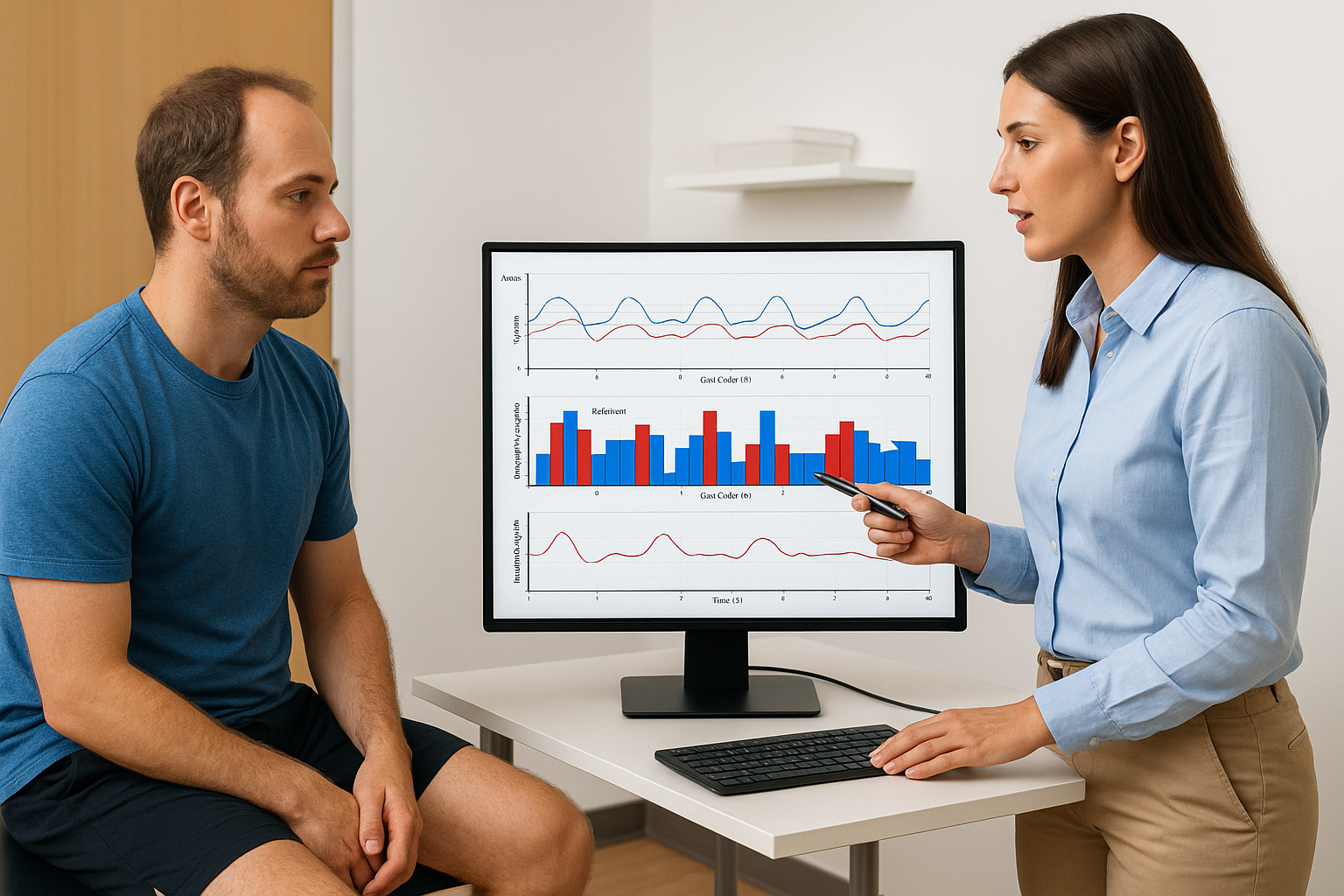
Objective force data removes the guesswork from post-surgical progression, which protects both the patient and the clinician from moving too quickly.
Tracking patient progress over time
Retesting a patient under identical lab conditions after completing a course of treatment gives you a direct, data-driven comparison. You line up the pre-treatment and post-treatment waveforms side by side and look for specific changes in joint angles, moment curves, and ground reaction force timing. If the numbers improve, you have quantifiable evidence of functional recovery that you can share with the patient and include in referral documentation. If they don’t, you have an early signal to adjust your approach before the patient plateaus or regresses further.
Accuracy, limitations, and practical buying questions
The vicon gait analysis system is widely regarded as a gold standard in motion capture, but no system is without trade-offs. Marker placement error is the most common source of inaccuracy, and it is operator-dependent. If you place a marker even a few millimeters from the intended anatomical landmark, every joint angle calculation downstream shifts accordingly. Consistent training and standardized protocols reduce that risk, but they don’t eliminate it entirely.
The system is only as accurate as the technician running it, which means staff training is as important as the hardware itself.
Understanding the core limitations
Gait labs require dedicated physical space, typically a 10-meter walkway with floor-embedded force plates, which rules out smaller or multi-use clinical rooms. The cost of a full Vicon setup, including cameras, force plates, software licenses, and installation, often runs into the six-figure range. Ongoing calibration and maintenance add to that investment over time, so you need to factor recurring costs into any budget projection, not just the upfront purchase price.
Practical questions to ask before buying
Before committing to a system, you need clear answers to a few key questions that vendors don’t always surface upfront:
- How many cameras do you need to cover your specific capture volume without blind spots?
- What Nexus software licensing model applies to your facility, and are updates included?
- Does the vendor provide on-site installation and staff training, or is that a separate contract?
- What is the warranty and service response time if a camera or force plate fails?
- Can the system integrate with your existing EMR or reporting software, or does data export require manual handling?
Getting written answers to each of these questions before signing a purchase agreement protects your practice from unexpected costs and workflow gaps after the system is installed.
What to do next
The vicon gait analysis system gives clinicians a precise, data-driven window into how the body moves, and that kind of objective measurement directly improves treatment outcomes for foot and ankle conditions. You now understand how the hardware captures movement, how Nexus processes that data into clinical waveforms, and how practitioners translate those results into targeted interventions and measurable progress tracking. That foundation is enough to evaluate whether this technology fits your practice or research setting.
For patients in Central Virginia dealing with foot or ankle pain, gait analysis is one of several advanced tools we use to find the real source of your problem, not just the surface symptom. Whether you’re recovering from an injury, managing a chronic condition, or trying to understand why pain keeps coming back, a thorough evaluation is the right starting point. Schedule a same-day appointment with our team and get answers backed by clinical evidence.