If you’ve been told you need a custom ankle-foot orthosis, one of your first questions is probably about custom AFO cost. That’s a fair question, and not one with a simple answer. Prices can range from a few hundred dollars to several thousand, depending on materials, design complexity, and where you get fitted. Without clear numbers upfront, it’s easy to feel stuck before treatment even begins. Understanding what drives these costs helps you make informed decisions and avoid surprises at checkout.
At Achilles Foot and Ankle Center, we fit and prescribe custom AFOs across our thirteen Central Virginia locations for patients dealing with drop foot, ankle instability, post-surgical recovery, and other conditions that affect mobility. Our team works directly with patients to determine the right orthotic solution and helps navigate insurance coverage so you know what to expect financially. We see the confusion around pricing firsthand, and that’s exactly why this guide exists.
This article breaks down current price ranges for custom AFOs in 2026, explains the factors that influence what you’ll pay, and walks through insurance coverage specifics including Medicare and private plans. We’ll also cover the difference between custom and prefabricated options so you can weigh cost against clinical benefit with real information, not guesswork.
Why custom AFO pricing varies so much
Custom AFOs are not mass-produced items pulled from a shelf. Each one is fabricated to match your specific anatomy, which means the cost reflects labor, materials, and clinical expertise rather than a standard retail markup. When you compare custom AFO cost across providers, you’re often comparing devices that share a name but differ significantly in construction, materials, and function. That built-in variability is one of the main reasons it’s hard to get a straight number without a full clinical evaluation first.
The fabrication process is not standardized
Orthotists use different fabrication methods depending on your condition and the level of ankle control you need. Some AFOs are built from a plaster or fiberglass cast of your leg, while others use digital scanning and CAD/CAM technology to produce a precise fit. Traditional casting requires more hands-on labor, while digital fabrication involves higher upfront technology overhead. Both approaches add cost in different ways, and neither method produces an identical end product.
The material selected during fabrication, whether carbon fiber, polypropylene, or a hybrid composite, can shift your total cost by several hundred dollars on its own.
Materials also matter significantly. Polypropylene is the most common rigid material used and typically the most affordable option. Carbon fiber AFOs are lighter and return more energy during each step, but they cost more to produce and fit. For an active patient managing drop foot, a carbon fiber design may deliver better long-term function, making the higher price a clinical question as much as a financial one.
Your clinical needs shape the design
The more complex your condition, the more complex your AFO. A standard posterior leaf spring AFO built for mild drop foot involves far less customization than a solid ankle AFO with anterior trim lines designed for a patient recovering from a severe neurological injury. Your orthotist needs to account for spasticity levels, range of motion restrictions, skin sensitivity, and weight-bearing requirements, and each additional factor increases both design complexity and production time.
Articulated AFOs include a mechanical ankle joint, which adds components and requires more fitting appointments to dial in correctly. If you also need custom padding, specialized liners, or adjustable strapping systems, those additions push the final cost higher. Pediatric patients present another layer of complexity because growing children need replacement devices more frequently, which affects long-term costs even when each individual AFO is priced lower than an adult equivalent.
Where you get fitted affects the final number
Your geographic location and the type of provider you choose both influence what you pay. An orthotist practicing in a high-cost urban area typically charges more for labor than one in a rural setting. Hospital-affiliated orthotics departments often carry facility fees that independent orthotic practices do not, and those overhead costs get reflected directly in your bill.
Provider credentials shape costs too. Certified Prosthetist-Orthotists (CPOs) with American Board for Certification credentials may charge more for their services, but their training directly affects fit quality and long-term outcomes. A poorly fitted AFO can cause pressure sores, skin breakdown, and functional setbacks that require additional treatment, so the expertise behind your device carries real clinical and financial consequences worth factoring into your decision.
Typical custom AFO price ranges in 2026
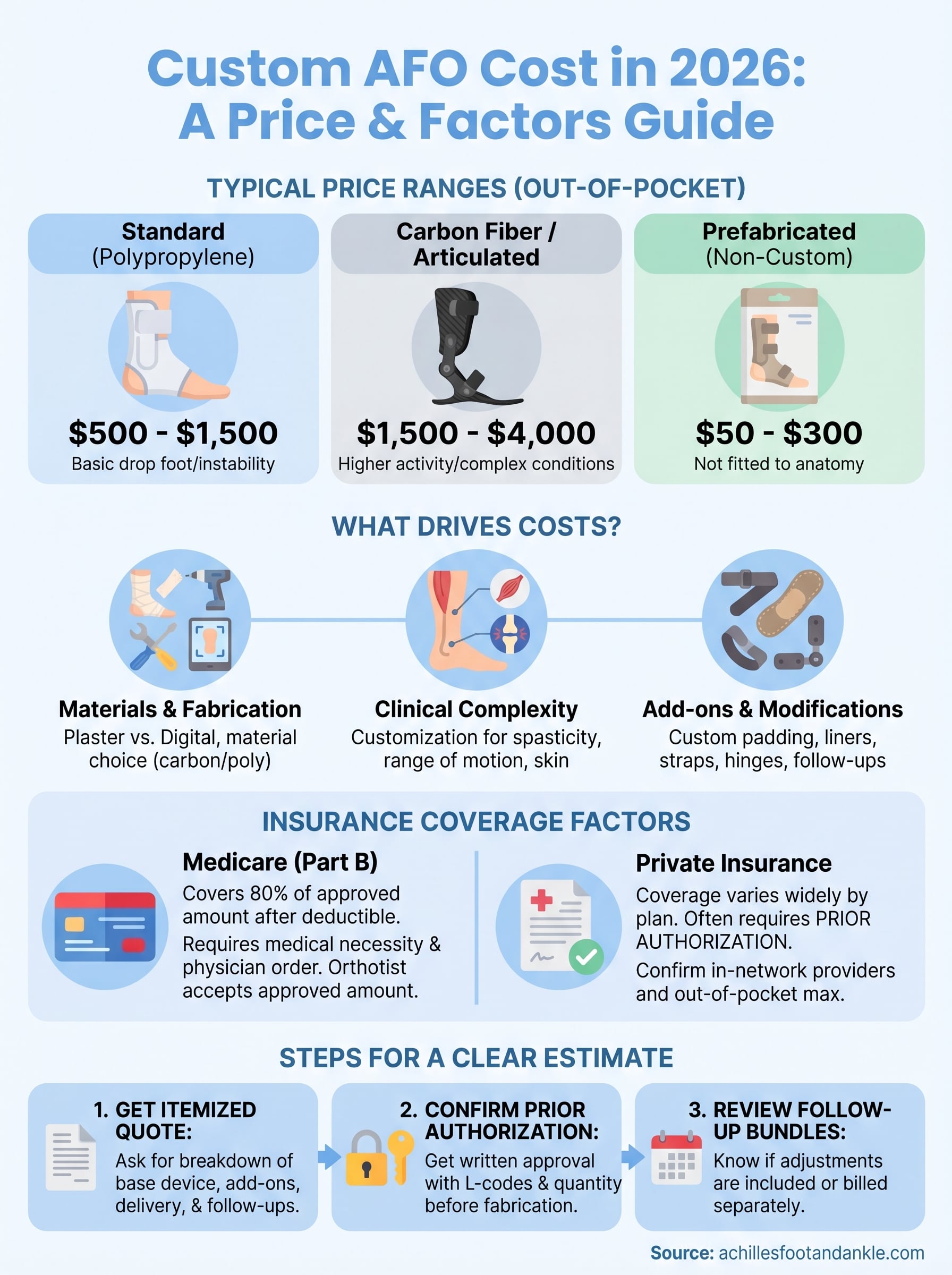
Knowing the actual numbers gives you a starting point for budgeting and insurance conversations. Custom AFO cost in 2026 typically falls between $500 and $4,000 depending on the device type, materials, and complexity of your condition. The ranges below reflect out-of-pocket costs before insurance is applied, which is why the gap between low and high estimates can look so wide before you understand what’s driving each tier.
Standard custom AFOs
A standard custom polypropylene AFO built for mild-to-moderate drop foot or basic ankle instability typically runs between $500 and $1,500. This range covers the casting, fabrication, fitting appointments, and minor adjustments. Most patients with straightforward conditions and a single-level neurological diagnosis fall somewhere in this tier.
Your total cost depends not just on materials, but on how many follow-up fitting adjustments your provider includes in the quoted price.
If your provider charges separately for follow-up trimming and padding modifications, those sessions can add $50 to $200 per visit on top of the initial device cost. Always confirm whether adjustment appointments are bundled into your quote or billed separately.
Carbon fiber and articulated AFOs
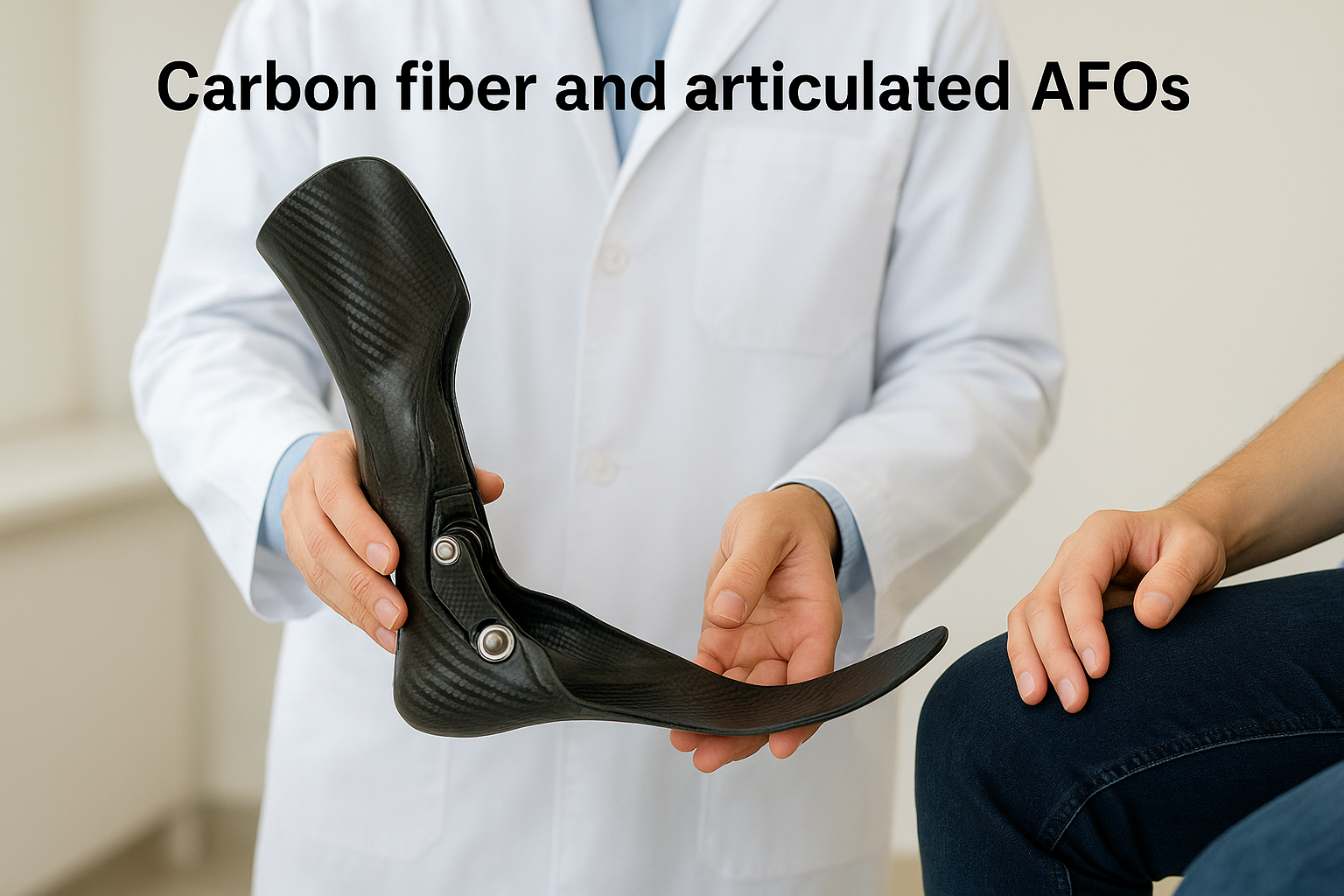
Carbon fiber AFOs carry a higher price because of material cost and the skilled labor required to laminate and finish them precisely. These devices typically run between $1,500 and $3,000 for a custom-fabricated option. Articulated AFOs, which include a mechanical ankle joint to allow controlled motion, fall in a similar or slightly higher range, often between $2,000 and $4,000.
Here is a quick reference for the main device tiers:
| AFO Type | Typical Price Range (2026) |
|---|---|
| Custom polypropylene (solid) | $500 – $1,500 |
| Custom carbon fiber | $1,500 – $3,000 |
| Custom articulated (hinged) | $2,000 – $4,000 |
| Prefabricated (non-custom) | $50 – $300 |
Prefabricated devices are included for comparison, but they are not individually fitted to your anatomy and often provide inadequate support for patients with complex conditions. The clinical difference between custom and prefab is substantial, which is why your provider’s prescription matters before you weigh the price difference alone.
What drives the cost of a custom AFO
Several specific billing and clinical factors determine your final custom AFO cost beyond just the device type. Understanding these line items helps you ask the right questions before you sign off on anything, and it puts you in a better position to review your explanation of benefits when insurance processes the claim.
Billing codes tied to your prescription
Medicare and most private insurers use HCPCS L-codes to classify orthotics for reimbursement purposes. Each code corresponds to a specific device design, and your orthotist assigns the appropriate code based on what your prescription requires. A more complex code, such as one covering a solid ankle double-upright AFO with custom fabrication, carries a higher allowable reimbursement rate than a basic posterior leaf spring code. The L-code attached to your device directly affects both what your insurer pays and what you owe.
If your orthotist assigns a code that doesn’t match your actual device, your claim can be denied or downgraded, which shifts more cost onto you.
Add-on components and modifications
The base device price rarely tells the full story. Custom padding, specialized liners, and reinforced strapping systems each carry separate charges in most billing setups. If your skin is sensitive or you have circulation concerns, your orthotist may add closed-cell foam padding or a neoprene interface layer to prevent breakdown. These additions improve outcomes but also increase your bill.
Modifications after delivery add cost too. Trimming, heat adjustments, and strap replacements during the break-in period are sometimes bundled into the original quote, but not always. Ask your provider upfront whether follow-up adjustments are included or billed separately so you can compare quotes accurately.
Replacement and repair over time
A well-fitted custom AFO typically lasts three to five years with regular use, though active patients or those with changing neurological conditions may need replacement sooner. Repairs, such as replacing worn ankle joints on articulated models or cracked footplates on carbon fiber designs, carry their own costs. Planning for replacement before your current device fails gives you time to work through insurance authorization rather than rushing the process under pressure.
How insurance changes what you pay
Insurance can reduce your custom AFO cost significantly, but the amount you actually save depends on your plan, your diagnosis, and how your provider submits the claim. Most insurance plans, including Medicare and many commercial policies, cover custom orthotics when they are medically necessary and properly documented. Without the right paperwork in place before your device is ordered, you risk receiving a denied claim and facing the full cost out of pocket.
Medicare coverage for custom AFOs
Medicare Part B covers custom AFOs as durable medical equipment (DME) when your treating physician provides a signed order and your orthotist documents medical necessity in a detailed chart note. Once those requirements are met, Medicare typically pays 80 percent of the approved amount after you satisfy your Part B deductible, leaving you responsible for the remaining 20 percent. If you carry a Medigap supplemental policy, that secondary coverage often picks up all or most of that remaining balance.
Your physician’s documentation must directly link your diagnosis to your functional limitations, because Medicare reviewers look for a clear clinical reason the AFO is necessary rather than optional.
Medicare assigns a fee schedule rate to each L-code, and your approved amount is based on that rate rather than your orthotist’s billed charge. If your orthotist is a participating Medicare supplier, they accept the approved amount as payment in full and cannot bill you beyond your 20 percent share. Confirming your provider’s participation status before you schedule your fitting appointment protects you from unexpected balance billing.
Private insurance and what to verify
Private plans vary more than Medicare, so you need to review your specific policy rather than assume coverage mirrors what a neighbor or coworker received. Start by calling your insurer’s member services line and asking three specific questions: whether custom AFOs are a covered benefit, whether your orthotist is in-network, and what your deductible and out-of-pocket maximum look like for DME claims.
Most private insurers also require prior authorization before your device is fabricated. Skipping this step, even unintentionally, typically results in a denied claim or a significantly reduced benefit. Ask your orthotist whether their office handles prior authorization on your behalf, since many established practices manage this process routinely to reduce delays and protect your coverage.
How to get a clear estimate before you order
Getting a reliable number on custom AFO cost before your device is built requires more than a phone call asking for a price. You need specific information from both your orthotist and your insurance plan, and you need it in writing before fabrication begins. Providers who handle AFOs regularly can walk you through this process, but you still need to ask the right questions to protect yourself from billing surprises later.
Ask for an itemized quote
Request a written quote that breaks down each component separately: the base device, any add-on liners or padding, delivery, and follow-up adjustment appointments. A single lump-sum number makes it impossible to compare quotes between providers or understand what you’re actually paying for. When you receive an itemized breakdown, you can also cross-reference the L-codes your orthotist plans to bill against your insurer’s fee schedule, which is publicly available for Medicare patients on the Centers for Medicare and Medicaid Services website.
Providers who resist providing itemized quotes are a warning sign. Any reputable orthotics practice should be able to give you a clear written breakdown before you commit.
Your quote should also specify whether fitting adjustments after delivery are included in the stated price or billed per visit. Some practices bundle two or three follow-up appointments into the initial fee, while others charge separately for each session. Knowing this upfront lets you calculate a realistic total rather than a starting point that grows over the first few months.
Confirm authorization before fabrication
Before your orthotist begins building your device, confirm in writing that prior authorization has been approved by your insurer. Authorization approval should include the specific L-code, the authorized quantity, and the authorization reference number. Keep a copy of this approval in your records because you will need it if your claim is later disputed or denied.
Your orthotist’s billing staff should handle the prior authorization submission on your behalf as standard practice. If they cannot confirm they have received written approval before scheduling your casting appointment, reschedule until that document is in hand. Building the device without it puts you at risk of paying the full cost out of pocket, regardless of what your policy covers.
Next steps
You now have a clear picture of what shapes custom AFO cost in 2026, from materials and fabrication methods to insurance documentation and prior authorization. The most important takeaway is that your final number depends on decisions made before your device is built, not after. Getting itemized quotes, confirming coverage details, and securing written authorization before fabrication begins are the three steps that protect you from unexpected bills.
If you’re in Central Virginia and ready to move forward, the next practical step is speaking with a specialist who can evaluate your condition, write the right prescription, and guide you through the insurance process from the start. Our team at Achilles Foot and Ankle Center handles this process every day across thirteen locations, and same-day appointments are available for patients who need answers quickly. Schedule your AFO evaluation today and get a clear plan in place before costs become a barrier to treatment.