

That sharp, nagging pain at the front or back of your ankle, the one that flares up when you climb stairs or push off while walking, could point to a common but often misunderstood condition. Bone spur in ankle symptoms tend to develop gradually, which means many people dismiss the early warning signs as general stiffness or "just getting older." By the time the pain limits daily movement, the spur may already be affecting surrounding tissue and joint function.
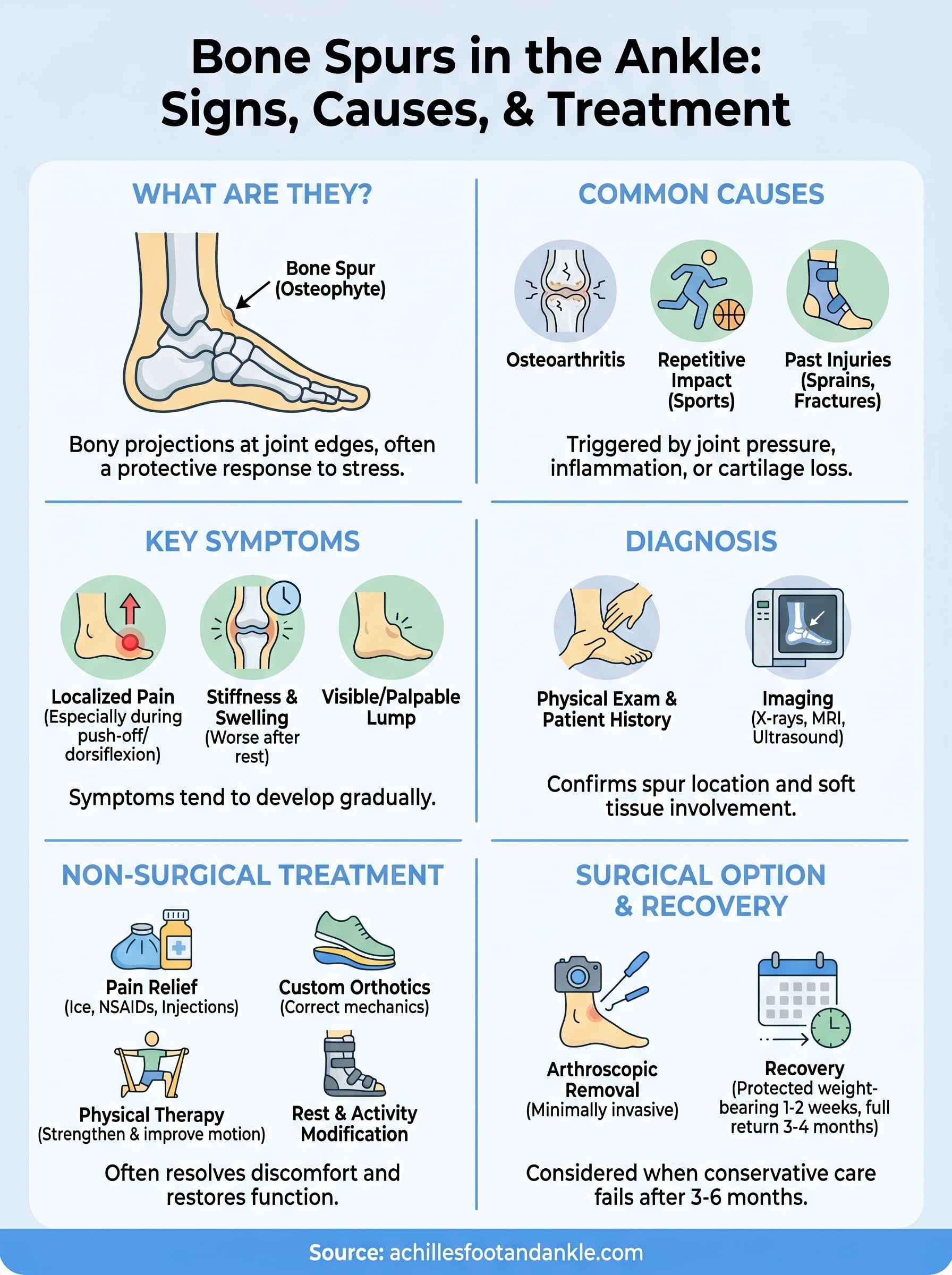
Bone spurs (osteophytes) are bony projections that form along joint edges, often in response to pressure, friction, or cartilage loss. In the ankle, they can restrict range of motion, cause swelling, and make even simple activities uncomfortable. Understanding what these symptoms look like, and what’s actually causing them, puts you in a much better position to seek the right care before the problem progresses.
At Achilles Foot and Ankle Center, our podiatric specialists diagnose and treat ankle bone spurs across our thirteen Central Virginia locations, using everything from advanced imaging to conservative therapies and surgical options when needed. This article breaks down the specific signs to watch for, the underlying causes, and the treatment approaches that can get you back on your feet with less pain and better function.
Why ankle bone spurs form and cause symptoms
Your body builds bone spurs as a protective response to ongoing stress. When a joint experiences repeated pressure, inflammation, or cartilage breakdown, the body attempts to stabilize the area by depositing extra calcium. Over time, those deposits harden into bony projections along the joint edges. In the ankle, this process commonly occurs at the front of the joint (anterior) or at the back near the heel (posterior), and the specific location often determines which movements become the most painful.
The mechanics behind bone spur formation
Several specific conditions set the stage for spur development. Osteoarthritis is one of the most frequent culprits, since the gradual loss of cartilage removes the cushioning between bones and prompts the body to compensate with extra bone tissue. Repetitive impact activities, such as running, basketball, or soccer, can also place persistent stress on the ankle joint and trigger the same calcium-building response over months or years of strain.
Past ankle injuries play a significant role as well. A sprain, fracture, or ligament tear that heals incompletely can leave behind areas of chronic low-grade inflammation. The body reads that signal as an ongoing threat and responds by reinforcing the site with additional bone. Individuals who sustain repeated ankle injuries face a higher cumulative risk for spur development, particularly if those injuries were never fully rehabilitated.
Common contributing factors include:
- Osteoarthritis and progressive joint degeneration
- Repetitive high-impact activity (running, jumping sports)
- History of ankle sprains or fractures
- Poorly fitted footwear that increases joint stress
- Flat feet or high arches that alter ankle mechanics
Why bone spurs in the ankle trigger pain
Bone spurs are not always painful on their own. The problem arises when the spur impinges on surrounding soft tissue, such as tendons, ligaments, or the joint capsule itself. In the ankle, this impingement tends to become most noticeable during movement, particularly when you flex the foot upward (dorsiflexion) or push off the ground while walking or running.
Bone spur in ankle symptoms frequently worsen during activities that compress the joint, and many people notice a sharp increase in discomfort after periods of rest followed by sudden movement.
Synovial tissue irritation compounds the problem further. When a spur repeatedly contacts the lining of the joint, it triggers localized inflammation that produces swelling, stiffness, and a persistent dull ache. The longer this impingement continues without attention, the more the surrounding tissue deteriorates, and what started as a manageable discomfort can gradually limit your ability to walk, exercise, or simply stand for extended periods.
How to tell if ankle pain may be a bone spur
Not every ankle ache signals a bone spur, but certain patterns are distinctly characteristic of osteophyte-related pain. The key is paying attention to when your discomfort appears, where it’s located, and how your range of motion changes over time. Bone spur in ankle symptoms tend to follow predictable patterns that differ from a sprain or a simple overuse injury, and recognizing those differences early can help you get the right care faster.
Common signs that point to a bone spur
Pain at a specific, localized point on your ankle is one of the most telling indicators. Unlike a general soreness that spreads across the joint, spur-related discomfort tends to concentrate directly where the bony projection contacts soft tissue. You may also notice a firm or hard bump just under the skin, particularly at the front of your ankle or along the heel.

Common signs to look for include:
- Sharp pain when bending the foot upward or pointing the toes
- Swelling around one specific area of the ankle joint
- Stiffness that is worst in the morning or after prolonged sitting
- A visible or palpable bony lump near the joint line
- Reduced range of motion that worsens gradually over weeks or months
Pain patterns that set bone spurs apart
One pattern that distinguishes bone spur pain from other ankle problems is how it behaves with activity. Rest often brings temporary relief, but the pain returns quickly once you resume movement, particularly during activities that compress the joint, such as walking uphill or climbing stairs.
If your ankle pain consistently flares during push-off movements and eases with rest, a bone spur is a strong possibility worth evaluating professionally.
Watch for catching or grinding sensations inside the joint during movement as well. Those sensations suggest the spur is actively contacting surrounding tissue with each step, which typically worsens without treatment.
How doctors diagnose a bone spur in the ankle
When you visit a podiatrist for suspected ankle bone spur symptoms, the diagnostic process is straightforward but thorough. A clear diagnosis matters because several other conditions, including tendinitis, ligament damage, and arthritis without spurs, can produce similar discomfort. Getting the right answer early means your treatment plan addresses the actual source of pain rather than a guess.
Physical examination and patient history
Your doctor begins by reviewing your activity level, injury history, and the specific pattern of your pain. They will manually press along the joint line to locate tender spots and ask you to perform movements like flexing or pointing your foot to identify where bone spur in ankle symptoms are most pronounced. Range of motion testing gives the doctor a measurable baseline and helps determine whether impingement is actively restricting your joint.
During the hands-on exam, your podiatrist may also detect a palpable bony prominence near the front or back of the ankle. Visible swelling, skin changes, or mechanical catching during movement adds further clinical evidence pointing toward an osteophyte rather than another condition.
Imaging tests that confirm the diagnosis
Physical findings alone rarely tell the full story, which is why imaging plays a central role in confirming a bone spur. Standard weight-bearing X-rays are typically the first step, as they clearly show bony projections along the joint edges and reveal any underlying joint space narrowing from arthritis.

X-rays taken while you bear weight on the ankle give a more accurate picture of how the joint functions under real load conditions.
When soft tissue involvement is unclear, your doctor may order an MRI or diagnostic ultrasound to assess whether the spur contacts tendons, the joint capsule, or surrounding structures. That information directly shapes the treatment approach your care team recommends.
How to treat ankle bone spurs without surgery
Surgery is not the starting point for most people dealing with bone spur in ankle symptoms. Conservative care resolves discomfort and restores function for many patients, especially when treatment begins before the spur causes significant soft tissue damage. Your podiatrist will recommend a combination of approaches tailored to the severity of your symptoms and your activity level, rather than a one-size-fits-all protocol.
Reducing pain and inflammation
The first priority is calming the inflammation that makes everyday movement painful. Non-steroidal anti-inflammatory medications (NSAIDs), such as ibuprofen, reduce swelling around the impinged tissue. Ice applied for 15 to 20 minutes after activity also limits acute flare-ups without adding stress to the joint.
Consistent use of ice and anti-inflammatory medication in the early stages gives the surrounding soft tissue time to recover and can significantly reduce how often symptoms interrupt your daily routine.
When over-the-counter options fall short, your doctor may recommend a corticosteroid injection directly into the affected area. This delivers targeted relief that lets you participate more fully in physical therapy without pain limiting your progress.
Addressing the root cause with mechanical support
Pain management alone does not prevent a spur from continuing to irritate surrounding tissue. Custom orthotics correct the foot mechanics that place excessive stress on the ankle joint, reducing the repetitive compression that aggravates symptoms with every step. Your podiatrist takes precise measurements to ensure the orthotic addresses your specific biomechanical pattern.
Physical therapy strengthens the muscles that support and stabilize your ankle, which reduces the load placed on the spur itself during movement. Your therapist will also work to improve your range of motion, so the joint moves more freely and impingement occurs less frequently during activity.
When surgery makes sense and what recovery looks like
Conservative treatment resolves bone spur in ankle symptoms for a large portion of patients, but some cases do not respond adequately to physical therapy, orthotics, or injections. When pain continues to limit your mobility after three to six months of consistent non-surgical care, surgery becomes a reasonable next step rather than a last resort. Your podiatrist will review your imaging results and functional limitations together before recommending a procedure.
Signs that conservative treatment has run its course
You have likely reached the point where surgery warrants serious consideration if you experience persistent impingement pain that prevents normal walking, or if imaging shows the spur has caused measurable damage to surrounding tendons or cartilage. Catching sensations that do not improve, visible swelling that remains despite treatment, and a continued loss of ankle range of motion over time are all indicators that the spur needs to be removed rather than managed around.
If your symptoms have not improved meaningfully after completing a structured conservative treatment program, surgical removal of the spur often produces more predictable and lasting relief than additional non-surgical attempts.
What the surgical procedure and recovery involve
Ankle bone spur removal is typically performed arthroscopically, using small incisions and a camera to guide the instruments. This minimally invasive approach reduces tissue disruption and shortens the overall recovery timeline compared to open procedures. Your surgeon removes the bony projection and addresses any damaged soft tissue identified during the procedure.
Recovery depends on the extent of the surgery, but most patients begin protected weight-bearing within one to two weeks and progress through a structured physical therapy program over the following six to eight weeks. Full return to sports or high-impact activity generally takes three to four months, with most patients reporting significant functional improvement well before that point.
Next steps for ankle pain
Recognizing bone spur in ankle symptoms early gives you the best chance of resolving pain with conservative treatment rather than surgery. The longer impingement continues without attention, the more the surrounding tissue deteriorates and the harder it becomes to restore full ankle function. Acting on persistent or worsening pain rather than waiting it out is the most practical decision you can make for your long-term mobility.
If your ankle pain limits your daily movement, causes stiffness after rest, or produces a sharp pinch during activity, a podiatric evaluation is the right next move. A clear diagnosis and a structured treatment plan tailored to your specific condition will do far more than self-managing with rest and over-the-counter medication alone. The specialists at Achilles Foot and Ankle Center are ready to help you identify the source of your pain and build a plan that works for your life. Schedule a same-day appointment and get answers today.