

You’re staring at a diagnosis, maybe a scheduled surgery, and you want to know exactly who’s treating your foot pain. So you ask is a foot doctor an MD, and the short answer is no. Foot doctors are podiatrists, and podiatrists hold a Doctor of Podiatric Medicine, or DPM, not a Doctor of Medicine, or MD.
That distinction doesn’t mean less training or lower quality care. Podiatrists complete four years of podiatric medical school, followed by a three-year surgical residency, and many go on to specialize further in areas like reconstructive surgery, sports medicine, or diabetic wound care. Their entire education focuses on the foot and ankle, which is exactly why they often catch problems that a general MD might miss.
In this article, we’ll break down what a DPM degree actually involves, how podiatrist training compares to an MD’s path, what procedures a foot doctor is licensed to perform, and when you should see one instead of an orthopedic surgeon. If you’re weighing your treatment options or just want to understand who’s about to operate on your foot, this guide answers those questions directly.
Why it matters whether your foot doctor is an MD or DPM
Asking whether your podiatrist is an MD isn’t just trivia. It shapes what you should expect from your visit, how insurance handles your claim, and how much confidence you can place in a surgical recommendation. Podiatrists and MDs follow different licensing paths, but both are fully qualified to diagnose and treat the conditions within their scope. Knowing the difference helps you ask better questions and spot red flags if something feels off about a provider’s qualifications.
Licensing determines what your foot doctor can legally do
A DPM’s license comes from a state podiatric medical board, separate from the board that licenses MDs, but the authority it grants is substantial. Licensed podiatrists can order imaging, prescribe medication, perform outpatient procedures, and in most states, operate on the foot and ankle up through the lower leg. The scope varies slightly by state, so a foot doctor practicing in Virginia has authority defined by Virginia’s podiatric licensing statutes, which cover everything from bunion correction to ankle fracture repair. This licensing structure exists because foot and ankle anatomy is complex enough to justify a dedicated specialty, not a watered-down version of general medicine.
A DPM license means your foot doctor trained specifically for the foot and ankle, not generally for the whole body with a side interest in feet.
Insurance networks and referrals hinge on the right credential
Insurance companies categorize podiatrists differently from MDs, which affects your copay, your referral requirements, and whether a claim gets approved at all. Referral paperwork from a primary care doctor often specifies
How podiatry training compares to medical school
Both podiatrists and MDs spend roughly the same number of years in training, but the content of that training diverges sharply after the first two years. A DPM curriculum dives into foot and ankle anatomy, biomechanics, and gait analysis almost immediately, while an MD program spreads its attention across every organ system in the body. Neither path is easier. They’re just built for different jobs, and understanding that difference answers the common question of how a podiatrist vs MD actually compares once you look past the letters after their name.
The educational path: DPM school vs MD school
Podiatric medical school runs four years, just like an MD program, and covers the same foundational sciences: anatomy, pharmacology, physiology, pathology. Where it splits off is specialization depth. Podiatric students spend far more clinical hours on foot and ankle radiology, lower extremity surgery, and wound care than a general MD student ever will, because that’s the entire focus of the degree.

| Training stage | Podiatrist (DPM) | Medical Doctor (MD) |
|---|---|---|
| Undergraduate degree | 4 years | 4 years |
| Medical/podiatric school | 4 years | 4 years |
| Residency | 3 years (surgical, foot/ankle focused) | 3 to 7 years (varies by specialty) |
| Licensing exam | APMLE | USMLE |
| Board certification | ABFAS or ABPM | Specialty-specific board (e.g., ABOS) |
Four years of school and three years of residency go into training a foot doctor, and every one of those years is spent on the foot and ankle specifically.
Residency turns classroom knowledge into surgical skill
Graduating from podiatric school doesn’t make someone an independent practitioner yet. Residency is where a DPM residency produces a surgeon capable of handling trauma, reconstructive cases, and diabetic limb complications, usually inside a hospital system alongside orthopedic and vascular residents. This three-year stretch includes hundreds of surgical cases, rotations in emergency medicine, and rigorous case log requirements before a graduate can sit for board certification.
Board certification signals ongoing expertise
Certification doesn’t end at residency graduation. Foot doctors seeking board certification through the American Board of Foot and Ankle Surgery or the American Board of Podiatric Medicine must pass rigorous exams and log a minimum number of supervised surgical cases. Recertification cycles require continuing education credits, so a board-certified podiatrist is someone actively staying current on techniques, not resting on a decades-old diploma. This mirrors the continuing education requirements MDs face through their own specialty boards, which the American Board of Medical Specialties oversees at abms.org.
So when you’re comparing credentials, the real question isn’t which degree sounds more prestigious. It’s whether the training matches the problem in front of you, and for anything involving the foot or ankle, a DPM’s training is built exactly for that job.
How to choose the right foot and ankle doctor for you
Finding the right specialist matters more than memorizing the difference between a DPM and an MD. Choosing a foot doctor means matching their training, experience, and location to your actual problem, whether that’s a nagging heel spur or a shattered ankle that needs surgery next week. A few practical checks upfront save you from switching providers midway through treatment.
Verify credentials before you book
Start by confirming board certification through the American Board of Foot and Ankle Surgery or the American Board of Podiatric Medicine, since certification means the doctor logged supervised surgical cases and passed exams beyond basic licensure. State licensing boards publish this information publicly, and a quick search tells you whether a provider’s license is active and in good standing. Board certification status also signals whether a podiatrist keeps up with continuing education, which matters if your case involves newer techniques like minimally invasive bunion correction.
The fastest way to vet any foot doctor is checking their board certification and license status before your first appointment, not after.
Match the specialist to your specific condition
General podiatrists handle routine care well, but complex cases call for someone with focused experience. Someone with a severe diabetic wound needs a practice running an actual limb salvage program, not just a foot doctor who occasionally sees diabetic patients. Reconstructive cases, chronic tendon tears, and pediatric deformities all benefit from a podiatric surgeon who handles that specific category regularly, since case volume correlates with outcomes in most surgical fields.
Ask the right questions before scheduling
Once you’ve narrowed your options, a short phone call or portal message clears up whether a provider fits your needs. Questions worth asking include:
- How many procedures like mine have you performed in the past year?
- Do you operate at an accredited surgical center or hospital?
- What nonsurgical options exist before we consider surgery?
- Which insurance plans do you accept, and is a referral required?
- Can I get a same-day appointment if my symptoms get worse?
These answers reveal a lot about how a practice operates. Practices offering same-day urgent visits and a dedicated surgical center, for instance, usually handle a higher volume of complex cases than a solo office seeing patients three days a week.
Ultimately, the letters after a doctor’s name matter less than their track record with your exact condition. Verify the credential, confirm the experience, and ask direct questions, and you’ll walk into your appointment already knowing your foot doctor can handle what’s in front of them.
What podiatrists can diagnose, treat, and prescribe
Many patients assume a podiatrist is limited to clipping toenails and fitting orthotics, but that undersells what a DPM is licensed to do. Podiatric scope of practice covers everything from diagnosing stress fractures on X-ray to performing complex ankle reconstruction, and in most states it includes prescribing controlled substances when medically necessary. Understanding this scope helps you know when your foot doctor can handle a problem outright versus when a referral makes sense.
Diagnostic capabilities go well beyond a visual exam
A foot doctor’s diagnostic toolkit includes digital X-ray, diagnostic ultrasound, and in some practices, on-site nerve conduction testing to pinpoint conditions like tarsal tunnel syndrome or peripheral neuropathy. Diagnostic imaging lets a podiatrist confirm a stress fracture, identify a Morton’s neuroma, or spot early signs of Charcot foot in a diabetic patient before it becomes a limb-threatening emergency. This isn’t guesswork based on symptoms alone. Practices with in-house imaging can often diagnose and start treatment in a single visit, which matters when pain has already limited someone’s ability to walk or work.
Treatment options span conservative care to reconstructive surgery
Treatment falls into two broad categories, and a good podiatrist moves between them based on what actually works, not what’s easiest to bill. Conservative options include custom orthotics, physical therapy referrals, bracing, and ultrasound-guided injections for conditions like plantar fasciitis or Achilles tendinitis. When conservative care fails, surgical treatment covers everything from minimally invasive bunion correction to total ankle joint replacement and reconstructive procedures for severe deformities.

| Category | Examples |
|---|---|
| Diagnostics | X-ray, ultrasound, nerve conduction studies, gait analysis |
| Conservative treatment | Orthotics, bracing, physical therapy, corticosteroid injections |
| Surgical treatment | Bunion correction, ankle fracture repair, tendon repair, joint replacement |
| Specialized programs | Diabetic wound care, limb salvage, sports injury recovery |
A podiatrist’s scope runs from reading an X-ray to performing joint replacement surgery, all focused on one region of the body.
Prescribing authority matches what the condition requires
Podiatrists hold full prescribing authority in nearly every state, meaning they can write prescriptions for antibiotics, anti-inflammatories, and pain medication, including certain controlled substances after surgery. Prescribing authority also extends to medical-grade diabetic shoes and custom bracing, which require a physician’s order to qualify for insurance coverage. This matters practically: a patient recovering from bunion surgery doesn’t need to loop in a separate physician just to manage post-operative pain or get antibiotics for a wound infection. The DPM overseeing the case can handle it directly, start to finish, because their license covers the full arc of care for that condition.
Podiatrist vs orthopedic surgeon: who to see and when
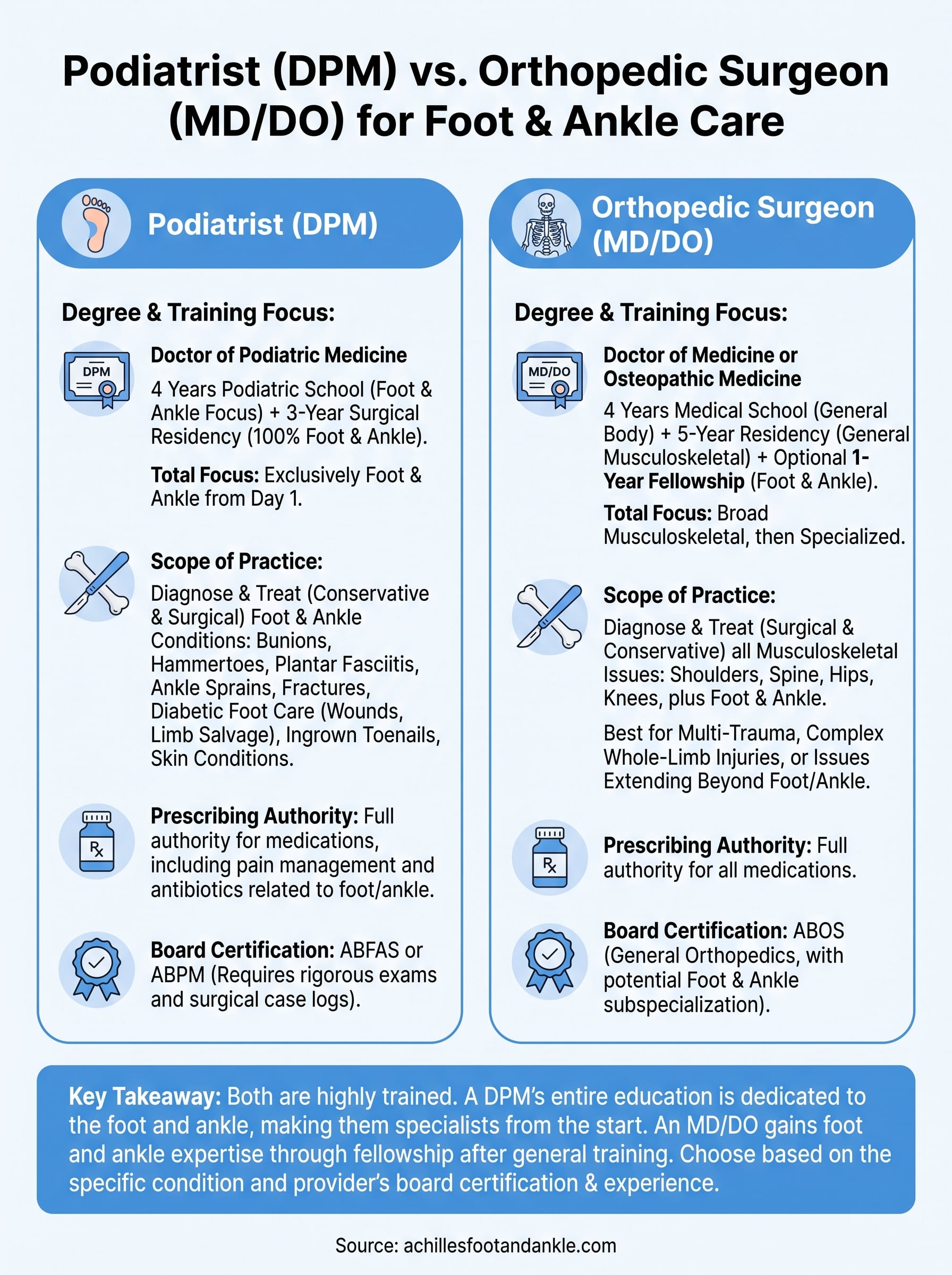
Comparing a podiatrist to an orthopedic surgeon comes down to training focus versus training breadth, not one being better than the other. Foot and ankle orthopedic surgeons complete an MD or DO, then a residency covering the entire musculoskeletal system, from shoulders to spine, before some choose an extra fellowship year to subspecialize in the foot and ankle. Podiatrists train exclusively on the foot and ankle from the first day of podiatric school through the end of a three-year residency, so that region is the entire job, not a fellowship tacked onto a broader career.
What separates the two specialties in practice
Fellowship-trained orthopedic surgeons who focus on the foot and ankle reach a depth of specialization similar to a DPM, just through a different route with more general training along the way. Scope of training is really the deciding factor here, not the letters after the name.

| Factor | Podiatrist (DPM) | Orthopedic Surgeon (MD/DO) |
|---|---|---|
| Degree | DPM | MD or DO |
| Residency focus | Foot and ankle exclusively | Entire musculoskeletal system |
| Foot/ankle depth | Built into core training | Requires extra fellowship year |
| Typical strength | Routine to complex foot/ankle cases | Multi-trauma, whole-limb injuries |
Ask whether a surgeon’s foot and ankle experience came from years of dedicated focus or a single fellowship year layered onto broader training.
When a podiatrist is the right call
General podiatrists and podiatric surgeons cover the vast majority of foot and ankle problems patients actually deal with. See a podiatrist first for:
- Bunions, hammertoes, and other structural deformities
- Plantar fasciitis, Achilles tendinitis, and heel pain
- Diabetic foot ulcers, nerve pain, and routine diabetic foot care
- Ankle sprains, stress fractures, and most fracture repairs
- Ingrown toenails, fungal infections, and skin conditions
Podiatric surgeons handle nearly all of this list surgically when conservative care fails, without needing a referral to another specialist.
When an orthopedic surgeon or team approach makes sense
Orthopedic surgeons become the better fit when the injury extends beyond the foot and ankle into the leg, knee, or involves severe multi-trauma from something like a car accident. Combined trauma cases often need an orthopedic team managing the leg while a podiatrist handles the foot and ankle portion of the injury, and good practices coordinate that care rather than forcing you to choose one specialist. If you’re unsure which applies to you, a podiatrist can evaluate the injury first and refer out if the case truly falls outside foot and ankle territory, which is faster than guessing on your own.
Making sense of your foot doctor’s credentials
So, is a foot doctor an MD? No, and now you know why that’s actually fine. A DPM credential reflects years of training built specifically around the foot and ankle, not a shortcut version of medical school. Whether you need a bunion fixed, a diabetic wound managed, or a fracture repaired, the letters after your doctor’s name matter less than their board certification, case experience, and willingness to answer your questions directly.
Use what you’ve learned here to vet any provider: check licensing, confirm certification, and ask about their specific experience with your condition. That’s how you walk into an appointment with confidence instead of guesswork. If your foot or ankle is bothering you now, don’t wait on it. Schedule a same-day appointment with our team and get a straight answer about what’s going on and how to fix it.