

If you’re on Medicaid and dealing with foot pain, one of the first questions that comes up is practical: does Medicaid cover foot care, and if so, what kind? The answer isn’t as straightforward as most people hope. Medicaid does cover many podiatry services, but there’s a significant gap between what qualifies as medically necessary treatment and what falls under routine care, and that distinction determines whether you pay out of pocket or not.
Coverage also varies depending on your state, your specific Medicaid plan, and your diagnosis. A diabetic patient needing wound care, for example, faces a very different coverage situation than someone wanting routine toenail trimming. Understanding these differences before you schedule an appointment can save you unexpected costs and frustration.
At Achilles Foot and Ankle Center, we accept Medicaid across our Central Virginia locations and help patients navigate their coverage every day. This article breaks down what Medicaid typically covers, what it doesn’t, and how to confirm your specific benefits, so you can get the foot care you need without surprises.
What Medicaid usually covers for foot care
When asking does Medicaid cover foot care, the answer starts with one key phrase: medical necessity. Medicaid will pay for podiatry services when a condition requires treatment to prevent serious health complications, relieve significant pain, or restore function. That standard applies across all states, even though the specific services covered can differ based on where you live and which Medicaid plan you’re enrolled in.
Conditions that typically qualify for coverage
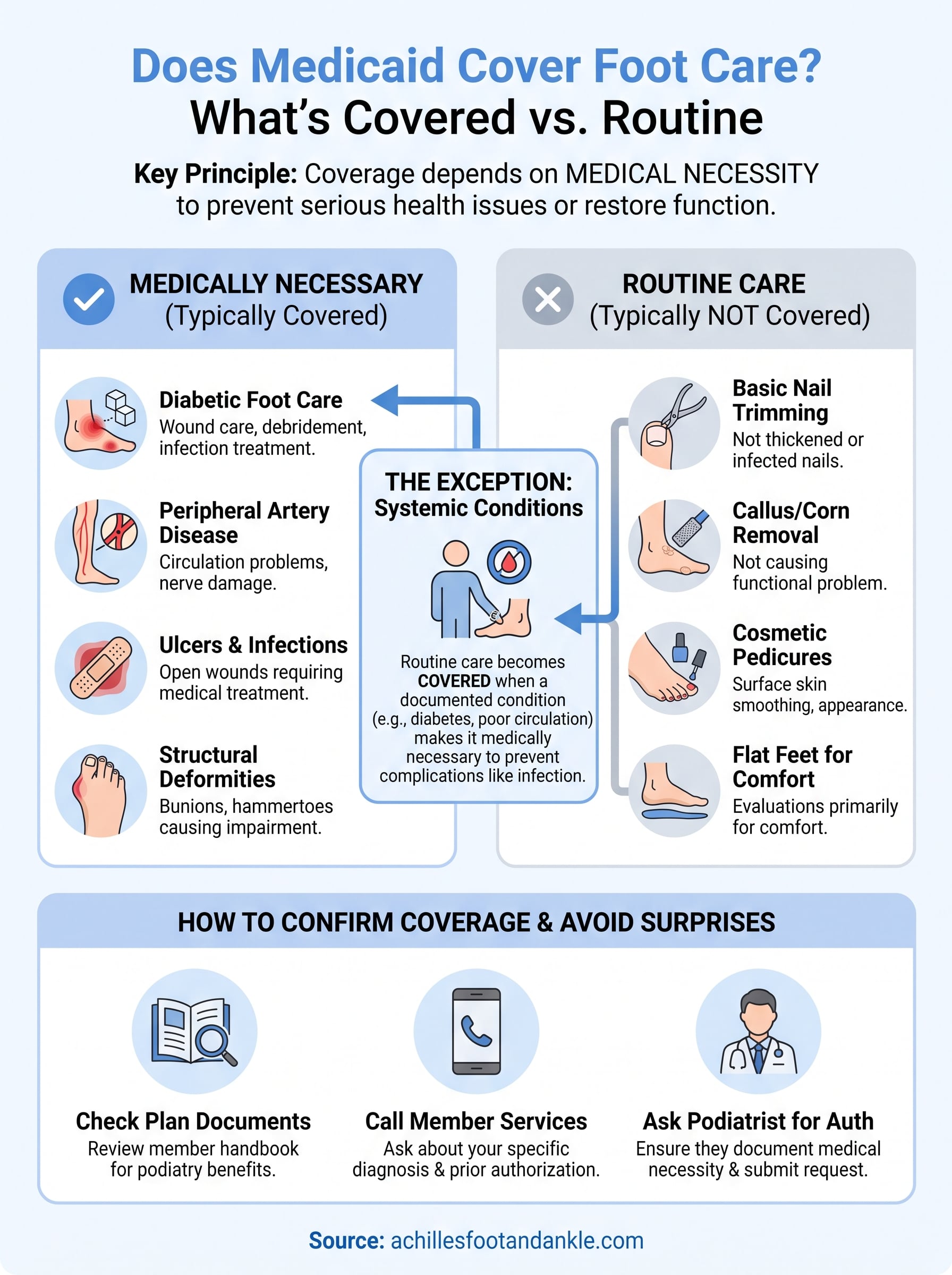
Medicaid generally covers foot care when your condition connects to a documented medical diagnosis. Diabetic foot care is one of the most consistently covered categories, and for good reason: unmanaged foot problems in diabetic patients can lead to infection, ulcers, and amputation. If you have diabetes, Medicaid almost always covers regular podiatric evaluations, wound care and debridement, and the treatment of infections or ulcerations.

Beyond diabetes, several other conditions regularly qualify for coverage. The key is that your diagnosis must be clinically documented and your provider must demonstrate that the treatment addresses a functional or health-related need:
- Peripheral arterial disease causing circulation problems in the feet
- Nerve damage or peripheral neuropathy affecting sensation and foot function
- Heel pain (plantar fasciitis) when documented and affecting your ability to walk
- Bunions, hammertoes, and other structural deformities causing functional impairment
- Ingrown toenails when infected or producing significant clinical symptoms
- Open wounds, ulcers, or infections requiring medical treatment
The common thread across all covered services is that your condition must affect your health or daily function, not just your comfort or appearance.
Surgical and specialist services
Medicaid also covers surgical procedures for foot and ankle conditions when conservative treatments have failed or when the severity warrants immediate intervention. This includes reconstructive surgeries, joint procedures, and fracture care. If your podiatrist recommends surgery and documents the medical justification, Medicaid typically covers the procedure at in-network rates, though your cost-sharing responsibility depends on your specific plan.
Specialist visits to a licensed podiatrist are generally covered as long as you follow your plan’s referral and prior authorization process. Some Medicaid plans require a referral from your primary care doctor before you see a foot specialist, so checking that requirement before your appointment prevents delays and unexpected bills. Your podiatrist’s office can often help you confirm whether a prior authorization is needed and assist with the paperwork to get that approval in place before your visit.
What Medicaid calls routine foot care
Routine foot care refers to services that maintain the feet rather than treat a specific medical condition. Medicaid, at both the federal and state level, draws a hard line between care that’s clinically necessary and care that’s considered basic hygiene or cosmetic maintenance. Knowing which side of that line your situation falls on helps you avoid denied claims and surprise costs.
Services that usually fall outside coverage
Medicaid typically will not pay for services you could reasonably perform at home or that don’t involve a documented diagnosis requiring professional treatment. When asking does Medicaid cover foot care, these are the categories most likely to fall into the uncovered column:

- Cutting or trimming nails that are not thickened, infected, or otherwise diseased
- Removing calluses or corns that aren’t causing a functional problem or secondary condition
- General foot hygiene maintenance with no underlying diagnosis
- Cosmetic treatments like pedicures or surface skin smoothing
- Flat feet evaluations or orthotics requested primarily for comfort rather than a documented functional impairment
Routine care only becomes covered when a systemic condition, such as diabetes or peripheral vascular disease, makes that same service medically necessary.
When routine care becomes a covered service
The exception to routine exclusions is significant. If you have a documented systemic condition that affects your feet, services that would otherwise be routine can qualify for coverage. A diabetic patient who needs nail trimming by a podiatrist, for example, qualifies because improper nail care could trigger an infection with serious consequences. Your provider must document this connection in your medical record clearly and specifically.
This reclassification from routine to medically necessary requires your diagnosis to appear in your chart and your podiatrist to justify the visit in clinical terms. Without that documentation, even a legitimate visit can get denied.
How to check your plan and get care approved
Before you schedule a podiatry visit, taking a few minutes to verify your coverage saves you time and unexpected costs. Medicaid plans differ more than most people realize, and assuming your care will be covered without checking first is one of the most common reasons patients end up with denied claims or surprise bills.
Start with your plan documents and member services
Your Medicaid member handbook is the best starting point. Look for sections covering podiatry, specialist visits, or foot and ankle care. If the language is unclear, call the member services number on the back of your insurance card and ask directly whether your diagnosis qualifies for coverage and whether you need a referral before seeing a podiatrist.
When you call, have your diagnosis code ready if your primary care doctor has already documented your condition. Ask specifically whether prior authorization is required for the type of visit you need. Getting a clear answer before your appointment prevents claim denials that are difficult to reverse after the fact.
What to bring when you seek prior authorization
When your situation requires prior authorization, your podiatrist’s office typically handles the submission, but you can help move the process forward by making sure your clinical documentation is current. Your primary care records should reflect your diagnosis, any related conditions like diabetes or peripheral neuropathy, and any conservative treatments you have already tried.
Prior authorization approvals are tied to specific services, so confirm that the exact procedure your podiatrist plans to perform matches what was approved before your appointment.
If you are still wondering does Medicaid cover foot care for your specific situation, the most reliable answer comes from combining your plan documents with a direct conversation between your podiatrist’s office and your Medicaid plan’s utilization management team.
What changes by state and by Medicaid plan type
Medicaid is a federal-state partnership, which means the federal government sets minimum requirements while each state decides how broadly to extend coverage. This structure creates real variation from one state to the next. In some states, podiatry coverage is robust and includes a wide range of services beyond diabetes-related care. In others, the program covers only the most essential treatments, and even qualifying for routine care exceptions can require additional documentation steps.
How state Medicaid programs differ
States have the authority to add benefits beyond what federal rules require, and many do. Some states cover custom orthotics and therapeutic footwear for patients with documented conditions like severe flat foot or post-surgical needs. Others restrict these items strictly to diabetic patients. A few states have also expanded telehealth podiatry consultations, which affects how you access initial evaluations. Checking your specific state’s Medicaid benefit list through your state health agency’s website gives you the most accurate picture of what applies to you.
Virginia Medicaid, for example, covers podiatry services when medically necessary, but the exact prior authorization requirements and covered service codes depend on whether you’re enrolled in managed care or fee-for-service.
Managed care vs. fee-for-service plans
Most Medicaid enrollees today are in a managed care organization (MCO) rather than traditional fee-for-service Medicaid. That distinction matters because MCOs can set their own policies within state-approved guidelines. Your MCO may require a primary care referral before authorizing a specialist visit, or it may have a narrower network of covered podiatrists. Fee-for-service Medicaid, by contrast, typically lets you see any provider who accepts Medicaid without a referral. If you’re still trying to figure out does Medicaid cover foot care under your specific plan, calling your MCO directly gives you a faster and more plan-specific answer than reading general state guidelines alone.
What to do if Medicaid denies or won’t cover it
A denial doesn’t mean the case is closed. Medicaid denials are common and often reversible, especially when the denial stems from missing documentation rather than a service that’s genuinely excluded. If you asked does Medicaid cover foot care for your condition and received a denial, your first step is to read the denial letter carefully. It will state the specific reason your claim or prior authorization was rejected, and that reason determines your next move.
File a formal appeal
Every Medicaid plan is required to offer an appeals process, and you have the right to use it. Your denial letter will include a deadline for submitting your appeal, which is typically 30 to 90 days from the denial date. Missing that window can eliminate your right to appeal, so act quickly.
An appeal is most effective when you submit it with supporting clinical documentation, including your diagnosis records, treatment history, and a letter from your podiatrist explaining the medical necessity of the service.
When you submit your appeal, organize your materials clearly. Include your diagnosis codes, any test results or imaging, a timeline of treatments you have already tried, and a written statement from your podiatrist connecting your condition to the specific service that was denied.
Ask your podiatrist to support the appeal
Your podiatrist’s office plays a critical role in a successful appeal. They can provide a letter of medical necessity that directly addresses the language in your denial. Ask them to use the specific terminology your plan uses when defining covered services, as a mismatch in clinical language is one of the most common reasons appeals fail.
If your appeal is denied at the first level, you can request a fair hearing through your state Medicaid agency. This gives you the opportunity to present your case to an independent reviewer who was not involved in the original decision.
Key takeaways and next steps
The core answer to does Medicaid cover foot care is yes, but only when your condition meets the medical necessity standard your plan applies. Covered services center on diagnosed conditions like diabetes, peripheral neuropathy, infections, and structural problems that affect your ability to function. Routine maintenance, like basic nail trimming or callus removal without an underlying diagnosis, falls outside that standard in most cases.
Your best move is to confirm your specific coverage before you schedule. Call your plan’s member services line, ask about prior authorization requirements, and make sure your podiatrist documents your diagnosis thoroughly. If Medicaid denies a claim, file an appeal with supporting clinical records and ask your provider to submit a letter of medical necessity.
When you’re ready to get evaluated and want a team that works with your Medicaid plan, schedule a same-day appointment at Achilles Foot and Ankle Center and get the care your feet actually need.