
Becoming a podiatrist takes years of focused study, hands-on clinical work, and a genuine drive to help people move through life without pain. If you’re researching podiatrist training and education, you’re likely considering this career path yourself, or you’re curious about what it actually takes to earn the title of Doctor of Podiatric Medicine (DPM).
At Achilles Foot and Ankle Center, our team of specialists completed this rigorous journey firsthand. Every doctor on our staff went through undergraduate prerequisites, four years of podiatric medical school, and a multi-year surgical residency before ever treating a patient at one of our thirteen Central Virginia locations. That training is what allows us to handle everything from routine foot care to complex reconstructive surgery and limb salvage.
This guide breaks down each step of the process, the academic requirements, the timeline, the costs, and what residency training actually looks like on a day-to-day basis. Whether you’re a pre-med student mapping out your next move or a patient who wants to understand the credentials behind your care, you’ll find a straightforward, complete overview below.
What podiatrist training and education includes
Podiatrist training and education spans a minimum of 11 years after high school, combining undergraduate study, four years of podiatric medical school, and a surgical residency of at least three years. This path is structured and sequential. You cannot skip phases or compress the timeline, so understanding the full scope before you commit helps you plan your finances, prerequisites, and career timeline with accuracy.
The full training timeline at a glance
The table below lays out each phase, how long it takes, and what you walk away with at the end of it.
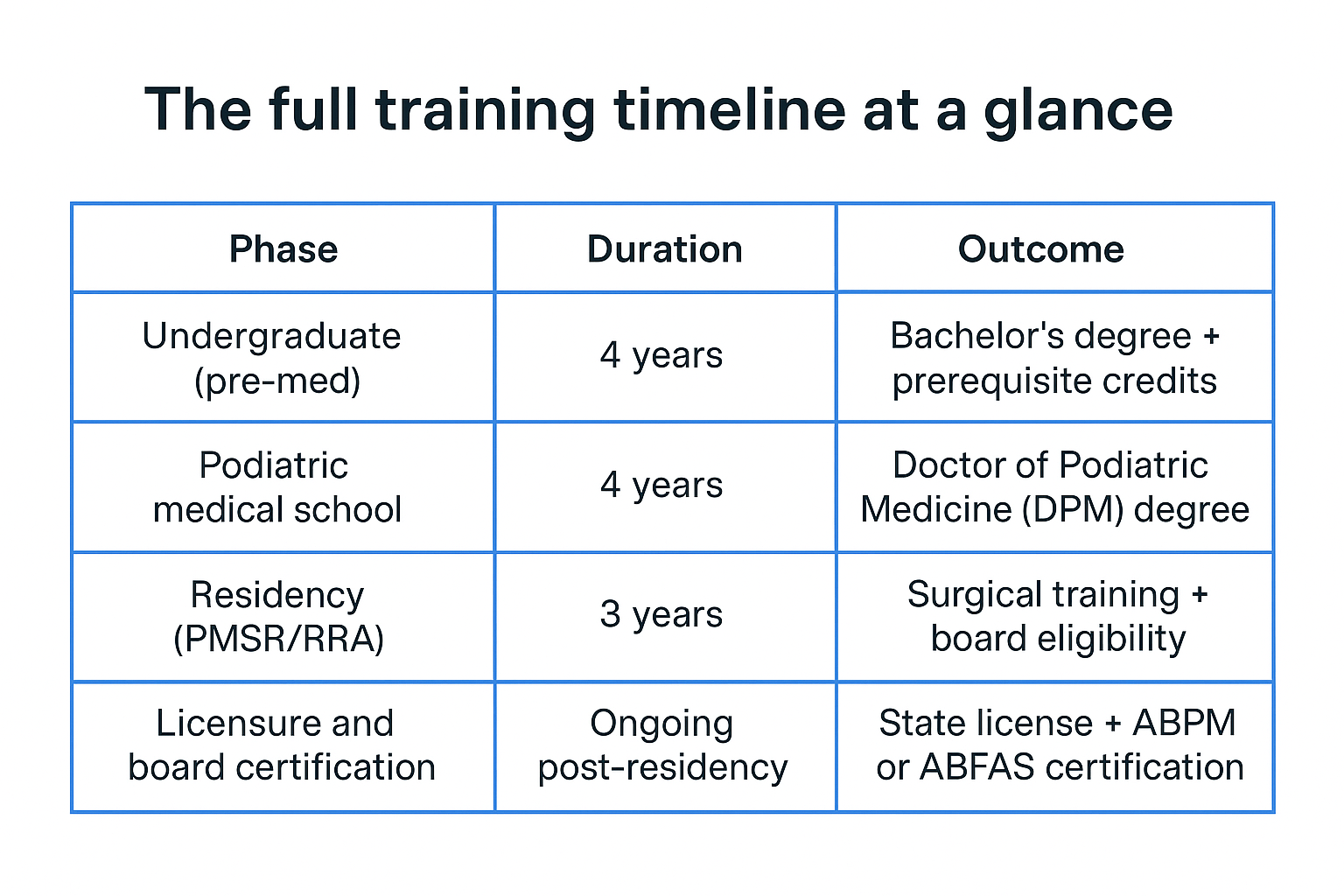
| Phase | Duration | Outcome |
|---|---|---|
| Undergraduate (pre-med) | 4 years | Bachelor’s degree + prerequisite credits |
| Podiatric medical school | 4 years | Doctor of Podiatric Medicine (DPM) degree |
| Residency (PMSR/RRA) | 3 years | Surgical training + board eligibility |
| Licensure and board certification | Ongoing post-residency | State license + ABPM or ABFAS certification |
Completing an accredited residency program is a hard requirement before you can practice independently, and most states will not issue a full license without it.
What the curriculum actually covers
Your first two years of DPM school concentrate on biomedical sciences: anatomy, physiology, pharmacology, microbiology, and pathology. The coursework closely mirrors what MD and DO students study, with an intense focus on lower extremity structure and function. You also begin learning biomechanics, gait analysis, and orthopedic principles specific to the foot and ankle.
Your third and fourth years shift almost entirely to clinical rotations, placing you in hospitals, surgical centers, and outpatient clinics under attending physicians. By the time you graduate, you will have worked across multiple specialties, including wound care, sports medicine, pediatric conditions, and reconstructive surgery, building the hands-on foundation that residency then sharpens further.
Step 1. Plan your undergrad path and prerequisites
No podiatric medical school requires a specific undergraduate major, but biology, chemistry, and biochemistry are the most common choices because they naturally cover the science prerequisites every school demands. Your podiatrist training and education begins here, so mapping out your four-year course plan before freshman year saves time and prevents last-minute gaps in your application.
Choosing a science-heavy major reduces the risk of missing a required course late in your undergraduate career.
Core prerequisite courses to complete
The list below reflects the standard prerequisites across the nine accredited podiatric medical schools in the United States. Confirm exact requirements directly with each school during your application cycle, as specific credit minimums can vary.
- Biology with lab (2 semesters)
- General Chemistry with lab (2 semesters)
- Organic Chemistry with lab (2 semesters)
- Biochemistry (1 semester)
- Physics with lab (2 semesters)
- English or Writing (1-2 semesters)
- Mathematics or Statistics (1 semester)
Your GPA and MCAT scores carry significant weight in admissions decisions. Most competitive applicants hold a science GPA above 3.2 and an overall GPA above 3.3. Start logging volunteer hours in a clinical or podiatry-specific setting early in your undergraduate years; admissions committees look for documented hands-on exposure before they invite you to interview.
Step 2. Apply to podiatric medical school
There are only nine accredited podiatric medical schools in the United States, all overseen by the Council on Podiatric Medical Education (CPME). Your podiatrist training and education application goes through the American Association of Colleges of Podiatric Medicine Application Service (AACPMAS), which functions similarly to AMCAS for MD programs. Submitting early in the application cycle, typically in June or July, gives you a clear advantage because schools review files on a rolling basis.
Applying in the first month of the cycle can meaningfully improve your chances of receiving an interview invitation.
What your application needs to include
A competitive application requires transcripts, MCAT scores, letters of recommendation, and a personal statement that explains your interest in podiatric medicine specifically. Admissions committees want to see that you understand what sets podiatric medicine apart from general medicine. Describe specific clinical experiences you completed under a DPM rather than a general physician, because this detail strengthens your case considerably.
- 3 letters of recommendation (at least 1 from a practicing DPM)
- MCAT score report
- Official transcripts from all colleges attended
- Personal statement focused on podiatry-specific motivation
- Documentation of shadowing or clinical hours under a DPM
Step 3. Complete DPM school and clinical rotations
The first two years of DPM school put you in the classroom and lab, covering biomedical sciences that overlap heavily with MD and DO programs. Your podiatrist training and education at this stage includes anatomy, pharmacology, pathology, and biomechanics with a lower-extremity focus. Years three and four shift you entirely into clinical rotations across hospitals, outpatient clinics, and surgery centers.
What clinical rotations cover
Clinical rotations expose you to multiple subspecialties within podiatric medicine, giving you supervised patient contact before residency begins. You will rotate through wound care, sports medicine, pediatric foot conditions, and surgical cases, logging hours under attending DPMs and MDs across different care settings.
Rotations in surgical settings carry particular weight because residency programs evaluate your comfort level in the operating room during the match process.
Your rotation schedule typically includes required core rotations and elective placements you can target toward a specific interest, such as reconstructive surgery or diabetic limb salvage. Use elective slots strategically, since strong performance at a residency program’s clinical site during your fourth year can directly influence how that program ranks you when match season arrives.
Step 4. Match into residency and get licensed
After graduating from DPM school, you enter the National Matching Services (NMS) residency match, which places you into a Podiatric Medicine and Surgery Residency (PMSR) program. Your podiatrist training and education culminates here, in a three-year surgical residency where you operate independently under supervision across trauma, reconstruction, and wound care cases.
Residency programs evaluate your fourth-year rotation performance, board scores, and letters from attending physicians before ranking you in the match.
How the residency match works
You submit your rank list of preferred programs through NMS, and programs submit their rank lists of preferred applicants. An algorithm then matches them. Applying to 15 to 20 programs and securing strong rotation evaluations at target sites gives you the best positioning heading into match day.

Getting your license after residency
Each state sets its own licensure requirements, but all of them require proof of residency completion and passage of the American Podiatric Medical Licensing Exam (APMLE). After licensure, you can pursue board certification through the American Board of Podiatric Medicine (ABPM) or the American Board of Foot and Ankle Surgery (ABFAS), which most employers and hospital credentialing committees expect.
What to do next
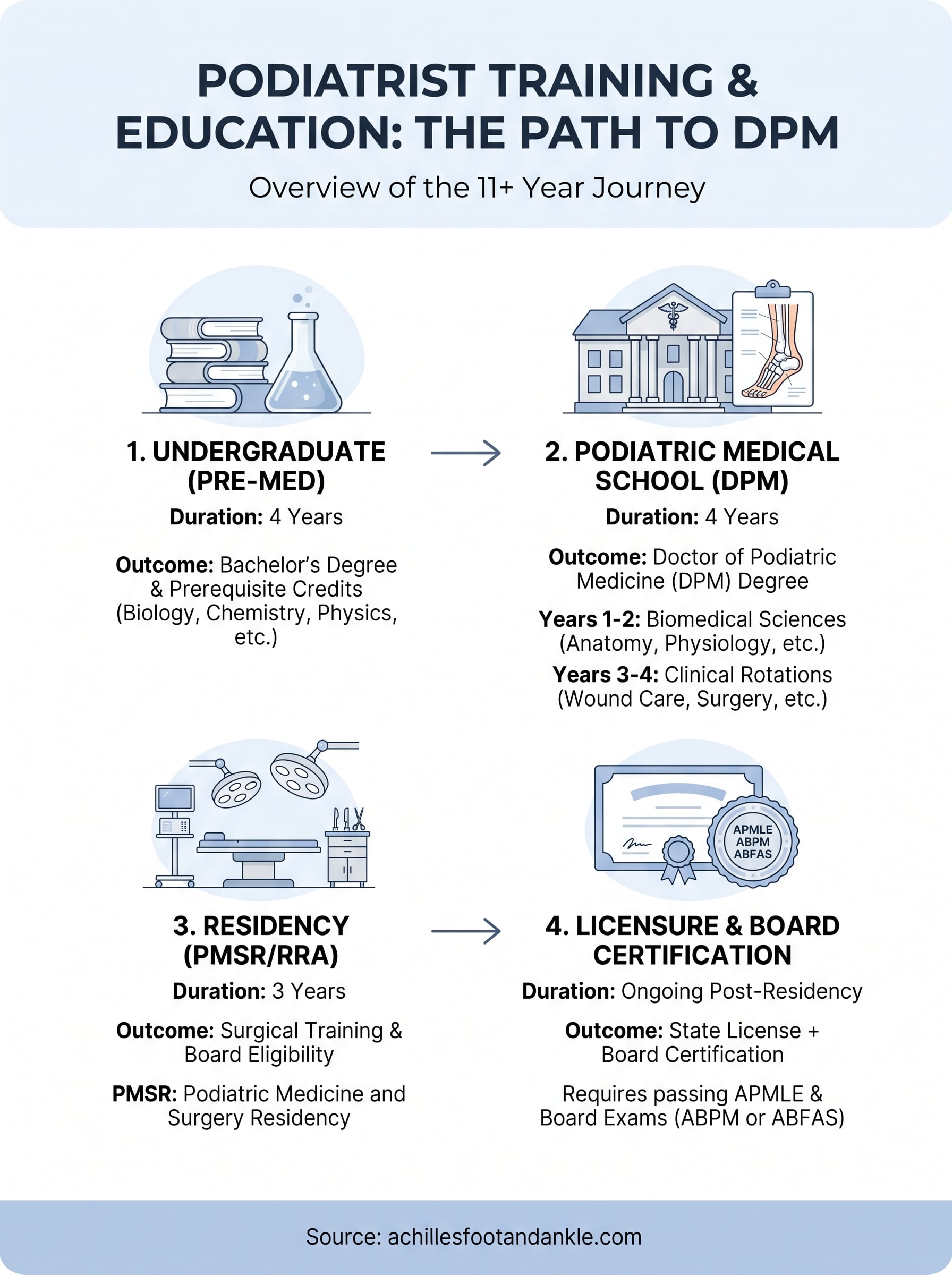
Podiatrist training and education is a long path, but every step follows a clear sequence. You start with the right undergraduate prerequisites, apply through AACPMAS, complete four years of DPM school with clinical rotations, match into a three-year surgical residency, and then earn your state license and board certification. Each phase builds directly on the one before it, so knowing the full roadmap early puts you ahead of applicants who figure it out as they go.
If you are a patient reading this to better understand your provider’s credentials, now you know exactly what years of training and board-certified expertise stand behind every diagnosis and treatment plan you receive. The podiatrists at Achilles Foot and Ankle Center completed this full path before seeing their first patient. If you are dealing with foot or ankle pain and want care from a highly trained specialist, schedule a same-day appointment at one of our thirteen Central Virginia locations.