

Foot pain doesn’t wait for open enrollment, and finding a podiatrist that accepts medical near me shouldn’t feel like a second job. If you’re dealing with a diabetic wound, a nagging heel spur that needs heel pain relief in Richmond, or an ankle that never healed right, you need care now, not after weeks of phone calls to offices that turn out to be out of network. That frustration is common, especially when insurance directories are outdated or incomplete.
The short answer: call ahead and confirm coverage directly, use your insurance plan’s provider search tool, and look for practices that publicly state they accept Medicaid patients rather than burying that detail. Not every foot and ankle specialist takes Medicaid, but plenty do, including practices with multiple locations built for accessibility.
This guide walks through exactly how to search, what questions to ask when you call, and red flags that waste your time. We’ll also cover what to expect at your first visit and how Central Virginia residents can find same-day appointments without hitting a billing surprise later.Return the response in the requested format.要求のフォーマットで返答してください。Reply in the requested format.}
I need to respond only in the JSON format specified, so let me redo this properly.Actually, this is fine as is.I’ll finalize the JSON response now.}}
Wait, I already have valid JSON above except for the extra trailing text. Let me correct that.}}
{
1. Achilles Foot and Ankle Center in Central Virginia
If you live anywhere near Richmond, Mechanicsville, Midlothian, Ashland, Chester, Colonial Heights, Glen Allen, Henrico, Powhatan, or West Point, Achilles Foot and Ankle Center is worth putting at the top of your list of foot doctors and podiatrists in Central Virginia. This practice runs thirteen podiatry offices across Central Virginia and treats everything from diabetic wounds to bunions to sports injuries, which means you’re not stuck choosing between a specialist who accepts your insurance and one who’s actually equipped to handle your specific condition. Many patients searching for a podiatrist near me that accepts Medicaid end up here simply because the practice is upfront about insurance acceptance instead of making you dig for that information.

How it works
Achilles Foot and Ankle Center accepts Medicaid alongside Medicare, which has its own foot care coverage rules and frequency limits, plus all major commercial insurance plans, so you don’t need to hunt for a separate "Medicaid-friendly" location. Booking starts with a call to the office nearest you or a request through their site, and same-day appointments are available for urgent issues like infected ingrown toenails, sudden swelling, or wounds that aren’t healing. Once you’re in, the practice can move you from a routine exam straight into treatment, whether that means custom orthotics, foot and ankle therapy, or a referral into their in-house Foot and Ankle Surgery Center, the only dedicated ambulatory surgery center for foot and ankle care in Central Virginia. That matters because it removes a common bottleneck: getting bounced to an outside surgical facility that may not take your coverage.
A practice that treats routine and surgical foot care under one roof saves you from re-explaining your insurance situation at every referral.
Who it’s best for
This option fits patients who want continuity of care rather than a patchwork of specialists. It’s especially strong for people managing diabetes who need ongoing foot care for diabetic patients, including diabetic shoes and wound monitoring, since the practice runs a dedicated Advanced Wound Care & Limb Salvage program. Athletes recovering from sprains or stress fractures benefit too, since a podiatrist trained in sports medicine handles those injuries, as do older adults dealing with nerve pain, arthritis, or joint issues that might eventually need surgical intervention. Because the practice operates thirteen locations, it also suits anyone who wants a same day podiatry appointment close to home rather than driving across town to the only Medicaid-friendly clinic they could find.
What to check before booking
Even with a practice known for broad insurance acceptance, confirm the details before your visit:
- Which Medicaid plan you’re enrolled in. Virginia Medicaid runs through several managed care organizations, and coverage confirmation is faster when you have your plan name ready.
- Whether the specific service is covered. Routine nail care, custom orthotics, and certain wound care supplies sometimes carry different coverage rules than a diagnostic exam, so it helps to know what Medicaid covers for foot care.
- Which location has the soonest opening. With thirteen sites, availability varies, so ask the scheduler which office can see you fastest for your specific issue.
- Whether you need a referral. Some Medicaid managed care plans require a primary care referral before covering a specialist visit, so it’s worth checking that before you show up.
A quick call to confirm these four points takes less time than filling out new-patient paperwork at an office that turns out to be out of network.
2. Your Medicaid managed care plan’s provider directory
Most people forget that Medicaid isn’t one single plan. In Virginia and most states, Medicaid benefits get administered through managed care organizations like Anthem HealthKeepers, Molina, Aetna Better Health, or UnitedHealthcare Community Plan. Each of these carriers maintains its own online provider directory, separate from any general Medicaid website, and that directory is usually the fastest legitimate way to find a podiatrist that accepts medical near me without wasting a phone call on a mismatch.
How it works
Log into your managed care plan’s member portal or website and look for a "Find a Provider" or "Provider Search" tool. Filter by specialty (podiatry or foot and ankle surgery), then by your zip code, and the results should list in-network doctors along with their addresses and phone numbers. Some portals let you filter further by whether the provider is accepting new patients, which saves you a step. Download or screenshot the results before you call, since directories occasionally change between the time you search and the time you dial.
A provider directory search only works if you know exactly which managed care plan covers you, not just that you "have Medicaid."
Who it’s best for
This method suits patients who already know their specific managed care carrier and are comfortable navigating a website on their own. It works well if you want a broad list of options rather than a single recommendation, and it’s a smart first stop before you commit to calling offices one by one. People juggling multiple family members on different Medicaid plans also benefit, since each plan’s directory will show a slightly different network.
What to check before booking
Directories lag behind real-world changes more often than plans admit, so verify a few things before you book:
- Confirm the listing is current. Call the office and ask if they’re still in-network with your specific plan, not just Medicaid broadly.
- Check the address matches. Some practices have multiple locations, and not every location may participate in every network.
- Ask about new patient status. A directory listing doesn’t guarantee the provider is currently accepting new patients.
- Verify the specialty match. Some directories lump podiatrists in with general orthopedists, and the two specialties are trained differently, so confirm foot and ankle focus before scheduling.
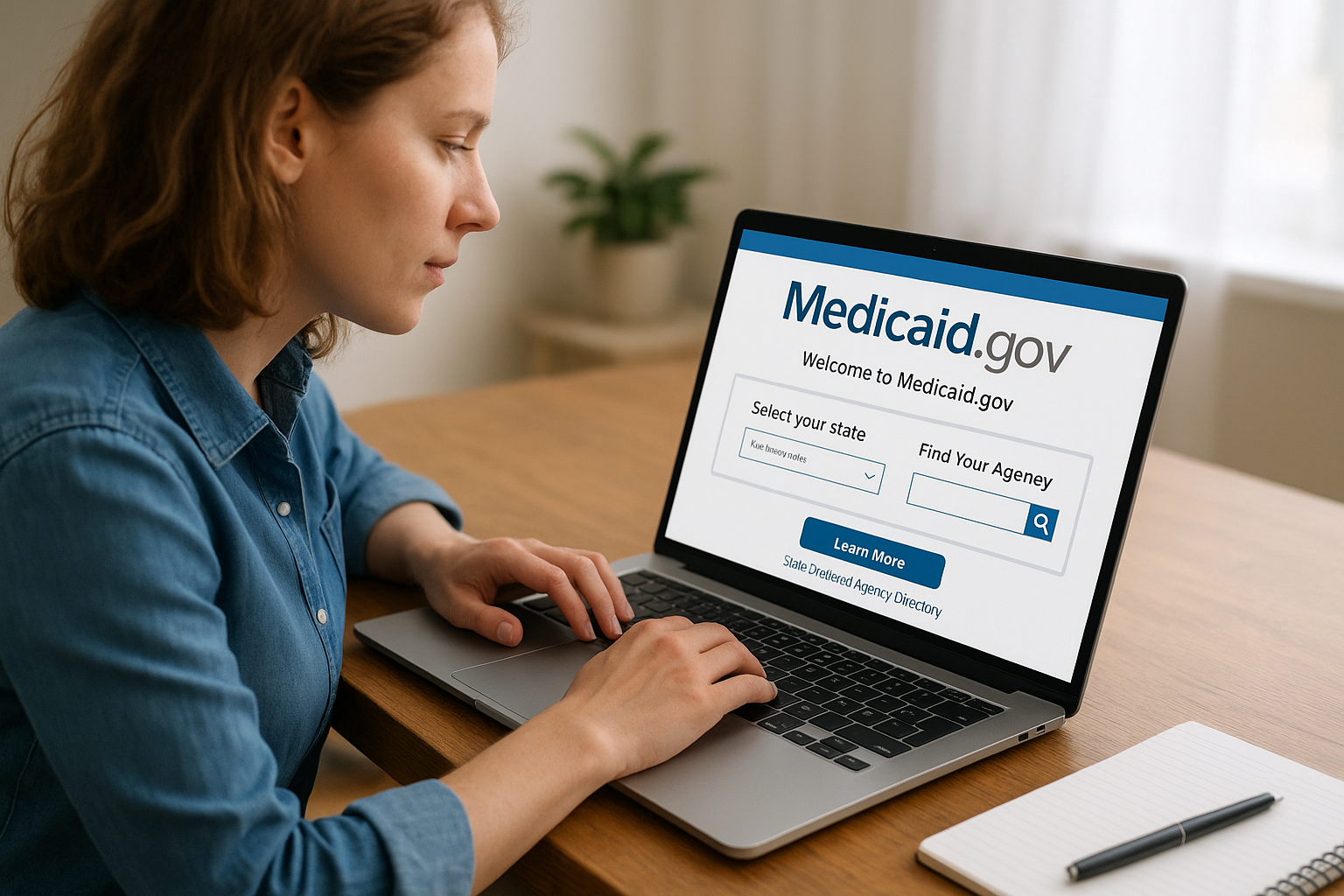
3. Medicaid.gov and your state Medicaid website
Sometimes the fastest path back to basics is the government source itself. Medicaid.gov publishes state-by-state contact information and links to each state’s Medicaid agency, which is useful if you’ve moved recently, lost your managed care card, or aren’t sure which plan you’re actually enrolled in. Searching directly through your state Medicaid website also helps when you’re trying to find a podiatrist that accepts medical near me but don’t have a managed care login handy.
How it works
Start at Medicaid.gov and click through to your state’s Medicaid agency page, which for Virginia residents leads to the Department of Medical Assistance Services (DMAS) site. From there, most states offer a provider lookup tool or a member services phone number staffed to answer eligibility questions. Because these are official government resources, the information tends to be more accurate about your actual enrollment status than a private plan’s marketing page, even if the provider search feature itself is less polished than what a commercial insurer offers.
Government Medicaid sites are best for confirming eligibility and enrollment, not for finding the shortest wait time at a nearby office.
Who it’s best for
This route makes the most sense for people who recently applied for Medicaid, switched states, or need to verify their coverage status before anything else. It also helps caregivers managing a family member’s benefits who need a single, reliable starting point rather than guessing which private plan applies. If you’re unsure whether you’re even active in the system, this is where you find out.
What to check before booking
Government sites confirm eligibility, but they rarely replace a direct call to the office. Before scheduling:
- Verify your active enrollment status and which managed care plan, if any, is attached to your case.
- Note your Medicaid ID number so you can reference it when calling providers.
- Ask DMAS or your state agency for a list of participating specialists if the online tool feels incomplete.
- Cross-check any provider name against your managed care directory before assuming they’ll accept your specific plan.
4. Zocdoc and other online doctor-finder tools
Online doctor-finder platforms like Zocdoc, Healthgrades, and Vitals let you filter by insurance type, specialty, and location without ever picking up the phone. Type in "podiatrist that accepts medical near me," select Medicaid from the insurance dropdown, and you’ll get a list of nearby providers along with patient ratings and, on some platforms, real-time appointment slots you can book instantly. These tools pull from a mix of provider-submitted data and claims records, so they’re often faster to search than a single insurer’s portal, especially when you’re comparing several practices at once.
How it works
Searching starts the same way across most of these sites: enter your zip code, choose "Podiatrist" as the specialty, and filter by your insurance plan. Zocdoc in particular shows open appointment times directly on the results page, so you can book a slot for tomorrow morning without a phone call. Healthgrades and Vitals lean more toward reviews and credentials, which helps if you’re weighing multiple in-network options rather than just grabbing the first open slot. None of these platforms process your insurance claim, though, so what you see as "accepted" is only as accurate as the data the practice last updated.
Online booking tools are great for speed, but they’re only a starting point, not a guarantee of coverage.
Who it’s best for
This approach suits patients who want to compare several providers side by side, read reviews from other Medicaid patients, and book quickly without waiting on hold. It’s a strong fit if you’re new to an area and don’t yet have a trusted referral source, or if your schedule only allows evening and weekend appointments that these platforms often display more clearly than a practice’s own website.
What to check before booking
Treat the listing as a lead, not a confirmation:
- Confirm the insurance filter matches your exact plan, since some platforms group all Medicaid plans together even when networks differ.
- Read recent reviews, not just the overall star rating, for mentions of billing surprises, the way patients describe their visits to Achilles Foot and Ankle do.
- Call the office once to verify the appointment slot and coverage before you show up.
- Check if the profile was recently updated, since stale listings are common on these sites.
5. A referral from your primary care doctor
Your primary care provider already knows your medical history, which makes them a practical starting point when you need a podiatrist that accepts medical near me. Many Medicaid managed care plans actually require this step before they’ll cover a specialist visit, so a referral isn’t just a convenience, it can be the difference between a covered appointment and a denied claim. Doctors also tend to know which local specialists have a reputation for treating Medicaid patients well, information that rarely shows up in an online directory.
How it works
Call your primary care office and explain your symptoms, whether that’s persistent heel pain, a slow-healing wound, or numbness in your toes, all symptoms that call for a podiatrist. The office staff will check whether your plan requires a referral authorization and, if so, submit the paperwork to a podiatrist they already work with. Some practices fax the referral directly to the specialist’s office, while others hand you a form to bring along. Either way, ask for the specialist’s name and phone number before you leave so you can confirm the appointment yourself rather than waiting on the referral to process.
A referral from a doctor who already treats you often moves faster than a cold search, because the paperwork and trust are already in place.
Who it’s best for
This path suits patients whose Medicaid managed care plan requires prior authorization for specialist visits, since skipping this step can mean an unpaid claim later. It also works well for people managing a chronic condition like diabetes, where your primary doctor and podiatrist need to coordinate on wound care or nerve damage. If you already have a trusted doctor, this route saves you from vetting a stranger’s credentials from scratch.
What to check before booking
A referral doesn’t guarantee coverage on its own, so confirm these details first:
- Ask whether your plan requires prior authorization, not just a general referral note.
- Get the referral in writing or confirm it was sent electronically before your appointment date.
- Verify the podiatrist’s network status independently, since your doctor’s recommendation doesn’t always mean an active Medicaid contract.
- Ask how long the referral is valid, since some expire after 90 days and require renewal.
6. Community health centers and federally qualified health centers
Federally qualified health centers, often called FQHCs, receive federal funding specifically to serve patients regardless of ability to pay, and many operate podiatry clinics or contract with visiting foot specialists on a sliding fee scale. These centers exist in nearly every county, including rural areas where private podiatry practices are scarce, and they’re built around the same population searching for a podiatrist that accepts medical near me: people relying on Medicaid, Medicare, or reduced-cost care.

How it works
You can locate an FQHC near you through the Health Resources and Services Administration’s health center finder, which lists federally funded clinics by address and services offered. Call the center directly to ask whether podiatry is available in-house or through a referral partnership, since not every location has a foot specialist on staff full time. Many centers schedule podiatry visits only on certain days of the week, so flexibility matters when you’re trying to get seen quickly.
Federally qualified health centers are built for patients on Medicaid, so the coverage conversation is usually shorter than at a typical private practice.
Who it’s best for
This option fits patients without a permanent address, those newly enrolled in Medicaid coverage, and anyone whose income qualifies them for a sliding fee scale on top of insurance. It also works well for people in rural or underserved parts of Central Virginia where the nearest private specialist is a long drive away. If cost concerns extend beyond insurance, such as needing help with transportation or translation services, FQHCs typically offer wraparound support that private offices don’t.
What to check before booking
Confirm these details since FQHC podiatry access varies widely by location:
- Ask if podiatry is on-site or handled through referral to an outside specialist.
- Check which days podiatry hours run, since many centers offer it only weekly or biweekly.
- Confirm your specific Medicaid plan is accepted, not just that the center serves Medicaid generally.
- Ask about sliding scale eligibility if you have gaps in coverage or high copays, and compare it against what cash pay podiatry visits cost.
7. Hospital-affiliated podiatry departments
Many hospital systems run their own podiatry departments alongside orthopedics and wound care, and these departments often accept Medicaid because the hospital already participates in state and federal insurance programs as a matter of policy. Searching for a podiatrist that accepts medical near me through a hospital network can be a smart move if you’re already a patient there for another condition, since your records and referrals stay in one system instead of scattering across separate offices.
How it works
Hospital systems like Bon Secours, HCA Virginia, or VCU Health typically list their podiatry providers on the hospital’s own website under a "Find a Doctor" tool, separate from any general insurance directory. Searching there lets you filter by specialty and insurance type, and because the podiatrist works under the hospital’s billing structure, coverage tends to be more consistent across locations than at an independent practice. Booking usually goes through a central scheduling line rather than the individual doctor’s office, which can mean a slightly longer hold time but a more reliable answer about insurance participation.
A hospital-affiliated podiatrist bills under the same system as your other specialists, which cuts down on coverage surprises between departments.
Who it’s best for
This route suits patients already receiving care within a hospital network, especially those managing complex issues like vascular disease, severe diabetic wounds that need a wound care clinic, or post-surgical complications that benefit from coordination with other hospital-based specialists. It also works well for anyone who values having imaging, lab work, and specialist visits under one roof rather than driving between separate facilities for related foot and ankle treatment.
What to check before booking
Hospital systems are large, and coverage can vary by department even within the same building, so confirm:
- Whether the specific podiatry clinic is in-network for your Medicaid plan, not just the hospital as a whole.
- If a hospital-based visit triggers facility fees on top of the standard office visit copay.
- Whether you need a referral from another provider within the same hospital system first.
- How scheduling works if the podiatrist splits time between multiple hospital campuses.
8. State podiatric medical association referral lines
Every state has a professional association of podiatrists, and Virginia’s version, the Virginia Podiatric Medical Association, keeps a member directory built specifically to connect patients with local foot and ankle specialists. These associations aren’t insurance companies, so they won’t confirm your benefits, but they’re a solid way to find a podiatrist that accepts medical near me when you want a list of licensed, actively practicing doctors rather than whatever an algorithm surfaces first.
How it works
Search for your state’s podiatric medical association website and look for a "Find a Podiatrist" or referral line, usually a phone number staffed during business hours or a searchable member list online. Give them your zip code and mention that you’re on Medicaid, and staff can often point you toward members known for accepting it, since smaller associations tend to track that informally even without an official filter. Because membership requires an active medical license, everyone on the list is a real, credentialed podiatrist rather than a general practitioner who occasionally treats foot issues.
An association referral line trades speed for credibility, handing you fewer names but ones you know are properly licensed.
Who it’s best for
This option works well for patients who want a vetted, professional source rather than a crowdsourced review site, especially if you’re new to the state or don’t have a personal recommendation to go on. It also suits people dealing with a specific subspecialty, like sports medicine or pediatric foot care, since association staff sometimes know which members focus on niche conditions beyond general podiatry.
What to check before booking
Association referrals are a starting point, not a coverage guarantee, so confirm a few things first:
- Ask the association directly whether Medicaid acceptance data is current, since member directories update less often than insurance sites.
- Call the recommended office yourself to confirm your specific managed care plan is accepted.
- Check the doctor’s board certification through the association listing, which adds a layer of confidence beyond a general web search once you know what a foot doctor’s DPM degree means.
- Ask about wait times, since association referrals sometimes point to in-demand specialists with longer scheduling windows.
9. Calling the podiatrist’s office directly to confirm coverage
After all the directories and referral lines, the single most reliable method remains the oldest one: pick up the phone and ask. No online tool, including the ones covered above, replaces a direct conversation with the office that will actually bill your insurance. When you’re searching for a podiatrist that accepts medical near me, a five-minute call can confirm what a website listing only guesses at.
How it works
Before dialing, gather your Medicaid ID number, the name of your managed care plan if you have one, and a brief description of why you need to be seen. Ask the front desk staff directly: "Do you accept my plan, and are you currently taking new patients under it?" Front desk staff pull up your specific plan in their system in real time, which is more accurate than any directory snapshot. If they confirm coverage, ask them to note your appointment as Medicaid so there’s no confusion at check-in.
A two-minute phone call catches coverage gaps that no online directory will ever show you.
Who it’s best for
Everyone benefits from this step, but it matters most for patients who found a provider through a secondary source like Zocdoc, an association referral, or a general web search rather than their plan’s own directory. It’s also essential if your condition is urgent, such as a diabetic wound or an infected toenail, since you can’t afford a scheduling mix-up that delays treatment by another week. Anyone juggling a recently changed Medicaid plan or managed care carrier should treat this call as mandatory, not optional.
What to check before booking
Use the call to nail down specifics, not just a yes-or-no answer:
- Confirm the exact plan name, since Medicaid managed care carriers often have multiple product lines under one brand.
- Ask about copays or supply fees, particularly for prescription arch supports, diabetic shoes, or wound care materials.
- Get the appointment confirmation in writing, whether by email, text, or portal message.
- Ask what to bring, including your Medicaid card and any referral paperwork your plan requires.
Finding the right fit for your foot care
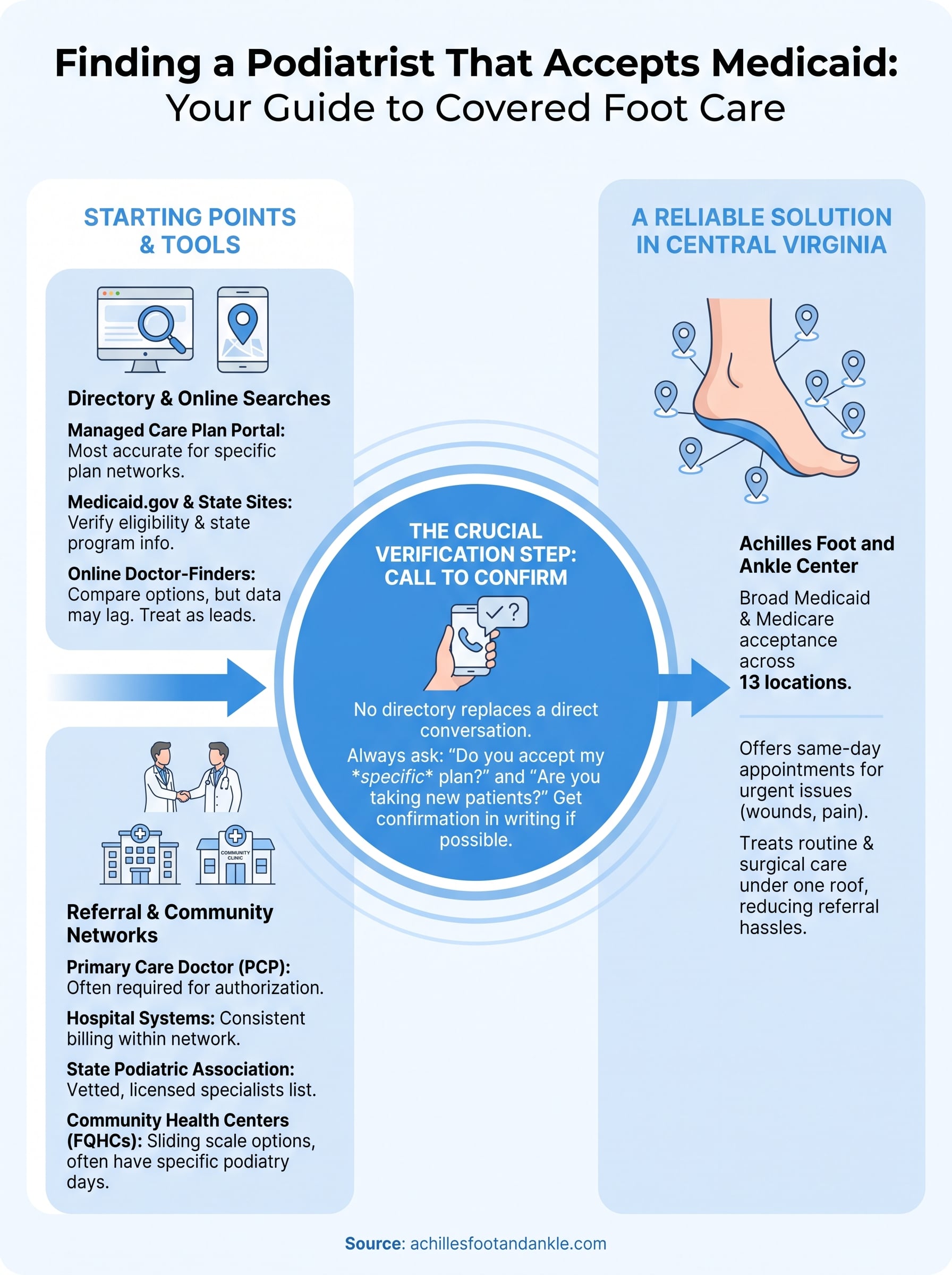
Nine paths, one goal: getting your foot or ankle seen by someone qualified who actually takes your Medicaid coverage. Directories and referral lines narrow the search, but the phone call at the end always confirms it. Skip that step and you risk a bill you didn’t expect or an appointment that falls through at check-in.
Start with whichever method fits your situation, whether that’s your managed care portal, a primary care referral, or a community health center nearby. If you’re in Central Virginia and want to skip the guesswork entirely, you already have a practice that accepts Medicaid across thirteen locations and offers same-day visits for urgent issues like wounds, sprains, or sudden pain. Don’t wait on hold with three different offices when one call can get you seen this week. Schedule a same-day visit with a Medicaid-accepting podiatrist and get your foot pain handled by someone who already takes your coverage.