

Foot pain doesn’t just slow you down, it can make every step a decision. When you search for a doctor for foot problems, you’re probably stuck between a primary care visit that goes nowhere and a nagging ache, numbness, or swelling that isn’t improving on its own. Knowing exactly who to call saves you weeks of guessing.
The short answer: a podiatrist is the specialist trained specifically in foot and ankle care, from bunions and plantar fasciitis to diabetic wounds and sports injuries. Unlike a general practitioner, a podiatrist can diagnose with on-site imaging, prescribe orthotics, and perform surgery when conservative care isn’t enough. That specialization matters when your pain has a specific cause rather than a generic one.
In this article, we’ll break down what podiatrists actually treat, how they differ from orthopedists, and the warning signs that mean you shouldn’t wait for an appointment. We’ll also cover what to expect at your first visit and how Achilles Foot and Ankle Center’s team across Central Virginia handles everything from routine care to complex limb salvage, so you know exactly where to turn.
Why seeing the right foot doctor matters
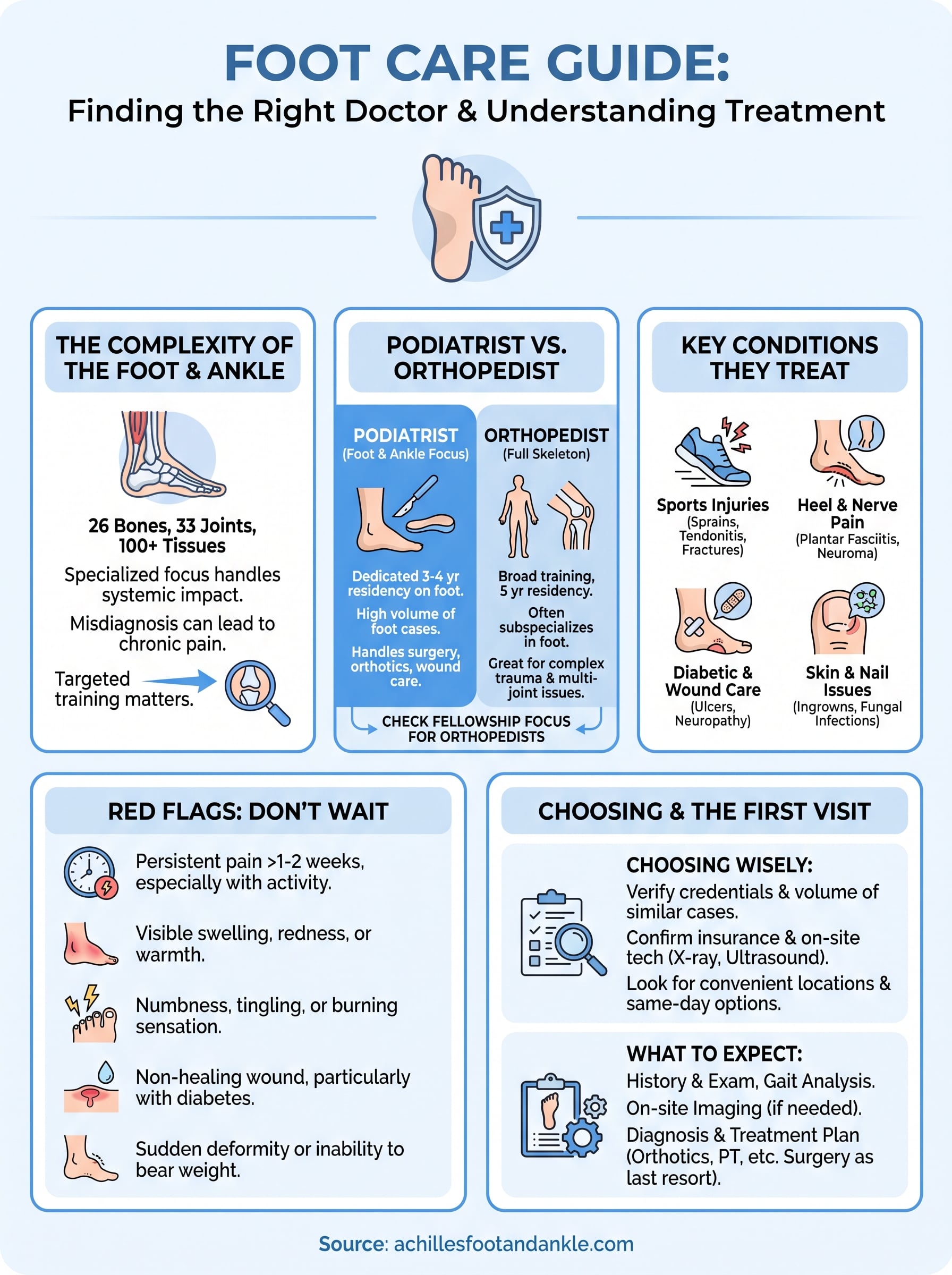
Your foot contains 26 bones, 33 joints, and more than 100 muscles, tendons, and ligaments, all working together every time you take a step, and that foot anatomy explains a lot about why things go wrong. When something in that system breaks down, whether it’s a stress fracture, nerve compression, or a slow-healing wound, the wrong evaluation can send you down months of ineffective treatment. Seeing a specialist who understands this anatomy from the start is often the difference between weeks of recovery and years of chronic pain, which is exactly why finding the right doctor for foot care matters more than most people realize.
A foot problem treated by the wrong provider rarely gets better, it just gets more complicated.
The foot’s complexity demands specific training
Because the foot bears your entire body weight with every stride, small structural issues cascade into bigger problems fast. A misaligned bone in your midfoot can alter your gait, which then strains your knee, hip, or lower back. General practitioners receive broad training across the whole body, but they typically spend only a few weeks of medical school focused specifically on foot and ankle anatomy. A podiatrist, by contrast, completes four years of podiatric medical school plus a three-year surgical residency dedicated entirely to the foot and ankle.

Delayed or misdirected care leads to bigger problems
Patients who wait, or who see a provider without the right specialty focus, often end up needing more invasive treatment later. Plantar fasciitis caught early responds well to stretching, orthotics, and physical therapy. Left untreated for a year, it can require corticosteroid injections or even surgery. Diabetic foot ulcers follow the same pattern: caught within days, they respond to wound care and offloading, but caught weeks later, they can threaten the limb itself. This is exactly why Achilles Foot and Ankle Center’s advanced wound care and limb salvage services exist, to step in before a slow-healing wound becomes a hospitalization.
The right specialist catches what others miss
Specialists trained specifically in foot and ankle care use tools that most primary care offices simply don’t have on hand. On-site digital imaging, diagnostic ultrasound, and fluoroscopy-guided injections let a podiatrist confirm a diagnosis in the same visit rather than sending you out for tests and follow-up appointments weeks later. That speed matters when you’re in pain and want real answers now, not sometime next month.
Getting the correct diagnosis early also means you avoid unnecessary treatments that don’t address the actual cause. A patient with heel pain who visits a general practitioner might get a generic anti-inflammatory prescription and a referral to physical therapy without ever learning whether the cause is plantar fasciitis, a heel spur, or nerve entrapment. A podiatrist examines your gait, footwear, and medical history together, then builds a treatment plan around the root cause rather than the symptom alone.
Ultimately, choosing the right doctor for foot pain from the start protects your long-term mobility. Chronic pain changes how you move, and altered movement patterns create new problems in your ankles, knees, and hips over time. Addressing the root cause with a qualified specialist keeps that chain reaction from ever starting in the first place.
Podiatrist vs orthopedist: which one do you need
Many patients assume any bone doctor can handle a foot problem, so they book with an orthopedist by default. That’s not always wrong, but it’s not always right either. A podiatrist specializes exclusively in the foot and ankle, while an orthopedic surgeon trains across the entire musculoskeletal system, from shoulders to spine to feet, then sometimes subspecializes in the foot and ankle afterward, and that podiatrist versus orthopedic surgeon comparison is worth understanding before you book. The distinction matters because depth of focus changes how quickly a provider recognizes what’s actually going on.
Training and scope differ in meaningful ways
The podiatrist education path runs four years of podiatric medical school, followed by a three-year surgical residency spent entirely on foot and ankle cases. Orthopedic surgeons complete medical school and a five-year residency covering the whole skeleton, with only a fraction of that time dedicated to the foot. Some orthopedists then pursue an additional fellowship focused on the foot and ankle, which closes much of the gap. Without that fellowship, though, a general orthopedist may see far fewer foot cases per year than a podiatrist sees in a single month.
| Factor | Podiatrist | General Orthopedist |
|---|---|---|
| Training focus | Foot and ankle exclusively | Full musculoskeletal system |
| Residency length | 3 years, foot/ankle only | 5 years, whole body |
| Non-surgical care | Orthotics, gait analysis, wound care | Bracing, injections |
| Surgical volume on feet | Typically high | Varies, lower unless fellowship-trained |
| Diabetic foot care | Core specialty | Less common focus |
If your problem starts and ends at the ankle, a podiatrist has usually seen more cases like yours than a general orthopedist has.
When each specialist makes the most sense
See a podiatrist first for bunions, plantar fasciitis, ingrown toenails, diabetic foot complications, sports injuries, or nerve pain like tarsal tunnel syndrome. These make up the bulk of everyday foot and ankle complaints, and podiatrists handle both the conservative treatment and the surgery if it’s needed. Orthopedists become the better call when a foot or ankle injury is part of a larger trauma, such as a fracture involving the leg, or when you need coordinated care across multiple joints at once, since what an orthopedic surgeon treats spans the whole skeleton.
Regardless of which title is on the door, ask about fellowship training and how many procedures similar to yours the doctor performs each year. That single question tells you more about fit than the degree itself.
Common foot and ankle conditions treated by specialists
Foot and ankle specialists see a wide range of problems, and most fall into a handful of categories covered in our guide to foot and ankle conditions and treatments. Knowing which bucket your symptoms fit into helps you describe them clearly when you book an appointment, and it gives you a sense of whether conservative care or something more involved is likely ahead.

Sports injuries and structural problems
Ankle sprains, Achilles tendonitis, stress fractures, and turf toe show up constantly in athletes and weekend runners alike. Structural issues like bunion treatment, hammertoes, and flat feet also fall here, since they often develop from years of abnormal mechanics rather than a single event. A podiatrist evaluates your gait and footwear alongside the injury itself, because treating the symptom without correcting the underlying mechanics usually invites a repeat injury.
Heel, arch, and nerve pain
Plantar fasciitis remains the most common cause of heel pain, but heel spurs, Morton’s neuroma, and tarsal tunnel syndrome (essentially carpal tunnel syndrome of the ankle) produce similar symptoms with different causes. Distinguishing between them requires a hands-on exam plus imaging, since nerve pain treatment and mechanical pain care follow completely different paths.
Two patients can describe identical heel pain and need entirely different treatment plans, which is why an accurate diagnosis matters more than a quick fix.
Diabetic and wound care needs
Diabetic patients face a distinct set of risks, including neuropathy, poor circulation, and slow-healing ulcers that can progress to infection without pain to warn them. Achilles Foot and Ankle Center’s Diabetic Foot Care program addresses this directly, pairing routine screenings with custom diabetic shoes and, when needed, the practice’s Advanced Wound Care & Limb Salvage services.
Skin and nail conditions
Rounding out the list are the conditions patients often try to treat themselves first: relief for ingrown toenails, fungal infections, warts, and calluses. These sound minor, but left unmanaged, they can lead to secondary infections, especially in diabetic patients or anyone with reduced circulation.
- Sports injuries: sprains, Achilles tendonitis, stress fractures
- Structural issues: bunions, hammertoes, flat feet
- Heel and nerve pain: plantar fasciitis, heel spurs, Morton’s neuroma, tarsal tunnel syndrome
- Diabetic complications: neuropathy, poor circulation, ulcers
- Skin and nail issues: ingrown nails, fungal infections, warts, calluses
Whatever category your symptoms fall into, a specialist trained specifically in foot and ankle care will recognize patterns a generalist might miss.
How to know when it’s time to see a foot doctor
Most people try to wait out foot pain, icing it after work and hoping it fades by the weekend. That works for a minor bruise or a rolled ankle that isn’t swelling much, but it doesn’t work for pain that keeps returning or gets worse with activity. Persistent pain lasting more than a week or two, even if it comes and goes, is your signal to stop self-treating and book with a foot doctor near you rather than guessing at the cause.
Warning signs you shouldn’t ignore
Certain symptoms point to something more than a simple strain and call for prompt evaluation, and they overlap closely with the 12 signs it’s time to see a foot doctor. Watch for:
- Pain that worsens with weight-bearing or doesn’t improve after a few days of rest
- Visible swelling, redness, or warmth around a joint or wound
- Numbness, tingling, or a burning sensation in the toes or sole
- A wound or sore that hasn’t started healing within a week, especially if you have diabetes
- Any deformity, like a toe pointing the wrong direction, after an injury
Noticing even one of these on its own is enough reason to call a specialist rather than wait for it to resolve alone.
When pain becomes urgent
Some situations move past "schedule a visit soon" into "go today." A sudden inability to bear weight, an open wound with drainage or odor, or a fever alongside foot swelling all point to infection or a serious structural injury. Diabetic patients especially need to treat any new sore as urgent, since nerve damage from neuropathy can mask pain that would otherwise send a healthy person straight to the doctor.
If you have diabetes and notice a wound you can’t explain, don’t wait to see if it heals on its own, get it checked the same week.
Chronic conditions deserve attention too
Ongoing issues like recurring bunions, arch pain that flares with every new pair of shoes, or nagging Achilles tightness often get dismissed as "just how my feet are." They’re not. These patterns usually point to a mechanical issue that a podiatrist can correct with orthotics, bracing, or targeted physical therapy long before surgery becomes the only option. Addressing them early keeps a manageable annoyance from turning into a limiting injury a few years down the road.
How to choose the right foot and ankle specialist near you
Finding a foot and ankle specialist doctor near you takes more than a quick search and a click on the first result. You want someone whose training matches your specific problem, whose office takes your insurance, and whose location doesn’t turn a simple follow-up into a half-day event. A little research upfront saves you from switching providers mid-treatment, which resets the clock on your recovery.
Verify credentials and specialty focus
Start by confirming the doctor is board-certified in foot and ankle surgery or podiatric medicine, not just licensed to practice. Ask how many years they’ve treated your specific condition, whether that’s diabetic wounds, sports injuries, or chronic heel pain. A podiatrist who handles hundreds of bunion corrections a year will spot complications faster than one who sees a handful.
The right specialist for you is the one who treats your exact condition regularly, not just the one closest to your house.
Confirm insurance and convenience
Call ahead or check the practice’s website to confirm they accept your plan, including Medicare or finding a podiatrist that accepts Medicaid if that applies to you. Beyond insurance, weigh how the practice fits your daily life:
- Multiple locations near work, home, or your commute
- Same-day appointments for urgent pain or wounds
- Online scheduling and a patient portal for records and billing
- Extended hours if you can’t easily leave work midday
Achilles Foot and Ankle Center covers this ground with thirteen locations across Central Virginia and same-day slots for urgent needs, plus a Healow patient portal for scheduling and bill pay without phone tag.
Check reviews and technology on-site
Patient reviews reveal patterns a website never will, things like how long the waiting room actually runs behind or how clearly a doctor explains treatment options. Look for practices that mention on-site imaging, ultrasound, or fluoroscopy-guided injections, since that advanced technology usually means faster, more accurate diagnoses in a single visit rather than a string of referrals.
Finally, notice whether the practice offers both conservative and surgical care under one roof. A specialist who can start you with orthotics or physical therapy, then move to surgery only if conservative treatment fails, keeps your care consistent instead of bouncing you between offices as your condition evolves.
What to expect at your first foot doctor appointment
Walking into a podiatrist’s office for the first time is easier when you know the rhythm of the visit ahead. Most first appointments run 30 to 45 minutes and combine a conversation about your history with a hands-on exam, so you leave with an actual plan rather than just a referral slip.

Before you arrive
A little preparation speeds up the visit and helps your doctor for foot pain get to the real answer faster. Bring or note the following:
- A list of current medications and any chronic conditions, especially diabetes or circulation issues
- The shoes you wear most often, since footwear often factors into the diagnosis
- A timeline of when the pain started and what makes it better or worse
- Any prior imaging, X-rays, or notes from other providers
- Your insurance card and a photo ID for check-in
During the exam
Expect the visit to start with questions about when your symptoms began, what activities trigger them, and whether you’ve tried anything on your own already. From there, the doctor examines your foot directly, checking range of motion, swelling, and tenderness, then watches you walk for a gait analysis. Many practices, including Achilles Foot and Ankle Center, offer on-site digital imaging, so if an X-ray is needed, you often get results the same visit instead of waiting days for a separate appointment.
A good first visit ends with a clear answer, not just a referral to somewhere else.
After the diagnosis
Once the doctor identifies the cause, you’ll walk through treatment options together, starting with the least invasive approach that makes sense for your condition. That might mean custom orthotics, a course of physical therapy, or a simple change in footwear. Surgery only enters the conversation when conservative care has a low chance of success or has already been tried without relief. You should leave with a written plan, including any follow-up timeline, so you know exactly what happens next and when to check back in.
Don’t hesitate to ask questions during this part of the visit. A trustworthy specialist welcomes them, whether you’re asking about recovery time, cost, or what happens if the first treatment doesn’t work. If something feels unclear, ask before you leave, not after you’re home trying to remember what was said.
Taking the next step for your foot health
Foot pain has a cause, and that cause has a name once the right specialist examines it. A podiatrist brings focused training, on-site imaging, and a treatment plan built around your actual condition, not a guess based on symptoms alone. Whether you’re dealing with a nagging ache, a diabetic wound that won’t close, or an injury that’s kept you off your feet for weeks, waiting rarely makes the fix simpler. It usually just adds time to your recovery.
Achilles Foot and Ankle Center gives you thirteen locations across Central Virginia, same-day availability for urgent problems, and a team that handles everything from routine screenings to complex limb salvage. You don’t need to keep guessing which doctor for foot pain fits your situation. If something’s bothering you today, don’t let it sit until next month. Book a same-day appointment and get an actual answer, not another referral.