

Foot pain has a way of derailing everything, from your morning run to a simple walk through Target. You start searching for a doctor of foot care and quickly realize the terms get confusing fast. Podiatrist, foot and ankle surgeon, orthopedist… who actually treats what you’re dealing with?
A doctor of foot, formally a podiatrist (DPM), specializes exclusively in the foot and ankle, from heel and arch pain to nerve issues, sports injuries, and toe deformities. If you’re typing "podiatrist offices near me" or hunting for a foot pain specialist near me who can see you this week, you need someone with focused training in this one area of the body, not a generalist who treats feet as an afterthought.
This article breaks down exactly what a podiatrist treats, when your foot pain warrants a visit versus home care, and what to expect during an appointment. We’ll also cover specialized needs like diabetic foot care and finding a foot and ankle doctor in your area with same-day or Saturday availability, so you know exactly who to call and when.
Why seeing a doctor of foot matters for your health
Your feet absorb roughly 1,000 tons of force during an average day of walking, according to the American Podiatric Medical Association. That’s a staggering amount of stress on 26 bones, 33 joints, and over 100 muscles, tendons, and ligaments packed into each foot. When something in that system goes wrong, whether it’s a stress fracture, a bunion, or nerve damage, the pain rarely stays contained to your foot. It changes how you walk, which strains your knees, hips, and lower back. A doctor of foot care catches these problems before they cascade into bigger orthopedic issues elsewhere in your body.

Small problems become serious ones without treatment
Ignoring foot pain doesn’t make it go away. It usually makes it worse and harder to fix. A minor case of plantar fasciitis left untreated for months can turn into a chronic condition that takes a year or longer to resolve instead of a few weeks. An ingrown toenail that seems trivial can develop into a spreading infection, especially if you have diabetes or poor circulation. Here’s what commonly happens when foot problems go unaddressed:
- Heel pain progresses from occasional discomfort to a limp that affects your gait
- Bunions grow larger and more painful, eventually requiring surgery instead of conservative bracing
- Ingrown nails become infected, sometimes requiring antibiotics or minor surgical removal
- Sports injuries like ankle sprains heal improperly, leading to chronic instability
- Nerve pain from conditions like tarsal tunnel syndrome spreads and intensifies
Diabetic foot care can be limb-saving
For patients managing diabetes, the stakes climb even higher. Reduced circulation and nerve damage mean a small cut or blister can go unnoticed until it becomes a serious wound or ulcer. The Centers for Disease Control and Prevention notes that diabetes is a leading cause of lower-limb amputations in the United States, and most of these amputations start with a foot ulcer that wasn’t caught early. This is exactly why searching for the best diabetic foot doctor near me isn’t overkill, it’s a smart, proactive move if you’re living with diabetes and need ongoing podiatric care for diabetic feet. Regular podiatry visits include circulation checks, nerve sensitivity testing, and wound monitoring that a primary care visit often doesn’t cover in the same depth.
Catching a diabetic foot problem early is the difference between a bandage and an amputation.
Mobility and independence are on the line
Beyond the immediate pain, foot health directly affects your ability to stay active and independent as you age. Older adults who lose confidence in their balance due to foot problems common in seniors often reduce their activity levels, which contributes to muscle loss, weight gain, and a higher fall risk. Regular checkups with a foot and ankle specialist help identify balance issues, arthritis changes, and skin or nail problems that increase fall risk long before they become dangerous. Treating these issues early keeps you walking, exercising, and doing the things you enjoy without modification.
Prevention costs less than correction
One more practical reason to take foot health seriously: cost. A same-day visit for early-stage plantar fasciitis, treated with stretching, orthotics, and possibly a cortisone injection, runs far less than the surgical correction needed once the condition becomes chronic. Insurance typically covers routine podiatry visits at standard copay rates, while surgical interventions carry higher out-of-pocket costs even with good coverage. Seeing a specialist at the first sign of trouble isn’t just better for your health, it protects your wallet too. At Achilles Foot and Ankle Center, our team is built around this exact philosophy, catching problems early through comprehensive foot and ankle care so small issues never become big ones.
How to find the right foot doctor near you
Finding a qualified podiatrist takes more than clicking the first result for "podiatrist offices near me." You want someone board-certified, close enough for follow-up visits, and equipped to handle your specific issue, whether that’s a sports injury or diabetic wound care. Start by checking credentials through the American Board of Foot and Ankle Surgery, which verifies a podiatrist’s certification status and surgical training. A quick search there tells you whether the doctor you’re considering actually meets the training standards you’d expect before trusting them with your feet.
Match the specialist to your specific problem
Not every podiatrist focuses on the same conditions, so match your search to your actual need. Someone managing a torn ligament from a weekend basketball game needs a different skill set than a patient looking for consistent diabetic foot care. Before you book, ask these questions:
- Does the practice treat your specific condition regularly, or only occasionally?
- Do they offer both conservative and surgical treatment options?
- Is there a dedicated diabetic foot program with wound care capability?
- Do they have in-house imaging like X-ray or ultrasound, so you’re not sent elsewhere for basic diagnostics?
The right foot doctor treats your specific problem often, not just occasionally.
Availability matters more than you’d think
Foot pain rarely waits for convenient office hours, which is why so many people search for a podiatrist open on Saturday near me or a podiatrist open near me and want to know how same-day podiatry visits work. A twisted ankle on a Friday afternoon shouldn’t mean three days of icing and guessing before you get seen. Practices offering extended hours, weekend appointments, or urgent same-day slots save you from unnecessary ER visits, which typically cost far more and lack foot-specific expertise. When you’re comparing options, weight availability heavily, especially if you’re active, work irregular hours, or manage a condition that can flare unpredictably.
Distance and location shouldn’t be an afterthought
Proximity matters for a practical reason: follow-up care. Post-surgical patients often need weekly or biweekly visits for wound checks, suture removal, or brace adjustments. If you searched for a foot doctor near me within 5 mi and settled for one 40 minutes away instead, those follow-ups become a burden that discourages you from keeping appointments. Look for a practice with multiple locations across your region, so you can find a foot and ankle doctor in your area close to home or work, whichever makes appointments easier to keep. Here’s a quick comparison of what to prioritize based on your situation:
| Your situation | What to prioritize |
|---|---|
| Active injury or acute pain | Same-day or urgent care availability |
| Diabetes or circulation issues | Dedicated diabetic foot program |
| Post-surgical recovery | Location close to home |
| Chronic condition management | Board certification and specialist experience |
Achilles Foot and Ankle Center operates thirteen locations across Central Virginia, including offices in Mechanicsville and the West End, specifically to keep travel time from becoming a barrier to consistent, quality care.
Common conditions a doctor of foot treats
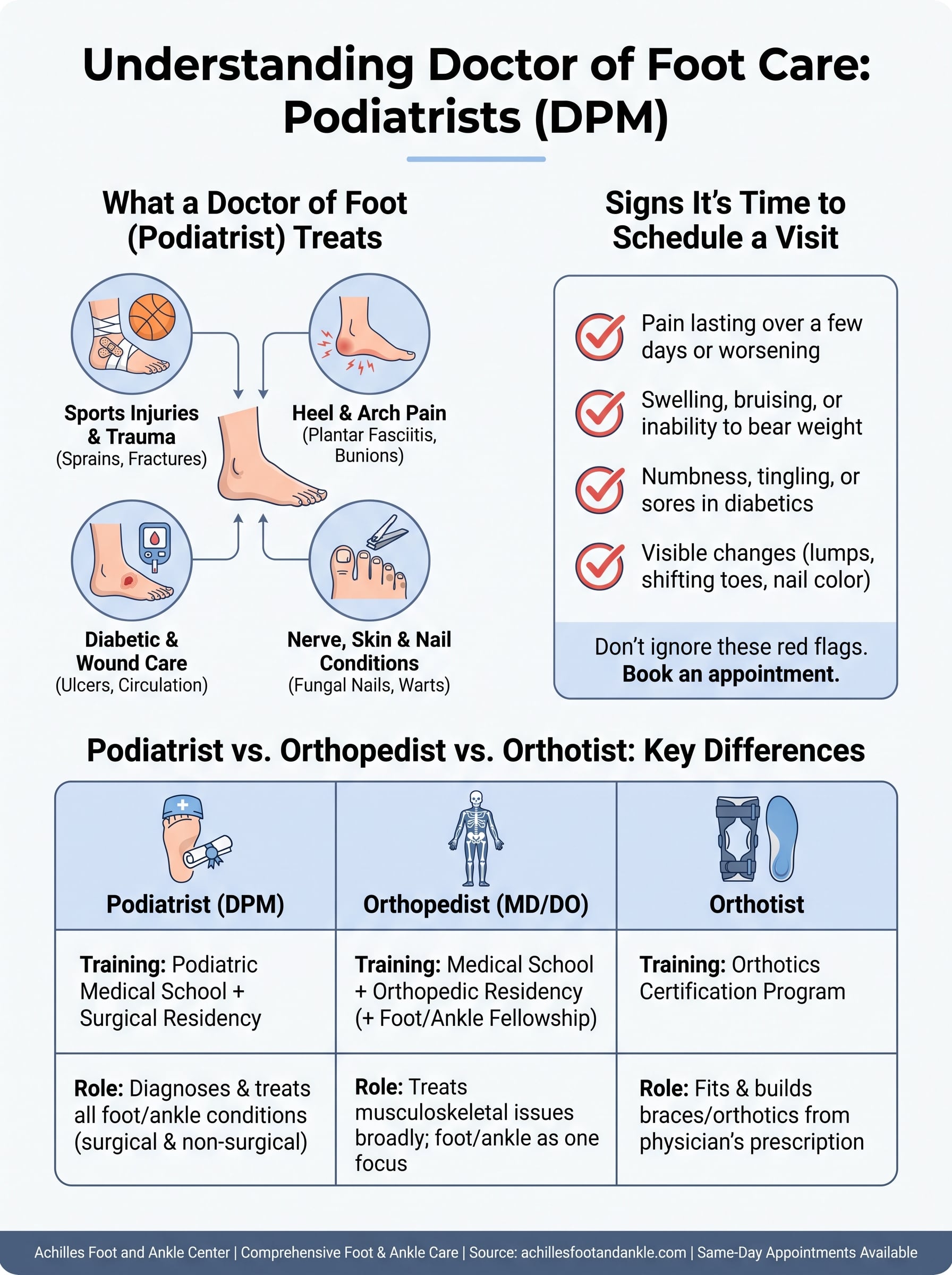
A doctor of foot care handles a much wider range of problems than most people expect, covering everything from a torn ligament on the basketball court to a stubborn ingrown toenail. Understanding the breadth of what podiatrists actually treat helps you recognize when your symptoms fall squarely into their wheelhouse instead of guessing whether you need a different type of specialist.

Sports injuries and trauma
Ankle sprains, Achilles tendon strains, stress fractures, and turf toe all land squarely in the domain of a sports medicine podiatrist. Weekend athletes and serious competitors alike show up with these injuries after a bad landing, a sudden pivot, or overtraining that finally caught up with them. Treatment ranges from bracing and physical therapy for mild sprains to minimally invasive surgery for torn ligaments that won’t heal on their own, depending on the severity and how the injury responds to conservative care.
Heel, arch, and structural pain
Plantar fasciitis remains one of the most common reasons people search for a foot pain specialist near me and treatment for heel pain, but it’s far from the only structural issue a podiatrist manages. Bunions, hammertoes, flat feet, and high arches all fall under this umbrella, often requiring a combination of custom orthotics, targeted stretching, and, in advanced cases, corrective surgery.
A doctor of foot treats the whole mechanical system, not just the spot where it hurts.
Diabetic and wound care needs
Diabetic foot ulcers, poor circulation, and peripheral neuropathy require specialized, ongoing monitoring that general practitioners typically aren’t equipped to provide in depth. Podiatrists trained in limb salvage use advanced wound care and amputation prevention techniques, offloading devices, and vascular referrals to keep a small wound from becoming a hospital admission.
Nerve, skin, and nail conditions
Nerve pain from tarsal tunnel syndrome, fungal toenails, plantar warts, and chronic ingrown nails round out the list of everyday complaints. These issues seem minor individually, but left alone they cause real disruption to walking comfort and, in diabetic patients especially, carry infection risk that shouldn’t be ignored.
| Condition Category | Common Examples | Typical First-Line Treatment |
|---|---|---|
| Sports injuries | Ankle sprains, Achilles strains, stress fractures | Bracing, PT, activity modification |
| Structural pain | Plantar fasciitis, bunions, hammertoes | Orthotics, stretching, footwear changes |
| Diabetic/vascular | Foot ulcers, neuropathy, poor circulation | Wound care, offloading, vascular referral |
| Nerve and skin | Tarsal tunnel, fungal nails, warts | Medication, injections, minor procedures |
Recognizing which category your symptoms fall into makes it much easier to describe your problem clearly when you call to book, which speeds up getting the right treatment plan from the first visit.
Signs it’s time to schedule a foot doctor visit
Most people wait too long to call a podiatrist, hoping the pain will just fade on its own. A good rule of thumb: if a symptom lasts more than a few days, gets worse instead of better, or stops you from doing normal activities, that’s your cue to book an appointment rather than wait it out. Knowing the specific red flags that warrant a podiatry visit below helps you decide whether you need a routine visit or a same-day slot with a foot pain specialist near me.
Pain that lingers, worsens, or changes how you walk
Sharp pain after a fall or twist that doesn’t ease within 48 hours usually means more than a simple bruise. Swelling that spreads, bruising that deepens, or an inability to bear weight are all signs of a possible fracture or torn ligament that needs imaging, not just rest and ice. If you notice yourself favoring one foot or limping to avoid pressure on a specific spot, that compensation pattern is your body telling you something structural is wrong and needs a professional look.
Pain you’re still limping around after a week isn’t healing, it’s a signal you’re ignoring.
Diabetic warning signs that require urgent attention
Everyone managing diabetes should treat certain foot changes as non-negotiable reasons to call immediately, not wait for a routine checkup. Numbness, tingling, or a complete loss of sensation in the toes or soles means nerve damage may already be progressing. Any cut, blister, or sore that hasn’t visibly improved within a few days needs eyes on it right away, since diabetic foot ulcers can worsen quickly without obvious pain to warn you. This is precisely why patients searching for the best diabetic foot doctor near me should treat that search as urgent rather than something to get to eventually.
Here’s a quick list of symptoms that warrant a same-day or urgent visit rather than a wait-and-see approach:
- Sudden, severe pain after an injury with visible swelling or deformity
- A wound, blister, or cut that isn’t healing within a few days, especially with diabetes
- Numbness, tingling, or burning that spreads or intensifies
- Redness, warmth, or streaking around a cut, suggesting infection
- A toenail that’s turned black, is lifting, or is draining fluid
- Persistent heel or arch pain that limits walking for more than two weeks
Visible changes worth a second opinion
Skin discoloration, a new lump near a joint, or a toe that’s slowly shifting out of alignment are easy to dismiss as cosmetic. They’re often early markers of bunions, arthritis, or circulation problems that respond much better to treatment when caught early. If you’re already typing "podiatrist open near me" into your phone because something looks off, trust that instinct and get it checked rather than monitoring it for another few months.
Podiatrist vs. orthopedist vs. orthotist: key differences
Confusion between these three titles sends a lot of patients to the wrong office first. Each one plays a distinct role in foot and ankle health, and knowing the difference saves you an appointment or two before you land where you actually need to be. A doctor of foot care, meaning a podiatrist, differs from an orthopedist and an orthotist in training, scope, and the kind of problems each is built to solve.

What sets a podiatrist apart
Podiatrists complete a Doctor of Podiatric Medicine (DPM) degree, followed by a three-year surgical residency focused entirely on the foot and ankle, which is how a foot doctor’s credentials compare to a medical doctor’s. That narrow focus means they see far more foot pathology in training than a general orthopedic surgeon does, and they’re the ones equipped to handle everything from nail fungus to reconstructive ankle surgery under one roof. If your search started with "foot and ankle doctor in my area," you’re already looking in the right place for most day-to-day foot complaints, sports injuries, and diabetic wound management.
When an orthopedist is the better fit
Orthopedic surgeons train across the entire musculoskeletal system, including hips, knees, and spine, with foot and ankle as just one possible subspecialty within that broader field, which is the core distinction between a podiatrist and an orthopedic surgeon. Some orthopedists do pursue additional fellowship training specifically in foot and ankle surgery, and those specialists overlap heavily with what a podiatrist handles. Where an orthopedist tends to get involved is when a foot or ankle issue connects to a larger joint problem, such as a hip misalignment affecting gait, or when a patient needs coordinated care across multiple body systems at once.
A podiatrist lives in the foot and ankle every day; an orthopedist visits it as one stop among many.
The orthotist’s specific role
An orthotist isn’t a physician at all. They’re a credentialed specialist trained to design, fit, and adjust braces, splints, and custom orthotic devices, usually working from a prescription written by your podiatrist or orthopedist rather than diagnosing the underlying condition themselves. Think of them as the craftsperson who builds the tool your doctor prescribes, whether that’s an ankle-foot orthosis after surgery or a custom insole for chronic arch pain.
| Specialist | Training | Typical Role |
|---|---|---|
| Podiatrist (DPM) | Podiatric medical school + surgical residency | Diagnoses and treats all foot/ankle conditions, surgical and non-surgical |
| Orthopedist | Medical school + orthopedic residency, sometimes foot/ankle fellowship | Treats musculoskeletal issues broadly, foot/ankle as one focus area |
| Orthotist | Orthotics certification program | Fits and builds braces and orthotic devices from a physician’s prescription |
For most foot pain, infections, nail problems, and diabetic complications, a podiatrist is your fastest, most direct path to treatment. Save the orthopedist referral for cases where your foot issue is tangled up with a hip or knee problem, and expect an orthotist to enter the picture only after your podiatrist has already prescribed a specific device.
Your next step toward healthier feet
Foot pain that lingers past a few days isn’t something to tough out. A doctor of foot care, your podiatrist, catches small problems like heel pain, ingrown nails, or early diabetic wounds before they turn into surgeries, infections, or lost mobility. Knowing what a podiatrist actually treats, how they differ from an orthopedist or orthotist, and which warning signs demand urgent attention puts you in control instead of guessing at home remedies that waste time you don’t have.
Getting seen quickly matters just as much as getting seen by the right specialist. Waiting weeks for an opening while a sprain worsens or a diabetic sore spreads only makes treatment harder later. If you’re dealing with pain, swelling, numbness, or a wound that isn’t healing, don’t sit on it. Schedule a same-day visit with our foot and ankle team and get answers, and relief, this week instead of next month.