

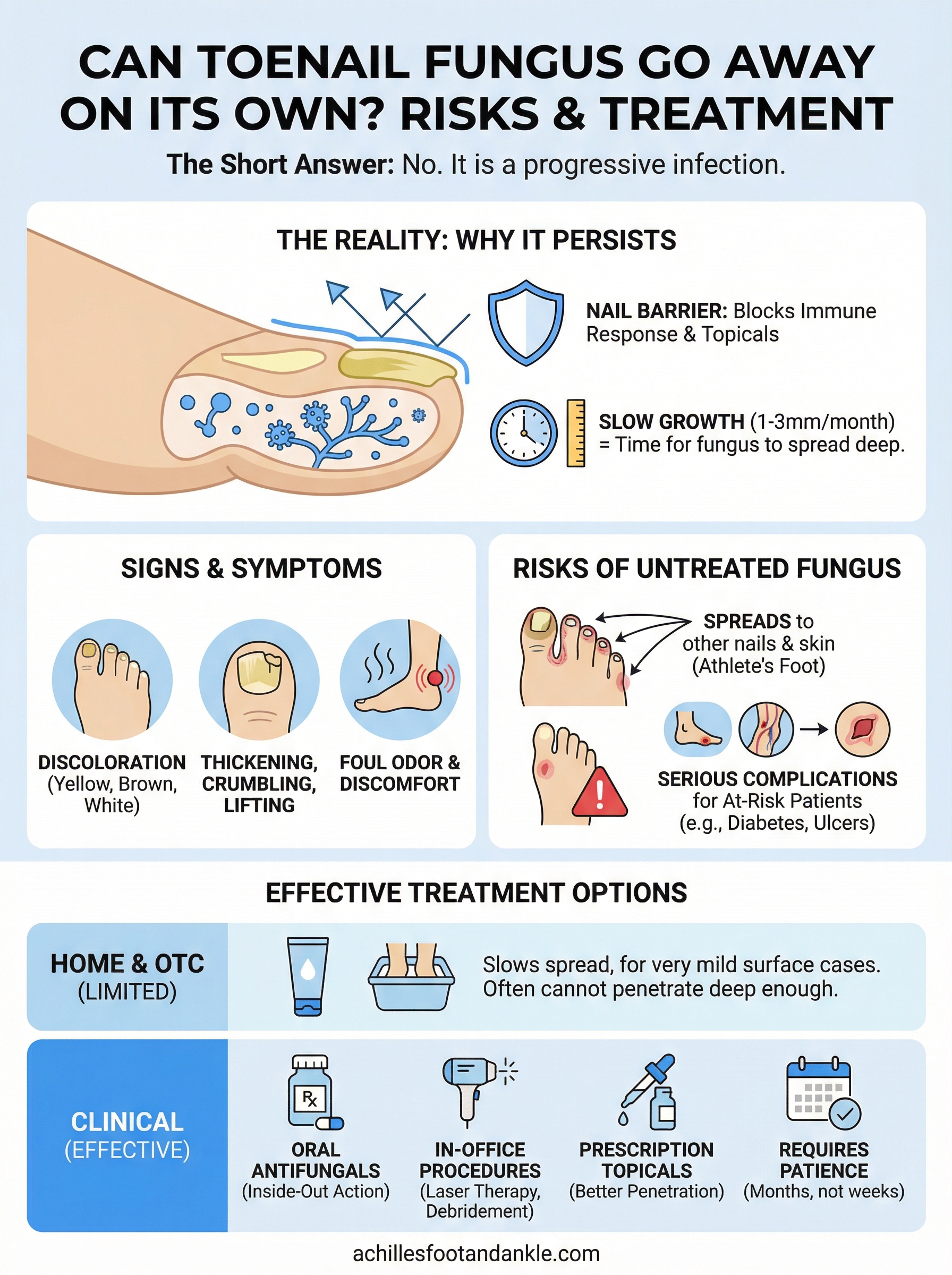
You noticed a discolored, thickened toenail a few months ago and figured it would clear up on its own. Now it looks worse. If you’re wondering whether can toenail fungus go away on its own, the short answer is no, it almost never does. Toenail fungus is a progressive infection that tends to spread deeper into the nail and to other toes the longer it goes untreated.
At Achilles Foot and Ankle Center, our podiatrists across Central Virginia treat toenail fungal infections at every stage, from early discoloration to severe cases that affect nail structure and comfort. We see firsthand how waiting it out rarely works, and how much faster patients recover when they start treatment early rather than hoping the problem resolves on its own.
This article covers why toenail fungus persists without intervention, what happens when you leave it alone, and the treatment options that actually work, both at home and in a clinical setting. Whether your case is mild or advanced, you’ll walk away with a clear picture of your next steps.
Why toenail fungus rarely goes away on its own
Toenail fungus, known medically as onychomycosis, is caused by a group of organisms called dermatophytes (and occasionally molds or yeasts). These organisms thrive in warm, moist environments and feed on keratin, the protein that makes up your nail. Once they establish themselves beneath or within the nail plate, they are physically shielded from your immune system and from anything you apply to the surface.
The biology behind a stubborn infection
The nail itself is the core reason can toenail fungus go away on its own gets a near-universal "no" from podiatrists. Toenails grow slowly, roughly 1 to 3 millimeters per month, which is about three to four times slower than fingernails. This slow growth rate means the fungus has months, sometimes years, to deepen and spread before a healthy nail can push it out.
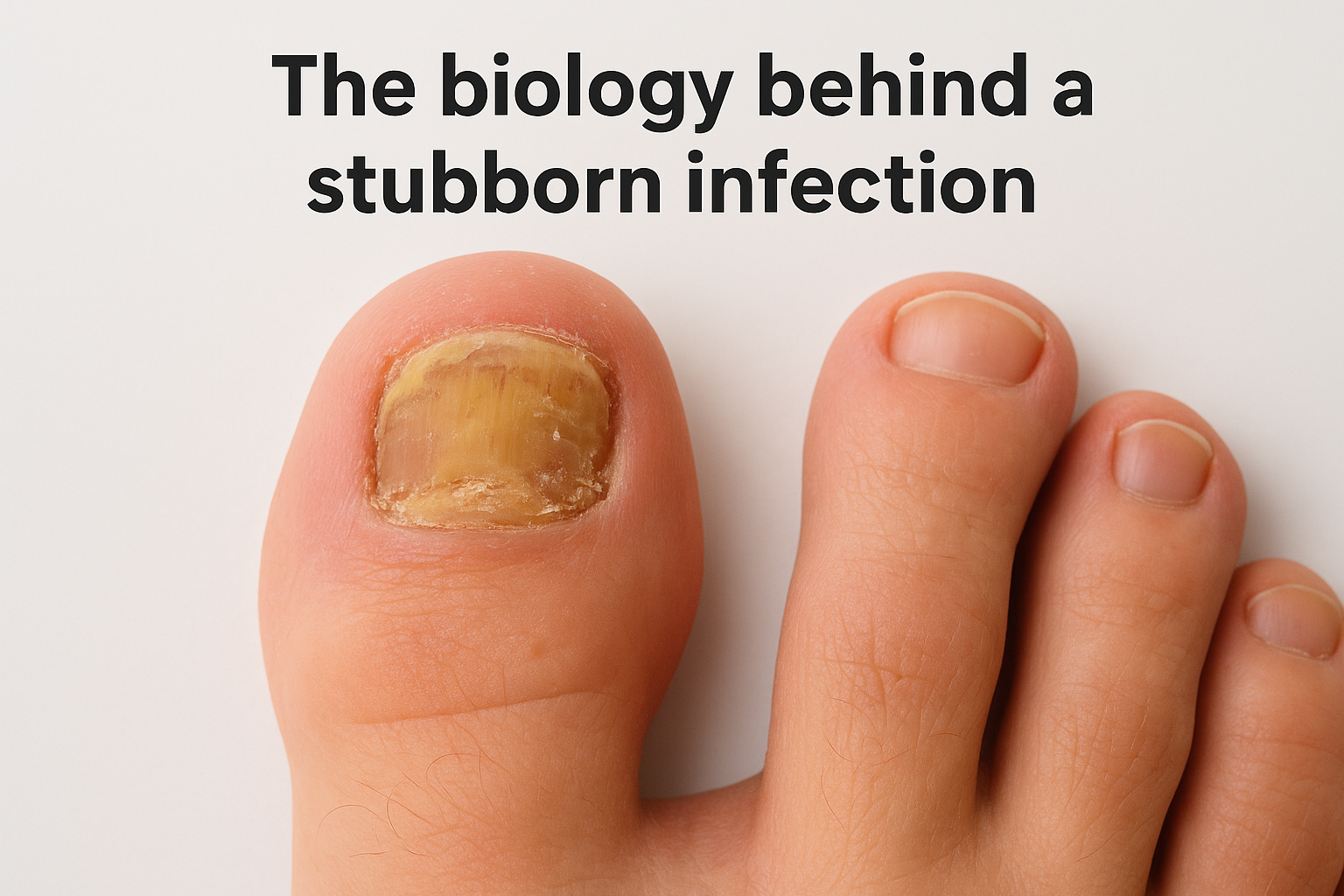
The nail acts as a physical barrier that protects the fungus from both your immune defenses and topical treatments applied to the surface.
As the infection progresses, the fungus consumes the keratin in the nail plate, causing the nail to thicken, crumble, and lift away from the nail bed. This creates more space and debris under the nail where the fungus continues to grow, making the environment even more hospitable. Without treatment that penetrates to the source, the cycle simply continues.
Why your immune system struggles to clear it
Your immune system clears many infections on its own, but toenail fungus presents a unique structural problem. The nail plate has limited blood supply running through it, which means your immune cells have little direct access to the site of infection. Unlike a skin infection where immune cells can flood the area quickly, the nail blocks that response entirely.
Certain factors make this even harder to overcome. Poor circulation, which is common in older adults and people with diabetes, excessive sweating, and repeated exposure to communal environments like pools or locker rooms all create conditions where the fungus can outpace any natural defense your body tries to mount. Without treatment, these factors combine to keep the infection active indefinitely rather than allowing it to resolve on its own.
Signs you may have toenail fungus
Toenail fungus doesn’t always announce itself with obvious pain, which means many people dismiss early changes as normal wear or minor injury. Knowing the specific visual and physical signs helps you act before the infection advances to a stage that’s harder and more expensive to treat.
Visual changes to look for
The first thing most people notice is a change in nail color. Infected nails typically turn yellow, brown, or white, and that discoloration usually starts at the tip or edge and works its way toward the base over time. As the infection deepens, the nail often becomes thickened and brittle, with sections that crumble or chip away at the edges rather than trimming cleanly. In more advanced cases, the nail may lift partially away from the nail bed, creating a visible gap underneath.
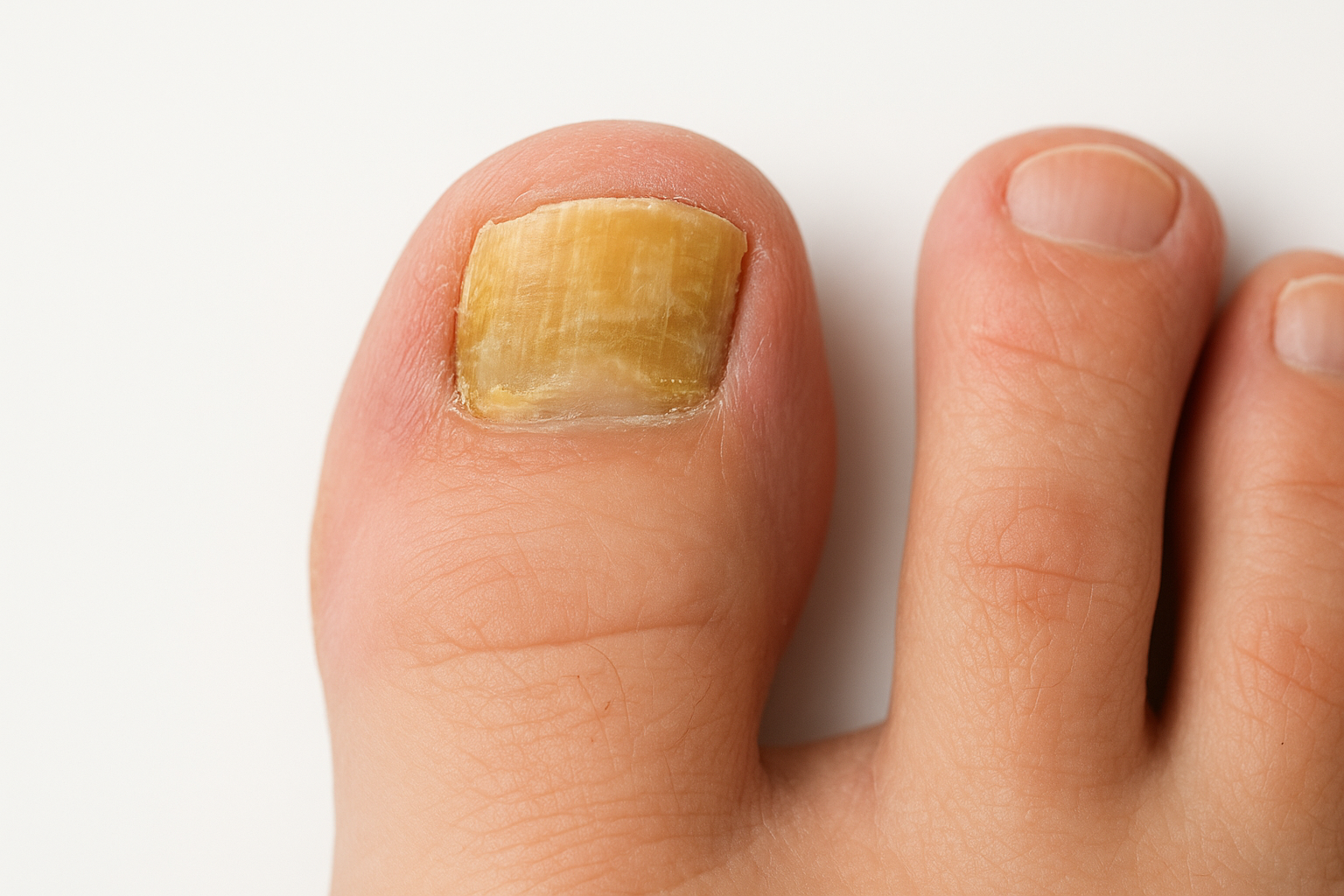
A nail that appears yellow and thicker than it used to be is almost always worth evaluating, even if it doesn’t hurt yet.
Some nails also develop a streaked or spotted appearance, with white patches scattered across the surface, which points to a superficial form of the infection called white superficial onychomycosis. This form is actually easier to treat when caught early.
Physical symptoms beyond appearance
Beyond how the nail looks, you may notice a foul odor coming from the affected toe, which comes from the debris that builds up as the fungus breaks down keratin beneath the nail. You might also feel mild pressure or discomfort when wearing closed-toe shoes, especially as the nail thickens and takes up more space inside the shoe. These physical symptoms are a clear signal that the question of can toenail fungus go away on its own is already answered by your body.
Risks of leaving toenail fungus untreated
Deciding to ignore toenail fungus is rarely a neutral choice. The infection does not stay contained to one nail and pause there. It actively spreads, and the longer you wait, the more tissue it damages and the harder it becomes to treat effectively. Understanding exactly what can happen if you let it progress gives you a concrete reason to act rather than wait and hope can toenail fungus go away on its own.
Untreated fungal infections regularly spread to neighboring toenails, skin, and in vulnerable patients, into deeper tissue.
Spread to other nails and skin
The fungus that infects one toenail releases microscopic spores that travel to adjacent nails through direct contact, shared footwear, and contaminated surfaces inside your shoes. Most people who start with one infected nail find that two or three others develop the same discoloration and thickening within months if no treatment is started. The infection also spreads easily to the surrounding skin, causing athlete’s foot, which presents as itching, scaling, and cracked skin between the toes.
Cracked skin creates an entry point for bacterial infections, which are a separate and more serious problem to manage on top of the original fungal infection.
Serious complications for certain patients
For people with diabetes or compromised immune systems, an untreated toenail infection carries significantly higher stakes. Reduced circulation and impaired immune response make it difficult for your body to fight even a localized infection. A fungal infection that spreads to surrounding skin can develop into an open wound or ulcer, which creates a direct risk of serious bacterial infection and, in severe cases, can threaten the limb itself.
What you can do at home and when to get care
Home care won’t cure toenail fungus on its own, but it can slow the spread and create better conditions for treatment to work. The most important steps involve removing the environment the fungus depends on. Keep your feet clean and dry, change socks daily, and rotate your footwear so shoes have time to fully dry between uses. Trim infected nails straight across and file down any thickened areas to reduce debris buildup under the nail plate.
Over-the-counter options and their limits
Antifungal nail polishes and creams sold at pharmacies, such as those containing undecylenic acid or clotrimazole, can help with very early, surface-level infections. Apply them consistently, follow the directions, and give them at least a few weeks before judging results. For mild cases, these products may reduce discoloration slightly. The problem is that most over-the-counter products cannot penetrate deep enough to reach the fungus growing inside the nail, which is the same structural barrier that answers the question of can toenail fungus go away on its own with a firm no.
If you’ve used an over-the-counter treatment for 12 weeks with no visible improvement, that’s a clear sign the infection needs professional attention.
When home treatment is not enough
You should contact a podiatrist if the nail is thickening, lifting, or spreading to other toes despite your home efforts. People with diabetes, peripheral neuropathy, or any condition that affects circulation should not attempt to self-treat at all. In those cases, even a minor fungal infection carries a real risk of skin breakdown and secondary bacterial infection, which makes early professional evaluation the safer and smarter choice.
Treatments that work and what to expect
When home remedies aren’t making a dent, prescription treatments give you real options that reach the fungus where it lives. The right treatment depends on infection severity, how many nails are affected, and your overall health, which is why a podiatrist evaluation is the most reliable starting point.
Prescription oral and topical medications
Oral antifungals like terbinafine or itraconazole are the most effective option for moderate to severe infections. These medications work from the inside out, reaching the nail bed through your bloodstream rather than trying to penetrate the nail surface. Most courses run 12 weeks, but because toenails grow slowly, a fully clear nail can take six months to a year after treatment ends.
Prescription-strength topicals like ciclopirox or efinaconazole penetrate the nail plate better than anything sold over the counter. These work well when can toenail fungus go away on its own has been ruled out but oral medication isn’t suitable due to other health factors. Daily application over 48 weeks or longer is required, and results are best when the infection hasn’t yet spread to the nail base.
Combining prescription treatment with professional nail debridement consistently produces better outcomes than medication alone.
In-office procedures
Laser therapy targets the fungal organisms directly through the nail using focused light energy, with no systemic side effects and no recovery time required. Your podiatrist may also perform nail debridement, trimming and thinning the infected nail to remove built-up debris and improve how well topical treatments absorb into the nail plate.
Regardless of which treatment path you follow, patience is essential. Toenail fungus treatment is measured in months, not weeks, and completing the full course your podiatrist recommends is what produces a lasting result.
Next steps
The evidence is clear: can toenail fungus go away on its own is not a question with a hopeful answer. Without treatment, the infection spreads to other nails, damages surrounding skin, and becomes progressively harder to clear. The good news is that effective treatment exists at every stage, and starting sooner means a faster path to a healthy nail.
If your nail is discolored, thickening, or crumbling, do not wait another few months to see if it improves. A podiatrist can confirm the diagnosis and recommend the right treatment plan based on how far the infection has progressed. At Achilles Foot and Ankle Center, our teams across Central Virginia treat toenail fungus with both prescription medications and in-office procedures tailored to your specific case. Book a same-day appointment and get a clear answer on what your nails need to recover.