

When foot or ankle pain sends you looking for a specialist, you’ll likely come across two types of doctors: podiatrists and orthopedic surgeons. Understanding the difference between podiatrist and orthopedic surgeon matters because it directly affects the type of care you receive. Both can treat foot and ankle problems, but their training, education, and clinical focus take very different paths.
At Achilles Foot and Ankle Center, our podiatric team treats everything from heel pain and sports injuries to diabetic wounds and complex reconstructive surgery across thirteen locations in Central Virginia. Patients regularly ask us how our training compares to that of an orthopedic surgeon, and it’s a fair question. Choosing the right specialist can mean faster recovery times, more targeted treatment, and better long-term outcomes.
This article breaks down the key differences in education, scope of practice, surgical training, and the specific conditions each specialist treats best. By the end, you’ll have a clear picture of which provider fits your situation and when one may be a better choice than the other.
Why this difference matters for your foot care
Picking the wrong specialist can lead to delayed diagnosis, unnecessary referrals, and treatment plans that don’t match your specific condition. The difference between podiatrist and orthopedic surgeon isn’t just a matter of title. It affects which tests get ordered, which surgical techniques are available to you, and how deeply your doctor understands the mechanics of the foot and ankle compared to the rest of the musculoskeletal system.
The cost of seeing the wrong specialist first
Seeing a specialist who isn’t the best fit for your condition wastes time and money. If you walk into an orthopedic surgeon’s office with a chronic ingrown toenail or a diabetic foot ulcer, you may be redirected to a podiatrist anyway. That extra step adds weeks to your care timeline.
Matching your condition to the right specialist from the start often shortens your recovery and reduces the total number of appointments you need.
Podiatrists spend years of residency training focused exclusively on the foot and ankle, which means they recognize patterns and complications that a generalist orthopedic surgeon may see far less frequently. That depth of focus matters when your condition involves skin, nails, soft tissue, or the long-term effects of diabetes on circulation and nerve function.
When foot problems are part of a bigger picture
Some conditions, like severe ankle fractures or hip alignment issues affecting gait, involve more of the body than the foot alone. In those cases, an orthopedic surgeon with broader musculoskeletal expertise may be the appropriate first call. Understanding each specialist’s scope before your appointment puts you in a stronger position.
Knowing which provider to see also helps you ask sharper questions during your visit and avoid delays caused by starting down the wrong referral path.
Podiatrist vs orthopedic surgeon: training and focus
The core difference between podiatrist and orthopedic surgeon starts in school. Both training paths require strong academic foundations, but they diverge sharply once each doctor chooses a specialty.

How podiatrists train
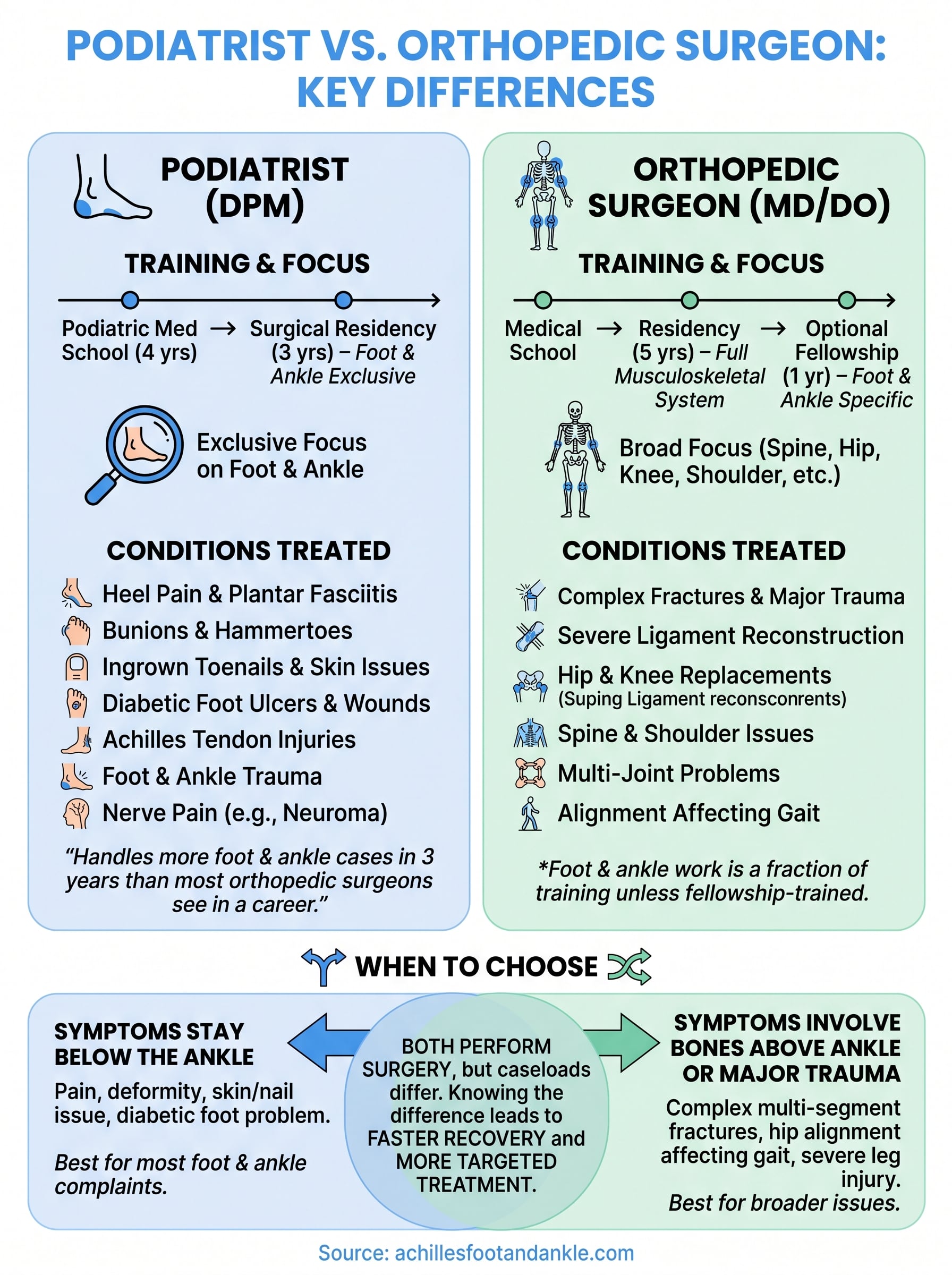
Podiatrists earn a Doctor of Podiatric Medicine (DPM) degree from an accredited podiatric medical school, a four-year program covering medicine, surgery, and biomechanics with an exclusive focus on the foot and ankle. After graduating, they complete a three-year surgical residency working directly on foot and ankle cases every day.
That concentrated residency experience means a podiatrist typically handles more foot and ankle cases in three years than most orthopedic surgeons see in an entire career.
How orthopedic surgeons train
Orthopedic surgeons complete medical school followed by a five-year residency covering the entire musculoskeletal system, including the spine, hip, knee, shoulder, and hand. Some then pursue a fellowship in foot and ankle surgery, adding one focused year after residency.
Without that fellowship, an orthopedic surgeon’s foot and ankle work represents only a fraction of their overall training. If your condition is strictly foot or ankle related, understanding this distinction helps you choose the right provider from the start.
What each specialist treats and common procedures
The difference between podiatrist and orthopedic surgeon becomes most visible when you look at their day-to-day caseloads. Both can perform foot and ankle surgery, but their typical patient lists look quite different.
Conditions podiatrists treat
Podiatrists handle the full spectrum of foot and ankle issues. Common conditions include plantar fasciitis, bunions, hammertoes, ingrown toenails, Achilles tendon injuries, diabetic foot ulcers, heel spurs, and nerve pain like Morton’s neuroma. They also perform reconstructive surgery, joint replacement, and advanced wound care. Because podiatrists focus entirely on this region, they stay current on the latest techniques specific to the foot and ankle.
If your problem starts and ends below the ankle, a podiatrist is almost always your most targeted option.
Conditions orthopedic surgeons treat
Orthopedic surgeons cover the entire musculoskeletal system, from spine and hip to knee and shoulder. Their foot and ankle work typically includes complex fractures, severe ligament reconstruction, and cases where alignment problems higher up the leg directly affect the foot. A fellowship-trained foot and ankle orthopedic surgeon can handle high-level trauma and deformity correction that involves bones extending beyond the ankle joint.
How to choose the right doctor for your symptoms
The difference between podiatrist and orthopedic surgeon comes down to where your problem is located. If your symptoms stay within the foot or ankle, a podiatrist is almost always the right first call. If your pain extends to multiple joints or follows major trauma to the leg, an orthopedic surgeon may fit better.

Signs a podiatrist fits your situation
Call a podiatrist when your pain, deformity, skin issue, or nerve problem starts and ends below the ankle joint. This covers the vast majority of foot and ankle complaints most people experience.
If you have diabetes and any foot symptom at all, see a podiatrist without delay.
Common reasons to book with a podiatrist:
- Heel or arch pain, bunions, or hammertoes
- Ingrown toenails, fungal nails, or chronic skin issues
- Diabetic foot wounds or numbness
When to consider an orthopedic surgeon
Choose an orthopedic surgeon when your injury involves bones above the ankle or a complex multi-segment fracture. A fellowship-trained foot and ankle orthopedic surgeon is the right call when serious trauma is involved.
Conditions like hip misalignment that affect your gait, or injuries traveling well up the leg, often need the broader expertise an orthopedic surgeon brings. When unsure, describe your symptoms to clinic staff and let them direct you to the right provider.
What to expect at your first visit and next steps
Your first appointment with either type of specialist follows a similar structure. You’ll answer questions about your symptom history, when the pain started, and what makes it better or worse. Bring any imaging studies like X-rays or MRIs you already have, since this helps the doctor skip unnecessary repeat testing and move directly to treatment options.
What the exam typically covers
The doctor will perform a physical examination of your foot, ankle, or affected area, checking range of motion, strength, and alignment. Understanding the difference between podiatrist and orthopedic surgeon helps here: a podiatrist will also assess your skin, nails, and circulation, especially if diabetes or nerve issues are part of your history.
Bringing a written list of your symptoms, current medications, and past injuries to your first visit saves time and improves the accuracy of your diagnosis.
After the exam, your doctor will outline treatment options in order from conservative to surgical, giving you a clear path forward. Ask about expected timelines, follow-up appointments, and what warning signs should prompt you to call the office between visits.
Key takeaways and how to get help
The difference between podiatrist and orthopedic surgeon comes down to training depth and clinical focus. Podiatrists complete four years of podiatric medical school plus a three-year residency dedicated entirely to the foot and ankle. Orthopedic surgeons train across the full musculoskeletal system, with foot and ankle work representing only a portion of their overall experience unless they complete a specialized fellowship. For the vast majority of foot and ankle problems, including heel pain, bunions, diabetic wounds, and nerve issues, a podiatrist offers the most targeted care available.
Your best next step is to match your symptoms to the right specialist and book an appointment before the problem worsens. Delays in treatment often turn manageable conditions into ones that require more complex interventions. The team at Achilles Foot and Ankle Center is ready to evaluate your condition and build a clear treatment plan around your needs. Schedule your same-day appointment today and get the answers you need fast.