
Your foot hurts, you’ve searched "foot and ankle specialist doctor near me" a dozen times, and you’re still staring at a list of names with no idea who actually fits your situation. That’s a real problem when you’re dealing with heel pain, a sports injury, or a diabetic wound that needs attention now, not after weeks of guessing.
Finding the right specialist isn’t about picking the first result on Google. You need someone with the right credentials, convenient office locations, and experience treating your specific condition, whether that’s a stubborn bunion or a complex ankle fracture. The doctor you choose should also take your insurance and offer appointment options that match your schedule, including same-day visits when pain won’t wait.
This article walks through five practical tips for narrowing your search, from checking board certification to understanding what services a practice actually offers under one roof. If you’re in Central Virginia and tired of sorting through vague reviews and outdated directories, these tips will help you find a qualified podiatrist close to home who can treat you correctly the first time.
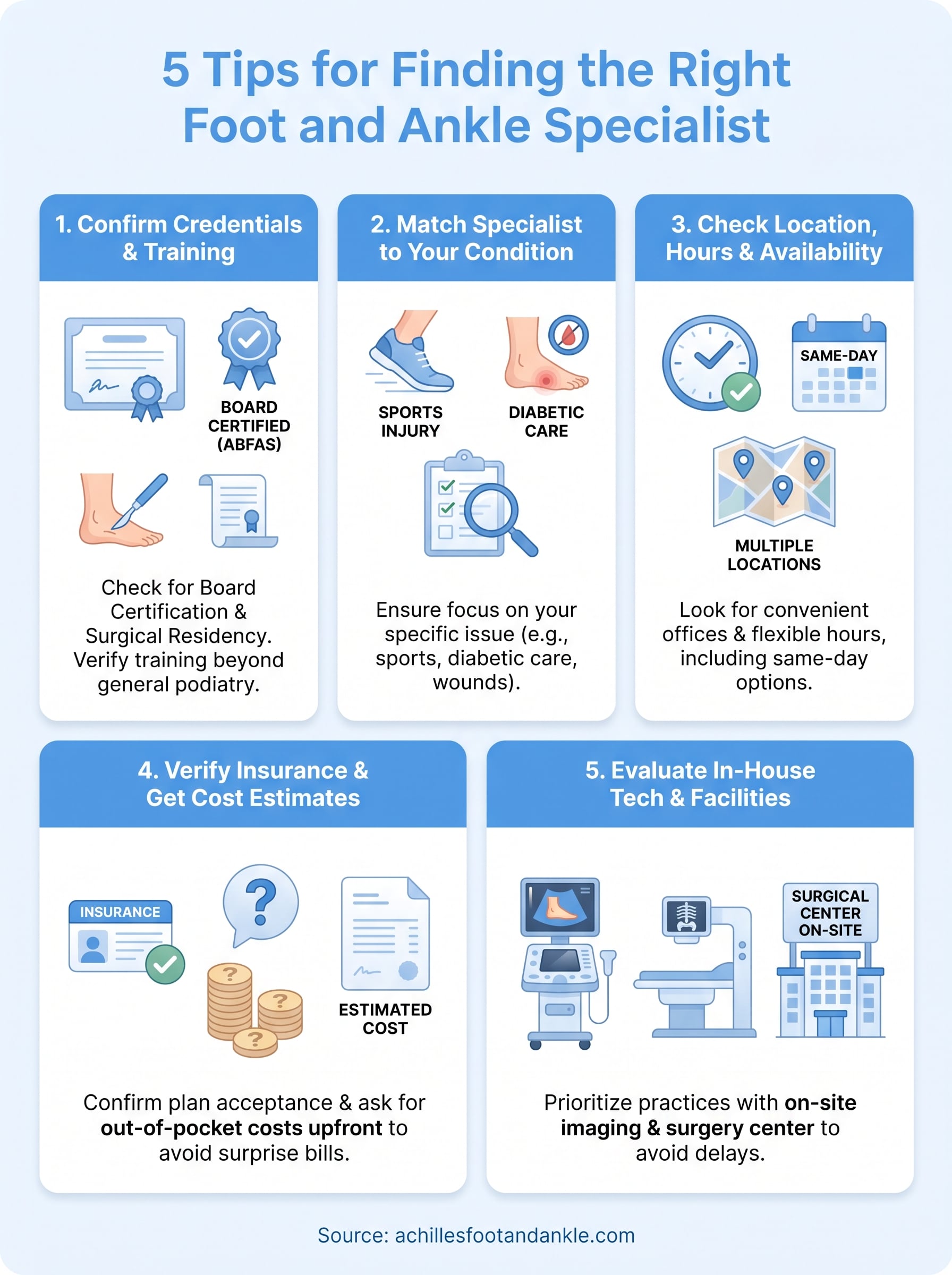
1. Confirm proper credentials and specialty training
Before you book anything, check the letters after the doctor’s name and learn whether a foot doctor is an MD. A board-certified podiatrist has completed a four-year podiatric medical school program plus a surgical residency, and how podiatrists are trained and educated matters more than a flashy website or a five-star review count. When you’re typing "foot and ankle specialist doctor near me" into a search bar, the results won’t tell you who actually finished a residency in reconstructive rear foot and ankle surgery versus general podiatry. You have to dig for that.
Why it matters
Credentials separate a doctor who can handle routine nail care from one equipped for complex ankle fractures or reconstructive surgery. A podiatrist without advanced surgical training might refer you out for anything beyond the basics, costing you weeks you don’t have if you’re already in pain.
A board certification isn’t a formality, it’s proof the doctor can actually do what your foot needs.
What to look for
Look for American Board of Foot and Ankle Surgery certification, which confirms both medical and surgical competency. Also check whether the practice lists individual doctor bios with residency details, fellowship training, and years in practice. Vague "our team is experienced" language without names or credentials is a red flag.
Questions to ask
Call the office or check their site for answers to these before scheduling:
- Is the doctor board-certified in foot and ankle surgery, not just licensed to practice podiatry?
- Where did they complete their residency, and did it include surgical training?
- How many years have they treated conditions similar to mine?
- Do they hold hospital privileges, which often signal peer-reviewed competency?
Getting straight answers to these four questions tells you more than any star rating ever will.
2. Match the specialist to your specific condition
Not every podiatrist treats every problem the same way. A doctor who’s excellent with diabetic foot care might not be the best fit for a torn Achilles tendon, and a sports medicine specialist may not have deep experience with limb salvage or chronic wound management. Matching the specialist to your actual diagnosis saves you a referral loop that delays treatment.
Why it matters
General podiatry covers a wide range, but conditions like peripheral neuropathy, tarsal tunnel syndrome, or advanced wound care require doctors who focus on those areas regularly, and knowing what causes foot nerve pain helps you ask for the right expertise. Choosing based on proximity alone, without checking their focus, often means starting over with someone else once the first doctor identifies the problem is outside their wheelhouse.
The closest office isn’t helpful if it can’t treat what’s actually wrong with your foot.
What to look for
Search for practices that list specialized programs by name, not just "foot and ankle care" as a blanket phrase. A site that separates services like sports injuries, nerve pain, and diabetic care shows organized expertise.
Questions to ask
- Does the practice regularly treat my specific diagnosis or symptom?
- Do they offer both conservative and surgical paths for my condition?
- Will I see the same doctor throughout treatment, or get bounced between providers?
3. Check location, hours, and same-day availability
Pain doesn’t wait for a convenient time slot, so the practical stuff matters just as much as credentials. A podiatrist near me search means nothing if the closest location has a two-week waitlist or hours that never match your work schedule. Achilles Foot and Ankle Center runs thirteen podiatry office locations across the Richmond area, which cuts down drive time and makes it easier to get seen fast.

Why it matters
Delaying treatment for a sprained ankle or an infected wound can turn a simple fix into a bigger problem. A practice offering same-day appointments keeps small issues from becoming emergencies, and one with multiple offices means you’re not stuck driving 45 minutes for a five-minute follow-up.
A great doctor you can’t get in to see quickly isn’t much help when your foot hurts today.
What to look for
Check the office locator on the practice website and confirm hours align with your routine, including evenings or weekends if you work standard business hours.
Questions to ask
- Do you offer same-day or next-day appointments for urgent pain?
- Which location is closest to my home or job?
- Are evening or Saturday hours available?
4. Verify insurance coverage and cost transparency
Money worries shouldn’t stop you from getting care, but surprise bills happen when a practice never confirms insurance coverage upfront. Before you commit to a foot and ankle specialist doctor near me, find out whether they accept your plan and what you’ll actually owe out of pocket.
Why it matters
Foot and ankle treatment ranges from a simple office visit to surgery with anesthesia and follow-up care, and costs vary wildly between those two scenarios. A practice that’s upfront about pricing and accepts your plan, including Medicare or Medicaid, saves you from billing disputes months later, so it helps to know Medicare’s coverage rules and frequency limits for foot care before your visit.
Ask about cost before treatment starts, not after the bill arrives.
What to look for
Check the practice website for a list of accepted insurers, and look for mentions of concierge-style service without added fees. Practices that accept all major insurance plans remove one more barrier between you and treatment.
Questions to ask
- Do you accept my specific insurance plan, including Medicare or Medicaid?
- What will my estimated out-of-pocket cost be for this visit or procedure?
- Are there any hidden fees for imaging, injections, or follow-up visits?
5. Evaluate technology, facilities, and patient feedback
Once you’ve narrowed your list by credentials, condition fit, location, and insurance, look at what actually happens inside the office. A practice using outdated equipment or relying only on referrals for imaging adds extra appointments and delays to your care. The best foot and ankle specialist doctor near me search ends with a provider who diagnoses and treats under one roof.

Why it matters
Advanced tools like digital imaging, ultrasound guidance, and fluoroscopy-guided injections let a doctor diagnose accurately and treat the same day instead of sending you elsewhere for scans, so it pays to understand which foot and ankle imaging tests do what. What a dedicated foot and ankle surgery center offers also means fewer hospital transfers and shorter wait times for procedures.
The right technology turns a diagnosis appointment into a treatment appointment.
What to look for
Check whether the practice operates its own surgical center, offers in-office imaging, and has real patient reviews mentioning specific outcomes, not just generic praise.
Questions to ask
- Does the office have in-house imaging and ultrasound equipment?
- Is there an on-site surgery center, or will I be referred elsewhere?
- What do recent patient reviews say about wait times and outcomes?
Taking the next step toward healthier feet
Finding a foot and ankle specialist doctor near me doesn’t have to mean endless searching and guesswork. Credentials, condition fit, location, insurance, and technology give you a clear checklist instead of a gut feeling. Go through each tip, ask the questions listed, and you’ll land on a provider who actually fits your situation instead of just the nearest address on a map.
Getting this right matters more than most people realize. Heel pain, a sports injury, or a diabetic wound left untreated rarely stays minor, and the wrong doctor can cost you weeks you don’t have. Handle the search the same way you’d handle any other medical decision: carefully, with real questions and real answers.
If you’re in Central Virginia and ready to stop searching and start healing, get seen today by a board-certified podiatrist who treats your foot and ankle correctly the first time.