Foot pain has a way of taking over your day. Whether it’s a stabbing heel ache first thing in the morning or a nagging ankle that never quite healed, you want someone qualified to look at it soon, not three weeks from now. Searching podiatrist doctor near me usually means you’ve already tried ice, rest, and maybe some drugstore inserts, and none of it worked.
Finding the right foot and ankle specialist isn’t just about proximity on a map. You need someone who treats your specific issue, accepts your insurance, and can actually get you in the door quickly. That’s true whether you’re a podiatrist for runners near me search away from getting back to training, or you’re managing diabetes and need a diabetic foot doctor near me who understands nerve damage, wound care, and prevention.
Below are seven practical tips for narrowing your search, from checking credentials to understanding when same-day care matters. Here in Central Virginia, Achilles Foot and Ankle Center sees this search every day, and these tips reflect what actually helps patients choose well.
1. Look for a comprehensive foot and ankle practice
Why it matters

Most foot and ankle problems don’t stay isolated. A bunion that’s ignored for years changes how you walk, which stresses your knees and hips. A sprained ankle that heals wrong can turn into chronic instability. This is why searching for a podiatrist doctor near me should lead you to a practice that handles the full range of foot and ankle conditions, not just one narrow specialty. A clinic that treats sports injuries, nerve pain, heel and arch pain, toe deformities, and skin and nail issues under one roof means you won’t get bounced between three different offices while your symptoms get worse.
Consider what happens when a single-focus clinic finds something outside its wheelhouse. You get referred out, wait weeks for a new patient appointment, and start your workup over from scratch. A comprehensive practice, like Achilles Foot and Ankle Center, keeps your imaging, history, and treatment plan in one place. That matters even more if you’re dealing with diabetes, since a diabetic foot doctor near me search should point you toward a team that also handles wound care and limb salvage, not just routine nail trims.
The fewer specialists you need to coordinate, the faster you actually get better.
How to evaluate it
Start by pulling up the practice’s list of foot and ankle services before you call. A thin list of two or three conditions is a signal you’re looking at a niche clinic, fine for some needs, but limiting if your situation is complicated or evolves. Look for specific mention of both conservative and surgical options, since a practice that only offers one or the other will eventually refer you elsewhere anyway.
Here’s what a genuinely comprehensive practice should have listed, and what a narrower one typically lacks:
| What to look for | Comprehensive practice | Narrow-scope practice |
|---|---|---|
| Sports injury treatment | Yes, with rehab pathways | Sometimes |
| Diabetic foot care & shoes | Yes, dedicated program | Rarely |
| Advanced wound care | Yes, often with limb salvage | No |
| Surgical center on-site | Sometimes | No |
| Custom orthotics & bracing | Yes | Sometimes |
| Pediatric foot deformities | Yes | Rarely |
Check whether the practice operates its own surgical center rather than sending patients to a hospital for every procedure. An in-house Ambulatory Surgery Center usually means shorter wait times, lower facility fees, and a surgeon who already knows your case history walking into the operating room. Ask specifically whether they treat runners and athletes if that’s your situation. A podiatrist for runners near me search deserves a practice with a track record in gait analysis, sports medicine, and getting active patients back to training safely, not just general foot care.
Also ask how the practice handles conditions that overlap specialties, like a diabetic patient with a sports injury or an older adult with both arthritis and a chronic wound. A comprehensive team should be able to loop in the right specialist internally rather than sending you out the door. Finally, look at whether the practice publishes patient education material on multiple conditions on its own site. That’s usually a reliable sign the clinic actually treats what it claims to, rather than listing services it rarely sees in practice.
2. Confirm board certification and specialty training
A license to practice podiatric medicine is the bare minimum, not proof of skill, so it helps to know how a DPM degree compares to an MD before you weigh credentials. Board certification through the American Board of Foot and Ankle Surgery means a doctor has passed rigorous exams and logged a required volume of surgical cases under review. When you’re vetting a podiatrist doctor near me, this is the credential that separates a doctor who dabbles in foot surgery from one who has built a career around it.
Why it matters
Surgical outcomes depend heavily on how many times a doctor has performed a given procedure and how recently they’ve kept up with training. Foot and ankle surgery has changed a lot over the past decade, with minimally invasive techniques replacing older open procedures for conditions like bunions and hammertoes. A podiatrist who completed residency years ago but never pursued continuing specialty training may still be using outdated approaches. Board certification requires ongoing education, so it’s a proxy for a doctor staying current, not just credentialed once and coasting.
A board certification isn’t a formality. It’s evidence the doctor keeps proving they’re still good at the job.
Certification also matters for insurance and hospital privileges. Many surgical centers won’t grant operating privileges to a podiatrist without board certification in foot surgery, ankle surgery, or both. If your case ever needs a hospital-based procedure, an uncertified doctor may have to hand you off to someone else at the exact moment continuity matters most.
How to evaluate it
Most practices list credentials directly on their website, usually on a bio page for each doctor. Look for these specific markers before you book:
- Board certification status: Look for "ABFAS certified" or similar language, and note whether it covers foot surgery, reconstructive rearfoot/ankle surgery, or both.
- Residency program: A three-year podiatric surgical residency is standard; shorter or unclear training history is worth asking about directly.
- Fellowship training: Extra training in sports medicine, wound care, or diabetic limb salvage signals a doctor who went beyond the minimum requirement.
- Years in practice and case volume: A doctor who has handled thousands of similar cases will generally spot complications faster than one who has handled a few dozen.
- State license verification: Your state’s medical or podiatric board website will confirm the license is active and free of disciplinary action.
If you’re searching specifically for a diabetic foot doctor near me, ask whether the podiatrist has fellowship training or documented experience in limb salvage and wound care, since these require a different skill set than general foot care. Similarly, a podiatrist for runners near me should be able to point to podiatric sports medicine training or a track record treating athletes, not just a general practice background. The Achilles Foot and Ankle Center team publishes physician bios with certifications and specialty training listed, which is exactly the kind of transparency you should expect from any practice you’re considering.
3. Match the podiatrist to your specific condition
Not every foot doctor treats every foot problem the same way, even inside a comprehensive practice. A podiatrist doctor near me search gets you a list of names, but the doctor who’s best for a teenager’s ingrown toenail isn’t necessarily the one you want managing a Charcot foot or a torn Achilles tendon. Matching the specialist to the condition, not just the practice to your zip code, is what actually determines how fast and how well you recover.

Why it matters
Generalist care works fine for routine issues like nail fungus or a simple wart, but complex conditions reward focused experience. Someone managing a diabetic foot doctor near me search, for example, needs a provider who understands peripheral neuropathy, vascular compromise, and wound staging together, since treating a diabetic ulcer like a regular cut can lead to amputation. Athletes face a similar mismatch risk: a stress fracture or Achilles tendinopathy responds differently depending on training load, biomechanics, and return-to-sport timelines that a podiatrist for runners near me is trained to manage but a general practitioner might not weigh correctly.
The right diagnosis means little if the treatment plan doesn’t account for your daily demands on your feet.
Children’s foot deformities, arthritic joint pain in older adults, and post-surgical reconstruction cases also call for different skill sets. A practice with dedicated pediatric, geriatric, and sports medicine experience inside its team can route you to the right person instead of applying a one-size-fits-all protocol.
How to evaluate it
Before booking, describe your condition when you call and ask which doctor on staff handles that specific issue most often. A good scheduling team should be able to answer this without hesitation. Practices with multiple podiatrists often assign informal specialties, and front-desk staff usually know who leans toward sports medicine, wound care, or reconstructive surgery.
Use this quick checklist to match your situation to the right type of specialist:
- Runners, athletes, and active adults: Look for what a podiatrist for athletes treats, including gait analysis and non-surgical rehab options before surgery is discussed.
- Diabetics or anyone with poor circulation: Confirm the practice runs a diabetic wound care clinic and limb salvage services, not just general foot exams.
- Parents of young children: Ask about pediatric flatfoot, in-toeing, or toe walking experience specifically.
- Older adults with arthritis or joint pain: Look for experience with joint-sparing procedures and bracing before jumping to surgery.
- Anyone with a prior failed treatment: Ask whether the practice offers a second opinion service, since a fresh set of eyes on imaging can catch what a first provider missed.
Achilles Foot and Ankle Center structures its team this way, with providers focused on sports injuries and others dedicated to diabetic foot care and limb salvage, so patients get matched internally rather than referred elsewhere after the fact. Asking this one question upfront, who specifically handles cases like mine, saves you from starting over with a different doctor months into treatment.
4. Check insurance coverage and cost transparency
Cost surprises are one of the fastest ways a good treatment plan falls apart. You find a podiatrist doctor near me with great reviews and board certification, then discover halfway through treatment that your insurance only covers half the visit or the surgical center is out of network. Before you commit to a practice, get clear answers on coverage and pricing, not vague reassurances that "most insurance is accepted."
Why it matters
Foot and ankle care ranges from a fifteen-minute nail treatment to a multi-visit surgical recovery with imaging, orthotics, and physical therapy layered in. Each of those has a different cost structure, and insurance plans handle podiatry coverage inconsistently. Medicare, for instance, covers medically necessary podiatric care but has specific rules around routine foot care that trip up a lot of patients. If you’re managing diabetes, understanding what’s covered matters even more, since a diabetic foot doctor near me search often leads to ongoing wound care visits, custom diabetic shoes, and periodic vascular testing that add up fast if your plan doesn’t cover them the way you expect.
A treatment plan you can’t afford to finish isn’t really a treatment plan.
Hidden fees are another problem worth watching for. Some practices tack on facility fees for procedures done at a hospital-affiliated surgical center that a patient never anticipated. A practice with cost transparency built into its process, meaning it tells you upfront what a procedure will cost and what your plan is likely to cover, saves you from a surprise bill weeks later.
How to evaluate it
Call the office directly and ask these questions before your first appointment, rather than assuming your card will just work:
- Which insurance plans does the practice accept in-network? Get this in writing or via the website’s insurance page, not just a verbal yes.
- Does the practice accept Medicare and Medicaid? Many older patients and those with chronic conditions rely on these, and not every specialist accepts both, so it pays to know which foot care Medicaid pays for.
- Are surgical procedures done in-network at every stage? Confirm the surgeon, anesthesiologist, and facility are all covered, since an out-of-network anesthesiologist at an in-network facility is a common billing trap.
- What’s the estimated out-of-pocket cost for your specific issue? A transparent office can give you a ballpark before you commit to a plan.
- Does the practice offer payment plans or cash pay pricing for procedures not fully covered? This matters most for orthotics, diabetic shoes, or elective surgical options.
Achilles Foot and Ankle Center accepts all major insurance plans, including Medicare and Medicaid, and its billing and insurance page spells out what patients can expect before they ever sit in an exam room. That kind of upfront clarity is worth prioritizing over a practice that dodges pricing questions until after your appointment.
5. Consider location, hours, and appointment availability
A great podiatrist three counties away does you no good when you’re limping and need to be seen this week. Once you’ve narrowed your list based on credentials and specialty fit, the practical question becomes simple: can you actually get an appointment when you need one, at a location you can reach without derailing your whole day? A podiatrist doctor near me search should weigh convenience just as heavily as clinical reputation, because a treatment plan only works if you can show up for follow-ups.
Why it matters
Foot and ankle conditions rarely resolve in one visit. Plantar fasciitis, post-surgical recovery, and diabetic wound management all require repeat appointments, sometimes weekly for months at a stretch. If the clinic is forty minutes away with limited parking, you’re more likely to skip visits, and skipped visits slow healing or, in the case of a diabetic ulcer, raise the risk of complications. Same-day availability matters too. A sudden ankle sprain or an infected ingrown toenail doesn’t wait politely for next Tuesday’s opening, and a practice that can’t work you in quickly forces you toward an urgent care or ER visit that costs more and often lacks foot and ankle specialty knowledge.
The best specialist in the state does you no good if you can’t get in the door before your condition worsens.
Multiple locations also matter for households juggling work schedules, school pickups, and eldercare. A practice with one office in a fixed location forces every family member to plan around a single spot and a single set of hours, while a network of clinics across a region gives you flexibility to book wherever fits that week.
How to evaluate it
Before committing, check these details rather than assuming a practice near your zip code automatically works for your schedule:
- Number and spread of locations: A practice with clinics across a wider region, not just one central office, means you can pick whichever site fits your commute that day.
- Same-day or urgent appointment slots: Ask directly whether the office reserves time for urgent cases, since not every practice does.
- Office hours relative to your work schedule: Early morning, evening, or Saturday hours matter if you can’t take time off for every visit.
- Average wait time for a new patient appointment: A two-week wait for a first visit is common, but anything beyond a month suggests understaffing.
- Telehealth options for simple follow-ups: Useful for medication checks or reviewing imaging without a full office visit.
Achilles Foot and Ankle Center runs thirteen clinics across Central Virginia, including Mechanicsville and the West End, along with same-day appointment availability for urgent needs. That kind of geographic spread and scheduling flexibility is worth checking for wherever you’re searching, since it often determines whether you actually follow through on the care plan your podiatrist recommends.
6. Read patient reviews and ask for referrals
Credentials tell you what a podiatrist is qualified to do. Reviews tell you what actually happens once you’re in the exam room. A podiatrist doctor near me search will surface plenty of well-credentialed practices, but online reviews and word-of-mouth referrals fill in the gaps that a bio page can’t, like whether the staff returns calls, how long you actually wait past your appointment time, and whether the doctor explains things clearly or rushes you out the door.
Why it matters
Google reviews, Healthgrades, and Facebook comments aren’t perfect, but patterns matter more than any single five-star or one-star post. If a dozen reviewers mention long wait times, that’s a real signal, not a fluke. If patients repeatedly praise how a doctor handled a complicated diabetic wound or got a runner back to training faster than expected, that tells you something about outcomes that a certification list never will. Referrals from your primary care doctor, physical therapist, or even a friend who’s been through similar treatment carry extra weight because they come from someone with no incentive to exaggerate.
A practice’s five-star rating means less than what patients say happened once treatment actually started.
This matters even more for niche needs. Someone running a diabetic foot doctor near me search should look specifically for reviews mentioning wound healing, limb salvage, or diabetic shoe fittings, since general five-star praise doesn’t confirm the practice handles complex cases well. Likewise, a podiatrist for runners near me search benefits from reviews that mention return-to-sport timelines or gait analysis, not just polite front-desk service.
How to evaluate it
Don’t just glance at the star average. Read the actual text of at least ten to fifteen reviews, and pay attention to how the practice responds to negative ones. A thoughtful, specific response to a complaint says more about a practice’s culture than a generic "sorry to hear that" reply.
Use this checklist when scanning reviews and gathering referrals:
- Look for recency: A practice with strong reviews from three years ago but silence since then may have changed staff or ownership.
- Search for condition-specific mentions: Reviews naming bunions, plantar fasciitis, diabetic ulcers, or sports injuries confirm real experience with your issue.
- Check review volume, not just rating: A 4.7 average across 300 reviews is more reliable than a perfect score from a dozen.
- Ask your primary care physician for a referral: PCPs typically know which local podiatrists communicate well and follow through on care plans.
- Ask friends or family with similar conditions: Someone who’s had diabetic wound care or foot surgery can tell you things a review never captures, like how the recovery actually felt.
Achilles Foot and Ankle Center has built a strong reputation across Central Virginia over years of treating the same communities repeatedly, which is reflected in what patients mention most in its reviews across its thirteen locations. That kind of sustained, region-wide track record is worth more than a handful of glowing but isolated reviews from a single office.
7. Ask about technology and treatment options before you book
Technology alone doesn’t make a good podiatrist, but its absence often signals a practice stuck in outdated diagnostic methods. Before you commit to a podiatrist doctor near me, ask what equipment they actually use for diagnosis and treatment, not just what’s listed on a services page. The gap between a clinic with in-house digital imaging and one that sends every X-ray order to an outside facility can mean the difference between a same-day diagnosis and a two-week wait for answers.

Why it matters
Diagnostic speed changes outcomes. A podiatrist with on-site digital X-ray, ultrasound, and fluoroscopy-guided injection capability can confirm a diagnosis and start treatment in one visit instead of sending you elsewhere and waiting for results to come back. This matters most for time-sensitive conditions like stress fractures, torn tendons, or infected diabetic wounds, where delayed imaging can let a manageable problem get worse. A diabetic foot doctor near me search should specifically turn up practices using vascular testing and advanced wound care technology, since diabetic ulcers require close monitoring that basic equipment can’t provide.
Better technology usually means fewer visits, faster answers, and less guesswork about your treatment.
Treatment options matter just as much as diagnostics. Minimally invasive surgical techniques, custom orthotics fabricated in-house, and non-surgical options like regenerative injections give you a fuller menu of choices before jumping to a major procedure. A podiatrist for runners near me should be able to discuss what a gait analysis involves and biomechanical assessment tools, since these directly inform return-to-sport timelines that generic foot care can’t match.
How to evaluate it
Ask these specific questions during your first call or consultation, rather than assuming every practice offers the same capabilities:
- What imaging is available on-site? Digital X-ray and diagnostic ultrasound save you a separate appointment and speed up diagnosis.
- Does the practice use ultrasound or fluoroscopic guidance for injections? Guided injections improve accuracy for conditions like plantar fasciitis or nerve pain compared to blind injections.
- Are minimally invasive surgical options available? Ask specifically for bunions, hammertoes, and heel spurs, since these procedures often mean shorter recovery than traditional open surgery.
- Can custom orthotics be fabricated in-house? This usually means faster turnaround than sending a mold to an outside lab.
- Does the practice offer regenerative or non-surgical options before recommending surgery? A practice that jumps straight to surgery without discussing alternatives is worth a second look.
Achilles Foot and Ankle Center uses digital imaging, ultrasound guidance, and fluoroscopy-guided injections across its locations, alongside its own Foot and Ankle Surgery Center for advanced procedures. Getting these answers before you book, rather than discovering the limits of a practice’s equipment mid-treatment, keeps you from restarting your care somewhere else after weeks of delay.
Finding the right podiatrist for your feet
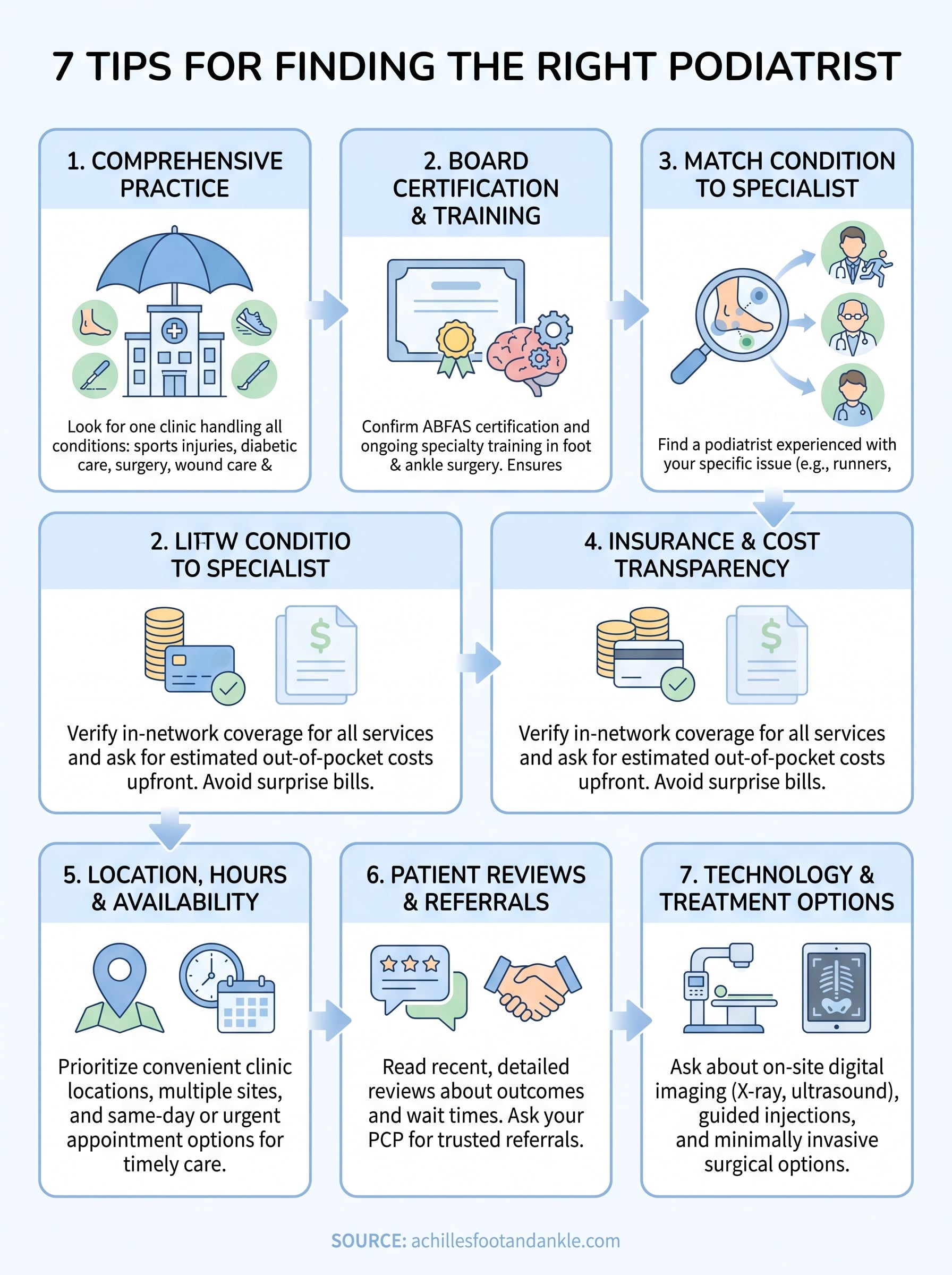
Your search for a podiatrist doctor near me doesn’t have to end in a coin flip between whoever has the shortest wait time. Work through these seven checkpoints, comprehensive care, board certification, condition-specific matching, insurance clarity, convenient scheduling, honest reviews, and real technology, and you’ll land on a practice that treats your foot or ankle problem correctly the first time instead of bouncing you between specialists for months.
Foot pain rarely fixes itself, and waiting only narrows your treatment options later. Whether you’re chasing down a diabetic foot doctor near me for wound care or trying to get back to running without reinjury, the right team makes recovery faster and less frustrating. Achilles Foot and Ankle Center checks every box outlined above, thirteen Central Virginia locations, board-certified specialists, and same-day access when you can’t wait. If something’s bothering you today, get seen today by a Central Virginia foot and ankle specialist and walk out with an actual answer instead of another week of guessing.