

Few things disrupt sleep quite like gout foot pain at night, that sudden, searing throb in your big toe that pulls you out of a dead sleep and makes even the weight of a bedsheet feel unbearable. If you’ve experienced it, you know it’s not something you can just shake off. And if you’re reading this at 2 a.m. with your foot propped up, wondering why gout seems to strike hardest after dark, you’re not alone.
There are specific biological reasons why gout flares tend to peak during nighttime hours, and understanding those reasons is the first step toward finding real relief. From shifts in body temperature and hydration levels to the way uric acid behaves while you sleep, the triggers are more predictable than most people realize, and many of them are manageable with the right approach.
At Achilles Foot and Ankle Center, our podiatrists across Central Virginia treat gout-related foot pain regularly. We see firsthand how repeated nighttime flares affect patients’ quality of life, and we know that clear, accurate information makes a difference. This article breaks down why gout attacks happen at night, what triggers them, and what you can do, both immediately and long-term, to get ahead of the pain.
Why Gout Foot Pain Flares at Night
Gout is caused by uric acid crystals that build up inside your joints. When uric acid levels in your blood climb high enough, the excess forms sharp, needle-like crystals that lodge in joint tissue. Your immune system reads these crystals as a threat and launches an inflammatory response, and that response is what produces the intense heat, swelling, and pain you feel during an attack. Knowing why this process intensifies at night puts you in a much stronger position to manage it.
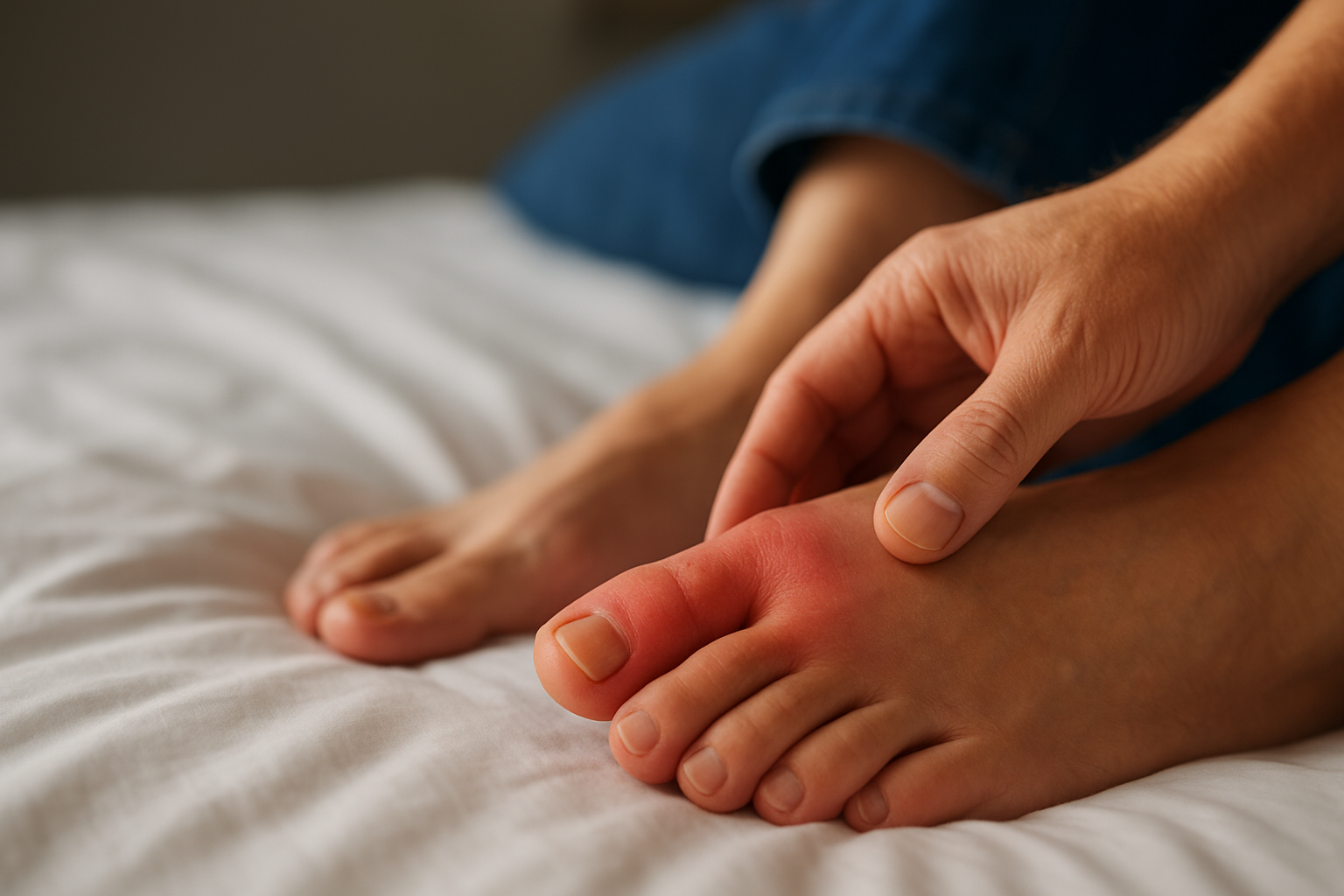
Your Core Body Temperature Drops During Sleep
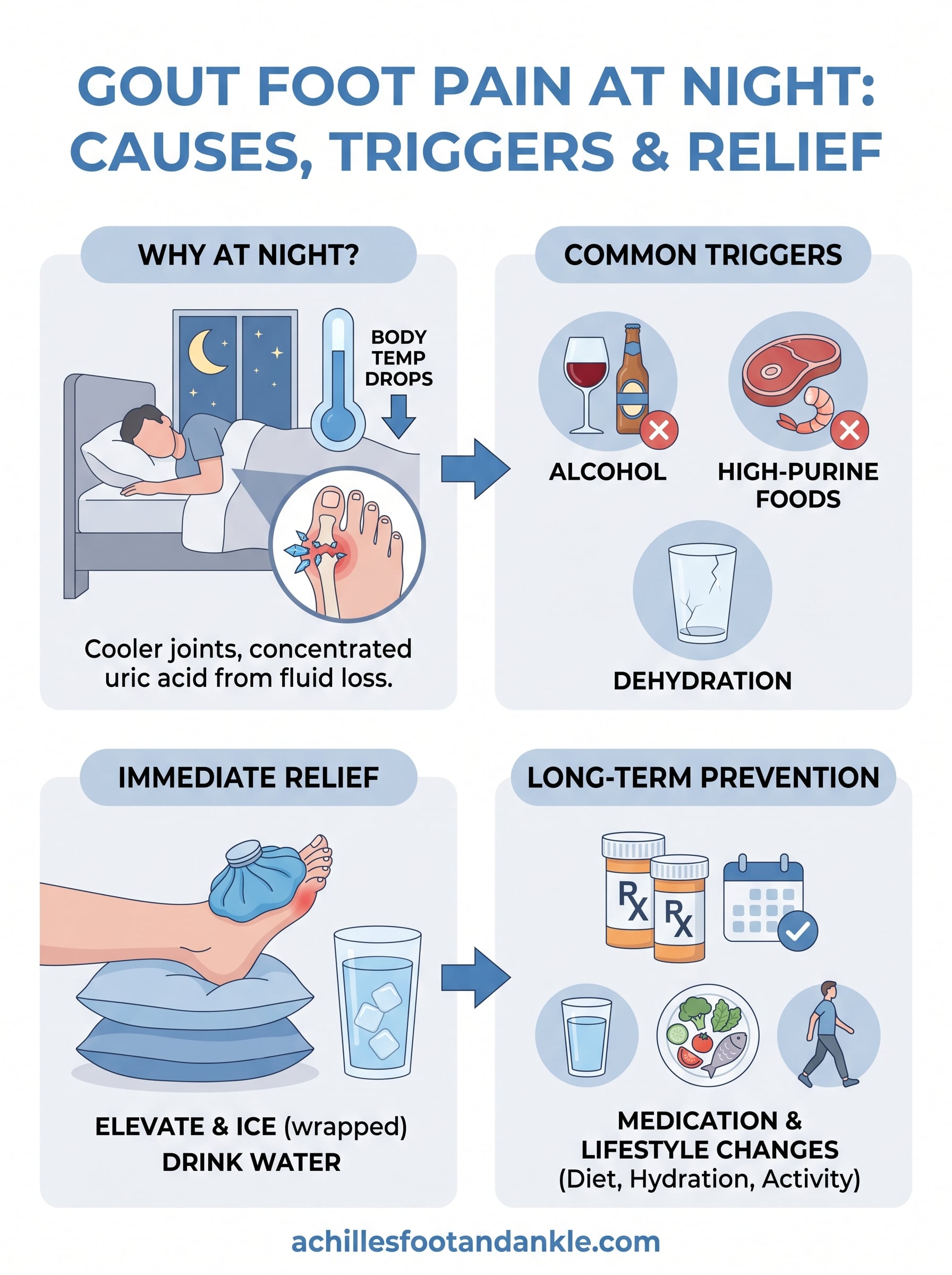
As you fall asleep, your body temperature naturally decreases by roughly 1 to 2 degrees Fahrenheit. That drop matters because uric acid becomes less soluble at lower temperatures, meaning it has a harder time staying dissolved in your blood and joint fluid. Your big toe sits the farthest from your heart and core, so it cools faster and more completely than other joints. This is a key reason gout foot pain at night so often targets the big toe more than any other location, a condition physicians call podagra.
When joint temperatures fall during sleep, urate crystals can form or expand at a much faster rate, often triggering a full inflammatory response within just a few hours.
Fluid Loss Raises Uric Acid Concentration Overnight
You go several hours without drinking water while you sleep. Your body loses fluid through breathing and perspiration throughout the night, and that gradual loss concentrates the uric acid already circulating in your bloodstream. Once your uric acid levels cross the saturation point, crystal formation inside your joints accelerates, often reaching a critical mass right around the time you’d normally be in your deepest sleep cycle.
Kidney function also shifts during nighttime hours, processing waste differently than it does when you’re active and upright. Research indicates that the kidney’s reduced capacity to filter and excrete uric acid overnight adds to the overall buildup in your joints. Cooling temperatures and rising uric acid concentration work together, making nighttime close to an ideal environment for a flare to take hold.
Common Triggers That Make Nighttime Flares Worse
Several habits and conditions stack on top of gout’s natural nighttime chemistry to push a flare from mild to severe. Identifying your personal triggers gives you direct control over how often you experience gout foot pain at night and how intense those episodes become.
Evening Eating and Drinking Habits
What you eat and drink in the hours before bed has an outsized impact on your uric acid levels by the time you fall asleep. Foods high in purines, including red meat, shellfish, organ meats, and certain fish like sardines and anchovies, break down into uric acid quickly. Eating a large purine-heavy meal at dinner gives your body a fresh wave of uric acid to process right before your kidneys slow down for the night.
Alcohol, particularly beer and spirits, both raises uric acid production and blocks the kidneys from excreting it efficiently, making it one of the most reliable triggers for a nighttime gout attack.
Even sugary drinks sweetened with fructose follow a similar pattern, spiking uric acid levels within hours of consumption.
Sleep Position and Reduced Movement
Your joints stay still for hours while you sleep, which allows uric acid crystals to settle deeper into joint tissue rather than being disrupted by movement. Blood circulation to your feet also slows when you’re lying flat and inactive. Less circulation means less uric acid clearance from the joint fluid, giving crystals more time to accumulate and trigger your immune system’s inflammatory response.
How to Get Relief During a Nighttime Gout Attack
When gout foot pain at night wakes you up, your immediate goal is to bring down the inflammation and limit how severe the flare becomes. Acting quickly within the first hour of an attack gives your body a better chance of recovering without the pain escalating through the rest of the night. The steps below are practical and concrete, so you can use them even when the discomfort is at its worst.
Reduce Inflammation Right Away
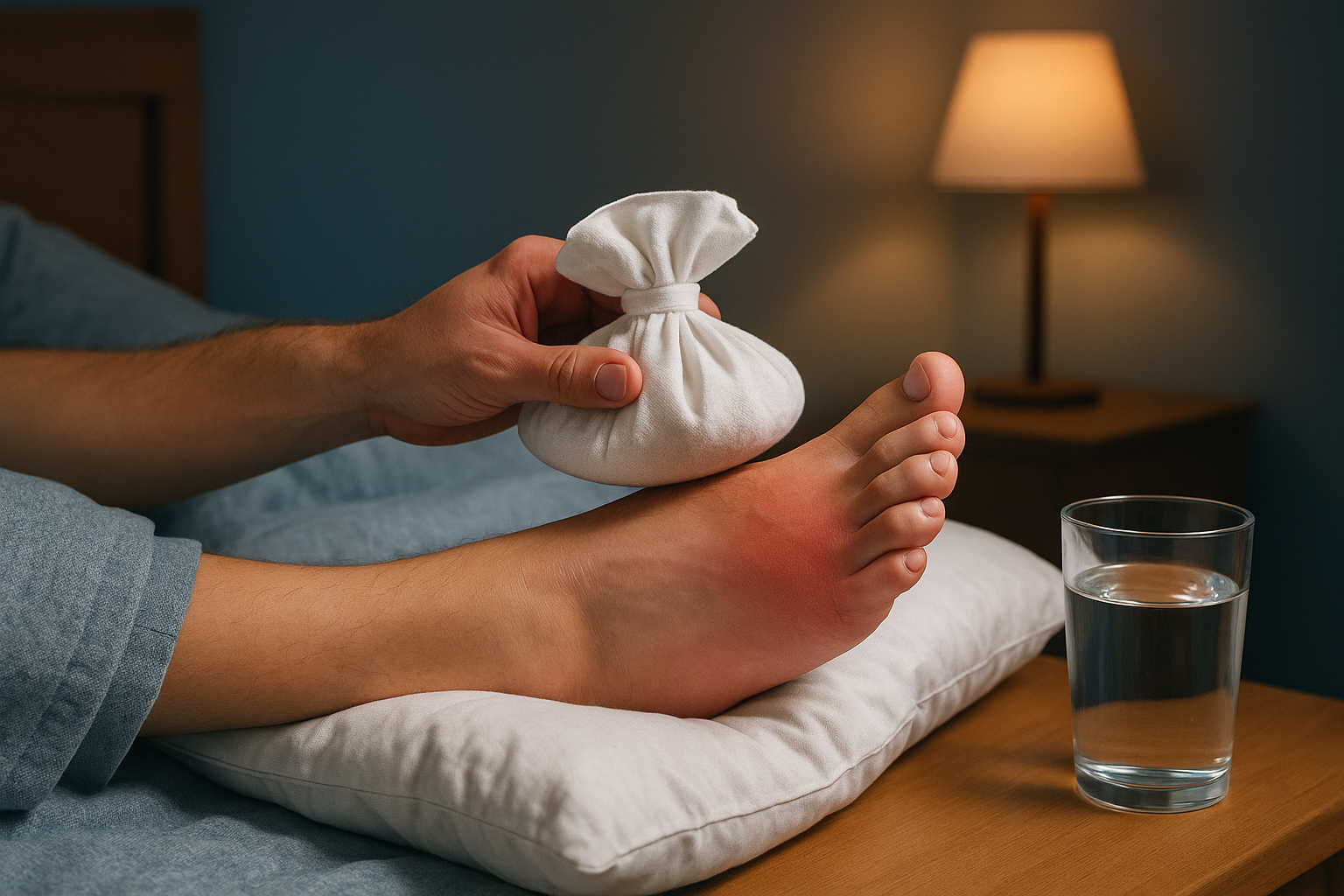
Your first move should be applying ice wrapped in a thin cloth directly to the affected joint for 20 to 30 minutes. Cold therapy slows circulation to the area, which helps suppress the inflammatory response your immune system is driving. Avoid placing ice directly on bare skin, as that can cause additional tissue damage on an already stressed joint.
Over-the-counter NSAIDs like ibuprofen or naproxen sodium can reduce both pain and swelling significantly during an active flare, but check with your doctor before using them if you have kidney problems or take blood thinners.
Elevate the Foot and Drink Water
Elevating your foot above heart level while you rest reduces pressure in the joint and limits fluid buildup. Prop your foot on two or three pillows and keep it consistently raised rather than letting it drop back down. Drinking 16 to 24 ounces of water right away also helps, because increasing fluid intake dilutes uric acid concentration in your bloodstream and gives your kidneys more to process through the rest of the night.
How Doctors Diagnose Gout vs Other Foot Problems
Accurate diagnosis matters because several foot conditions share symptoms with gout, including infections, pseudogout, rheumatoid arthritis, and stress fractures. Treating the wrong condition wastes time and leaves you vulnerable to more gout foot pain at night while the underlying problem goes unaddressed.
What the Exam Involves
Your doctor will start with a physical exam, pressing around the affected joint to assess swelling, warmth, and range of motion. From there, a serum uric acid blood test checks whether your levels exceed the standard threshold of 6.8 mg/dL. Blood tests alone do not confirm gout, though, because uric acid levels can temporarily drop during an active flare, producing a misleading normal result.
The most definitive test is joint aspiration, where a physician draws a small sample of fluid from the inflamed joint and examines it under a microscope to identify urate crystals directly.
Conditions That Can Look Like Gout
Pseudogout produces nearly identical symptoms but involves calcium pyrophosphate crystals rather than uric acid crystals, and it responds differently to treatment. Your doctor may order imaging studies such as X-rays or ultrasound to look for crystal deposits, erosion patterns, or soft tissue changes that distinguish one condition from another.
Cellulitis, a bacterial skin infection, also causes redness, heat, and swelling around the foot and can be mistaken for gout without proper lab work. Getting the diagnosis right the first time is what allows your treatment plan to actually work.
Long-term Treatment to Prevent Future Night Flares
Managing gout foot pain at night in the moment is necessary, but the real goal is reducing how often those flares happen in the first place. Long-term treatment combines prescription medication with consistent lifestyle adjustments, and sticking to both gives you the best chance of sleeping through the night without interruption.
Medication That Lowers Uric Acid
Your doctor may prescribe urate-lowering therapy, most commonly allopurinol or febuxostat, to reduce the amount of uric acid your body produces. These medications work gradually over weeks, bringing your serum uric acid below the 6.0 mg/dL target that prevents new crystal formation. Your doctor will monitor your blood levels regularly to fine-tune your dose and confirm the treatment is working.
Starting urate-lowering medication can temporarily trigger a flare, so many physicians also prescribe a short course of colchicine or a low-dose NSAID to cover the transition period.
Lifestyle Changes That Reduce Flare Risk
Consistent daily habits significantly cut your frequency of nighttime gout attacks. These adjustments are worth building into your routine permanently:
- Drink at least 8 to 10 glasses of water throughout the day, including a glass before bed
- Limit alcohol and high-purine foods like red meat, shellfish, and organ meats
- Maintain a healthy body weight, since excess weight increases uric acid production
- Avoid fructose-sweetened beverages entirely, as fructose raises uric acid rapidly
Combining medication with these daily habits gives your body a consistent environment where uric acid stays at manageable levels rather than spiking overnight.
Next Steps for Calmer Nights
Gout foot pain at night is predictable enough that you can take meaningful steps to reduce both how often it happens and how severe each episode becomes. The combination of cooling joint temperatures, concentrated uric acid, and evening eating habits creates a pattern that works against you, but consistent medical treatment paired with deliberate daily changes can break that cycle. You now understand the biology behind nighttime flares, what triggers them, and how to respond both in the moment and over time.
If your flares are happening frequently or growing more intense, that’s a clear signal to see a podiatrist. Waiting only allows more crystal buildup and more disrupted nights. The team at Achilles Foot and Ankle Center is ready to diagnose your condition accurately and build a treatment plan that fits your life. Schedule a same-day appointment and start getting the consistent relief you need.