

Stiffness in the morning. A deep ache after a long walk. Swelling that won’t quit. If your feet hurt and you’re not sure why, arthritis could be the reason, but knowing which type matters more than most people realize. There are several types of arthritis in feet, and each one has different causes, affects different joints, and responds to different treatments. A diagnosis of "arthritis" is really just the starting point.
At Achilles Foot and Ankle Center, our podiatrists across Central Virginia treat foot and ankle arthritis at every stage, from early stiffness that slows you down to advanced joint damage that changes how you walk. We see firsthand how the right identification leads to the right care, and how much quality of life improves when patients understand exactly what’s happening in their joints.
This article breaks down the most common forms of arthritis that affect the feet and ankles, including their specific symptoms, underlying causes, and available treatments. Whether you’re dealing with a recent flare-up or years of gradual pain, this guide will help you make sense of what you’re feeling and know when it’s time to see a specialist.
What foot and ankle arthritis means
Arthritis is not a single disease. The word itself simply means inflammation of a joint, and it serves as an umbrella term for more than 100 conditions that damage the structures inside your joints. When arthritis develops in your feet or ankles, the result is pain, stiffness, and progressive loss of function that can interfere with something as basic as walking across a room. Understanding the mechanics of what’s happening gives you a clearer picture of why symptoms appear, why they worsen, and why treatment needs to match the specific condition causing them.
How arthritis damages the joint
Inside a healthy joint, a layer of cartilage covers the ends of your bones. That cartilage acts as a cushion and smooth surface that lets bones glide past each other without friction. When arthritis develops, that cartilage breaks down, becomes thinner, or is attacked by your own immune system, depending on the type involved. Bone-on-bone contact leads to the grinding sensation many patients describe, while inflammation in the joint lining produces the swelling and warmth you might notice around your ankle or the ball of your foot.
The damage arthritis causes is often gradual, which means many people adapt to worsening pain without realizing how much function they’ve already lost.
Beyond cartilage, the surrounding tendons, ligaments, and soft tissue can also be affected as arthritis progresses. Chronic inflammation weakens those supporting structures, creates instability that changes your gait, and puts extra stress on other joints throughout your foot.
Where it shows up in the foot and ankle
Your foot alone contains 28 bones and more than 30 joints, which gives arthritis a wide range of places to develop. The most commonly affected areas include:

- The ankle joint (tibiotalar joint): where your leg meets your foot
- The subtalar joint: just below the ankle, responsible for side-to-side motion
- The midfoot joints: the cluster of small bones in the arch area
- The big toe joint (first metatarsophalangeal joint): a frequent target for gout and osteoarthritis
Different types of arthritis in feet tend to favor different locations. Osteoarthritis often attacks the big toe joint and midfoot, while rheumatoid arthritis frequently targets the smaller joints across the forefoot. Recognizing which joints are involved and connecting that pattern to the correct diagnosis is exactly what your podiatrist is trained to do, and it’s why a thorough clinical evaluation matters before any treatment begins.
Why identifying the type matters
When a doctor tells you that you have arthritis, that label alone does not point you toward the right treatment. The different types of arthritis in feet behave differently at the cellular level, which means they require different medications, therapies, and sometimes entirely different specialists to address properly. Treating one type the way you’d treat another still leaves you in pain.
Treatment is built around the specific type
Each form of foot arthritis calls for a distinct approach:
- Osteoarthritis responds to physical therapy, joint injections, and activity modification
- Rheumatoid arthritis requires immune-suppressing drugs that have no effect on wear-and-tear damage
- Gout demands dietary changes and medications that lower uric acid levels in your blood
Choosing the wrong treatment path does not just fail to help. It can delay the correct intervention while your joints continue to deteriorate.
Your podiatrist also relies on the diagnosis when making surgical decisions. A procedure that resolves end-stage osteoarthritis of the ankle may be completely wrong for someone whose joint damage comes from an inflammatory condition that requires systemic medical management alongside any surgical correction.
Early and accurate diagnosis protects your function
The earlier your provider identifies the specific cause of your foot pain, the more treatment options remain available to you. Catching rheumatoid arthritis before significant joint erosion occurs gives your care team the ability to slow or even stop that damage.
Accurate diagnosis also sets clearer expectations for what recovery looks like, how long it takes, and which daily habits will have the biggest impact. With that information, protecting your long-term mobility becomes something you can actively work toward rather than simply hope for.
Types of arthritis in feet and ankles
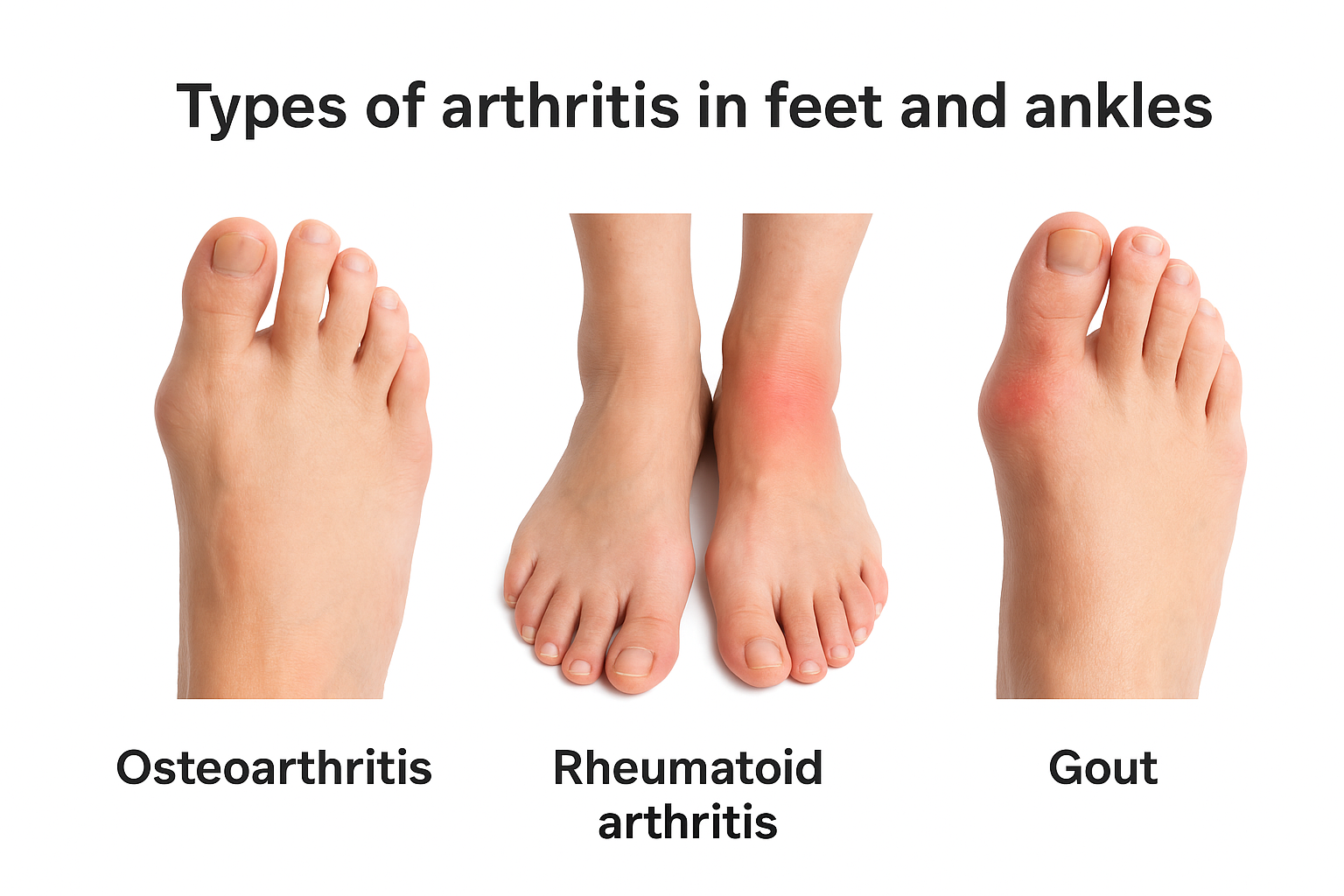
The most common types of arthritis in feet that podiatrists treat are osteoarthritis, rheumatoid arthritis, gout, and post-traumatic arthritis. Each condition has a distinct mechanism behind the damage, which is why symptoms can look similar on the surface but require very different care.
Osteoarthritis
Cartilage breakdown from cumulative wear is what drives osteoarthritis. Over years of use, the smooth cushioning inside your joints gradually wears away, leaving bone surfaces to grind against each other. The pain tends to build with activity and ease with rest, making it easy to dismiss early on as normal soreness from a long day on your feet.
Osteoarthritis most often targets the big toe joint and the midfoot joints in the arch area. You may notice bony bumps forming around the joint, reduced range of motion, and a deep aching discomfort that gradually becomes harder to ignore.
Rheumatoid arthritis
Rheumatoid arthritis works differently from other types because your immune system is the source of the damage. It attacks the lining of your joints rather than resulting from physical wear, producing inflammation that erodes bone and cartilage over time. Morning stiffness that lasts longer than an hour is one of the most telling signs.
If your pain appears in a symmetrical pattern across both feet and comes with warmth, swelling, or fatigue, rheumatoid arthritis is worth ruling out promptly.
Gout and post-traumatic arthritis
Gout forms when uric acid crystals accumulate inside a joint, most commonly the big toe. Flares arrive suddenly and intensely, with severe pain and redness peaking within hours. Post-traumatic arthritis, by contrast, develops years after a fracture or significant joint injury, as altered mechanics slowly wear down the affected joint, often the ankle.
How providers diagnose foot arthritis
Accurate diagnosis starts before any imaging is ordered. Your podiatrist will begin by asking detailed questions about your symptoms, including when the pain started, which joints hurt, and whether the discomfort follows any pattern tied to activity, time of day, or diet. That conversation, combined with a hands-on physical examination, gives your provider critical information that no scan alone can reveal.
Physical exam and patient history
During the exam, your provider will press on specific joints, assess your range of motion, and observe how you walk. Subtle changes in your gait often reflect compensation patterns your body has built around the pain without you realizing it. Warmth, redness, or visible swelling around a joint narrows the list of likely conditions significantly.
The pattern of which joints are affected, and whether symptoms appear on one side or both, points strongly toward specific types of arthritis in feet before a single test is run.
Your full medical history matters here too. Prior fractures, family history of autoimmune disease, and any existing conditions like diabetes or psoriasis all influence which form of arthritis is most likely driving your symptoms.
Imaging and lab tests
X-rays show joint space narrowing, bone spurs, and erosion that confirm cartilage loss and help your provider gauge how advanced the damage is. In some cases, an MRI gives a clearer look at soft tissue involvement. For suspected rheumatoid arthritis or gout, blood work plays an equal role, measuring markers like rheumatoid factor, anti-CCP antibodies, or uric acid levels to confirm what’s behind the inflammation.
Treatment options and self-care that help
Treatment for foot arthritis works on two levels: managing your current symptoms so you can function day to day, and slowing joint damage over time. Because the types of arthritis in feet each have different underlying mechanisms, your provider will build a plan around the specific condition driving your pain rather than applying a generic approach.
Medical and procedural treatments
Your podiatrist has several clinical tools available depending on how advanced your arthritis is and which joints are involved. Corticosteroid injections reduce inflammation directly inside the joint and can deliver meaningful relief lasting weeks to months. For rheumatoid arthritis, a rheumatologist typically prescribes disease-modifying antirheumatic drugs (DMARDs) that address the immune response at its source. Gout flares respond well to colchicine or anti-inflammatory medications, combined with uric acid-lowering therapy for long-term prevention. When conservative measures are no longer effective, surgical options can restore function significantly.
The goal of surgical intervention is not only pain relief, but restoring the mechanical stability your foot needs for normal movement.
Common surgical approaches include:
- Joint fusion (arthrodesis): Permanently stabilizes a severely damaged joint by joining the bones together
- Joint replacement: Replaces the damaged joint with a prosthetic implant, preserving motion
- Minimally invasive procedures: Address bone spurs or joint debris through smaller incisions with shorter recovery times
Daily habits that reduce pain and protect joints
What you do between appointments has a real impact on how your joints hold up over time. Custom orthotics redistribute pressure away from damaged areas and reduce the mechanical stress that accelerates cartilage breakdown. Supportive footwear with adequate cushioning and a wide toe box protects inflamed joints during everyday movement.
Maintaining a healthy body weight reduces the load on your feet with every step. Low-impact activities like swimming or cycling keep the muscles surrounding your joints strong without grinding already damaged surfaces.

What to do next
Now that you understand the different types of arthritis in feet, the most important step is getting a clear diagnosis from a specialist who works with these conditions every day. Foot pain that you’ve been managing on your own with rest or over-the-counter medication may have a specific, treatable cause that responds to targeted care once identified correctly.
Your feet carry you through every part of your daily life, and delaying evaluation gives joint damage more time to progress. A podiatrist can confirm which type of arthritis is affecting your joints, rule out other sources of pain, and build a treatment plan matched to your specific condition rather than a general approach that may not address the real problem.
If you’re in Central Virginia and ready to get clear answers about your foot pain, schedule a same-day appointment with the team at Achilles Foot and Ankle Center and take the first step toward lasting relief.