

Rheumatoid arthritis often shows up in the feet and ankles before it affects larger joints, yet many people dismiss the early aches as simple wear and tear. Recognizing rheumatoid arthritis feet symptoms early can make a real difference in how the condition progresses and how well you maintain your mobility. The problem is that swelling in a toe joint or stiffness in the ball of your foot doesn’t always scream "autoimmune disease," so these signals get overlooked for months or even years.
At Achilles Foot and Ankle Center, our podiatrists in Central Virginia regularly evaluate patients who come in for foot pain and discover that rheumatoid arthritis is the underlying cause. Because RA affects the small joints of the feet so frequently, studies suggest the feet are involved in up to 90% of RA cases, foot and ankle specialists are often the first to identify the condition and connect patients with the right care.
This article breaks down the specific signs of rheumatoid arthritis in the toes, midfoot, and ankles, including the early warning signals that are easy to miss. You’ll learn how RA foot symptoms differ from other common causes of foot pain, what physical changes to watch for, and when it’s time to see a specialist rather than wait it out.
Why rheumatoid arthritis often affects feet first
Rheumatoid arthritis is an autoimmune disease, meaning your immune system mistakenly attacks the synovial tissue that lines your joints. This inflammation doesn’t strike randomly. It follows patterns based on joint structure, mechanical load, and how much synovial tissue a joint contains, which is exactly why the feet are so frequently in the crosshairs. Understanding why this happens can help you make sense of the symptoms you’re experiencing and why a foot and ankle specialist is often the right starting point.
The immune system targets synovial-rich joints
The synovium is a thin membrane that produces fluid to keep your joints moving smoothly. Joints with more synovial tissue are more exposed to the immune system’s misdirected attacks. Your feet contain 33 joints, and many of those joints are small and densely lined with synovial membrane. That gives RA a significant amount of tissue to attack, which is why the feet are involved in roughly 90% of RA cases over the course of the disease, according to research published in medical literature on rheumatoid conditions.
Early rheumatoid arthritis feet symptoms often begin in the metatarsophalangeal joints, the joints at the base of each toe, before spreading to other areas of the foot.
When the immune system triggers inflammation in these joints, the synovium swells, produces excess fluid, and gradually damages the cartilage and bone surrounding it. Because the feet have so many small joints packed closely together, the damage can spread quickly from one joint to the next without causing the kind of dramatic pain that might send you to a doctor right away.
Small joints receive the first attack
RA has a known pattern of targeting small joints before large ones. In the hands, this means the knuckles and finger joints. In the feet, the metatarsophalangeal (MTP) joints at the base of the toes are typically the first affected. These joints handle an enormous amount of repetitive stress with every step you take, and that constant mechanical pressure may amplify the inflammatory response already triggered by your immune system.
Your forefoot absorbs the force of pushing off the ground with every stride. When the MTP joints are inflamed, even routine walking becomes painful. Many patients describe this as feeling like they’re walking on small stones or marbles, a sensation that stems directly from the swollen joint tissue pressing against the sole of the foot. Because this discomfort often starts gradually, it’s easy to attribute it to ill-fitting shoes or a long day on your feet rather than a systemic disease.
Why symmetry matters as a warning sign
One of the distinguishing features of RA compared to other forms of arthritis is that it tends to affect both sides of the body at the same time. If you notice swelling or pain in the ball of your right foot, RA is more likely than other causes if you have matching symptoms in the same area of your left foot. This bilateral pattern reflects the systemic nature of the disease, because it’s your immune system reacting throughout your body rather than a localized injury or mechanical problem.
Other conditions like osteoarthritis or a stress fracture typically affect one side or one specific location. When both feet show similar symptoms in the same joints, that symmetry is a significant clinical signal. Paying attention to whether your discomfort mirrors itself across both feet can give you and your doctor important diagnostic information before more advanced testing is done.
What rheumatoid arthritis foot symptoms feel like
Describing RA foot symptoms is easier when you think about how they differ from typical foot pain. Most foot injuries or overuse problems produce pain that worsens with activity and improves with rest. Rheumatoid arthritis feet symptoms often work in the opposite direction; your feet may feel at their worst when you first get up in the morning and gradually loosen up as you move around. That reversal is one of the clearest signals that inflammation, not mechanical damage, is driving your discomfort.
Morning stiffness and the warm-up period
People with RA in their feet frequently describe a stiffening sensation that hits the moment they put weight on the floor after waking up. Your feet may feel wooden, swollen, and resistant to movement for anywhere from 30 minutes to several hours. This is called morning stiffness, and its duration is clinically meaningful. When joint stiffness lasts longer than 45 minutes after waking, it points strongly toward an inflammatory arthritis like RA rather than osteoarthritis, where stiffness typically fades within a few minutes.
Morning stiffness lasting more than 45 minutes is a recognized clinical indicator that separates inflammatory arthritis from mechanical or degenerative joint conditions.
Your foot pain during this warm-up period often feels deep and achy rather than sharp. You may notice it concentrated at the ball of your foot or the base of your toes, and pressing on those joints with your fingers may produce tenderness that seems disproportionate to how the foot looks from the outside.
Persistent swelling and warmth
Beyond stiffness, visible swelling around one or more toe joints is a common physical finding. The affected joints may feel warmer than the surrounding tissue because inflammation increases blood flow to the area. Unlike swelling from a sprain or blunt injury, RA-related swelling tends to be softer and more diffuse, often spanning across the knuckles of multiple toes rather than concentrating at a single spot.
Fatigue also plays an underappreciated role in how RA affects your feet. Your muscles and tendons work harder to stabilize inflamed and less stable joints, so your feet may feel exhausted after even short periods of standing or walking, not because you overdid it, but because your body is actively fighting inflammation.
Symptoms by location: toes, ball, arch, ankle
Rheumatoid arthritis feet symptoms don’t spread evenly across the foot all at once. They tend to follow a predictable path through specific locations, and knowing which area is affected gives you useful information about how far the condition has progressed. The sections below break down what you’re likely to experience in each part of the foot.
Toes and MTP joints
The metatarsophalangeal (MTP) joints, located at the base of each toe, are typically where RA announces itself first. You may notice swelling around one or more toe knuckles, with the second and third toes most commonly affected. The toes can take on a reddish tint from increased blood flow, and pressing on the joints often produces tenderness that feels out of proportion to the visible swelling.

Swelling across multiple MTP joints at the same time, particularly when both feet are involved, is a strong indicator of an inflammatory condition rather than a localized injury.
Over time, chronic inflammation at the MTP joints can pull tendons out of alignment, causing toes to drift outward or buckle into deformities like hammertoe or claw toe.
Ball of the foot
The ball of the foot sits directly over your MTP joints, so inflammation in those joints transmits pressure and pain straight to the forefoot. Many patients describe a burning or bruised sensation under the ball of the foot that worsens when walking on hard floors without cushioned footwear. Fat pad atrophy is a related problem in which the protective padding under the forefoot thins out due to prolonged inflammation, leaving the underlying bones with less natural cushioning.
Arch and midfoot
RA can affect the joints in the middle of the foot, known as the tarsal joints, though this happens less often than forefoot involvement. When it does occur, you may feel a diffuse aching pain along the inner arch that doesn’t trace back to a single injury. Some patients notice their arch gradually flattening as the supporting ligaments and tendons weaken under the strain of ongoing inflammation.
Ankle involvement
The ankle joint carries the full weight of your body with every step, making ankle pain from RA particularly limiting. Swelling above the heel and around the sides of the ankle is common, and stiffness can restrict how far you can flex your foot upward or push it downward. You may also feel instability, as inflamed tissue around the joint provides less support than healthy tissue does.
Early-stage symptoms vs worsening signs
Recognizing where you fall on the spectrum of rheumatoid arthritis feet symptoms matters because early intervention consistently produces better outcomes than waiting for the damage to accumulate. The difference between early and later-stage RA in the feet isn’t just about pain intensity. It shows up in structural changes to your joints, tendons, and walking mechanics that become harder to reverse the longer inflammation goes unmanaged.
What early RA in the feet looks like
In the early stages, your foot symptoms may be subtle enough to dismiss. You might notice mild puffiness around one or two toe joints that appears in the morning and partially fades by midday. A dull ache at the ball of your foot after walking is common, as is a faint feeling of warmth over the MTP joints when you press on them. These symptoms often come and go, which makes it easy to credit them to your shoes or a busy day rather than an inflammatory disease.
Early rheumatoid arthritis in the feet frequently produces intermittent symptoms that fluctuate with activity levels and rest, making them easy to overlook or attribute to other causes.
Another early signal is unexplained fatigue in your feet after activities that previously caused no trouble. If standing for 20 minutes leaves your feet feeling exhausted and achy when that was never an issue before, that change in tolerance deserves attention. Early-stage RA also tends to produce tenderness when you squeeze across the MTP joints sideways, a simple test your podiatrist can perform during an initial evaluation.
Signs that RA is progressing
As RA advances, the symptoms shift from intermittent to persistent. Pain at the ball of the foot becomes constant rather than occasional, and morning stiffness extends well past an hour. You may start to notice visible joint deformities developing, including toes that drift sideways, hammertoe formation, or a bunion-like shift at the big toe joint caused by ligament loosening under chronic inflammation.
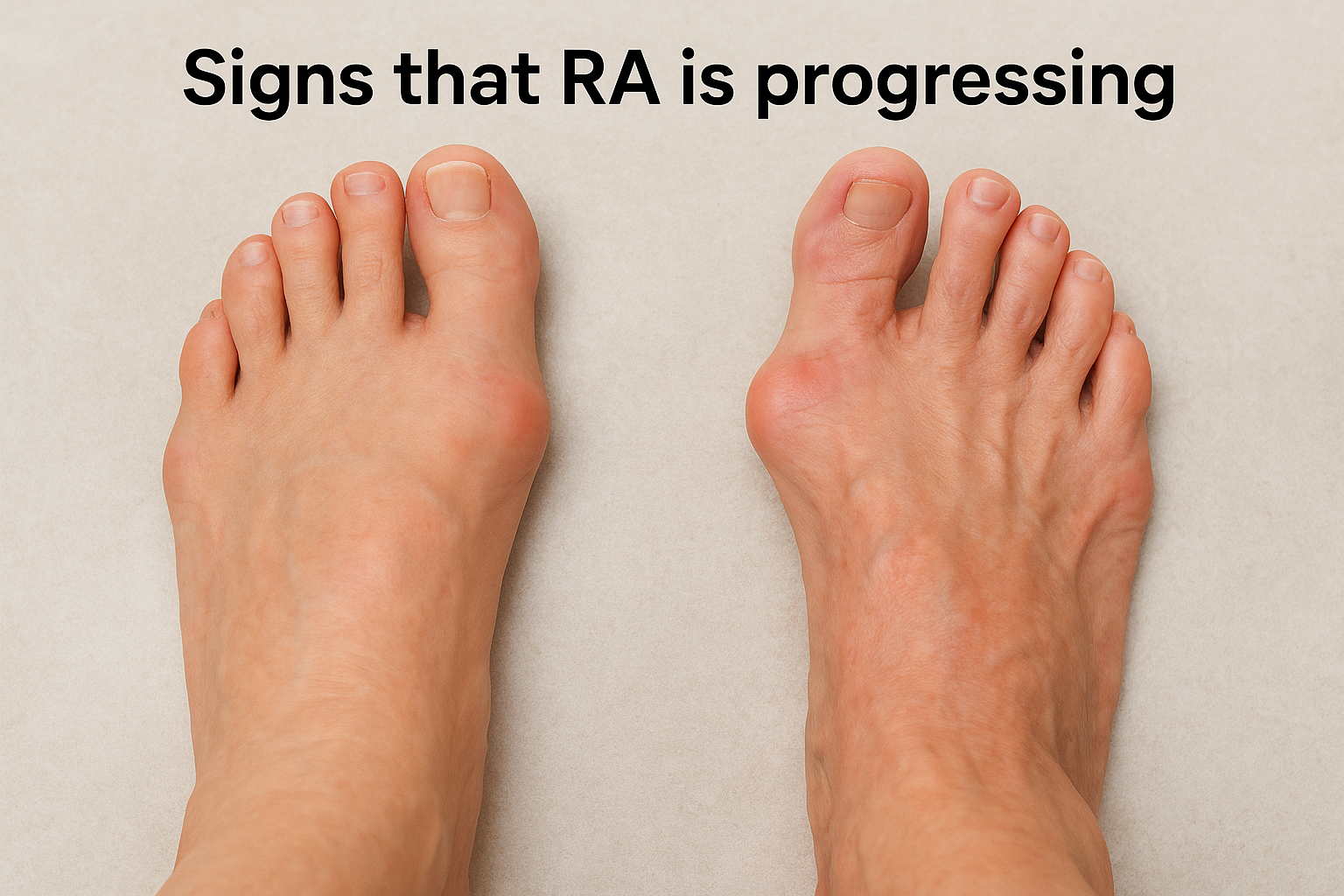
Flattening of the arch is another sign that the disease has moved beyond the early stage, as this reflects structural weakening rather than simple inflammation. Walking patterns often change as your body compensates for pain, which can create secondary problems in your knees, hips, and lower back. At this point, conservative treatment alone may not be sufficient, and a comprehensive evaluation with imaging becomes essential to map the damage and guide your treatment plan.
Diagnosis and treatment options for foot pain
When rheumatoid arthritis feet symptoms point to an inflammatory cause, getting an accurate diagnosis is the critical first step before any treatment can work effectively. A podiatrist evaluates not just how your foot feels but how the disease has affected its structure, which guides every decision that follows.
How a podiatrist diagnoses RA in the feet
Your podiatrist will start with a physical exam, pressing across the MTP joints to assess tenderness and checking for swelling, warmth, and any early deformity. They will also evaluate your gait, because changes in how you walk often reveal which joints are compensating for pain. Imaging plays a central role in this process, and your specialist will typically order weight-bearing X-rays to assess joint space narrowing, bone erosion, and alignment changes that confirm the diagnosis and show how far the condition has progressed.
Blood tests ordered through your rheumatologist, including rheumatoid factor and anti-CCP antibodies, work alongside imaging findings to confirm an RA diagnosis and rule out other inflammatory conditions.
Ultrasound is another valuable tool that allows your podiatrist to visualize active synovial inflammation in real time, which X-rays alone cannot show. This combination of clinical exam, imaging, and lab work gives your care team a complete picture rather than relying on any single test.
Treatment options that protect your foot structure
Conservative treatment is the starting point for most patients, and it focuses on reducing inflammation, redistributing pressure, and slowing joint damage. Custom orthotics can offload the MTP joints and support a flattening arch, while anti-inflammatory medications prescribed in coordination with your rheumatologist address the underlying immune response. Corticosteroid injections delivered directly into inflamed joints provide faster localized relief when a specific joint is acutely painful and limiting your daily activity.
When conservative measures no longer control your symptoms adequately, surgical options become relevant. Procedures range from synovectomy, which removes the inflamed joint lining, to joint fusion or reconstruction for joints that have sustained significant structural damage. Minimally invasive techniques are available at Achilles Foot and Ankle Center, and your specialist will match the approach to the specific joints involved and the degree of deformity present. Acting before deformities become fixed gives surgical correction a much better chance of restoring comfortable function.
Key takeaways and next steps
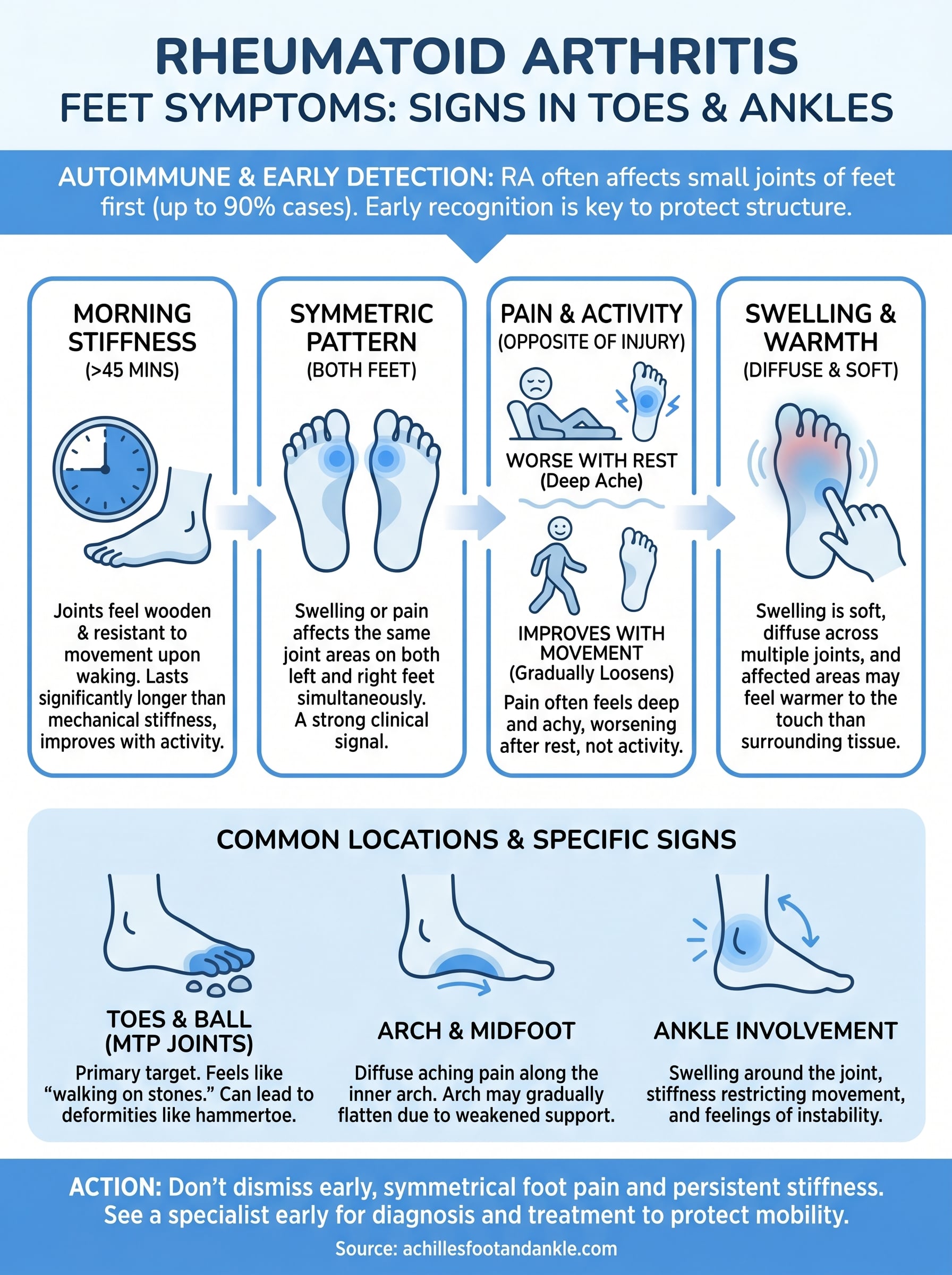
Rheumatoid arthritis feet symptoms follow a recognizable pattern: morning stiffness lasting more than 45 minutes, symmetric swelling across the MTP joints, and pain that eases with movement rather than rest. These signals differ meaningfully from typical overuse injuries, and catching them early gives you the best chance of protecting your joint structure before deformities develop. The feet are involved in up to 90% of RA cases, which makes a podiatrist a critical part of your diagnostic team, not just your rheumatologist.
If you recognize these symptoms in your own feet, don’t wait for the pain to become constant before seeking an evaluation. A podiatrist can assess your joints with imaging and a clinical exam, identify structural damage early, and build a treatment plan that addresses both your pain and the underlying inflammation. Schedule a same-day appointment at Achilles Foot and Ankle Center to get an accurate diagnosis and start protecting your mobility today.