

If you’ve ever noticed a thick, hardened patch of skin on your toes or the ball of your foot, you’ve probably wondered what are corns on feet, and whether they’re something to worry about. Corns are one of the most common foot complaints we treat at Achilles Foot and Ankle Center, and while they’re rarely dangerous, they can cause persistent discomfort that interferes with walking, exercising, and wearing your favorite shoes.
Corns develop when skin thickens in response to repeated friction or pressure, usually from footwear that doesn’t fit well or from structural issues in the foot itself. They might look minor on the surface, but left untreated, they can become painful enough to change the way you walk, which creates a chain reaction of problems in your ankles, knees, and beyond.
In this article, our podiatry team breaks down the types of corns, what causes them, how to recognize the symptoms, and which treatment options actually work. Whether you’re dealing with a small annoyance or a corn that’s affecting your daily life, you’ll find clear, practical guidance to help you take the right next step.
Why corns form on feet
To fully understand what are corns on feet, you need to know how your body responds to repeated stress. When your skin experiences consistent friction or pressure in the same spot, it builds up extra layers of keratin, a tough protein found in skin, as a protective response. That thickening is the corn itself. Your body is trying to shield the tissue underneath, but over time, the buildup becomes the source of pain rather than the solution.
The role of friction and pressure
Friction is the primary driver behind corn formation. Every time you take a step, your foot shifts slightly inside your shoe, and certain areas, specifically the tops of the toes, the sides of the little toe, and the ball of the foot, bear concentrated loads. When that repetitive rubbing happens day after day, your skin has no choice but to harden in response.
The tighter or narrower the shoe, the faster that friction compounds, which is why ill-fitting footwear is the single most common cause of corns.
Activities that place extra demand on your feet, like running, hiking, or standing for long shifts, accelerate the process considerably. If your work keeps you on your feet for hours, or if you train regularly without properly fitted athletic shoes, you’re already creating the exact conditions that produce corns.
How foot structure contributes
Not every corn comes from a shoe problem. Sometimes, the shape and mechanics of your foot are the real culprit. Bunions push the big toe out of alignment, forcing neighboring toes to crowd together and rub against each other. Hammertoes cause one or more toes to bend permanently at the middle joint, creating a raised bony prominence that presses directly against the top of your shoe with every step you take.
High arches concentrate pressure on the ball of the foot and the heel, while flat feet distribute weight unevenly across the entire sole. Either extreme can create consistent hot spots where skin thickens over time. If you’ve tried switching shoes and still keep developing corns, your foot structure and walking mechanics may be driving the problem more than your footwear.
Who develops corns most often
Corns can affect almost anyone, but certain groups deal with them far more frequently. Older adults tend to have less fatty padding on the soles of their feet, which means less natural cushioning between bone and shoe. People with diabetes or peripheral neuropathy face a higher risk because reduced sensation means they may not notice early irritation before a corn becomes deep and difficult to treat.
Athletes, people who regularly wear dress shoes, and anyone who goes barefoot on rough surfaces also show up in podiatry offices with corns. If you have a prior foot injury or a condition like rheumatoid arthritis, your risk increases further because these factors change how your foot loads and moves with every step.
Signs and symptoms of a foot corn
Recognizing a corn early makes treatment much simpler. Unlike a general patch of dry skin, a corn has specific physical characteristics that set it apart, and it tends to produce a particular type of discomfort that gets worse the longer you ignore it.
What a corn looks and feels like
A corn typically appears as a small, round, raised bump with a hard center surrounded by inflamed or tender skin. Hard corns, which are the most common type, form on the tops or sides of your toes and have a dense, waxy core that you can often see if you look closely. Soft corns, by contrast, tend to appear between the toes where moisture keeps the skin from hardening fully, giving them a rubbery, whitish appearance instead.
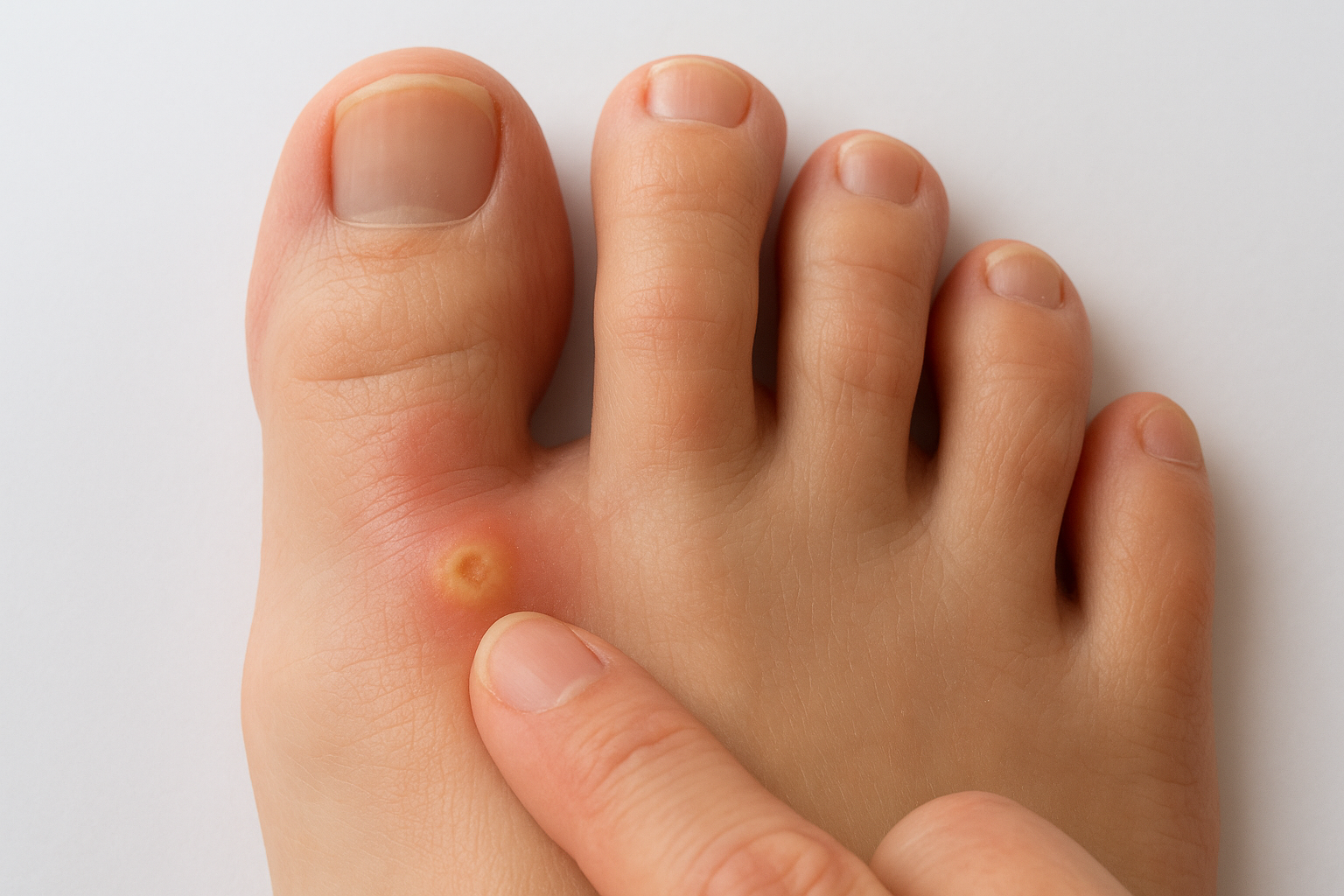
When you press on a corn, you’ll usually feel a sharp, focused pain rather than a dull ache. That concentrated pain comes from the hard core pressing inward against deeper tissue and nerve endings beneath the skin. Understanding what are corns on feet means recognizing that the discomfort is mechanical in nature, not infectious.
If a corn starts to feel warm, swollen, or begins to drain fluid, that signals an infection that needs prompt professional attention.
When to take corn pain seriously
Pain from a corn doesn’t always stay in one spot. As the corn grows deeper, you may notice burning or tenderness that lingers even when you’re not wearing shoes. Some people describe a sensation of walking on a pebble that never goes away.
If you have diabetes or poor circulation, any corn warrants an immediate visit to a podiatrist. Reduced sensation means damage can progress quickly without obvious warning signs, turning a simple corn into a wound that’s far harder to treat. Even without those conditions, a corn that persists for more than a few weeks or noticeably changes how you walk deserves professional evaluation.
Corn vs callus vs plantar wart
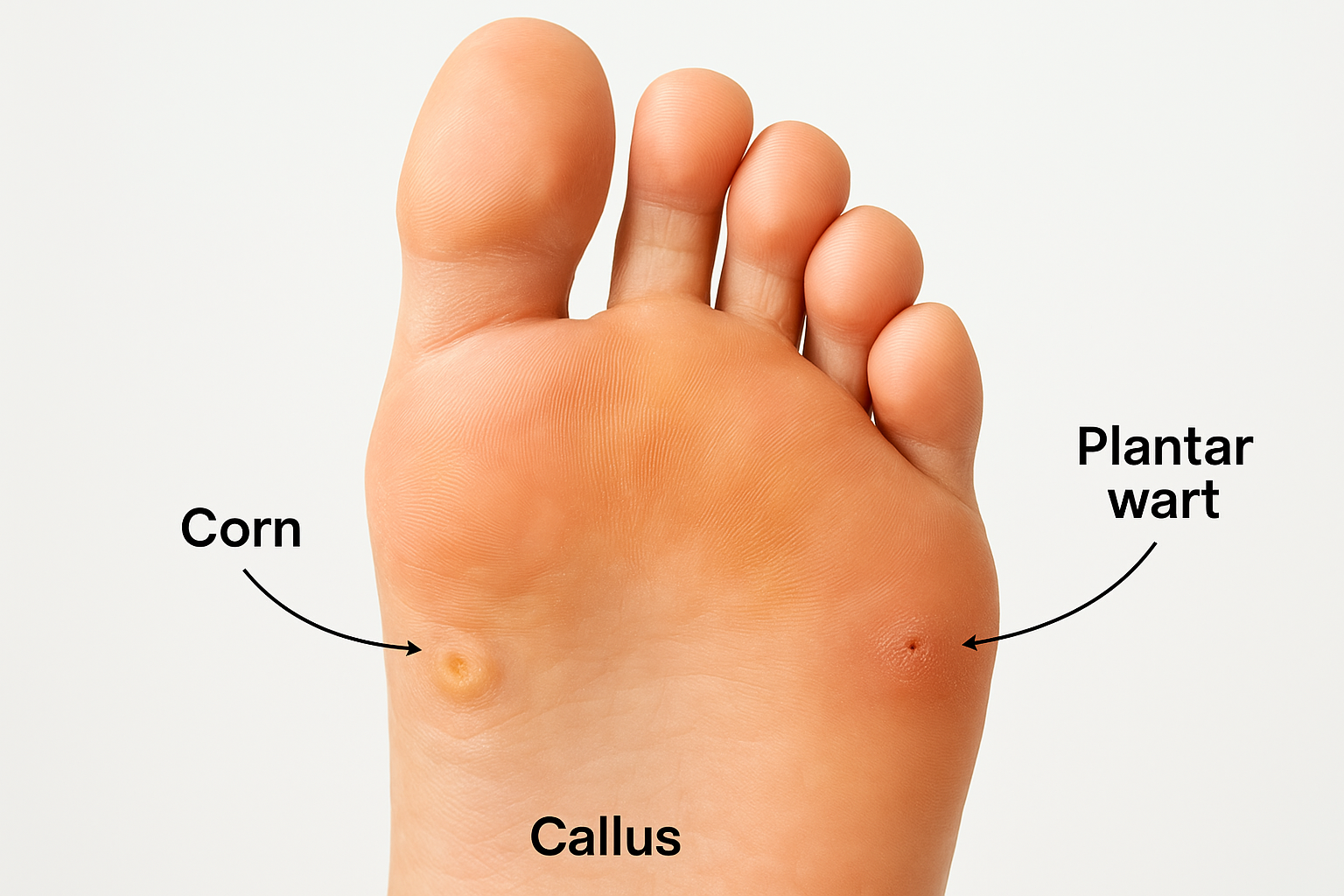
People often confuse corns, calluses, and plantar warts because all three create thickened or raised areas of skin on the foot. Understanding what are corns on feet requires knowing how to tell them apart, because each one has a different cause and requires a different treatment approach.
How a callus differs from a corn
A callus is also a patch of hardened skin caused by friction, but it covers a broader, flatter area rather than forming the tight, concentrated bump you see with a corn. Calluses most often appear on the heel or the ball of the foot, and they tend to cause less direct pain because they lack the hard central core that makes corns so uncomfortable. While a callus responds to a wide zone of pressure, a corn responds to a smaller, more focused stress point, which is why corn pain feels sharp and pinpointed rather than dull.
| Feature | Corn | Callus |
|---|---|---|
| Shape | Small, round, raised | Broad and flat |
| Location | Toes, top or sides of foot | Heel, ball of foot |
| Core | Hard central core present | No defined core |
| Pain level | Sharp, localized | Mild or none |
What makes a plantar wart different
A plantar wart looks similar to a corn at first glance, but it has a completely different origin. Plantar warts are caused by the human papillomavirus (HPV), which enters through small cuts or abrasions on the sole of your foot. Unlike a corn, a wart will often show small black dots when you look closely, which are clotted blood vessels inside the growth.
If squeezing the spot side-to-side causes more pain than pressing directly on it, you’re more likely dealing with a plantar wart than a corn.
Plantar warts also tend to interrupt the natural skin lines on the bottom of your foot, while corns and calluses follow the normal skin pattern around them. That distinction helps both patients and podiatrists identify which condition they’re actually treating, and it matters because applying corn treatment to a wart will not produce results.
How to treat and remove corns safely
Treating a corn correctly comes down to removing the source of pressure while safely reducing the thickened skin. Jumping straight to a blade or aggressive scrubbing tool without addressing what caused the corn will only bring it back within weeks. A layered approach, starting with conservative care and escalating to professional treatment when needed, gives you the best chance of long-term relief rather than temporary improvement.
Safe at-home options
The most accessible first step is soaking your foot in warm water for 10 to 15 minutes to soften the hardened skin, then gently using a pumice stone or emery board to file down the top layers. Avoid cutting corns with scissors or blades at home, as this creates a real risk of infection and skin damage, especially if you have diabetes or reduced circulation. Over-the-counter salicylic acid pads can help break down a corn gradually, but read the label carefully; these products are not appropriate for everyone, and applying them to healthy surrounding skin can cause irritation.
If you have diabetes, skip all at-home removal methods and go straight to a podiatrist, since even minor skin trauma carries serious risk.
Cushioning pads designed specifically for corn relief are available at most pharmacies and can reduce friction against the shoe while you treat the underlying problem. These work best as a short-term comfort measure, not a solution on their own.
When a podiatrist should treat the corn
Understanding what are corns on feet also means knowing when home care isn’t enough. A podiatrist can safely debride the corn using sterile instruments, removing the core and surrounding tissue in a way that significantly reduces pain right away. For corns caused by structural issues like hammertoes or bunions, your podiatrist may recommend custom orthotics to redistribute pressure, and in some cases, a minor surgical procedure to correct the underlying deformity is the only way to stop the corn from recurring.
How to prevent corns from coming back
Once you’ve treated a corn, the last thing you want is to go through the whole process again. Prevention comes down to eliminating the friction and pressure that caused the corn in the first place, which means addressing both your footwear choices and foot mechanics before they create new problems.
Choose footwear that fits properly
The right shoe fit is your first and most effective line of defense against recurring corns. Look for shoes with a wide toe box that gives your toes enough room to lie flat without crowding or rubbing against each other. Avoid pointed-toe styles and shoes that force your toes into a compressed position, since these designs recreate the exact pressure environment that grows corns.
If you shop for shoes later in the day, your feet will be at their largest, which helps you avoid buying a fit that’s too tight.
When trying on shoes, check that you have roughly a thumb’s width of space between your longest toe and the end of the shoe. Socks matter too; opt for moisture-wicking, seamless styles that reduce friction without bunching inside the shoe.
Address underlying foot structure issues
Part of understanding what are corns on feet is recognizing that footwear alone won’t solve the problem if your foot mechanics are driving the pressure. Hammertoes, bunions, high arches, and flat feet all continue to create hot spots no matter how well your shoes fit. Talk to a podiatrist about custom orthotics, which redistribute weight across your foot and reduce concentrated stress on vulnerable areas.
Stretching and strengthening exercises for your toes and intrinsic foot muscles can also improve how your foot moves and loads with each step. Consistent care, including regular moisturizing to keep skin supple and periodic professional foot exams, gives you the best chance of staying corn-free long term.
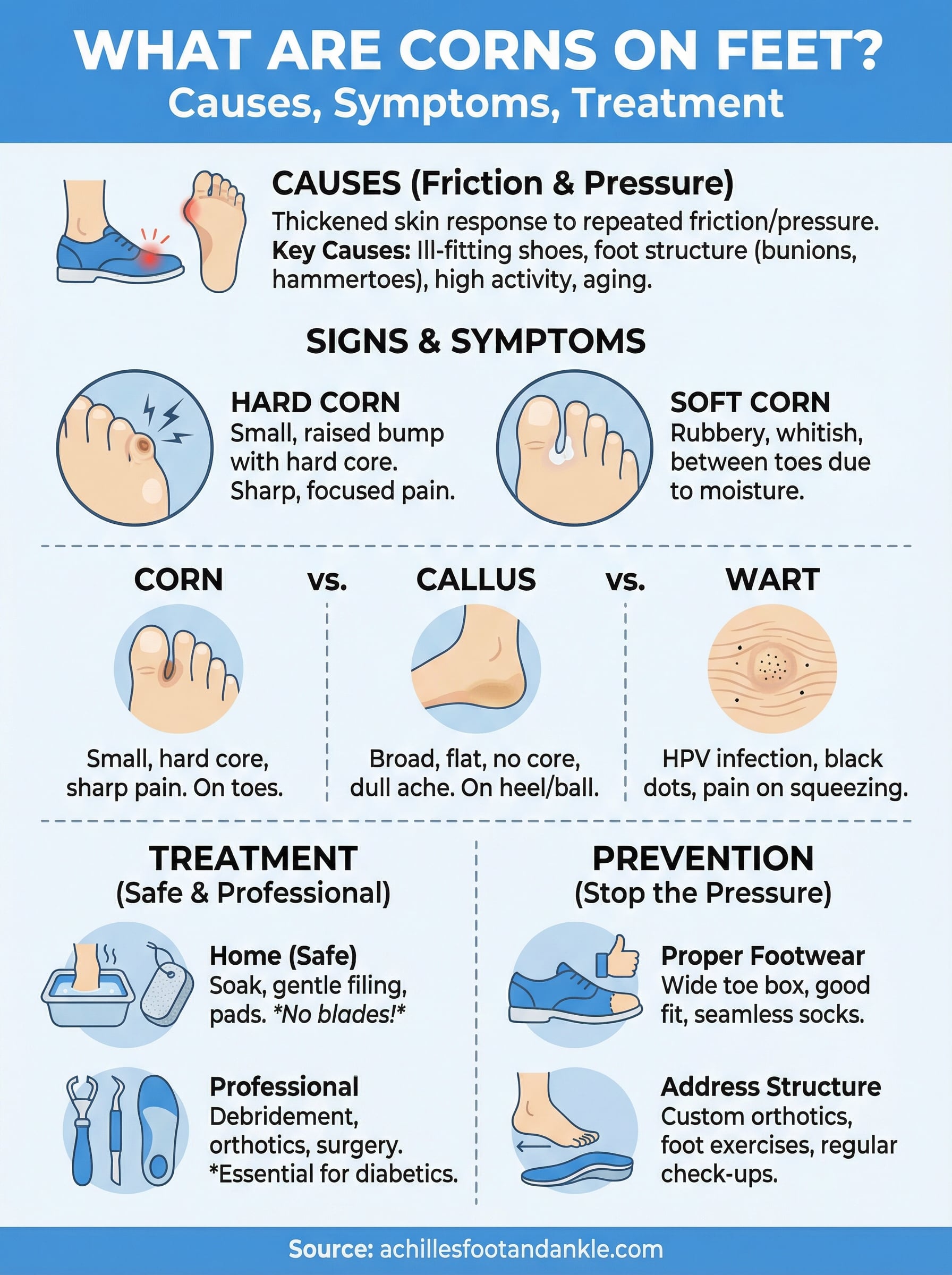
Next steps for healthier feet
Now that you understand what are corns on feet, what causes them, and how to treat them, you’re in a much better position to act before a small problem becomes a painful one. The key takeaway is straightforward: corns are a mechanical problem that responds well to the right combination of footwear changes, at-home care, and professional treatment when the situation calls for it. Ignoring them rarely makes them go away, and in people with diabetes or circulation issues, delay carries real risk.
If you’ve been dealing with a corn that won’t resolve, or if your feet are telling you something is consistently wrong, getting a professional evaluation is the most efficient path to relief. The team at Achilles Foot and Ankle Center treats corns and the underlying conditions that cause them every day. Schedule a same-day appointment and get your feet moving comfortably again.