

That ache across the top or bottom of your midfoot doesn’t always announce itself with a dramatic injury. Sometimes it builds slowly after a long day on your feet, other times it shows up overnight and won’t let you put weight down comfortably. If you’re searching for what causes pain in middle of foot, you’re probably trying to figure out whether this is something you can manage at home or something that needs a doctor’s attention.
Midfoot pain usually traces back to one of a handful of culprits: plantar fasciitis, stress fractures, tendon inflammation, arthritis, or nerve compression like Morton’s neuroma, and it helps to know how plantar fasciitis differs from ordinary arch pain. The location, timing, and type of pain (sharp versus dull, constant versus activity-related) all offer clues about which one you’re dealing with, and some causes come with warning signs that shouldn’t be ignored.
Below, we break down the most common reasons for middle foot pain, what symptoms tend to accompany each one, and when it’s time to stop guessing and get it checked. Our podiatrists at Achilles Foot and Ankle Center see these cases regularly across our Central Virginia locations, and we know that catching the right diagnosis early makes recovery faster and simpler.
Why middle foot pain deserves your attention
Ignoring midfoot pain rarely makes it disappear on its own. The midfoot packs a dense network of small bones, ligaments, and tendons into a tight space, so a problem in one structure often changes how you walk, which then strains your knees, hips, or lower back over time. What causes middle foot pain in one person, say a stress fracture with the telltale signs of a stress fracture in the foot after ramping up running mileage too fast, can look completely different from the burning nerve pain another person feels from Morton’s neuroma. Knowing the difference matters because the wrong home remedy can delay healing or let the underlying problem get worse.
The longer you push through midfoot pain without a diagnosis, the more likely a minor issue turns into a chronic one.
The most common culprits
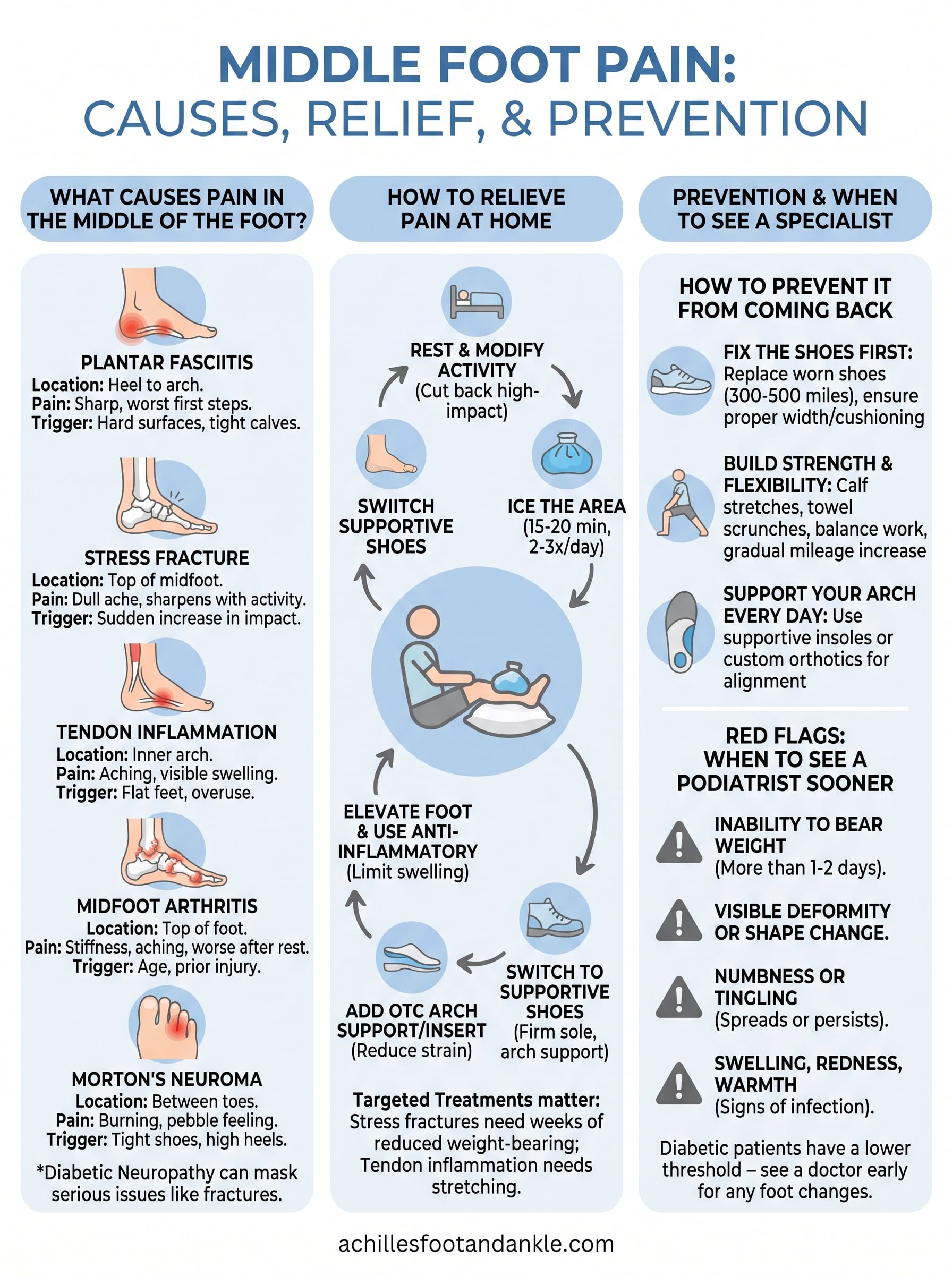
Most cases of midfoot pain trace back to a short list of diagnoses, and each one has a distinct pattern of symptoms that can help you narrow things down before you even walk into a clinic.

| Cause | Typical location | Pain pattern | Common trigger |
|---|---|---|---|
| Plantar fasciitis | Heel and arch, radiating into midfoot | Sharp, worst with first steps in the morning | Standing/walking on hard surfaces, tight calves |
| Stress fracture | Top of midfoot | Dull ache that sharpens with activity | Sudden increase in running or high-impact exercise |
| Tendon inflammation | Inner arch | Aching, visible swelling along the tendon | Flat feet, overuse, extra body weight |
| Midfoot arthritis | Top of foot, spreading with activity | Stiffness, aching, worse after rest | Age, prior injury, joint wear |
| Morton’s neuroma | Between third and fourth toes | Burning, tingling, feels like a pebble in the shoe | Tight or narrow shoes, high heels |
Why the details matter
Pinpointing the exact structure involved changes the treatment plan completely. A stress fracture needs weeks of reduced weight-bearing to heal properly, while tendon inflammation often responds well to targeted stretching and bracing instead. Treating one condition like the other wastes valuable time and can turn a six-week recovery into a six-month one, which is exactly why guessing at home rarely pays off.
Diabetic and nerve-related complications
Nerve damage from diabetes, known as peripheral neuropathy, adds another layer of concern to midfoot symptoms, and it’s worth understanding when foot numbness is serious. Numbness can mask a fracture or a developing ulcer until it’s already advanced, which is why our diabetic foot care program builds in regular sensation checks and imaging for at-risk patients. Sensory loss combined with reduced blood flow means small problems escalate quickly, sometimes without the pain that would normally send someone to a doctor sooner.
Left unaddressed, several of these conditions lead to permanent joint damage, chronic instability, or, in diabetic patients, wounds that are slow to heal. That’s the real reason midfoot pain deserves more than a shrug and a bag of ice: catching the cause early keeps a manageable problem from becoming one you’ll be dealing with for years.
How to relieve pain in the middle of your foot
Once you have a decent guess at what’s causing your discomfort, most mild to moderate cases respond well to the same first-line approach. Rest and activity modification come first: cutting back on high-impact exercise for a week or two gives inflamed tissue a chance to calm down without you losing all your conditioning. Swimming or cycling can keep you active while you take weight off the midfoot.
Rest doesn’t mean sitting still forever, it means giving the injured structure a break long enough to actually heal.
Home care basics
Simple, consistent home care handles a surprising number of midfoot complaints, especially ones tied to overuse rather than structural damage, and our podiatrist-approved tips for treating foot pain at home cover the basics. Try these steps for the first one to two weeks:
- Ice the area for 15-20 minutes, two to three times a day, especially after activity
- Switch to supportive shoes with a firm sole and good arch support, and skip flip-flops or worn-out sneakers
- Add an over-the-counter arch support or insert to reduce strain on the midfoot bones and ligaments
- Take an anti-inflammatory like ibuprofen if your doctor says it’s safe for you, to reduce swelling and pain
- Elevate your foot when you’re sitting or lying down to limit swelling at the end of the day
Giving these a fair trial for two weeks tells you a lot. If the pain eases steadily, you’re likely dealing with a manageable overuse issue. If it doesn’t budge, or gets worse, that’s a signal the cause is something home care alone won’t fix.
Targeted treatments for specific causes
Beyond the basics, treatment often needs to match the diagnosis directly. A suspected stress fracture calls for a stiff-soled shoe or walking boot and a real break from impact activity, sometimes for six to eight weeks, which is the core of healing a stress fracture at home. Tendon inflammation usually improves with a stretching routine aimed at the calf and arch, paired with a brace to limit motion during the worst of the flare-up. Nerve-related pain from something like Morton’s neuroma often responds to wider shoes and a metatarsal pad that shifts pressure away from the nerve, and there are further treatment options for Morton’s neuroma if that isn’t enough.
Several of these treatments are things we build into a custom plan at our clinics, using custom orthotics or bracing fitted to your specific foot shape rather than a generic drugstore insert. Matching the fix to the actual problem is what separates quick relief from months of frustration.
How to prevent midfoot pain from coming back
Once your pain calms down, the real work is making sure it doesn’t return in three months. Most recurrences trace back to the same triggers that caused the problem the first time, usually a mismatch between your shoes, your training load, and the actual shape of your foot. Understanding what causes pain in middle of foot issues in the first place is the key to building habits that keep the problem from resurfacing.
Preventing midfoot pain isn’t about doing more, it’s about removing the specific stress that caused it.
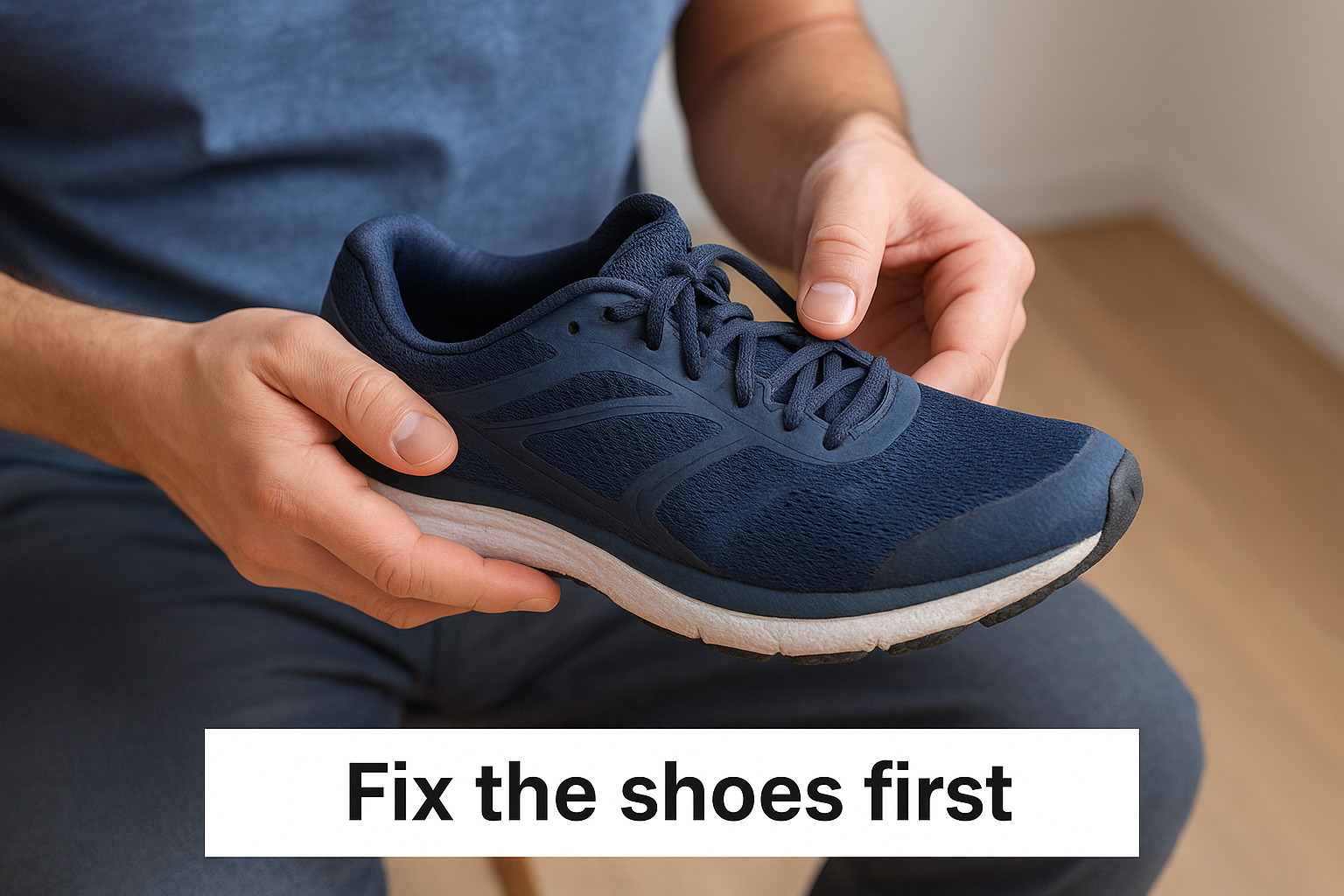
Fix the shoes first
Worn-out or poorly fitted shoes are behind a huge share of repeat cases we see. A shoe that’s lost its cushioning stops absorbing shock, so that impact travels straight into your midfoot bones with every step. Rotate your athletic shoes every 300 to 500 miles, and get fitted for width as well as length since a narrow toe box is a common trigger for nerve-related pain.
Build strength and flexibility gradually
Tight calves and weak intrinsic foot muscles put extra strain on the midfoot, so a short daily routine pays off, much like the habits behind keeping plantar fasciitis from starting. Focus on:
- Calf stretches against a wall, held for 30 seconds, twice daily
- Towel scrunches to strengthen small foot muscles
- Balance work on one foot to improve stability and control
- Gradual mileage increases of no more than 10% per week if you run
Support your arch every day
Standing or walking for hours without arch support wears down tissue slowly over weeks, not all at once. Custom orthotics correct alignment issues that even the best arch support insoles can’t touch, especially if you have flat feet or a high arch that shifts weight unevenly across the midfoot. Our team fits these based on how you actually walk, not just how your foot looks standing still.
Sustaining these habits matters more for some patients than others. If you have diabetes or a history of neuropathy, daily foot checks catch small problems before they turn into something serious, since reduced sensation can hide early warning signs. Pair that habit with well-fitted diabetic shoes and you dramatically lower the odds of a repeat episode, whatever the original cause turned out to be.
When it’s time to see a foot and ankle specialist
Home care solves plenty of midfoot pain cases, but certain signs mean you shouldn’t wait two weeks to find out if things improve. Sharp pain that hits suddenly, foot swelling that doesn’t respond to ice, or an inability to bear weight at all point toward something that needs imaging and a professional diagnosis rather than a trial run with rest and ibuprofen.
Red flags that call for immediate care
Certain symptoms move a case from wait-and-see to same-day territory. Watch for:
- Inability to bear weight on the affected foot for more than a day or two
- Visible deformity or a foot that looks different in shape compared to the other side
- Numbness or tingling that spreads or doesn’t improve with a shoe change
- Swelling and redness paired with warmth, which can signal infection
- Pain that wakes you up at night or keeps getting worse despite rest
Any one of these deserves a same-day evaluation rather than another week of guessing.
If you can’t put weight on your foot without significant pain, that’s your body telling you to get it imaged, not iced.
Why diabetic patients face a lower threshold
Anyone managing diabetes or peripheral neuropathy should treat midfoot symptoms with extra urgency, even mild ones. Numbness can hide a fracture or a developing ulcer for weeks, and by the time pain finally shows up, the damage is often further along than it looks. If you notice any change in your foot’s color, temperature, or shape, don’t wait for pain to confirm something’s wrong. Our diabetic foot care team schedules these patients faster precisely because the stakes of a missed early sign are so much higher.
What a specialist visit actually involves
Getting evaluated by a podiatrist isn’t just a formality before more home remedies, and midfoot pain is only one of the reasons to get a podiatry evaluation. A proper workup usually includes a physical exam, a look at your gait and shoe wear, and imaging like an X-ray or ultrasound to confirm what’s actually happening under the skin. That level of detail is what separates a guess from an actual diagnosis, and it’s the fastest route to a treatment plan that fixes the real problem instead of masking symptoms for a few more weeks.
Getting back on your feet
Midfoot pain has a clear cause almost every time, whether it’s plantar fasciitis, a stress fracture, tendon strain, arthritis, or a pinched nerve. The trick is matching the right treatment to the right diagnosis instead of guessing your way through weeks of rest that may not even target the real problem. Home care handles plenty of mild cases, but sharp pain, swelling that won’t quit, or numbness are your cue to stop waiting and start asking questions.
Recovery goes faster when you catch the cause early, and that’s true whether you’re dealing with a weekend athlete’s stress fracture or a diabetic patient’s early warning sign. You know your foot better than anyone, so trust it when something feels off longer than it should.
Our team at Achilles Foot and Ankle Center sees these cases every week across Central Virginia, and we can usually tell you what’s going on the same day you walk in. Reserve a same-day visit with our podiatrists and get a real answer instead of another guess.