

That burning, tingling, or electric-shock sensation in your foot isn’t something to ignore. If you’re searching for what causes nerve pain in your foot, you’re probably already dealing with symptoms that interfere with walking, sleeping, or just getting through your day, and you want answers, not guesses.
Foot nerve pain usually traces back to a handful of common culprits: diabetic peripheral neuropathy, tarsal tunnel syndrome, Morton’s neuroma, a pinched nerve from injury, or nerve compression caused by structural issues like bunions or flat feet. Each condition has distinct symptoms and triggers, and pinpointing which one applies to you is the first step toward real relief instead of temporary fixes.
Below, we break down the most frequent causes of foot nerve pain, what symptoms typically accompany each one, and when it’s time to stop self-treating and see a specialist. Our podiatrists at Achilles Foot and Ankle Center diagnose these conditions daily using advanced imaging and nerve testing, so you’ll also get a sense of what an accurate diagnosis actually involves.
Why nerve pain in your foot shouldn’t be ignored
Nerve pain rarely fixes itself. Unlike a sore muscle that heals with rest, damaged nerve tissue tends to get worse the longer it’s left untreated, and what starts as occasional tingling can progress into constant burning, numbness, or even loss of balance. Many patients wait months before booking an appointment, assuming the sensation will fade, only to discover the underlying condition has advanced to the point where treatment options are more limited and recovery takes longer.
Nerve pain often signals a bigger problem
Sensations like burning feet, pins and needles, or a stabbing pain between your toes are your body’s early warning system. These symptoms typically point to nerve compression, metabolic damage, or an injury that hasn’t healed correctly. In diabetic patients especially, foot nerve pain can be one of the first signs of peripheral nerve damage in the feet, a condition that, left unmanaged, raises the risk of unnoticed cuts, infections, and even amputation. The American Diabetes Association notes that nerve damage affects roughly half of people with diabetes over time, which is why routine foot checks matter so much for that population.
Ignoring foot nerve pain doesn’t make the underlying nerve damage go away, it just gives it more time to get worse.
Waiting can limit your treatment options
Early-stage nerve compression often responds well to conservative care such as orthotics, physical therapy, or targeted injections. Once nerve damage becomes chronic, though, those same treatments become less effective, and surgical intervention may be the only path to relief. Podiatrists see this pattern constantly: a patient with Morton’s neuroma who could have managed symptoms with padding and shoe changes a year ago now needs surgical removal of the affected nerve tissue.
It can also throw off your gait and balance
Severe or prolonged nerve pain changes how you walk, whether you realize it or not. Shifting your weight to avoid a painful spot puts stress on your knees, hips, and lower back, and numbness in the foot increases your fall risk, particularly in older adults. Treating the root cause early protects more than just your foot, it protects your overall mobility and independence.
How doctors pinpoint the cause of foot nerve pain
Getting an accurate diagnosis starts with more than just describing your symptoms. A thorough podiatric exam combines your medical history, a physical evaluation of your foot’s structure, and targeted tests that reveal exactly which nerve is affected and why. Because so many conditions share overlapping symptoms, like burning, tingling, or numbness, guessing at the cause often leads to the wrong treatment plan entirely.
A precise diagnosis is what separates a treatment plan that actually works from months of trial and error.
The diagnostic tools podiatrists rely on
Our team at Achilles Foot and Ankle Center typically works through a sequence of tests to narrow down the source of your foot nerve pain:

- Physical exam and gait analysis to check for structural issues like flat feet, bunions, or abnormal pressure points
- Nerve conduction studies that measure how well electrical signals travel along the affected nerve
- Diagnostic ultrasound to visualize soft tissue and detect thickened nerves, as seen in Morton’s neuroma
- Digital imaging or X-rays to rule out fractures, arthritis, or bone spurs pressing on a nerve
- Blood work to check for diabetes or other metabolic conditions tied to peripheral nerve damage
Each of these tools answers a different question, and combining them gives a much clearer picture than any single test alone.
Why the right diagnosis matters so much
Skipping proper testing means treating symptoms instead of the actual problem, which is why an accurate diagnosis matters. Two patients with identical burning sensations in their toes might have completely different underlying causes, one a pinched nerve from tight footwear, the other early diabetic neuropathy. Testing removes the guesswork and points directly toward treatment that fits your specific condition.
Common conditions that cause nerve pain in the foot
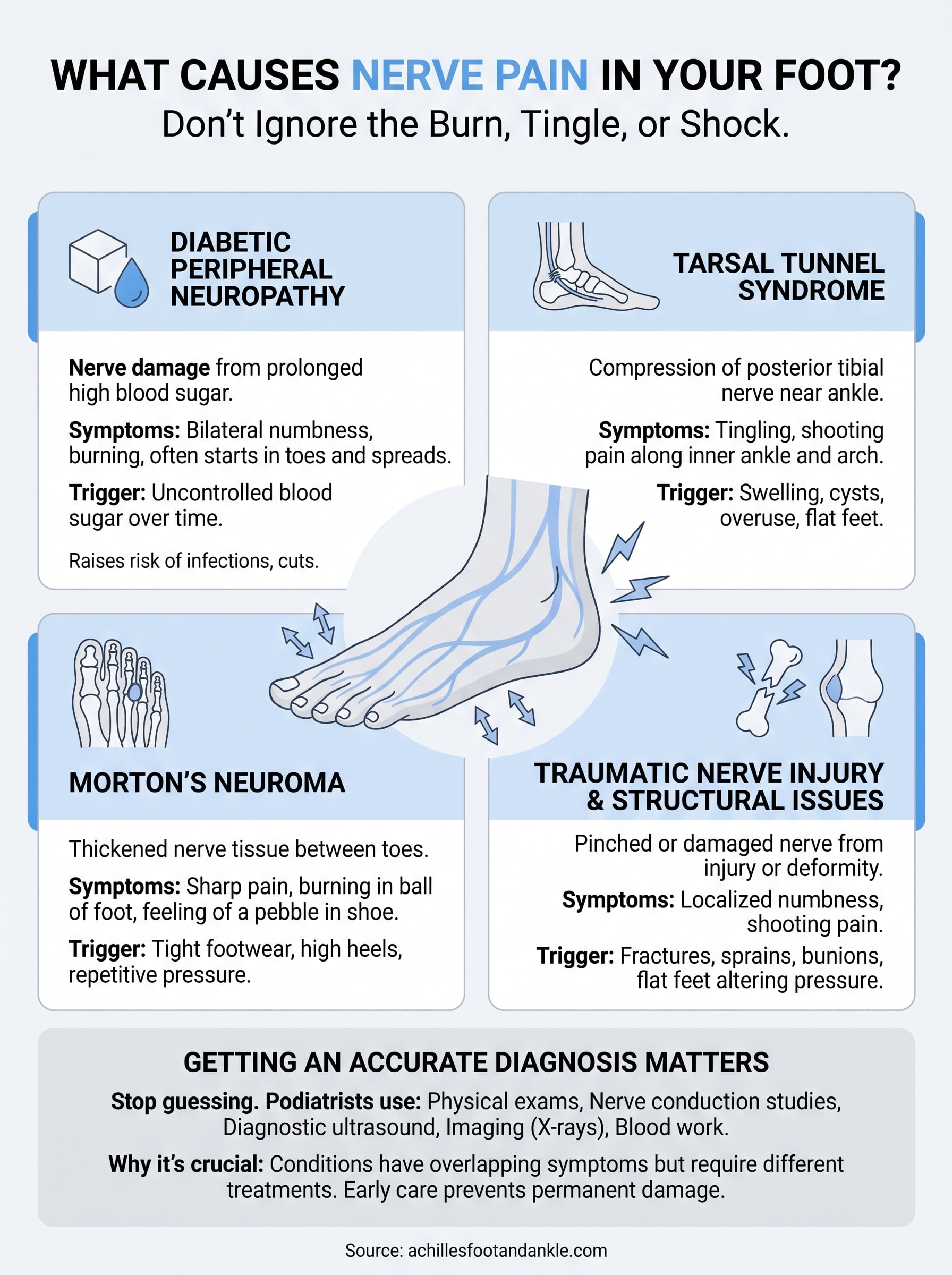
Several distinct conditions account for most cases of foot nerve pain, and each one has its own pattern of symptoms and its own trigger. Diabetic peripheral neuropathy develops from prolonged high blood sugar damaging small nerve fibers, usually starting in the toes and spreading upward. Tarsal tunnel syndrome happens when the posterior tibial nerve gets compressed as it passes through a narrow tunnel near the ankle, often from swelling, a cyst, or overuse. Morton’s neuroma involves thickened nerve tissue between the third and fourth toes, typically caused by tight shoes or repetitive pressure from running or dancing.

Most foot nerve pain traces back to one of just a few conditions, and each one responds to a different treatment.
Comparing the leading causes
Here’s how the most frequent diagnoses stack up against each other:
| Condition | Typical symptoms | Common trigger |
|---|---|---|
| Diabetic neuropathy | Numbness, burning, symmetric pain in both feet | Uncontrolled blood sugar over time |
| Tarsal tunnel syndrome | Tingling, shooting pain along the inner ankle and arch | Nerve compression from swelling or overuse |
| Morton’s neuroma | Sharp pain between third and fourth toes | Tight footwear, high heels, repetitive impact |
| Traumatic nerve injury | Localized numbness or shooting pain after injury | Fracture, sprain, or surgical scar tissue |
Structural causes deserve attention too
Underlying foot deformities, including bunions, flat feet, and severe arthritis, can also produce a pinched nerve in the foot by altering how pressure distributes across your joints. Left uncorrected, these structural issues keep irritating the same nerve pathways no matter how many times symptoms are treated. Our team at Achilles Foot and Ankle Center evaluates your foot care needs as a diabetic patient alongside structural factors, since the two frequently overlap in patients with long-term nerve symptoms.
How to relieve nerve pain in your foot at home
Some mild cases of foot nerve pain respond well to changes you can make without a prescription. Home care works best for early-stage nerve irritation, not established neuropathy or a thickened neuroma, so treat these steps as a starting point rather than a cure.
Simple steps worth trying first
Start with the basics before assuming you need a specialist visit:
- Switch to wider, low-heeled shoes that don’t compress your toes or arch
- Ice the painful area for 15 minutes to calm inflammation around the nerve
- Try over-the-counter arch supports to reduce pressure on the tarsal tunnel
- Stretch your calves and plantar fascia daily to ease tension along the nerve pathway
- Keep blood sugar in check if you have diabetes, since tight glucose control slows nerve damage
Home remedies can quiet mild nerve irritation, but they can’t reverse nerve damage that’s already underway.
Know the limits of self-treatment
Home measures rarely resolve tarsal tunnel syndrome or advanced diabetic neuropathy on their own, because the underlying compression or metabolic damage keeps working against you, and treating tarsal tunnel syndrome usually calls for more than shoe changes. Numbness that spreads, pain that worsens at night, or symptoms lasting more than two to three weeks despite rest and shoe changes are signs the problem needs professional evaluation. Padding a Morton’s neuroma might quiet symptoms for a while, but if the nerve tissue keeps thickening, padding alone won’t stop it from eventually requiring an injection or surgical fix.
When to see a podiatrist for foot nerve pain
Knowing when self-care isn’t enough saves you weeks of frustration. Persistent nerve pain that doesn’t improve after two to three weeks of home treatment, or that keeps you up at night, warrants a professional evaluation rather than another round of ice packs and new shoes.
Red flags you shouldn’t wait out
Certain symptoms mean you need to call a podiatrist right away instead of waiting to see if things improve on their own:
- Numbness or tingling that spreads beyond the original spot
- Pain that wakes you up with burning feet or worsens when you’re off your feet
- Any open sore or wound on a foot with reduced sensation, especially with diabetes
- Weakness that affects your balance or causes you to trip
- Symptoms lasting more than three weeks despite shoe changes and rest
If your foot symptoms are changing your gait, sleep, or balance, that’s your cue to get evaluated, not to wait it out.
What a specialist visit actually involves
Seeing a podiatrist early means catching nerve compression before it becomes permanent damage, and expert nerve pain treatment in Richmond is available close to home. Our team at Achilles Foot and Ankle Center can typically identify the source of your symptoms in a single visit, using the same targeted exams and imaging described earlier, and outline a treatment path suited to your specific diagnosis. Treating a suspected sports injury or nerve issue right after it starts almost always means simpler, less invasive care than treating one that’s been ignored for months. Reaching out sooner rather than later keeps your options open and your recovery timeline shorter.
Getting to the bottom of your foot pain
Foot nerve pain almost always has an identifiable cause, whether that’s diabetic neuropathy, tarsal tunnel syndrome, a neuroma, or a structural issue putting pressure on a nerve. Guessing at home treatments might quiet symptoms for a while, but only an accurate diagnosis actually stops the underlying problem from progressing. The sooner you understand what causes nerve pain in your foot, the sooner you can choose a treatment that actually fits your condition instead of cycling through remedies that only mask it.
Guessing wastes time you don’t need to lose. If your symptoms have lasted more than a couple weeks, or you’re noticing numbness, weakness, or pain that disrupts your sleep, that’s your signal to get checked rather than wait it out. Our podiatrists can usually pinpoint the source in one visit and get you started on a plan that fits your specific diagnosis. Reserve a same-day visit with our podiatrists and get real answers instead of more guesswork.