
You pushed through that last mile, and now the arch of your foot is screaming at you. Arch pain from running is one of the most common complaints we hear from runners of all levels, from weekend joggers to competitive athletes. It can start as a mild ache and quickly turn into something that sidelines you for weeks if you ignore it.
The tricky part is that arch pain doesn’t have a single cause. It can stem from overuse, poor foot mechanics, worn-out shoes, or an underlying condition that needs professional attention. Knowing what’s behind your pain makes all the difference between a quick recovery and a chronic problem that keeps coming back.
At Achilles Foot and Ankle Center, our podiatrists across Central Virginia treat runners dealing with this exact issue every day. Below, we break down nine common causes of arch pain from running, explain what’s actually happening in your foot, and walk you through proven ways to fix it, so you can get back on the road or trail with confidence.
1. You have a stress fracture or a plantar fascia tear
A stress fracture or a full plantar fascia tear sits at the serious end of arch pain from running. These injuries don’t always announce themselves loudly at first, which is why runners sometimes keep going until the damage becomes significantly worse and forces them off the road entirely.
What it feels like
A stress fracture in the metatarsal or navicular bone typically produces sharp, localized pain that worsens with each step and eases when you rest. A plantar fascia tear often causes a sudden pop or snap sensation followed by intense pain in the arch or heel. Swelling and bruising may appear within hours of the injury.
If you felt a sudden snap in your arch mid-run and the pain stopped you immediately, treat it as a tear until a podiatrist confirms otherwise.
Why it happens in runners
Both injuries share a common root: repetitive mechanical stress placed on tissue or bone without adequate recovery time. Stress fractures develop when your bones absorb more impact than they can handle, especially during high-mileage weeks or speed sessions on hard pavement. A plantar fascia tear often follows months of chronic inflammation that has gradually weakened the tissue to the point where it can no longer hold up under load.
What to do now
Stop running immediately. Ice the area for 15-20 minutes several times a day to manage swelling and reduce inflammation. Keep weight off the foot as much as possible and avoid any activity that reproduces the pain. You can use over-the-counter arch support insoles as temporary padding, but they will not fix the underlying structural injury on their own.
When to see a podiatrist
See a podiatrist within 24 to 48 hours if you suspect either of these injuries. Both conditions require diagnostic imaging, such as an X-ray or MRI, to confirm what is actually happening in the foot. A stress fracture that goes untreated can progress to a complete break, while a plantar fascia tear may need immobilization, targeted physical therapy, or surgical repair depending on the severity. Early evaluation cuts your total recovery time down considerably.
2. You have plantar fasciitis
Plantar fasciitis is the most common source of arch pain from running, and it tends to sneak up on runners because it often feels minor at first before turning into a stubborn, daily problem that interferes with training and basic movement.
What it feels like
The classic sign is a sharp, stabbing pain in the heel or along the arch that hits hardest during your first few steps out of bed or after sitting for a long period. The pain usually fades as you warm up but tends to return after long runs or by the end of the day.
Why it happens in runners
The plantar fascia is a thick band of tissue connecting your heel bone to your toes. Repeated impact during running creates tiny tears in this band, triggering inflammation and pain. Runners with tight calves, flat feet, or high arches are especially vulnerable because all three conditions put excess tension on the fascia with every stride.
Plantar fasciitis rarely resolves without addressing the mechanical cause driving the repeated strain.
What to do now
Stretch your calves and plantar fascia daily, especially before your first steps in the morning. Rolling a frozen water bottle under your arch for 10 minutes reduces acute inflammation and provides real short-term relief.
When to see a podiatrist
Book an appointment if pain persists beyond two to three weeks of consistent home care. A podiatrist can assess your foot mechanics and recommend custom orthotics, targeted physical therapy, or corticosteroid injections to accelerate your recovery.
3. You have posterior tibial tendon pain
The posterior tibial tendon runs along the inside of your ankle and into the arch, and when it gets irritated or damaged, it produces a distinct type of arch pain from running that many people mistake for plantar fasciitis. Getting the right diagnosis early matters because this condition can progress to a full tendon rupture and a collapsed arch if left untreated.
What it feels like
Pain from posterior tibial tendon dysfunction typically shows up along the inner ankle and inner arch, rather than the heel. You may notice swelling on the inside of the ankle, and the pain tends to worsen during activity and linger well after your run ends.
Why it happens in runners
The posterior tibial tendon works hard with every stride to support your arch and stabilize your foot. High mileage, overpronation, and running on uneven terrain all force this tendon to absorb extra load. Runners with flat feet face a higher risk because the tendon is already working at a mechanical disadvantage.
If you notice your arch visibly flattening or your heel tilting outward when you stand, your posterior tibial tendon may already be under significant stress.
What to do now
Reduce your mileage immediately and apply ice to the inner ankle for 15 minutes after activity. Supportive footwear with a firm midsole takes meaningful stress off the tendon during daily movement.
When to see a podiatrist
See a podiatrist promptly if inner ankle swelling does not improve within a week. Treatment often includes custom orthotics, bracing, or physical therapy to prevent further tendon damage.
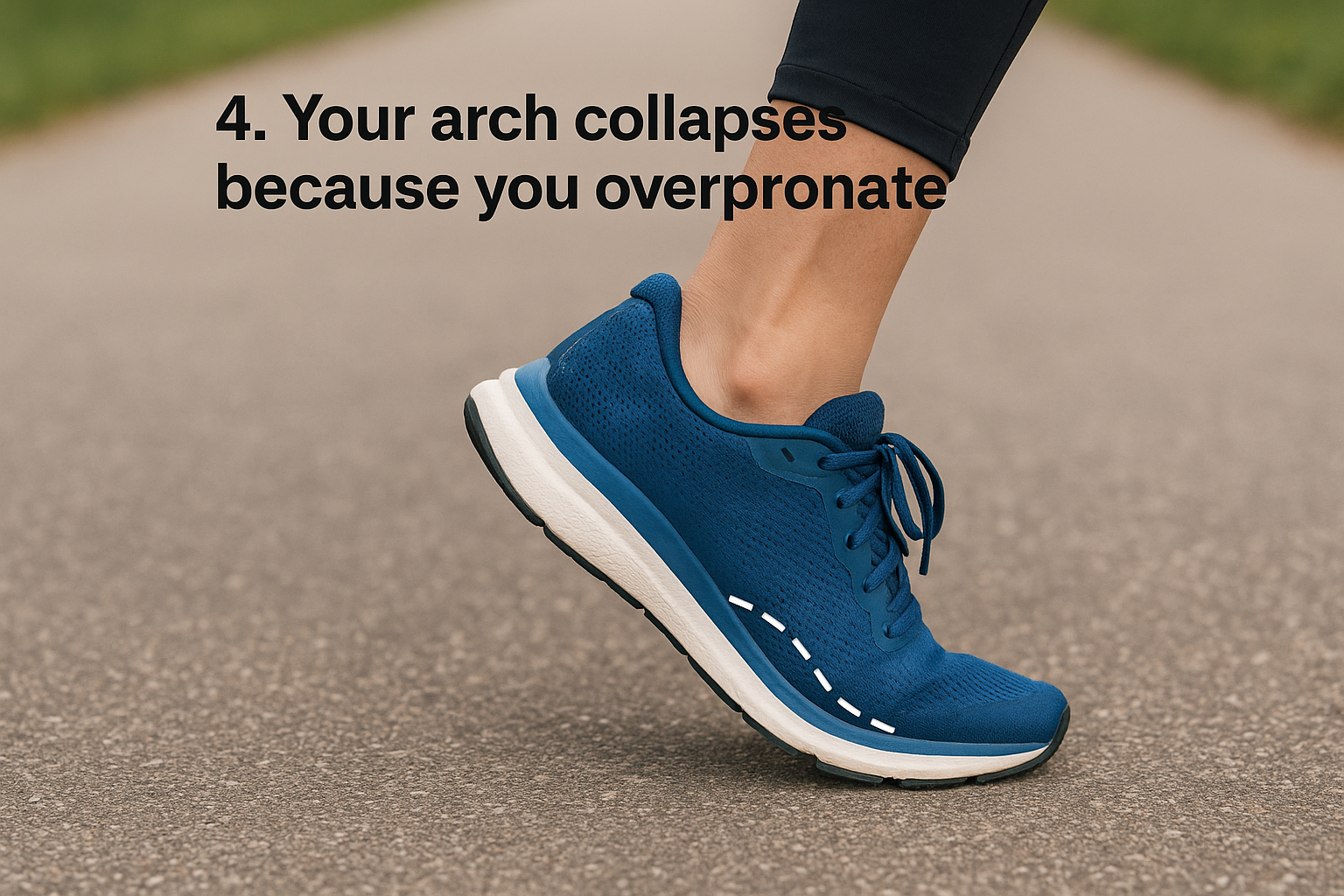
4. Your arch collapses because you overpronate
Overpronation means your foot rolls inward excessively with each step, causing your arch to collapse toward the ground. This mechanical pattern puts the entire midfoot under repeated strain, and for runners, it’s a reliable path to arch pain from running that compounds with every mile you log.
What it feels like
Overpronation-related pain tends to spread across the entire inner arch rather than concentrating at a single point. You may notice the discomfort builds gradually during a run and leaves your arch feeling tired, achy, or sore for hours after you stop.
Why it happens in runners
Your foot naturally pronates slightly to absorb shock, but when it rolls too far inward, the arch loses its structural integrity and flattens under load. Runners with flat feet or weak hip and ankle stabilizers overpronate most often, especially as fatigue sets in during longer runs.
Worn-down shoe soles that tilt noticeably inward are a visible sign you’re overpronating with every stride.
What to do now
Switch to motion-control or stability running shoes designed to limit excessive inward roll. Strengthening exercises targeting your glutes, calves, and intrinsic foot muscles reduce the mechanical demand on your arch and help correct the movement pattern over time.
When to see a podiatrist
Schedule an appointment if new shoes and strengthening work don’t reduce your pain within three to four weeks. A podiatrist can perform a gait analysis and fit custom orthotics that correct your foot mechanics precisely and prevent long-term joint damage.
5. Your high arches overload the midfoot
High arches might sound like a structural advantage, but for runners, they create a specific mechanical problem that leads directly to arch pain from running. Unlike flat feet, a high-arched foot is rigid and inflexible, which means it cannot distribute ground impact effectively across the entire foot.
What it feels like
Pain from high arches typically concentrates along the outer edge of the foot and through the midfoot. You may notice your arch feels tight or stiff, and the pain tends to spike during longer runs when cumulative impact has nowhere to disperse.
Why it happens in runners
A high-arched foot has a reduced contact area with the ground, so pressure concentrates on the heel and ball of the foot rather than spreading evenly. This forces the midfoot and surrounding soft tissue to absorb far more load than they’re designed to handle with each footfall.
Runners with high arches tend to supinate, rolling outward rather than inward, which increases stress fracture risk in the outer foot bones.
What to do now
Choose cushioned running shoes with a neutral or curved last to improve shock absorption across the foot. Adding flexible, cushioned insoles with arch support designed specifically for high arches reduces midfoot pressure significantly during every run.
When to see a podiatrist
See a podiatrist if midfoot pain persists beyond a few weeks of adjusted footwear. Custom orthotics built for your specific arch profile provide support that off-the-shelf insoles cannot replicate, and a gait analysis will confirm whether supination is compounding your injury risk.
6. Your running shoes cause the problem
Your shoes are the only barrier between your foot and the ground, so when they fail, your arch pays the price. Worn-out midsoles, poor arch support, and the wrong shoe type for your foot mechanics are among the most overlooked triggers of arch pain from running, yet they are also among the most straightforward to fix.
What it feels like
Shoe-related arch pain typically spreads diffusely across the arch and heel rather than concentrating at one specific spot. You may notice the discomfort arrives earlier and earlier into your runs as your shoes age, which signals that the cushioning is no longer absorbing impact the way it should.
Why it happens in runners
Running shoes lose their shock-absorbing capacity long before the outsole looks visibly worn. Most pairs are built to last 300 to 500 miles, after which the foam compresses and stops protecting your foot with each stride.
Replace your running shoes every 300 to 500 miles, even if they still look new on the outside.
Shoes with the wrong support level for your arch type compound the damage further by placing the load on the wrong structures with every footfall.
What to do now
Check the mileage on your current pair and swap them out if you’ve passed the 400-mile mark. Visit a specialty running store for a proper fitting based on your arch type and gait pattern before buying your next pair.
When to see a podiatrist
Book an appointment if new, properly fitted shoes don’t ease your pain within two to three weeks. A podiatrist can determine whether custom orthotics are necessary to correct the underlying mechanics your shoes alone cannot fix.
7. You ramped up training too fast or changed surfaces
One of the most preventable causes of arch pain from running is a sudden spike in training load or an abrupt switch to a harder or softer running surface. Your foot needs time to adapt, and when you remove that adaptation window, the soft tissue and bones in your arch absorb stress faster than they can recover.
What it feels like
This type of arch pain usually develops gradually over several days or weeks rather than appearing suddenly. You may notice a dull, spreading ache across the arch that arrives earlier in your runs compared to when you first started the new training block or surface.
Why it happens in runners
Your arch acts as a shock absorber, and every new surface or increased workload changes the mechanical demands placed on it. Jumping from trails to pavement, adding 20% or more mileage in a single week, or introducing back-to-back hard days all exceed the tissue’s capacity to repair itself between sessions.
The 10% rule, limiting weekly mileage increases to no more than 10% at a time, exists specifically because soft tissue adaptation lags behind cardiovascular fitness.
What to do now
Pull your weekly mileage back to a level that felt comfortable and build again more gradually. If you switched surfaces, alternate between both to allow progressive adaptation before committing fully to the new terrain.
When to see a podiatrist
See a podiatrist if the pain doesn’t settle within two weeks of reduced training. Continuing to push through overload injuries often turns a manageable strain into a stress fracture or tendon injury that requires a much longer recovery.
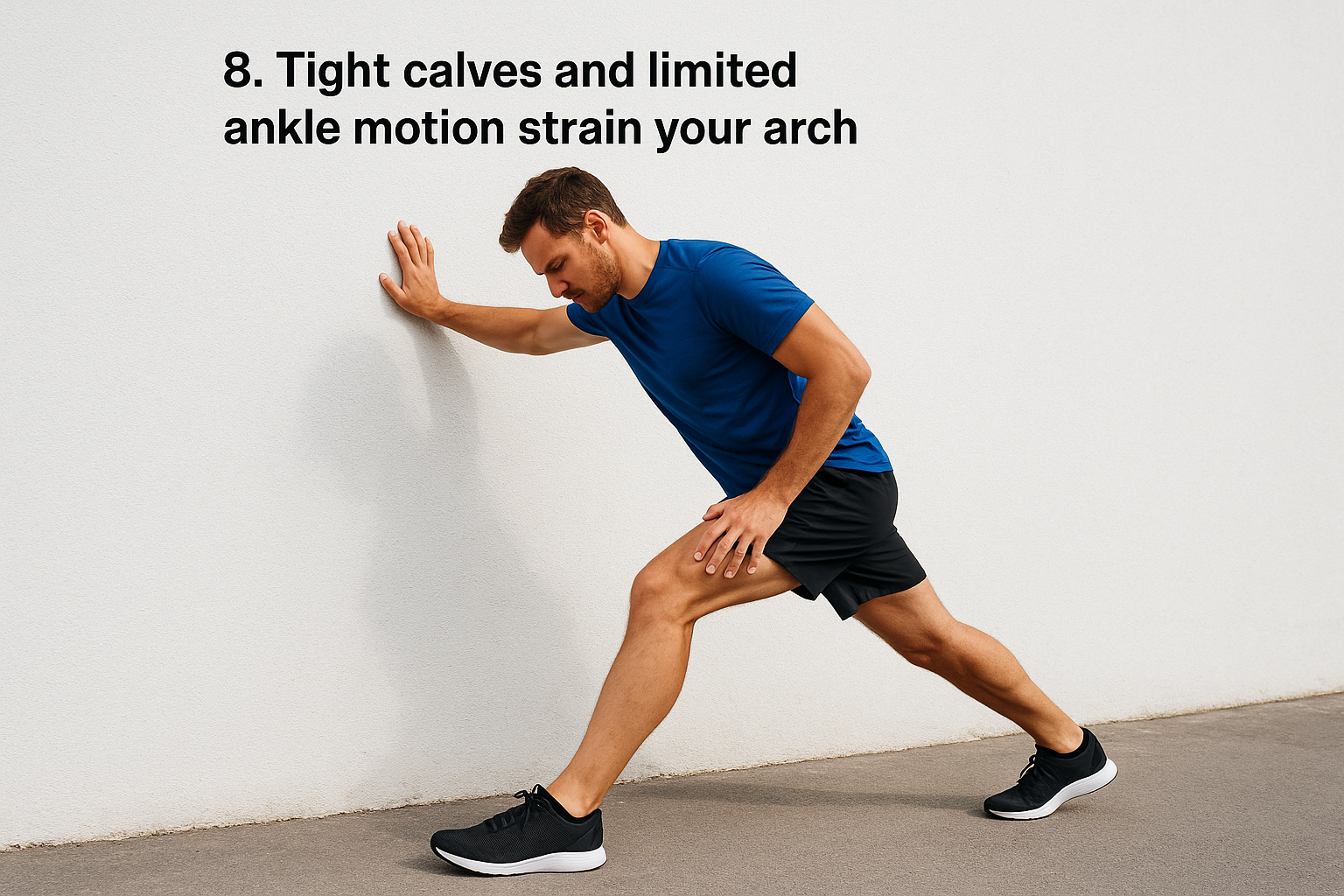
8. Tight calves and limited ankle motion strain your arch
Most runners focus on the foot itself when arch pain develops, but the problem often starts higher up the leg. Tight calf muscles and restricted ankle mobility force your arch to compensate for movement that should happen at the ankle joint, and that substitution adds up fast over miles.
What it feels like
This pain tends to build gradually through a run rather than striking from the first step. You may notice a deep ache across the arch and midfoot, often paired with ankle stiffness that doesn’t fully loosen even after warming up.
Why it happens in runners
When your ankle cannot dorsiflex adequately, your foot compensates by rolling inward or your arch flattens to create the motion your ankle won’t provide. Every stride repeats this substitution, placing cumulative strain on the arch and surrounding soft tissue. Tight calves are the most common reason runners lose dorsiflexion range over time.
A simple test: if your knee cannot travel past your toes while your heel stays flat on the ground, your ankle dorsiflexion is likely restricted.
What to do now
Stretch your calves with both a straight-leg and a bent-knee variation to target the gastrocnemius and soleus separately. Adding daily ankle mobility drills, such as wall ankle stretches, restores the range of motion your arch currently compensates for.
When to see a podiatrist
Book an appointment if arch pain from running persists despite three weeks of consistent stretching and mobility work. A podiatrist can assess whether custom orthotics or physical therapy will provide the structural support your arch needs while your mobility improves.
9. A nerve irritation triggers arch pain
Nerve-related arch pain is easy to overlook because it doesn’t follow the typical pattern of a structural injury. Conditions like Baxter’s nerve entrapment or tarsal tunnel syndrome compress or irritate nerves that run through the arch and heel, producing pain that feels entirely different from the mechanical soreness most runners expect.
What it feels like
Nerve irritation in the arch produces burning, tingling, or shooting pain rather than a dull ache associated with tissue overuse. You may also notice numbness along the bottom of your foot that worsens during or after a run and sometimes persists well into your rest periods, even after you’ve stopped all activity.
Why it happens in runners
Repeated impact and inflammation from running can compress nerves that pass through tight anatomical tunnels in the foot and ankle. Runners with flat feet or overpronation face elevated risk because a collapsing arch narrows the spaces through which these nerves travel with every footfall.
Nerve-related arch pain from running often intensifies after prolonged standing or sitting, not just during activity, which helps distinguish it from purely mechanical causes.
What to do now
Reduce any activity that provokes the burning or tingling sensation and apply ice to calm the surrounding inflammation. Switching to wider, softer footwear immediately removes direct compression from the irritated nerve during daily movement.
When to see a podiatrist
Schedule an appointment promptly if burning or numbness persists beyond a week. A podiatrist can confirm the diagnosis using a nerve conduction study or diagnostic ultrasound and recommend targeted treatment including injections or, in persistent cases, surgical nerve release to restore full function.
Your next step
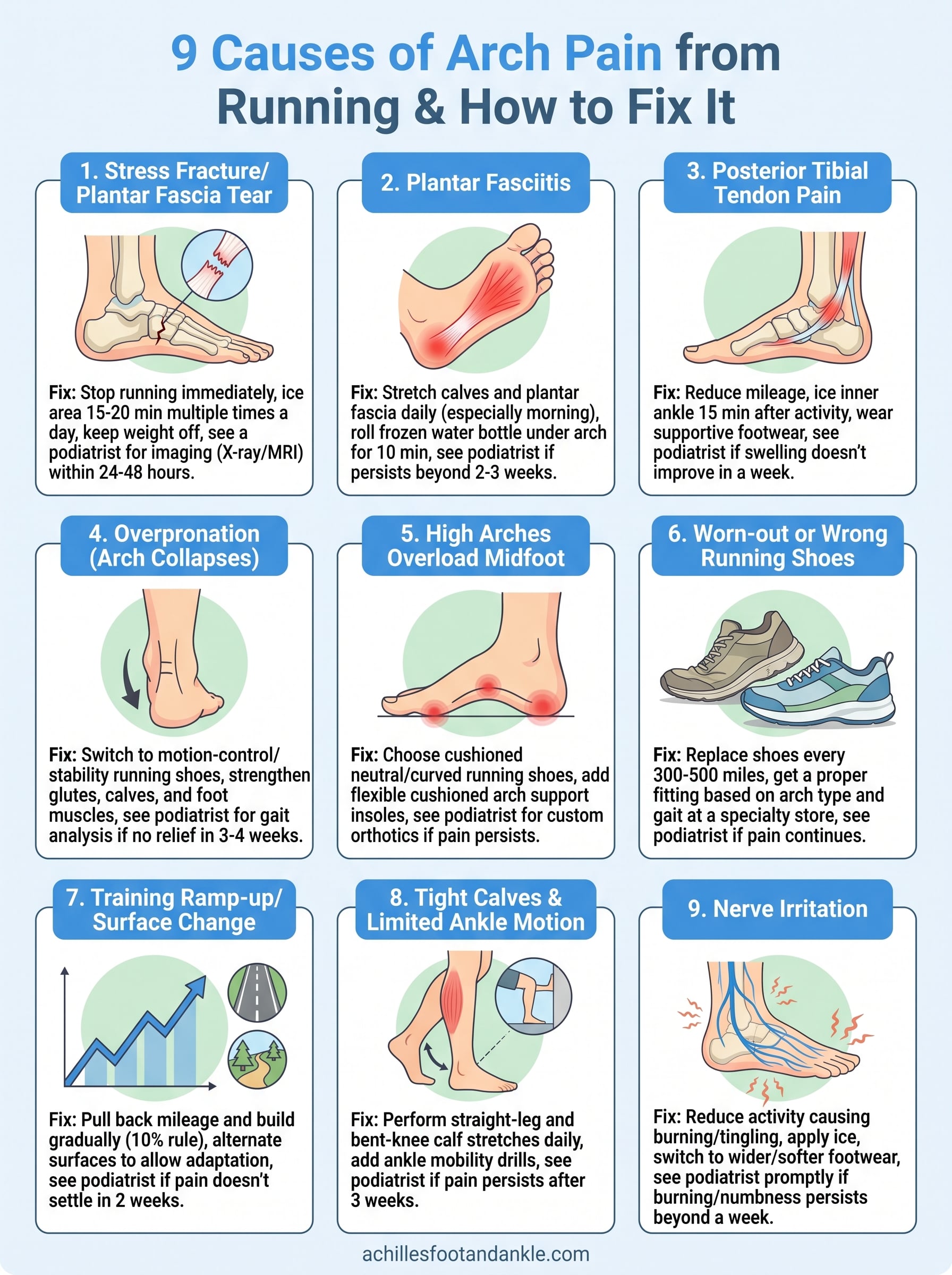
Arch pain from running rarely fixes itself, and the longer you run through it, the longer your recovery will take. The nine causes covered in this article range from simple footwear issues you can address today to structural injuries that require professional diagnosis and treatment. Identifying the right cause is the first and most important step toward getting back to running without pain.
If your arch pain has lasted more than two weeks, is getting worse with every run, or came with sudden swelling, you need a podiatrist to evaluate it directly. The team at Achilles Foot and Ankle Center treats runners across Central Virginia with access to advanced diagnostic tools and a full range of treatment options, from custom orthotics to surgical care. Book a same-day appointment and get a clear answer about what is causing your pain and exactly what to do about it.