

Your feet contain more than 30 joints each, and every one of them is a potential target for arthritis. When stiffness, swelling, or aching sets in, it can turn simple activities like walking to your mailbox into a painful ordeal. Understanding arthritis in feet causes is the first step toward getting the right diagnosis and, more importantly, the right treatment plan for your specific situation.
Arthritis in the feet isn’t a single condition. It comes in several forms, each with its own set of triggers, from autoimmune responses that attack healthy joint tissue to decades of mechanical wear on cartilage. Some causes you can control; others, like genetics and age, you can’t. But knowing what’s driving your symptoms helps you and your doctor make informed decisions about how to manage them.
At Achilles Foot and Ankle Center, our podiatrists across Central Virginia diagnose and treat every stage of foot and ankle arthritis, from early joint stiffness to advanced cases requiring surgical intervention. This article breaks down the major types of arthritis that affect the feet, the specific triggers behind each one, and the risk factors that make certain people more susceptible, so you can walk into your next appointment with a clearer picture of what’s going on.
Why arthritis shows up in feet and ankles
The feet and ankles are among the most mechanically complex regions of the human body. Each foot contains 28 bones, 30 joints, and more than 100 muscles, tendons, and ligaments, all working together to absorb shock and propel you forward. That complexity also means there are dozens of joint surfaces where cartilage can degrade, inflammation can take hold, and arthritis can develop. Most adults take between 4,000 and 6,000 steps per day, which means your feet absorb enormous cumulative stress across a lifetime.
The structure that makes feet vulnerable
Your foot divides into three regions: the hindfoot (heel and ankle), the midfoot (the arch), and the forefoot (the ball of the foot and toes). Each region contains multiple joints that carry different loads and move in different directions. The ankle joint alone transfers your entire body weight through a surface roughly the size of a postage stamp. That concentration of force in a small area makes the ankle highly susceptible to cartilage wear and post-injury arthritis.
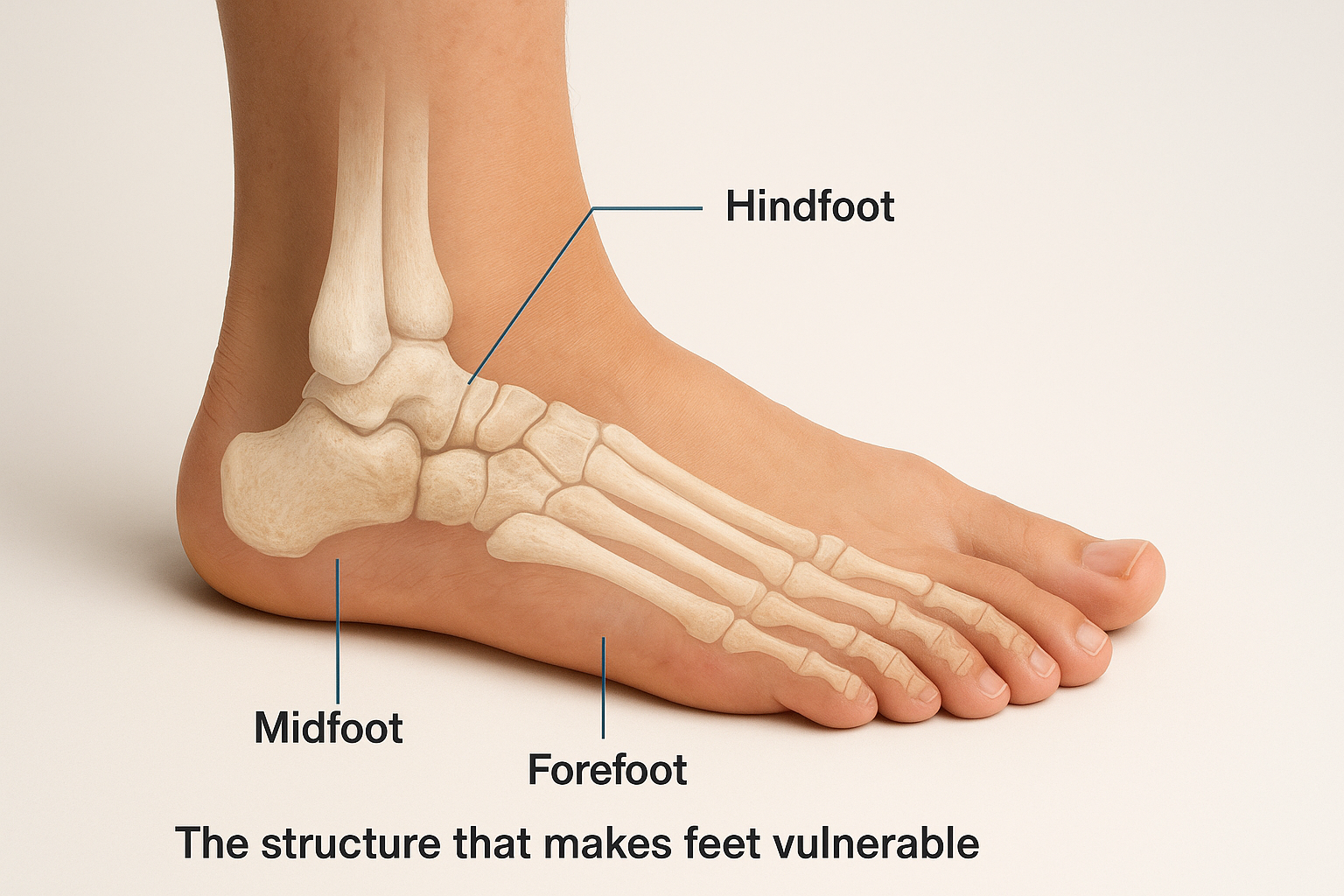
The forefoot takes on a different kind of stress. When you push off with each step, the metatarsophalangeal joints at the base of your toes bear a load that can exceed twice your body weight. Over years of walking, running, or standing on hard surfaces, that repetitive loading gradually breaks down cartilage in those joints. People with flat feet or high arches face an uneven distribution of force across the foot, which accelerates wear in specific joints while leaving others relatively untouched.
The joint configuration of the foot means arthritis can develop independently in multiple joints at the same time, which is why foot arthritis often feels diffuse rather than limited to one spot.
How cartilage breaks down over time
Cartilage is the smooth, rubbery tissue that covers the ends of bones inside a joint. Its job is to reduce friction and absorb impact so bones can glide past each other without grinding. Unlike most tissues, cartilage has a limited blood supply, which means it repairs itself slowly and incompletely after injury or wear. Once cartilage thins or develops rough patches, the joint mechanics change, and bone-on-bone contact triggers pain, swelling, and further tissue damage.
Several of the arthritis in feet causes that patients report begin with a single cartilage injury that was never fully treated. A sprained ankle that healed "well enough," a stress fracture that went untreated, or years of wearing shoes without adequate support can each initiate a cycle of cartilage breakdown that unfolds over decades. The damage is often silent at first, producing only mild morning stiffness before it progresses to persistent pain during everyday activity.
When inflammation enters the picture
Not all foot arthritis starts with mechanical wear. In autoimmune forms, your immune system mistakenly targets the synovial membrane, the thin lining that surrounds each joint and produces lubricating fluid. When that membrane becomes inflamed, it thickens and releases enzymes that actively destroy cartilage and bone. This process can be aggressive, damaging multiple joints simultaneously even in people who have never had a foot injury and live otherwise physically moderate lives.
Inflammatory arthritis also disrupts the synovial fluid itself. Healthy synovial fluid is thick and viscous, providing cushioning with each step. Inflamed synovial tissue produces thinner, less effective fluid, which leaves joint surfaces more vulnerable to impact and friction. That change in fluid quality is one reason inflammatory arthritis can cause significant joint destruction even when the mechanical load on your foot remains relatively low.
Types of arthritis that cause foot pain
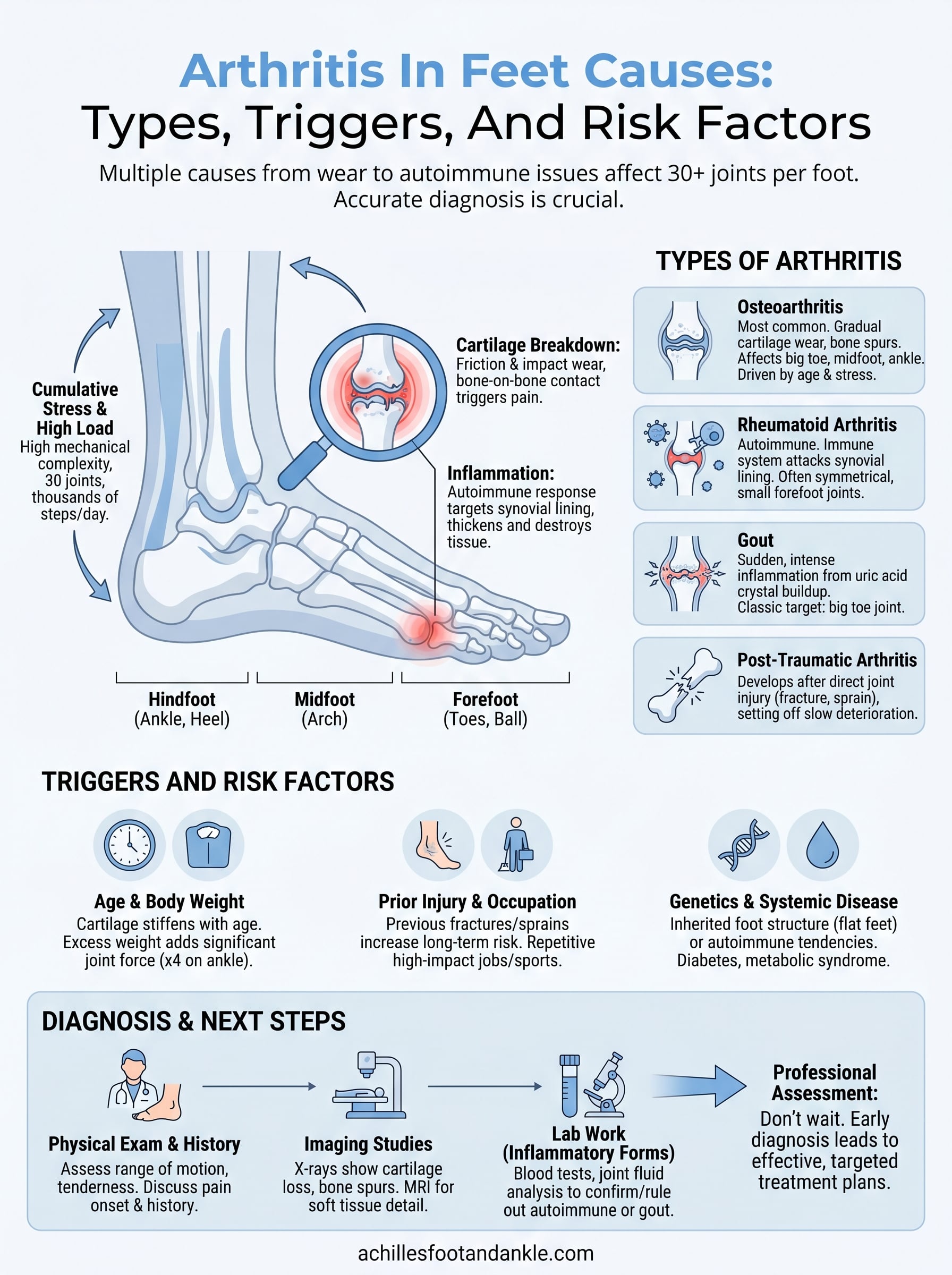
Several distinct conditions fall under the broad label of arthritis, and each one attacks foot and ankle joints through a different mechanism. Identifying which type is responsible for your symptoms directly shapes the treatment approach your podiatrist recommends. Here are the most common arthritis in feet causes, organized by type.
Osteoarthritis
Osteoarthritis is the most common form affecting the feet. It develops when cartilage gradually wears away from joint surfaces, eventually allowing bones to rub against each other. The big toe joint, the midfoot, and the ankle are the sites most frequently affected. Over time, the body responds to cartilage loss by forming bone spurs around the joint, which further restricts movement and causes pain when you walk or stand.

Age and cumulative mechanical stress drive this process in most patients. People typically begin noticing symptoms in their 50s or 60s, though athletes and those who spend long hours on hard surfaces can develop osteoarthritis considerably earlier.
Rheumatoid arthritis
Rheumatoid arthritis is an autoimmune condition in which your immune system attacks the synovial lining of your joints. It typically starts in the smaller joints of the forefoot and often affects both feet simultaneously, which distinguishes it from osteoarthritis. Without treatment, the ongoing inflammation destroys cartilage and bone, leading to joint deformity and significant loss of function.
Rheumatoid arthritis affects the feet in up to 90 percent of patients at some point during the disease, making foot and ankle evaluation a critical part of managing the condition.
Gout and post-traumatic arthritis
Gout develops when uric acid crystals accumulate inside a joint, triggering sudden, intense inflammation. The big toe joint is the classic target, though gout can also strike the ankle and midfoot. Attacks come on rapidly, with the affected joint becoming red, swollen, and extremely tender within hours of onset.
Post-traumatic arthritis develops after a direct injury to a joint, such as a fracture, severe sprain, or ligament tear. Even when the original injury heals properly, cartilage damage sustained at the time of impact can set off a slow deterioration process. Research indicates that post-traumatic arthritis accounts for roughly 12 percent of all osteoarthritis cases, with ankle fractures carrying a particularly high long-term risk.
Common triggers and risk factors
Understanding why arthritis develops in your feet requires looking beyond joint structure. Specific lifestyle factors, health conditions, and biological traits can tip the balance between healthy joint function and progressive degeneration. Some of these arthritis in feet causes are modifiable, which means addressing them directly can slow how fast the condition advances.
Age and body weight
Age is the single most consistent risk factor for foot arthritis. As you get older, cartilage loses water content and becomes stiffer, making it less effective at absorbing impact. The proteoglycans that keep cartilage resilient also decline with age, so the tissue becomes more vulnerable to cracking and thinning under normal daily loads.
Body weight compounds the problem significantly. Every pound of body weight adds roughly four pounds of force across your knee and ankle joints during walking. Carrying excess weight accelerates cartilage wear in the midfoot and ankle while also promoting low-grade systemic inflammation, which raises your risk for rheumatoid and psoriatic arthritis flares.
Losing even a modest amount of weight reduces the mechanical load on your foot joints and can meaningfully slow the progression of cartilage breakdown.
Prior injury and occupation
A previous foot or ankle injury dramatically increases your long-term arthritis risk. Fractures that involve joint surfaces, severe ligament tears, and repeated ankle sprains all damage cartilage directly, even when the soft tissue heals. That initial cartilage trauma starts a slow deterioration cycle that may not produce noticeable symptoms for years.
Your occupation matters too. People who spend extended hours standing on concrete, perform repetitive heavy lifting, or regularly participate in high-impact sports apply cumulative stress that wears down joint surfaces faster than sedentary activity would. Construction workers, nurses, and competitive runners all face elevated risk for the mechanical forms of foot arthritis.
Genetics and systemic disease
Your family history shapes your susceptibility in two ways. First, inherited joint geometry, such as flat arches or loose ligaments, changes how force distributes across your foot, accelerating wear in specific joints. Second, the tendency toward autoimmune conditions like rheumatoid arthritis and psoriatic arthritis runs in families through identifiable genetic markers.
Systemic diseases also play a direct role. Diabetes, gout, and obesity-related metabolic syndrome each alter joint chemistry or create inflammatory conditions that damage cartilage independently of mechanical stress. Managing these underlying conditions is often an essential part of controlling foot arthritis symptoms.
How clinicians pinpoint the cause
Identifying which form of arthritis is affecting your foot requires more than noting where it hurts. A thorough diagnostic process combines physical findings, imaging, and laboratory data to distinguish between mechanical wear, autoimmune inflammation, crystal deposition, and post-traumatic damage. Getting the diagnosis right matters because the treatment for osteoarthritis differs substantially from the treatment for gout or rheumatoid arthritis, and starting with the wrong approach wastes time while your joints continue to change.
Physical examination and patient history
Your podiatrist starts by asking detailed questions about when your pain began, what activities make it worse, and whether you have a history of foot injuries, prior joint disease, or relevant family history. That conversation alone can narrow the list of likely arthritis in feet causes considerably. Gout, for instance, tends to produce sudden severe pain that peaks within 24 hours, while osteoarthritis typically builds gradually over months or years.
During the hands-on exam, your clinician assesses joint range of motion, areas of tenderness, and visible deformities such as bunions or toe drifting. Swelling that involves multiple joints simultaneously often points toward an autoimmune cause, while localized tenderness around a single joint after a past ankle fracture suggests post-traumatic arthritis. Comparing how joints on both feet look and move side by side gives the clinician useful information about whether the process is symmetrical.
Imaging studies
X-rays are the standard first imaging step. They reveal cartilage loss, bone spur formation, and joint space narrowing, which are the hallmarks of osteoarthritis and post-traumatic arthritis. Your podiatrist will often take weight-bearing X-rays so the images reflect how your joints actually behave under load rather than in a resting position.
MRI provides detailed views of soft tissue structures that X-rays cannot capture, making it especially useful when cartilage damage or ligament involvement is suspected but not yet visible on standard imaging.
Lab work for inflammatory forms
When an autoimmune or crystal-related cause is suspected, blood tests and joint fluid analysis fill in the gaps that imaging cannot. A rheumatoid factor test, anti-CCP antibodies, and inflammatory markers like CRP and ESR help confirm or rule out rheumatoid arthritis. Uric acid levels in the blood support a gout diagnosis, though joint fluid analysis remains the most definitive test because it can identify the crystals directly inside the affected joint.
What to do now
Now that you understand the main arthritis in feet causes, from cartilage wear and autoimmune inflammation to post-traumatic damage and crystal deposits, the next practical step is getting a professional assessment. Waiting rarely works in your favor. Joint cartilage does not regenerate on its own, and the window for conservative, non-surgical treatment tends to narrow the longer symptoms go unaddressed.
Your symptoms, whether that means morning stiffness in your big toe, swelling around the ankle, or sharp pain that flares without warning, deserve a specific diagnosis rather than a general guess. A podiatrist can match your findings to the right type of arthritis and build a treatment plan around your activity level, medical history, and goals. The team at Achilles Foot and Ankle Center serves Central Virginia patients across thirteen locations and offers same-day appointments for urgent concerns. Book your foot and ankle evaluation today and get a clear answer about what is driving your pain.