

You just finished a long run, pull off your shoes, and notice a dark, bruised toenail staring back at you. Black toenails from running, sometimes called runner’s toe, are one of the most common foot issues distance runners deal with. While a discolored nail might look alarming, the cause is usually straightforward: repeated trauma to the toe inside your shoe.
That said, not every black toenail is harmless, and ignoring certain signs can lead to infection or nail loss. Knowing when to treat it at home and when to see a specialist matters. At Achilles Foot and Ankle Center, our podiatrists regularly treat runners across Central Virginia for this exact problem, from minor bruising to subungual hematomas that need professional drainage.
This article breaks down exactly why running turns toenails black, what treatment options are available, and how to prevent it from happening again.
Why runners get black toenails
The short answer is repeated trauma. Every time your foot strikes the ground, your toes slide forward and press against the inside of your shoe. Over miles, that constant friction and impact bruise the tissue under the nail, causing blood to pool beneath it. The medical term for this is a subungual hematoma. The discoloration you see is simply dried or clotting blood trapped under the nail plate.
The longer your runs, the more impact cycles your toes absorb, which is why marathoners and trail runners deal with this more than casual joggers.
The role of shoe fit
Shoes that are too small are the leading culprit behind black toenails from running. When there is not enough room in the toe box, your nails hit the front of the shoe repeatedly with each step. But shoes that are too large cause the same problem in a different way: your foot slides forward on downhills, driving your longest toe into the shoe wall with every stride.
Running shoes also compress slightly after heavy mileage. A pair that fit perfectly at 100 miles may be too tight at 400 miles, especially in the toe area. Worn-out shoes lose cushioning and structure, which increases the impact your toes absorb on each foot strike.
How your running style contributes
Your gait and foot mechanics also factor in. Runners who land hard on their forefoot or who pronate significantly put more pressure on specific toes, often the big toe or second toe. Downhill running is a known trigger because gravity drives your foot forward into the shoe with more force than flat terrain does.
Socks matter too. Thick, bunching socks or socks made from materials that retain moisture reduce the space in your shoe and increase friction against the nail bed during long efforts.
Signs, stages, and how long it lasts
Black toenails from running follow a fairly predictable pattern, and recognizing where you are in that progression helps you decide what to do next. The first sign is usually tenderness under or around the nail, sometimes before visible discoloration even appears. As blood pools under the nail plate, the color shifts from red to purple to dark brown or black over the following hours or days.
What the nail looks like at each stage
The severity of a subungual hematoma ranges widely depending on how much trauma occurred. Here is what each stage typically looks like:
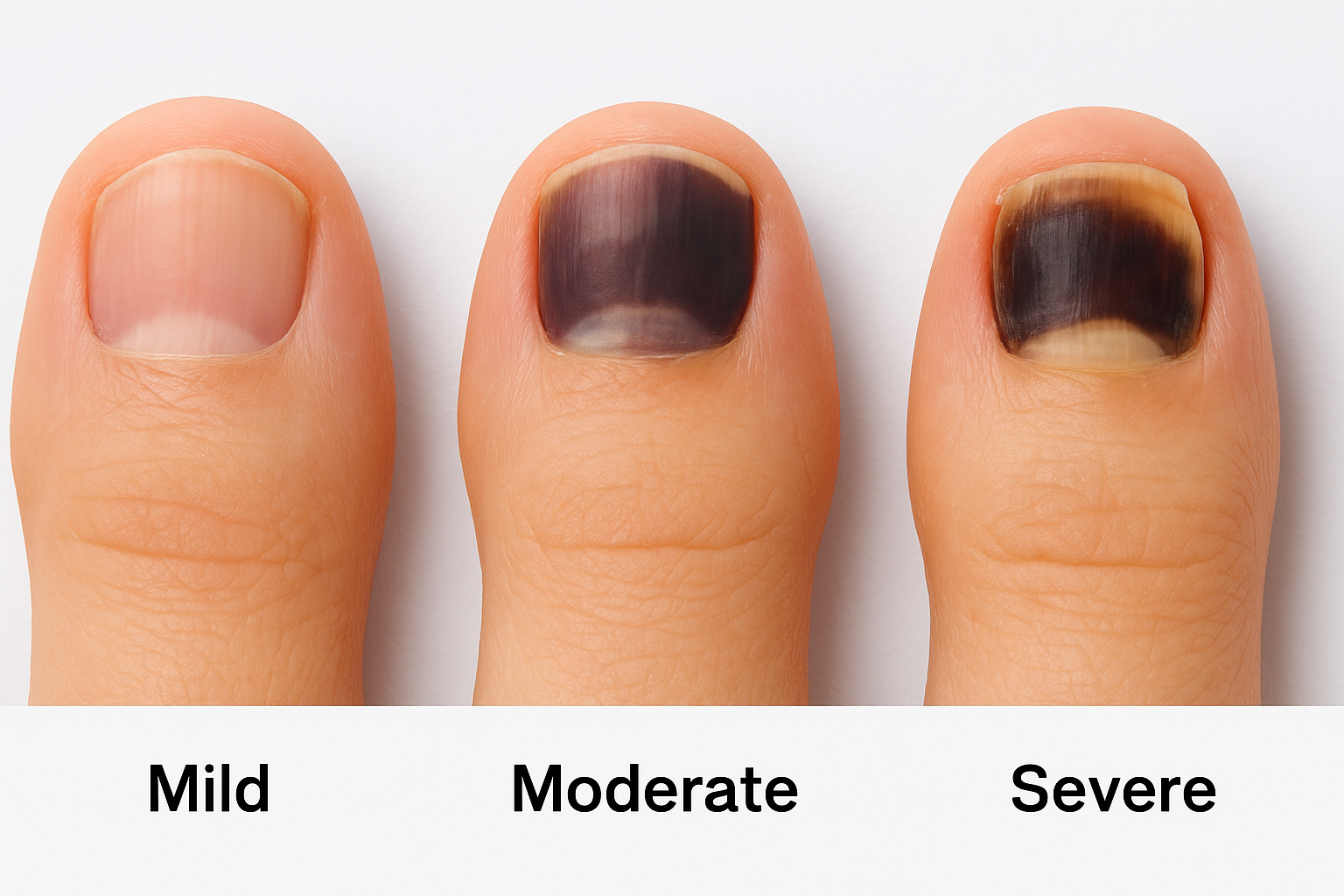
- Mild: Light pink or reddish bruising under the nail, minimal pain, no separation from the nail bed
- Moderate: Dark purple or black discoloration covering more than half the nail, noticeable pressure, possible throbbing
- Severe: The nail lifts partially or fully from the nail bed, significant pain, and potential for the nail to fall off on its own
How long until the nail heals
Recovery depends on how much damage happened. Minor bruising often fades within two to three weeks without any intervention. When the nail separates from the bed, a new nail needs to grow in fully, which typically takes six to nine months.
The nail underneath is usually intact and growing normally even while the damaged nail is still in place.
When you should see a podiatrist
Most mild cases of black toenails from running resolve on their own within a few weeks. But certain signs indicate you need professional evaluation rather than a wait-and-see approach. Pain that builds rather than fades, a nail that appears infected, or discoloration that does not match the pattern of a typical bruise all warrant a podiatrist visit.
Ignoring an infected or severely traumatized nail can lead to permanent nail damage or a spreading skin infection.
Warning signs that require a visit
Not every black toenail is a straightforward hematoma. Contact a podiatrist promptly if you notice any of the following:
- Severe, throbbing pain that does not ease within 24 to 48 hours
- Signs of infection: redness spreading beyond the nail, warmth, swelling, or discharge
- A nail that has completely detached or is lifting significantly from the nail bed
- Irregular discoloration: streaky, asymmetrical, or not resembling the pattern of a bruise
- A dark spot that appeared without any trauma or physical cause
What a podiatrist will check
Your podiatrist will examine the nail, assess pressure and pain levels, and rule out conditions like subungual melanoma, which can mimic a hematoma in appearance. They will also evaluate your foot mechanics and footwear to identify what contributed to the injury and reduce your risk of recurrence.
Treatment options and what to avoid
Treatment for black toenails from running depends on how severe the injury is. Mild cases need little more than rest and monitoring, while moderate to severe hematomas may require professional drainage to relieve pressure and pain. Understanding what helps and what makes things worse speeds up your recovery significantly.
At-home care that works
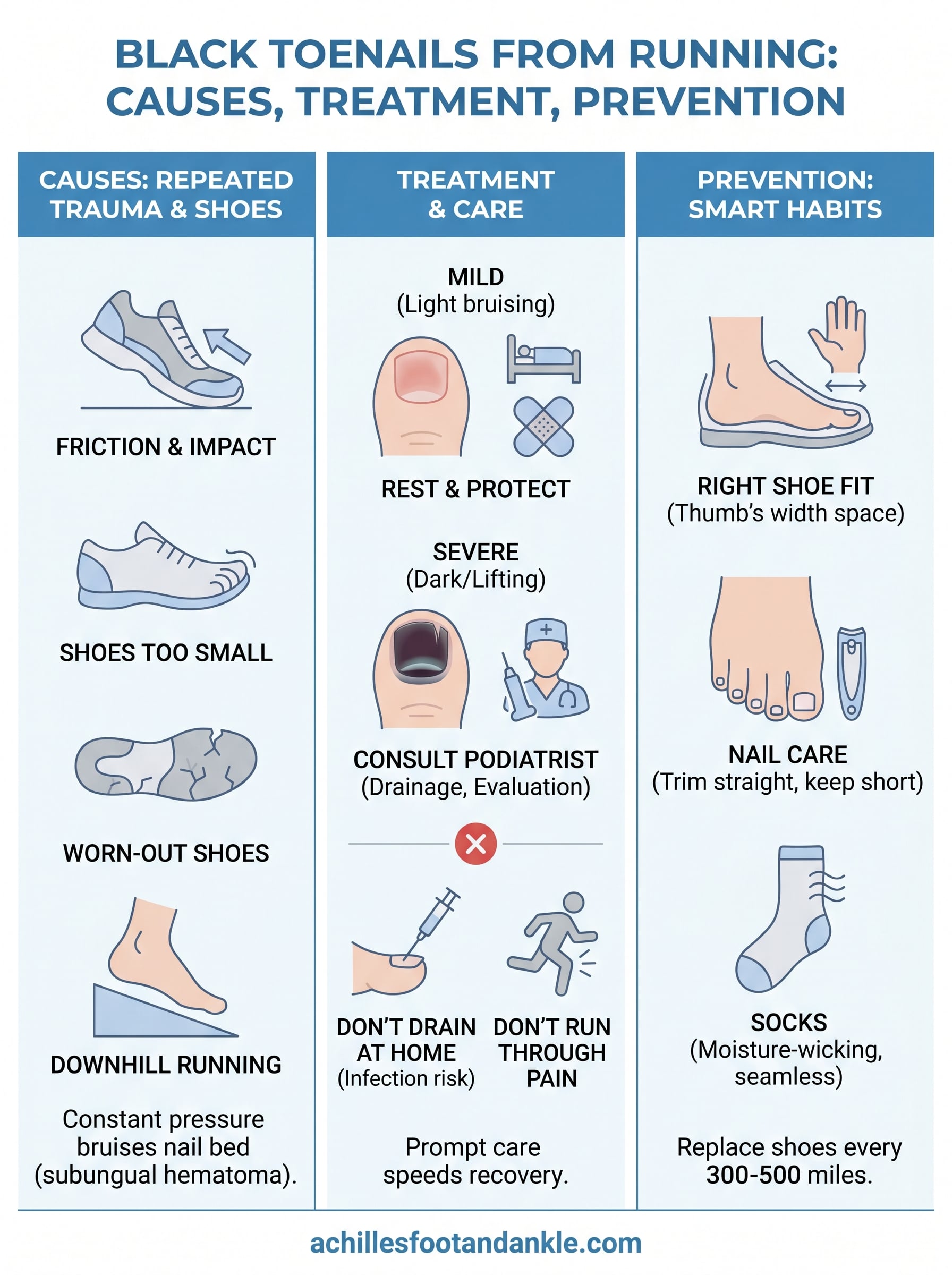
For minor cases, your goal is to reduce pressure and prevent infection while the nail heals on its own. Keep the nail trimmed short and clean so it does not catch on socks or shoes. Applying a thin bandage over the nail protects it during runs if you choose to continue training.
Do not attempt to drain the blood yourself by piercing the nail at home. This creates a direct pathway for bacteria to reach the nail bed.
What you should never do
Several common instincts actually slow healing or raise infection risk. Avoid picking at or forcing off a nail that is partially detached. Even a loose nail still provides a protective barrier over the nail bed underneath.
Also avoid running through severe pain or in shoes that caused the problem in the first place. Tight footwear extends the trauma cycle and prevents the nail bed from recovering. If pain, swelling, or discoloration worsens after a few days, stop self-treating and schedule a podiatrist appointment.
How to prevent black toenails from running
Prevention is far more effective than treatment when it comes to black toenails from running. Most cases are entirely avoidable with a few consistent habits around footwear, nail care, and training adjustments.
The most impactful change most runners can make is buying shoes that are one half-size larger than their street shoe size.
Get the right shoe fit
Your toe box needs enough room to move slightly without pressing against the front or sides of the shoe. When you stand in your running shoes, you should have roughly a thumb’s width of space between your longest toe and the end of the shoe. Get fitted at the end of the day or after a short run, when your feet are at their largest.

Replace your running shoes every 300 to 500 miles. Worn-out cushioning increases the impact force your toes absorb, even if the upper still looks intact.
Manage your nails and socks
Trim your toenails straight across every one to two weeks, keeping them short enough that they do not contact the top of your shoe during a stride. Nails that are too long act as a lever, transferring impact pressure directly into the nail bed.
Moisture-wicking, seamless socks reduce friction and keep your foot from sliding inside the shoe on long efforts. Avoid thick cotton socks that bunch up and take up toe box space during runs.
Next steps
Black toenails from running are almost always preventable, and most mild cases heal completely with the right footwear, trimmed nails, and a little patience. The key steps are straightforward: get shoes with adequate toe room, keep nails trimmed short, and pay attention to early warning signs before a bruise turns into something more serious.
If your nail is not improving after a few weeks, shows signs of infection, or the discoloration appeared without any obvious trauma, do not wait it out. Your podiatrist can drain a painful hematoma, rule out more serious conditions, and give you a clear plan to get back to running without making the injury worse.
The team at Achilles Foot and Ankle Center treats runners across Central Virginia and offers same-day availability for exactly this type of concern. Schedule your appointment today and get your nail evaluated by a specialist who understands the demands of running.