
If you’ve been diagnosed with a bone spur, or suspect you have one, you’re probably wondering: do bone spurs go away on their own? The short answer is no. Bone spurs are permanent bony projections that form along the edges of bones, often in response to prolonged pressure, friction, or inflammation. Once they develop, they don’t shrink or dissolve without intervention.
But here’s what matters more: not every bone spur needs treatment. Many people walk around with bone spurs in their feet and ankles and never feel a thing. It’s only when a spur starts pressing on nerves, tendons, or soft tissue that pain and limited mobility become a problem worth addressing.
At Achilles Foot and Ankle Center, our podiatrists across Central Virginia diagnose and treat bone spurs regularly, from conservative approaches like custom orthotics and physical therapy to surgical removal when necessary. This article breaks down why bone spurs form, what symptoms to watch for, and the treatment options that actually work so you can make an informed decision about your next step.
What bone spurs are and why they form
A bone spur, also called an osteophyte, is a small bony outgrowth that develops along the edge of an existing bone. Despite the name, most bone spurs are smooth and rounded, not sharp. Many cause zero pain. They appear most often in the feet and ankles, where bones handle constant load from walking, running, and standing throughout the day. Understanding what they are and how they develop is the first step toward figuring out why people asking "do bone spurs go away on their own" are asking the right question.
The biology behind bone spur growth
Your body builds bone spurs as a protective response to stress. When a bone experiences repeated friction, pressure, or inflammation, the body interprets that as a sign of damage that needs stabilizing. It responds by depositing extra calcium along the bone’s surface, and over time that calcium hardens into a bony projection. The body is essentially trying to reinforce a weakened area, but the extra growth can end up pressing on surrounding nerves, tendons, and soft tissue.
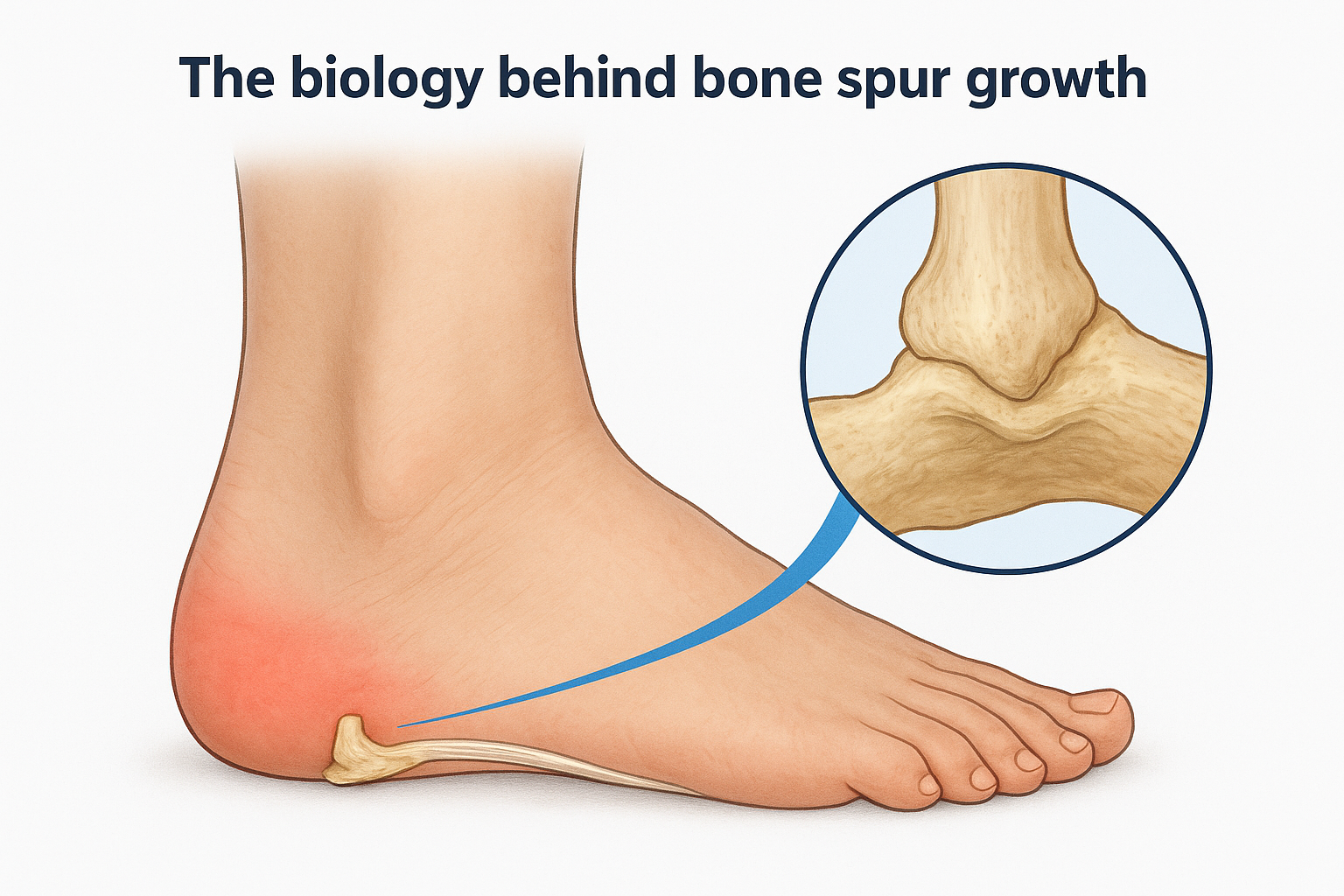
Once a bone spur forms, your body has no mechanism to reabsorb it, which is why it will not disappear without some form of treatment.
Plantar fasciitis illustrates this process clearly. When the plantar fascia ligament pulls repeatedly against the heel bone, that tension triggers calcium deposits at the attachment point. Over months or years, those deposits accumulate into a visible spur that can measure anywhere from a few millimeters to over a centimeter on an X-ray, often appearing as a small hook at the base of the heel.
Common causes and risk factors
Several conditions and habits raise your likelihood of developing a bone spur. Age is a major factor because cartilage naturally breaks down over time, exposing bone surfaces to more direct friction. Conditions like osteoarthritis speed this up by eroding the protective cartilage inside joints, which pushes the body to compensate with extra bone growth along the joint margins.
Your daily habits and physical structure also play a significant role. Contributing factors include:
- Excess body weight, which increases load on every joint in your foot and ankle
- Poorly fitting footwear that creates abnormal pressure points over time
- Flat feet or high arches, which shift how weight distributes across your foot
- Repetitive activity such as distance running or prolonged standing on hard floors
- Previous injuries, including unhealed fractures or tendon damage that never fully resolved
Do bone spurs go away without surgery
The direct answer to "do bone spurs go away on their own" is no. Bone tissue does not reabsorb once it forms, which means the spur itself stays put regardless of what you do. That said, the goal of most treatment is not to eliminate the spur but to eliminate the pain and inflammation it causes. Many people manage bone spurs for years without ever needing surgery.
When conservative care is enough
If your spur is not pressing on a nerve or tendon, you may never need any treatment at all. For people who do have symptoms, non-surgical options resolve the pain in the majority of cases. Rest, targeted stretching, and supportive footwear often reduce irritation enough that day-to-day function returns to normal.
Most patients see significant improvement within a few weeks of starting conservative treatment, without ever needing an operating room.
Physical therapy strengthens the muscles and connective tissue around the affected area, which takes direct pressure off the spur and reduces inflammation. Custom orthotics redistribute your body weight across the foot so the spur contacts less soft tissue with each step. Anti-inflammatory medications like ibuprofen can help in the short term, though they treat symptoms rather than the underlying bone growth.
When surgery becomes necessary
Surgery moves to the front of the conversation when conservative treatment fails after several months or when the spur causes structural damage to a tendon or nerve. At that point, a podiatrist may recommend surgical removal to protect the surrounding tissue and restore full function. Your specific anatomy, activity level, and how long symptoms have persisted all factor into that decision.
Symptoms and where bone spurs show up
Whether or not you feel a bone spur depends almost entirely on where it sits and what it contacts. Many people ask "do bone spurs go away on their own" only after a spur starts pressing on nearby soft tissue, triggering pain that disrupts daily activity. Others discover a spur on an X-ray taken for a completely different reason, with no symptoms at all.
Pain patterns and what they feel like
The most common symptom is localized pain that worsens with activity and eases with rest. You might notice a sharp or aching sensation at a specific point on your foot or ankle, especially during the first few steps in the morning or after long periods of standing. If a spur presses on a nerve, you may also feel numbness, tingling, or a burning sensation that radiates into the surrounding area.
Swelling and tenderness around the affected site are reliable signs that a spur is irritating surrounding tissue and warrants a professional evaluation.
Common locations in the foot and ankle
Bone spurs develop wherever repetitive stress or inflammation occurs over time. In the foot and ankle, the most frequent sites include:
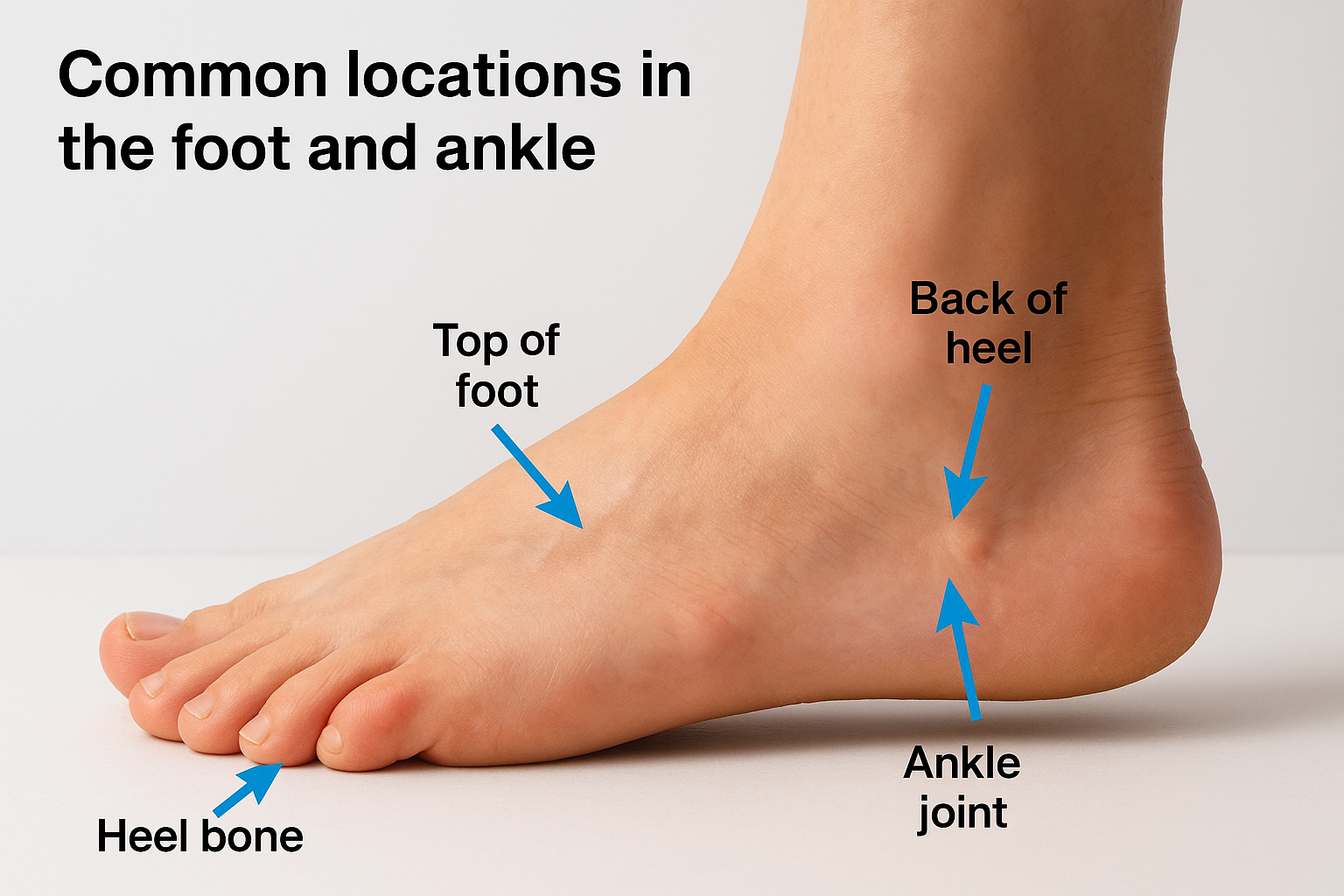
- Heel bone (calcaneus): The underside of the heel, where the plantar fascia attaches, is the single most common location
- Back of the heel: Spurs here often accompany Haglund’s deformity and can irritate the Achilles tendon
- Top of the foot: Pressure from tight footwear frequently triggers spur growth along the midfoot joints
- Ankle joint: Arthritis-related spurs develop along the joint margins, gradually limiting your range of motion
- Toes: Spurs near the toe joints often appear alongside bunions or hammertoe deformities
What you can do at home for relief
While bone spurs will not disappear, and the question of do bone spurs go away on their own comes with a clear "no," you can significantly reduce pain and inflammation at home with the right habits. The goal is to take pressure off the spur so surrounding tissue has a chance to calm down.
Reduce inflammation and offload pressure
Your first move is to limit the activities that trigger pain. If long walks or standing on hard floors make your heel ache, scaling back those activities for a few weeks gives the inflamed tissue time to settle. Applying ice to the affected area for 15 to 20 minutes several times a day reduces swelling and dulls acute pain without any medication.
Over-the-counter anti-inflammatory medications like ibuprofen can help manage short-term pain, but they address symptoms only, not the bone spur itself.
Switching to supportive, well-cushioned footwear makes a real difference. Shoes with adequate arch support and cushioned heel cups shift load away from the irritated site with every step. Heel pads or over-the-counter orthotic insoles provide an added layer of shock absorption that can reduce daily irritation considerably.
Stretching and strengthening
Targeted stretching reduces the tension that often aggravates bone spurs, particularly in the heel. A consistent routine helps loosen tight calf muscles and the plantar fascia, both of which pull directly on the heel bone.
Effective stretches to add to your daily routine include:
- Calf stretches against a wall, held for 30 seconds each side
- Plantar fascia stretches, pulling your toes back gently before your first steps in the morning
- Towel toe curls to strengthen the small muscles that support your arch
Medical treatments and when to seek care
Home remedies help many people manage bone spur pain, but if you’ve been asking do bone spurs go away on their own while dealing with symptoms that won’t quit, professional care gives you more targeted options. A podiatrist can confirm the spur’s exact location with X-ray imaging and recommend treatments based on how severely it affects your surrounding tissue and mobility.
Professional treatment options
Your doctor has several non-surgical tools beyond what you can do at home. Corticosteroid injections deliver anti-inflammatory medication directly to the irritated tissue, providing faster and longer-lasting relief than oral medications. Physical therapy programs prescribed by a podiatrist are more structured and targeted than home stretching, addressing muscle imbalances that contribute to ongoing irritation.
Custom orthotics fitted by a specialist differ from store-bought insoles because they account for your specific foot structure and gait pattern, offloading pressure from the exact site of the spur. If non-surgical approaches fail after three to six months, surgical removal becomes a realistic option, with most patients returning to full activity within a few weeks of recovery.
When to see a podiatrist
Schedule an appointment if pain persists beyond a few weeks despite rest and home care, or if you notice numbness, tingling, or a burning sensation that suggests nerve involvement.
Delaying care when a bone spur presses on a tendon or nerve can lead to structural damage that requires more complex treatment to correct.
Rapid swelling, an inability to bear weight, or visible deformity around the affected joint are signs you need same-day evaluation rather than a wait-and-see approach.
Conclusion
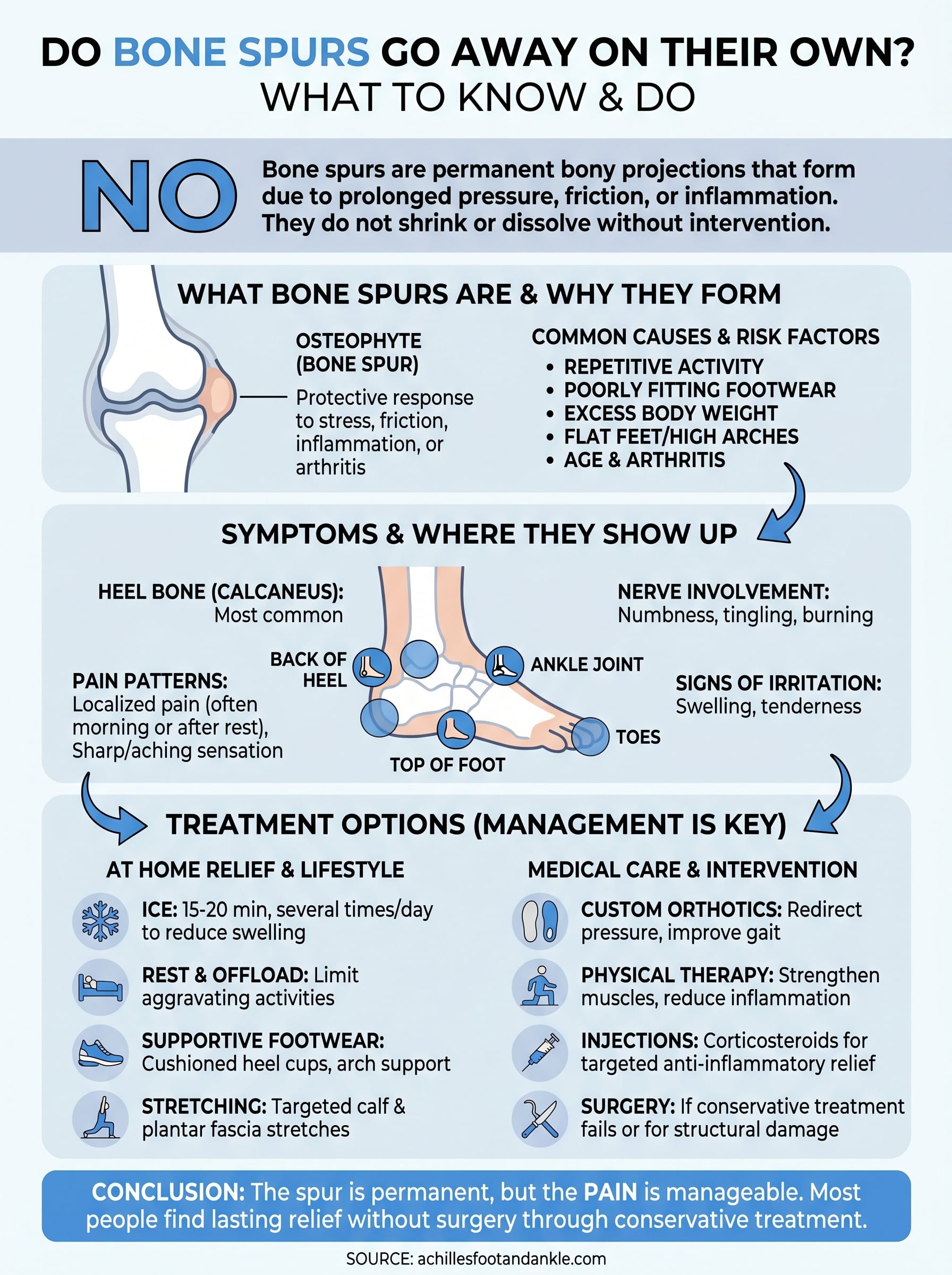
Bone spurs do not go away on their own. Once that bony outgrowth forms, your body has no way to reabsorb it. But the spur itself is rarely the real problem. What matters is whether it presses on nerves, tendons, or soft tissue and whether that contact causes pain that limits your daily life.
The good news is that most people find lasting relief without surgery. Reducing inflammation, switching to supportive footwear, stretching consistently, and working with a podiatrist on custom orthotics resolves symptoms for the majority of patients. If you’ve been asking do bone spurs go away on their own while dealing with persistent heel pain, foot swelling, or numbness, the answer is clear: the spur stays, but your pain doesn’t have to.
If symptoms aren’t improving, Achilles Foot and Ankle Center is ready to help. Book a same-day appointment and get a clear diagnosis and treatment plan tailored to your specific situation.