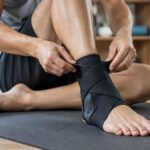

Running is one of the best things you can do for your body, until your feet start fighting back. If you’ve ever wondered how to prevent foot pain when running, you’re not alone. Plantar fasciitis, stress fractures, tendonitis, and general soreness sideline thousands of runners every year, from beginners lacing up for their first mile to experienced athletes pushing for a new PR. The good news? Most running-related foot pain is preventable with the right approach.
At Achilles Foot and Ankle Center, our podiatrists across Central Virginia treat runners at every level who are dealing with foot and ankle injuries, many of which could have been avoided. We see the patterns: worn-out shoes, too-fast mileage increases, skipped warm-ups, and ignored warning signs. These mistakes are common, but they’re also fixable with practical changes to your routine.
This guide breaks down 12 proven strategies to keep your feet healthy and pain-free on every run. From choosing the right footwear to building strength in the muscles that support your arches, you’ll walk away with a clear plan to protect your feet for the long haul.
Why your feet hurt when you run
Running puts 2 to 3 times your body weight through each foot with every stride. Over a single mile, your foot hits the ground roughly 1,500 times, which means a 5-mile run generates millions of pounds of cumulative force on a relatively small set of bones, tendons, and ligaments. When your feet, footwear, or training habits can’t absorb or distribute that load properly, something gives. Understanding exactly why foot pain develops is the first step in figuring out how to prevent foot pain when running before it sidelines you.
The most common running foot injuries
Most runners deal with a short list of conditions that account for the majority of pain complaints. Plantar fasciitis, which is inflammation of the thick band of tissue running along the bottom of your foot, is the single most common cause of heel pain in runners. Other frequent problems include stress fractures in the metatarsals from repeated impact, Achilles tendinitis from overloading the tendon connecting your calf to your heel, and metatarsalgia, which is general pain and inflammation across the ball of the foot. Blisters, black toenails, and Morton’s neuroma (nerve compression between the toes) round out the list for many runners.
Here’s a quick overview of what you’re most likely to encounter:
| Condition | Location | Primary Cause |
|---|---|---|
| Plantar fasciitis | Heel / arch | Overuse, tight calves, poor support |
| Stress fracture | Metatarsals / heel | Too much mileage added too fast |
| Achilles tendinitis | Back of heel | Rapid increases in speed or distance |
| Metatarsalgia | Ball of foot | Improper footwear, hard surfaces |
| Morton’s neuroma | Between toes | Narrow shoes, repetitive impact |
What drives these injuries
Overuse is the number one culprit behind running foot injuries. Your body adapts to stress over time, but it needs adequate recovery between sessions to do so. When you add miles, speed, or hill work too quickly, the tissues in your feet don’t have time to remodel and strengthen. This is why so many injuries appear not during a hard workout, but a day or two later when the accumulated damage becomes apparent.
Running injuries rarely appear without warning; your feet almost always send signals through tightness, minor aches, or localized soreness before a full injury develops.
Biomechanics also play a major role. Flat arches, high arches, and overpronation all change how force travels through your foot, placing extra strain on specific structures with each step. Weakness in the smaller stabilizing muscles of your foot and ankle compounds the problem significantly. If your intrinsic foot muscles aren’t doing their share of the work, your plantar fascia and tendons absorb load they were never designed to handle on their own, and that’s when chronic pain takes hold.
Footwear and training surfaces add the final layer. Worn-out shoes lose their cushioning and stability, which means your foot absorbs more raw impact with every stride. Hard concrete accelerates that breakdown, and a sudden switch from a treadmill to asphalt can be enough to trigger symptoms in runners who seemed completely fine the week before. Each of these factors is fixable once you know where to look.
Step 1. Get shoes, socks, and fit right
Your footwear is the most direct line of defense when figuring out how to prevent foot pain when running. Before you adjust your training or add exercises, make sure your shoes and socks are actually working for you. The wrong combination can cause problems no amount of stretching will fix, and the right combination can resolve issues that have been nagging you for months.
Choose shoes built for your foot type
Not every running shoe works for every foot. Neutral shoes suit runners with normal to high arches who don’t overpronate, while stability or motion-control shoes are designed for flat arches and moderate to severe overpronation. Getting this match wrong adds unnecessary stress to your plantar fascia, Achilles tendon, and ankle joints on every single stride.

Visit a specialty running store for a gait analysis before buying shoes; this one step removes most of the guesswork and points you directly to the category your foot actually needs.
A properly fitted shoe should give you a thumb’s width of space between your longest toe and the end of the toebox, with no heel slippage and no compression across the widest part of your foot. Also track mileage on your shoes. Most running shoes lose significant cushioning between 300 and 500 miles, and running on worn-out shoes is one of the fastest paths to heel or forefoot pain.
Get socks right too
Socks are easy to overlook, but moisture-wicking, seamless running socks protect against blisters and reduce the friction that creates hot spots during longer runs. Cotton holds sweat against your skin, which softens tissue and makes it far more vulnerable to tearing. Synthetic blends or merino wool move moisture away and keep your foot dry throughout your run.
Compression socks or sleeves can also benefit runners who deal with arch fatigue or mild plantar fasciitis symptoms by providing light support and improving circulation in the lower leg. They work best as a complement to a properly fitted shoe, not as a substitute for one.
Step 2. Build a training plan your feet can handle
How you increase your training load matters just as much as what’s on your feet. Overuse injuries account for the majority of running-related foot problems, and nearly all of them trace back to doing too much too soon. Building a structured plan that respects your body’s adaptation timeline is one of the most direct answers to how to prevent foot pain when running, and it costs nothing but a little patience.
Follow the 10% rule and build in down weeks
The 10% rule is the most reliable guideline for building weekly mileage safely: don’t increase your total weekly distance by more than 10% from one week to the next. If you ran 20 miles last week, cap this week at 22. This sounds conservative, but connective tissue like tendons and the plantar fascia adapts far more slowly than your cardiovascular system, which means your lungs feel ready long before your feet actually are.
Your cardio fitness will always outpace your tissue strength, so let your feet set the ceiling on how fast you ramp up mileage.
Here’s a simple 4-week build cycle you can apply to any base mileage:
| Week | Mileage (relative to base) | Effort Level |
|---|---|---|
| Week 1 | Base mileage | Moderate |
| Week 2 | Base + 10% | Moderate |
| Week 3 | Base + 20% | Moderate to hard |
| Week 4 | Drop back to base | Easy recovery |
Schedule rest days and easy runs deliberately
Recovery days are not optional filler; they are when your foot tissues actually repair and strengthen. Schedule at least one full rest day per week and keep two to three runs at an easy, conversational effort. Alternating hard and easy days prevents the cumulative micro-damage that eventually develops into plantar fasciitis or a stress fracture.
Cross-training on low-impact options like swimming or cycling keeps your cardiovascular fitness intact while your foot tissues recover. Swapping even one weekly run for a bike ride can meaningfully reduce your injury risk, especially during stretches when you’re adding mileage and intensity at the same time.
Step 3. Warm up, mobilize, and strengthen your feet
Skipping a warm-up is one of the most common mistakes runners make, and your feet pay the price for it. Cold, stiff tissues are far more vulnerable to strain, especially in those first few minutes of a run when impact forces ramp up quickly. Building a consistent pre-run routine is a direct and practical answer to how to prevent foot pain when running, because it prepares the specific structures that take the most stress before they have to absorb any real load.
Dynamic warm-up before you run
A proper warm-up raises tissue temperature and increases the range of motion in your ankle and toe joints before your foot hits the pavement. Static stretching before a run has limited benefit and can temporarily reduce muscle output, so focus on dynamic movements that take your ankle and arch through their full range of motion instead.
Spending just five minutes on dynamic foot and ankle prep before each run significantly reduces the chance of starting a workout with stiff, unresponsive tissues.
Here are five movements to include in your pre-run routine:
- Ankle circles: 10 rotations each direction, each foot
- Toe spreads: spread all five toes wide, hold for 2 seconds, repeat 10 times
- Calf raises: 15 slow raises on both feet, then 10 on each foot individually
- Foot doming: press your toes into the ground and lift your arch without curling your toes, 10 reps per foot
- Heel-to-toe walks: walk 20 steps on your heels, then 20 steps on your toes
Strengthen the muscles that support your arch
Weak intrinsic foot muscles shift the entire workload onto your plantar fascia and tendons during a run. Strengthening these small muscles takes only a few minutes a few times per week, but the protective effect on your arch, heel, and forefoot is significant. Adding targeted foot exercises to your routine on non-running days builds the structural support that prevents overuse injuries from developing in the first place.
Three exercises that directly strengthen the foot and ankle:
- Towel scrunches: place a small towel on the floor and scrunch it toward you using only your toes, 3 sets of 15 per foot
- Single-leg balance: stand on one foot for 30 to 60 seconds, then progress to an unstable surface like a folded towel
- Resistance band dorsiflexion: loop a band around your foot and flex upward against resistance, 3 sets of 15 per side
Step 4. Improve form, surfaces, and recovery
How you move, where you run, and how you recover between sessions all shape your long-term foot health. Running form and surface selection directly affect how force travels through your foot on every stride, and neglecting recovery allows small amounts of damage to stack up into real injuries. These three factors reinforce each other, so addressing all of them gives you a much more complete answer to how to prevent foot pain when running.
Run with form that protects your feet
Your stride pattern determines where impact lands and how much shock your tissues have to absorb. Overstriding, which means landing your foot well ahead of your center of mass, spikes ground reaction forces and places heavy strain on your heel and plantar fascia. Focus on landing with your foot close to directly beneath your hip, shortening your stride slightly while increasing your cadence to around 170 to 180 steps per minute.

A quick way to check your cadence is to count how many times your right foot hits the ground in 30 seconds and multiply by 4; most running watches track this metric automatically.
Upper body posture also affects foot mechanics more than most runners realize. Keep your shoulders relaxed and your arms swinging forward and back rather than crossing your body. Tension in the upper body disrupts stride mechanics and shifts extra load onto your foot with every step.
Choose your surfaces and recover between runs wisely
Hard concrete generates higher impact forces than asphalt, packed trail, or a rubberized track. Rotating between surface types during your training week distributes stress more evenly and reduces wear on any single foot structure. When you do shift to harder surfaces, make the change gradually over two to three weeks rather than all at once.
Recovery deserves the same attention as the runs themselves. Elevating your feet after a long run and rolling your arch over a frozen water bottle for five to ten minutes reduce inflammation before it becomes chronic. Prioritizing seven to nine hours of sleep each night gives your connective tissue the time it needs to repair between sessions.
Keep it simple and know when to see a podiatrist
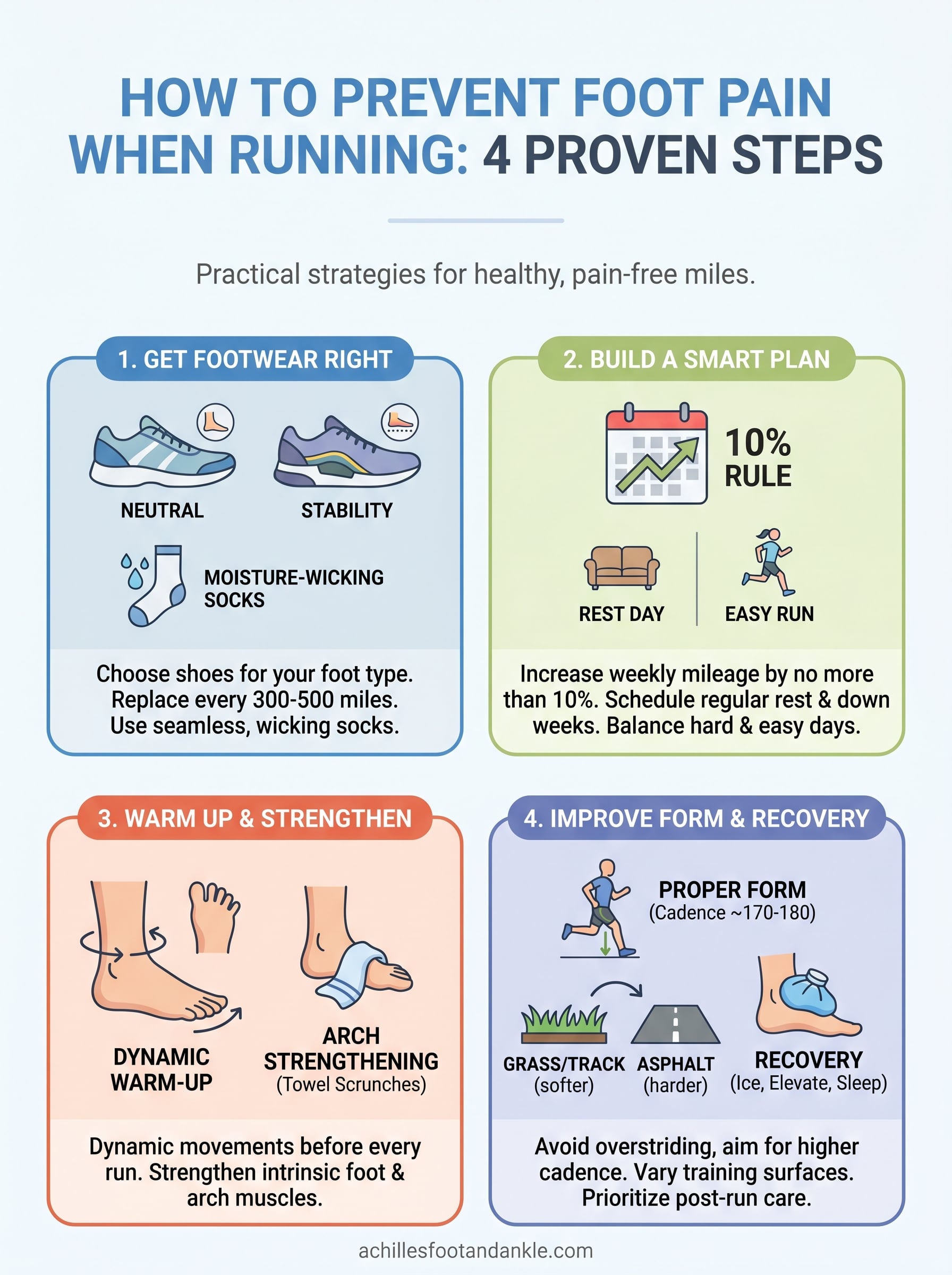
The most effective approach to how to prevent foot pain when running comes down to four core habits: wear the right shoes, build mileage gradually, warm up before every run, and recover with intention. You don’t need a complicated system to stay injury-free. Consistency with these basics will protect your feet through most training cycles without requiring expensive equipment or hours of extra work.
That said, some pain signals demand professional attention rather than a wait-and-see approach. Sharp heel pain that worsens with your first steps in the morning, numbness in your toes, or swelling that persists for more than a few days after a run are all signs that something needs evaluation beyond stretching and rest. Catching a problem early almost always shortens your recovery time and gets you back on the road faster. If any of these symptoms sound familiar, book a same-day appointment with our podiatrists at Achilles Foot and Ankle Center.