Standing on your feet for 8, 10, or 12 hours in work boots takes a real toll on your arches. Without proper support, that daily strain leads to plantar fasciitis, flat foot fatigue, and chronic heel pain that follows you home long after you clock out. If you’ve been searching for the best arch support insoles for work boots, you’re already one step ahead, because the insoles that come standard in most boots are, frankly, terrible at supporting your foot’s natural structure.
At Achilles Foot and Ankle Center, our podiatrists treat these overuse injuries across our Central Virginia clinics every single day. Construction workers, nurses, warehouse staff, retail employees, the pattern is the same. Worn-out insoles and poor arch support cause compensatory issues that travel up through the ankles, knees, and lower back. We’ve seen firsthand how the right insole can prevent months of pain and keep people working without limitation.
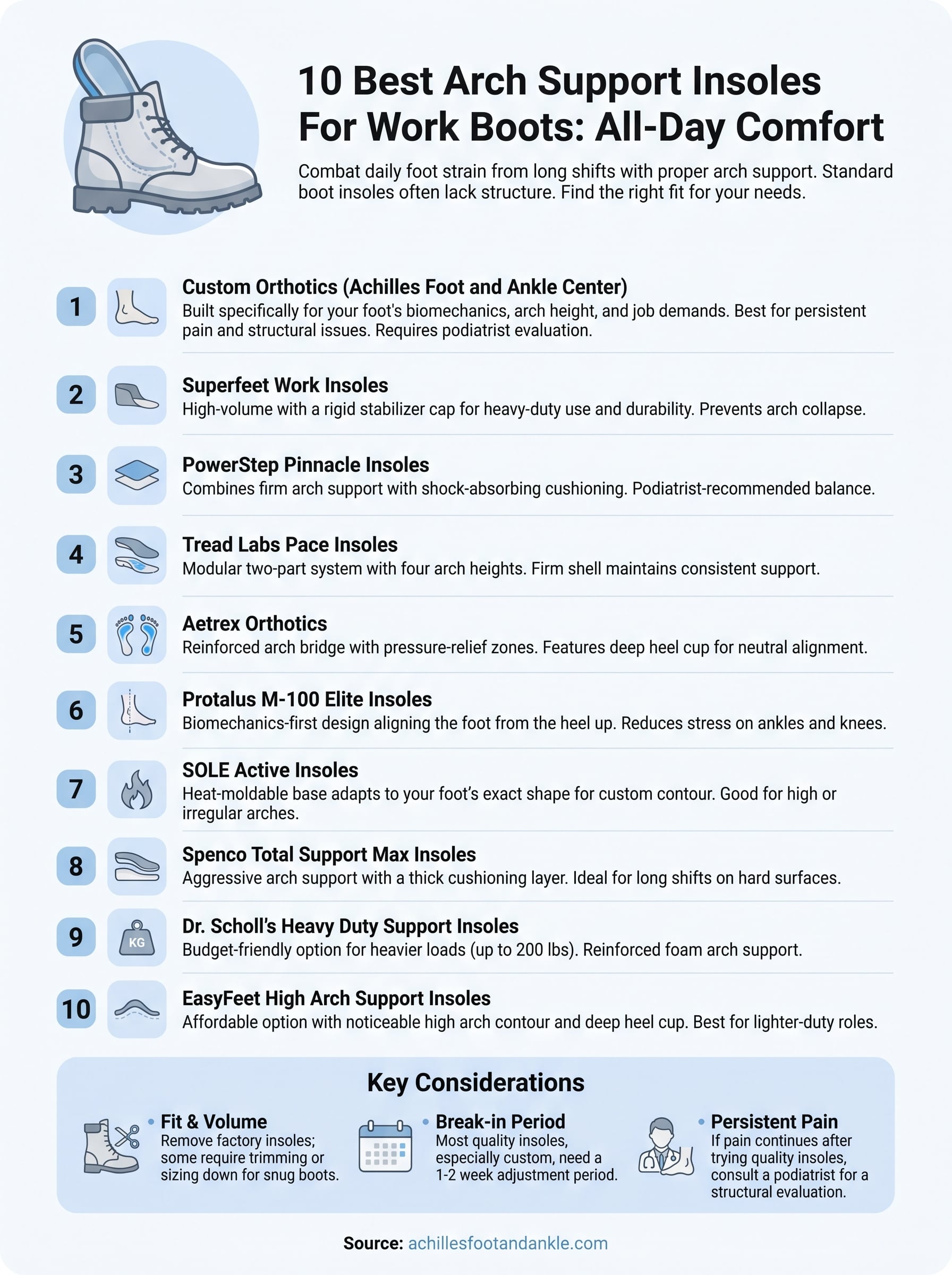
This guide breaks down 10 top-performing arch support insoles built for the demands of work boots. We evaluated each option based on arch type compatibility, cushioning durability, heel stability, and how well they hold up over long shifts. Whether you have high arches, flat feet, or something in between, you’ll find a recommendation that fits. And if your foot pain persists even with quality insoles, that’s a sign it’s time to see a specialist for a proper evaluation.
1. Custom orthotics from Achilles Foot and Ankle Center
Custom orthotics from a podiatrist sit at the top of this list for good reason. Unlike any over-the-counter product, custom orthotics are built specifically for your foot’s biomechanics, your arch height, your gait pattern, and the physical demands of your job. For workers dealing with persistent pain, this level of precision makes a measurable difference.
How custom orthotics support high arches in work boots
Custom orthotics address high arches by redistributing pressure evenly across the entire foot rather than concentrating it on the heel and the ball. A high arch creates a rigid lever that transfers stress up through the ankle and lower leg with every step you take. Rigid or semi-rigid custom shells correct this by filling the gap under your arch precisely, giving it a stable platform to load against during long shifts.
Work boots present a specific challenge because they have deeper heel cups and stiffer midsoles than everyday footwear. Custom orthotics account for that internal geometry, which means your podiatrist factors in the volume and structure of your specific boot during the evaluation rather than designing for a generic shoe.
Who should choose custom orthotics vs OTC insoles
If you’ve already tried several of the best arch support insoles for work boots and still deal with daily heel pain, plantar fasciitis, or significant arch fatigue, custom orthotics are likely the right move. Over-the-counter insoles work well for mild to moderate support needs, but they are built around an average foot shape, not yours.
Custom orthotics are especially worth the investment if your pain is bilateral, meaning both feet hurt consistently, or if you have a structural condition like flat feet, high rigid arches, or overpronation that standard insoles cannot fully correct.
Workers with diabetes, chronic nerve pain, or a history of stress fractures should prioritize custom orthotics over any off-the-shelf option. The precision fit reduces areas of concentrated pressure that can lead to serious complications over time.
How the fitting process works and what to expect
At Achilles Foot and Ankle Center, the process starts with a full biomechanical evaluation by one of our podiatrists. You’ll walk, stand, and have your gait observed so the doctor can identify exactly how your foot functions under load and where stress concentrates.
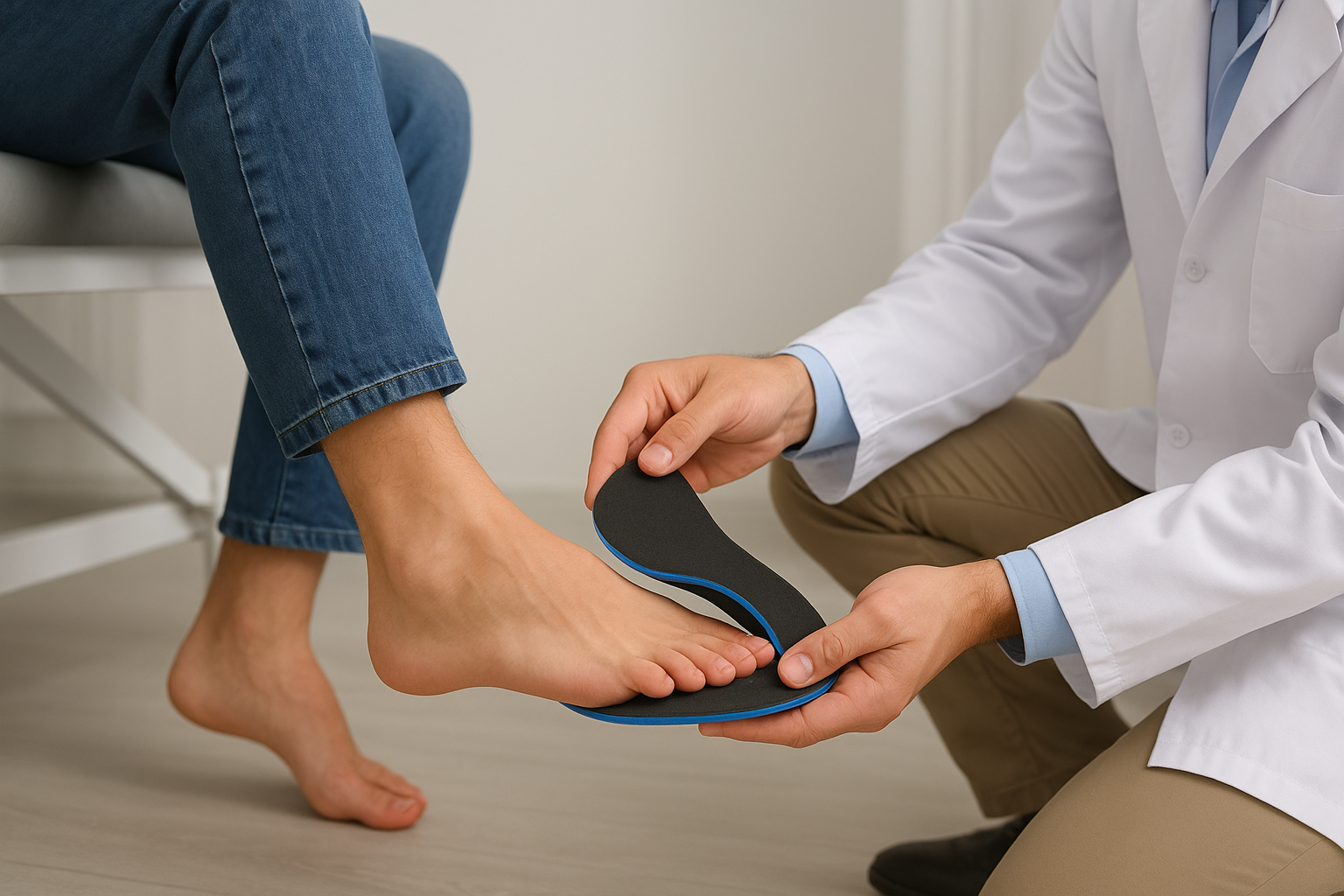
From there, your podiatrist takes a cast or digital scan of your foot, which serves as the blueprint for fabrication. The lab builds the shell and top cover to those exact specifications. You return for a fitting once they are ready, and most patients go through a break-in period of one to two weeks before wearing them through full shifts without discomfort.
Typical price range and insurance considerations
Custom orthotics from a podiatry practice typically cost between $400 and $800 per pair without insurance coverage. That range reflects the evaluation, casting, and fabrication process, which is far more involved than purchasing an insole off a shelf.
Many major insurance plans, including Medicare, cover custom orthotics when your podiatrist documents medical necessity. At Achilles Foot and Ankle Center, our team handles prior authorization and billing directly. If your plan does not cover orthotics, a pair that lasts three to five years with proper care often delivers strong value compared to replacing OTC insoles every few months.
2. Superfeet Work insoles
Superfeet has built a reputation for producing high-volume, structured insoles that hold up through demanding work environments. Their Work line specifically targets heavy-duty boot use, making them one of the most recognized options when people look for the best arch support insoles for work boots. The rigid stabilizer cap underneath the heel and arch is what separates Superfeet from thin foam alternatives that collapse within weeks.
How Superfeet builds rigid arch support and heel stability
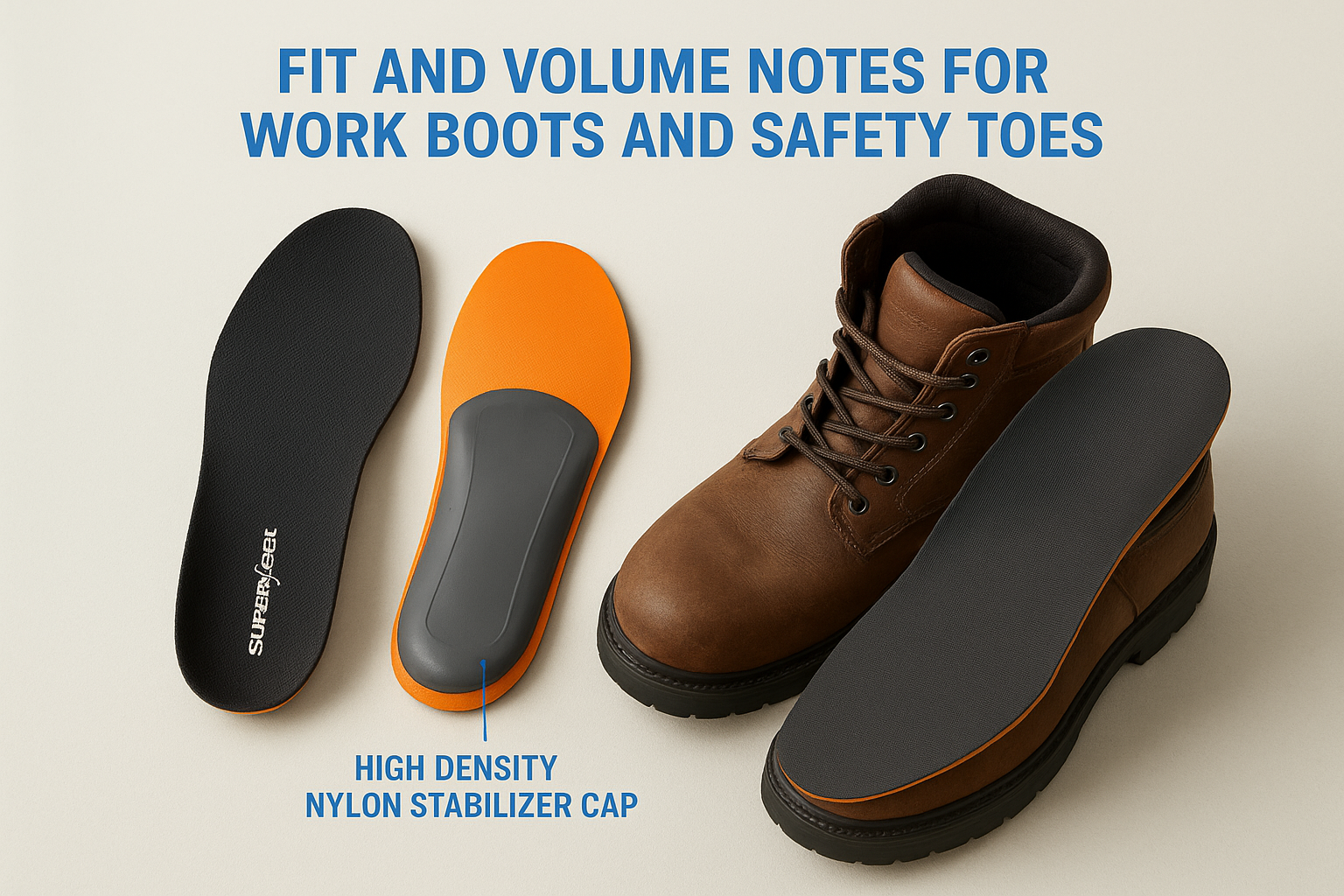
Superfeet Work insoles use a high-density nylon stabilizer cap that runs from the heel through the arch, locking your foot into a neutral position regardless of how many hours you’re on your feet. That rigidity prevents arch collapse by giving your foot a firm surface to press into rather than a soft foam that compresses and loses its shape. The deep heel cup pulls your calcaneus into alignment, which reduces stress on the plantar fascia and keeps your lower leg mechanics efficient over long shifts.
The stabilizer cap design means Superfeet holds its structural integrity far longer than cushion-only insoles, making them cost-effective across months of daily use.
Who these work best for
Superfeet Work insoles perform best for workers with mild to moderate arch support needs who spend long hours walking or standing on hard surfaces. If your main complaint is general arch fatigue or heel soreness by the end of a shift, these insoles address that well. Workers with severe high arches or diagnosed structural issues may find the arch height doesn’t fully fill the gap their foot needs, in which case custom orthotics are a better fit.
Fit and volume notes for work boots and safety toes
Superfeet Work insoles are higher-volume than average, which means they take up meaningful space inside your boot. Before installing them, remove the existing factory insole completely to avoid crowding your toes. Steel-toed and composite-toed boots often have a tighter forefoot, so sizing down from your boot size by half a step and trimming to the printed cut lines on the insole will usually get you a clean fit.
Typical price range
Superfeet Work insoles typically retail between $50 and $60 per pair, depending on the retailer and specific model. That puts them in the mid-range tier for OTC arch support options, and their durability makes that price reasonable across six to twelve months of regular use.
3. PowerStep Pinnacle insoles
PowerStep Pinnacle insoles are one of the most widely recommended OTC orthotics by podiatrists, and that reputation is well earned for work boot applications. They strike a balance between structured arch support and shock-absorbing cushioning that most rigid-only insoles skip, making them a practical choice for workers who need both stability and comfort across a full shift.
How PowerStep combines firm arch support and cushioning
PowerStep Pinnacle insoles use a semi-rigid polypropylene shell under the arch and heel to control foot motion, paired with a dual-layer EVA foam top cover that cushions impact without bottoming out. That combination matters because a rigid shell alone can feel punishing on concrete floors after several hours, while foam-only insoles offer comfort early in the day but lose their structural integrity by midshift. The Pinnacle design addresses both problems at once.
This dual-layer approach is why PowerStep Pinnacle consistently appears on podiatrist-recommended lists and makes a strong case among the best arch support insoles for work boots.
Who these work best for
These insoles work well for workers with mild to moderate high arches who deal with plantar fasciitis, heel pain, or general arch fatigue during long shifts. If you overpronate slightly, the shell geometry helps correct that without overcorrecting your natural stride. Workers with very severe arch deformities or significant structural misalignment will likely need custom orthotics to get adequate correction, but for the majority of workers with common foot pain complaints, the Pinnacle handles it well.
Fit tips for boots with limited toe box space
PowerStep Pinnacle insoles run on the thicker side compared to budget foam insoles, so always pull out your boot’s factory insole before inserting them. In boots with a narrow or composite safety toe, trim along the size guidelines printed on the insole itself rather than guessing. If your boot already fits snugly, go up half a size on the insole trim to leave your forefoot room to spread naturally under load, which reduces toe fatigue on long shifts.
Typical price range
PowerStep Pinnacle insoles retail between $40 and $55 per pair, depending on the specific model and retailer. That price point makes them one of the more accessible mid-range options, and most pairs hold their structure reliably for six to nine months of daily work boot use before needing replacement.
4. Tread Labs Pace insoles
Tread Labs takes a different approach than most insole brands, and for workers with high arches, that difference is significant. Their Pace insoles use a modular two-part system that separates the firm arch support shell from the cushioning top cover, so you can mix and match components based on your foot structure and the demands of your shift.
How the modular arch system supports high arches
The Pace insole shell is made from medical-grade nylon that holds its shape under sustained load without collapsing or compressing over time. Unlike foam-based insoles that soften and lose their contour after a few weeks, the Pace shell maintains a consistent arch height from your first shift to your last. That consistency is critical for high arches, which need a stable and predictable surface to distribute weight across the full foot rather than concentrating pressure on the heel and forefoot.
The firm shell design means Tread Labs Pace insoles deliver reliable support across months of use, making them a strong contender when searching for the best arch support insoles for work boots.
Who these work best for
Tread Labs Pace insoles work best for workers with moderate to high arches who have struggled to find OTC insoles with enough lift under the arch. The modular design also suits people who rotate between multiple pairs of boots, since you can swap the shell between boots and simply replace the top cover when it wears out. Workers with flat feet or very low arches should look elsewhere, as the Pace shells are designed around higher arch profiles and may not sit flush against flatter foot structures.
How to pick the right arch height and top cover
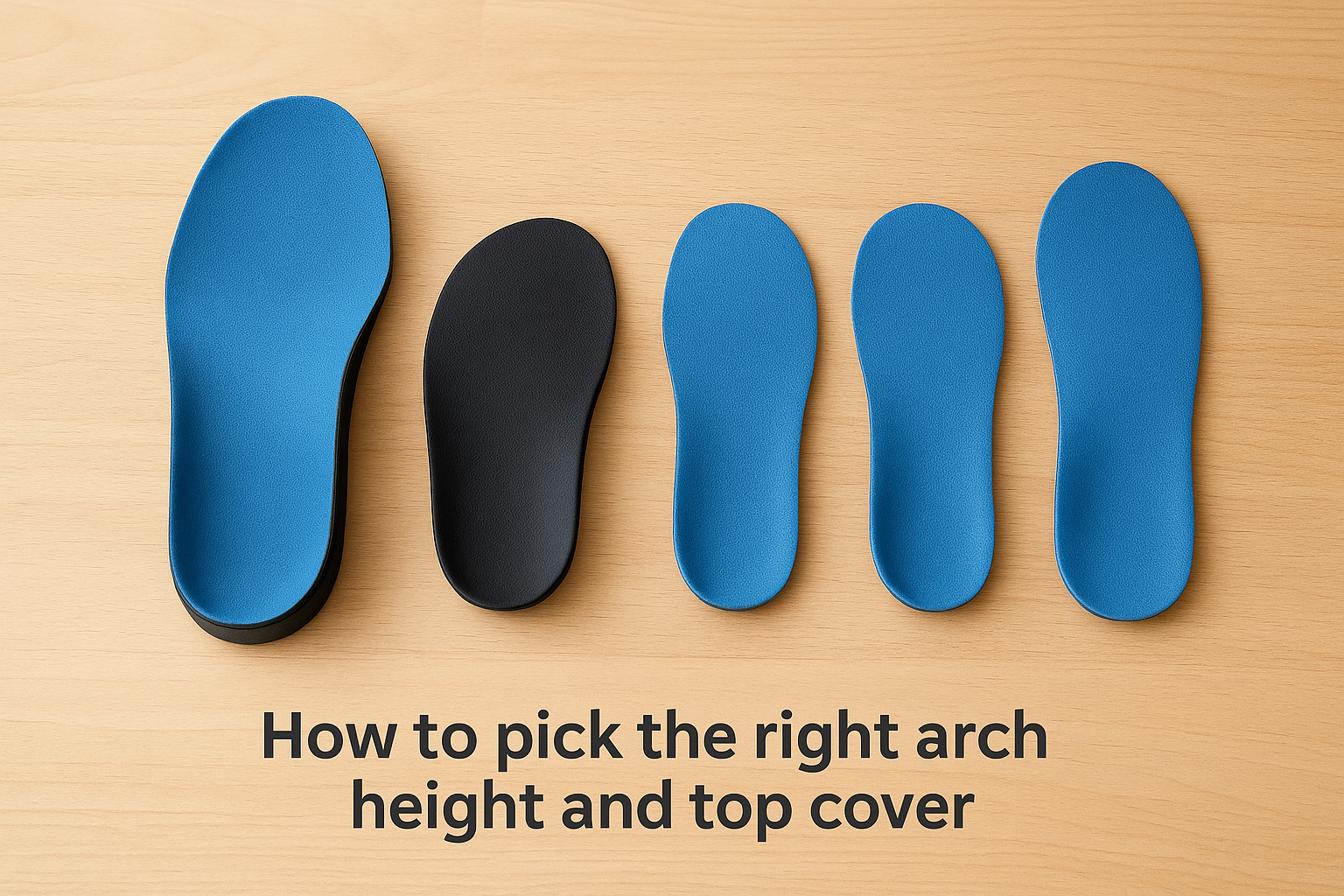
Tread Labs offers four arch height options (low, medium, high, and extra high), and selecting the right one matters. You can use their online fit guide to match your arch measurement to the correct shell. For work boots, pair the arch shell with a thicker top cover to add cushioning on hard surfaces and reduce shock through long shifts. Remove your factory insole before installing the Pace system to maintain proper boot volume.
Typical price range
Tread Labs Pace insoles typically retail between $75 and $90 per pair, which includes both the shell and an initial top cover. Replacement top covers cost around $20 to $25, making long-term use more economical than replacing full insoles every few months.
5. Aetrex orthotics for work boots
Aetrex builds orthotics with a stronger podiatric foundation than most OTC brands, which is why their products frequently appear in clinical settings alongside the best arch support insoles for work boots. Their designs integrate structured arch support with targeted pressure-relief zones, making them a reliable option for workers who need more than basic cushioning from their insoles.
How Aetrex supports high arches and reduces heel strain
Aetrex orthotics use a reinforced arch bridge that maintains consistent contact with your foot’s midfoot, preventing the collapse that leads to plantar fascia overload during long shifts. The deep heel cup positions your calcaneus in a neutral alignment, which reduces the impact force that travels up through your heel and into your ankle with each step. That heel geometry matters particularly on hard surfaces like concrete, where uncontrolled heel strike compounds stress across the entire kinetic chain.
Workers dealing with chronic heel pain often see significant relief when they switch to an insole that combines proper arch contact with a structured heel cup, which is exactly what Aetrex delivers.
Who these work best for
Aetrex orthotics suit workers with moderate to high arches who experience both arch fatigue and heel soreness by the end of a shift. Their pressure-mapping technology gives them an edge for people who carry extra body weight on the job, since the reinforced structure handles higher loads without bottoming out as quickly as standard foam insoles. Workers with mild overpronation also benefit from the medial arch support that keeps the foot tracking straight over long distances.
How to choose the right Aetrex model for your arch
Aetrex offers several work-ready models, and arch height is the primary factor to match before buying. Their L300 series targets moderate support needs, while the L400 line provides a higher arch profile for feet that need more lift under the midfoot. Use the brand’s online sizing guide or consult your podiatrist before committing to a model, and always remove your boot’s factory insole first to maintain proper fit volume inside the boot.
Typical price range
Aetrex orthotics typically retail between $50 and $70 per pair, depending on the specific model and retailer. Most pairs hold their structural integrity for six to nine months of daily use in work boots before the arch support begins to soften noticeably.
6. Protalus M-100 Elite insoles
Protalus takes a biomechanics-first approach to insole design, and the M-100 Elite reflects that focus directly. Rather than simply adding cushioning under the arch, Protalus engineers the heel geometry to shift your entire foot into a corrected alignment, which reduces the downstream stress that accumulates in your ankles, knees, and lower back over a long shift.
How Protalus targets alignment and stability under load
The M-100 Elite uses a patented translation technology embedded in the heel cup that angles your foot slightly inward from the heel, encouraging neutral alignment up through the ankle joint before your arch even comes into contact with the insole surface. That approach differs from most insoles that address arch support in isolation. By starting the correction at the heel, Protalus distributes load more evenly across the entire foot and reduces the torque that builds at the ankle during prolonged standing or walking on uneven surfaces.
This heel-first alignment strategy makes the M-100 Elite particularly useful for workers who experience knee or lower back fatigue alongside their foot pain, since the correction works up the kinetic chain rather than stopping at the arch.
Who these work best for
Protalus M-100 Elite insoles work well for workers with mild to moderate overpronation or those who carry a heavier build and need structural support that doesn’t compress under sustained load. If your primary complaint is ankle instability or knee pain that accompanies arch fatigue, the alignment-focused heel design addresses the problem more effectively than standard arch-only insoles. Workers with rigid high arches who need significant arch lift may find the M-100 Elite underwhelming in that specific area, since the correction emphasis sits at the heel rather than the midfoot.
When the profile and heel geometry may not fit your boots
The M-100 Elite has a thicker heel profile than most OTC insoles, which creates a fit challenge in low-volume work boots or boots with a built-in molded footbed that can’t be removed cleanly. Always pull the factory insole out before installing the M-100 Elite, and check that your heel sits flush without lifting toward the boot collar. In steel-toed boots with a snug forefoot, trim carefully along the printed size lines to avoid crowding your toes.
Typical price range
Protalus M-100 Elite insoles typically retail between $60 and $75 per pair, positioning them in the upper mid-range of the best arch support insoles for work boots category. Most users get six to ten months of reliable support before the heel geometry begins to soften under daily use.
7. SOLE Active insoles
SOLE Active insoles stand out from most OTC options on this list because they adapt directly to your foot’s shape rather than asking your foot to conform to a generic mold. That heat-moldable design gives them a distinct advantage for workers with high or irregular arches who have struggled to find standard insoles that actually make full contact under the midfoot.
How heat-moldable support helps high arches
SOLE Active insoles use a thermoplastic base layer that softens when heated, allowing the arch and heel cup to conform to your foot’s exact contours when you step into them. For high arches, this matters because most OTC insoles leave a gap under the midfoot rather than filling it completely. A custom-conformed arch surface transfers load more evenly, reducing the concentrated pressure on your heel and forefoot that causes fatigue and pain during long shifts.
Who these work best for
SOLE Active insoles perform well for workers with high or asymmetrical arches who find standard rigid insoles uncomfortable because the arch peaks in the wrong place for their foot. They also suit workers who rotate between different boot styles or brands, since the moldable base allows each insole to adapt to minor differences in internal boot geometry. Workers who need significant structural correction for overpronation or diagnosed plantar fasciitis will still benefit more from custom orthotics than from any heat-moldable OTC option.
Heat molding vs wear molding and break-in expectations
You have two ways to mold SOLE Active insoles: oven heating at home following the manufacturer’s instructions, or simply wearing them through natural body heat until they conform over time. Oven molding gets you a fitted result faster, typically within one session, while wear molding takes several days to a week of regular use before the base fully conforms to your arch. Most workers find the oven method more reliable for high arches, since body-heat molding alone may not generate enough softening to fill a steep arch gap completely.
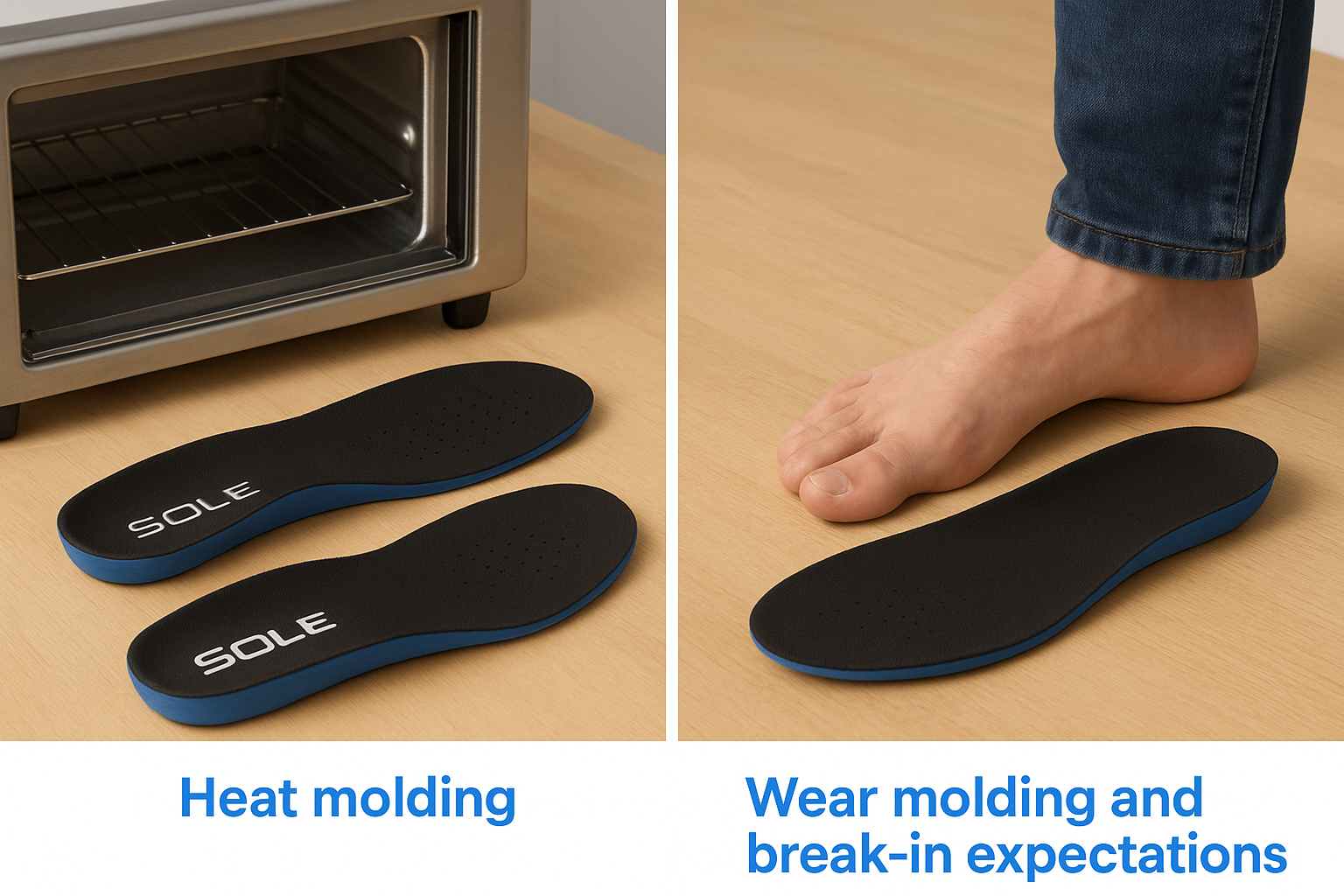
If you skip the oven step and rely on wear molding, expect a longer break-in period and less precise arch contact, especially if your arch height is above average.
Typical price range
SOLE Active insoles typically retail between $45 and $65 per pair, putting them in the mid-range category among the best arch support insoles for work boots. The moldable base holds its shape reliably for five to eight months of daily use before the arch contour begins to flatten and support diminishes.
8. Spenco Total Support Max insoles
Spenco has been producing orthotics for decades, and the Total Support Max represents their most aggressive arch support offering in the OTC category. For workers who need more lift and structure than a standard cushioned insole provides but aren’t ready to pursue custom orthotics, this model fills that gap reliably across demanding shifts.
How Spenco builds structured support with added cushion
The Total Support Max uses a rigid polypropylene arch shell combined with a thick layer of SpenFoam cushioning on top, giving you firm structural correction without the harsh feel that fully rigid insoles sometimes deliver. The deep heel cup cradles your calcaneus and prevents lateral rocking, which reduces the micro-instability that compounds into ankle and knee soreness by the end of a long day. Metatarsal support built into the forefoot spreads pressure away from the ball of your foot, which makes a real difference if you’re walking on hard floors rather than standing in one place.
That combination of a rigid shell and shock-absorbing foam layer is exactly what separates the Spenco Total Support Max from budget insoles that offer cushioning without any meaningful structural correction.
Who these work best for
These insoles perform best for workers with moderate arch heights who deal with both arch fatigue and heel impact pain simultaneously. If your shift involves walking long distances on concrete, tile, or asphalt rather than primarily standing, the cushioning layer in the Spenco Total Support Max absorbs repetitive impact more effectively than a rigid-shell-only design. Workers searching for the best arch support insoles for work boots who need a step up from basic foam but aren’t dealing with a diagnosed structural condition will find this model handles their needs well.
Fit notes for wide boots and long shifts on concrete
Spenco Total Support Max insoles come in wider width options, making them one of the more accommodating choices for workers with wider feet or wide-fitting work boots. Always remove your factory insole before inserting them to preserve proper boot volume. The thicker cushioning layer means the forefoot adds more height than slimmer insoles, so if your steel-toe box already fits tightly, trim carefully along the marked size guides to maintain comfortable toe clearance.
Typical price range
Spenco Total Support Max insoles typically retail between $40 and $55 per pair. Most workers get six to nine months of reliable structure before the foam layer compresses enough to warrant replacement.
9. Dr. Scholl’s Heavy Duty Support insoles
Dr. Scholl’s Heavy Duty Support insoles target workers who carry more body weight on the job or spend extended hours on their feet under physical load. They sit in the budget-to-mid-range tier of the best arch support insoles for work boots category, which makes them accessible for workers who need meaningful support without committing to a higher price point right away.
How these insoles add arch support for heavier loads
Dr. Scholl’s Heavy Duty Support insoles use a reinforced arch support structure designed to handle body weights up to 200 pounds without collapsing by the end of a shift. The built-in gel heel cushion absorbs impact on hard surfaces, and the contoured foam layer under the arch provides lift that prevents the midfoot from flattening during sustained standing or walking. That combination gives heavier workers a noticeable step up from the thin, flat footbeds that ship inside most standard work boots.
Workers who carry more body weight put significantly higher pressure on the arch and heel with every step, and a support insole rated for heavier loads holds its structure far longer than a standard OTC foam option.
Who these work best for
These insoles perform well for workers with low to moderate arch support needs who are on their feet all day and want relief from general heel and arch soreness. If your work involves standing on concrete or hard flooring for most of your shift without covering significant distance, the cushioning profile suits that use case well. Workers with diabetes, diagnosed plantar fasciitis, or significant structural foot issues should look at more clinically designed options rather than relying on this insole for adequate correction.
Limitations to know if you need true rigid support
Dr. Scholl’s Heavy Duty insoles rely primarily on dense foam rather than a rigid polypropylene shell, which means the arch support compresses more under sustained load compared to semi-rigid OTC options like the Spenco or PowerStep models. If you need true biomechanical correction for overpronation or a high rigid arch, foam-based support will not hold its shape consistently across a full 10 or 12-hour shift.
Typical price range
Dr. Scholl’s Heavy Duty Support insoles retail between $15 and $25 per pair, making them the most budget-friendly option on this list. Most pairs last three to five months of daily use before the foam compresses enough to require replacement.
10. EasyFeet high arch support insoles
EasyFeet insoles are a budget-friendly option that targets workers with pronounced high arches who want dedicated arch contour without paying mid-range prices. They don’t compete with semi-rigid polypropylene designs on structural integrity, but for workers with mild to moderate foot pain who spend full shifts standing or walking, they deliver noticeable relief compared to the thin footbeds that ship inside most work boots.
How EasyFeet delivers high arch contour and heel cup support
These insoles feature a raised arch ridge that extends further into the midfoot than most budget-tier insoles, making direct contact with high arches rather than leaving a gap underneath. The deep heel cup keeps your calcaneus centered and reduces lateral heel movement that contributes to ankle strain over long shifts. That combination of arch contact and heel containment gives your foot a more stable base than flat foam insoles, particularly during the later hours of a demanding shift.
Workers with genuinely high arches often find that the EasyFeet arch profile makes contact where other budget insoles fall completely flat, which is the primary reason this option earns a spot among the best arch support insoles for work boots.
Who these work best for
EasyFeet insoles suit workers with high arches and mild foot fatigue who want a step up from flat factory insoles without committing to a higher price point. They work particularly well for workers in lighter-duty roles like retail, hospitality, or light warehouse work where the physical load is consistent but not extreme. Workers with diagnosed plantar fasciitis, significant overpronation, or jobs that involve carrying heavy loads will need a more structurally reinforced option to get adequate correction and durability.
Common fit problems and how to avoid them
The most frequent complaint with EasyFeet insoles is that the arch peak sits too far forward for some foot types, creating pressure under the midfoot rather than genuine support. Before committing to a full shift, wear them for a short trial period and verify the arch ridge aligns with your actual arch midpoint rather than the ball of your foot. Always remove the factory insole first, and trim along the printed guidelines carefully to avoid bunching at the toe box in boots with limited forefoot space.
Typical price range
EasyFeet insoles typically retail between $20 and $30 per pair, making them the second most affordable option on this list. Most pairs hold their shape for three to five months of daily work boot use before the arch contour softens and support drops off noticeably.
Next steps
Finding the best arch support insoles for work boots is a smart starting point, but it’s not always the finish line. If you’ve worked through several of the options on this list and still leave every shift with heel pain, arch fatigue, or ankle soreness, your foot is telling you something an OTC insole can’t fix. Persistent pain after trying quality insoles points to a structural issue that needs a clinical eye, not another product swap.
Your next move is to get a proper evaluation from a podiatrist who understands the demands of your job. At Achilles Foot and Ankle Center, our team works with workers across Central Virginia every day to identify what’s actually driving foot and ankle pain and build a treatment plan that fits your life. Custom orthotics, targeted therapy, and same-day availability mean you don’t have to wait weeks to get answers. Schedule your appointment today and start your shift pain-free.