
You’re mid-run, feeling good, and then it hits, a sharp ache in your foot that stops you in your tracks. If you’ve ever asked yourself why does my foot hurt when running, you’re far from alone. Foot pain is one of the most common complaints among runners, whether you’re training for a marathon or just getting back into a regular jogging routine.
The tricky part is that foot pain during a run can stem from several different sources. A dull throb under your heel points to a completely different problem than a burning sensation near your toes. Pinpointing the cause matters because the wrong self-treatment can make things worse, or turn a minor issue into a serious injury.
At Achilles Foot and Ankle Center, our podiatry team across Central Virginia sees runners with these exact problems every week. Below, we break down eight common causes of running-related foot pain and what you can actually do about each one, from simple at-home fixes to treatments that may require professional care.
1. An undiagnosed injury that needs a podiatry exam
Before diving into specific conditions, there’s one important truth: many runners push through pain without ever finding out what’s actually causing it. If you keep asking yourself why does my foot hurt when running and nothing you try seems to help, the most important step may be getting a proper clinical evaluation before a manageable problem becomes a serious setback.
Clues that your pain needs a real diagnosis
Not every ache demands an emergency visit, but certain signs tell you that self-treatment is not enough. Watch for these specific warning signals:
- Pain that gets worse as a run continues rather than loosening up after the first mile
- Swelling that does not go down overnight with rest and elevation
- A sharp, pinpoint spot that hurts when you press directly on it
- Numbness, tingling, or burning that radiates into the toes
- Any pain that forces you to alter your stride or favor one side
What a podiatrist checks during a running foot exam
A podiatrist does more than ask where it hurts. During your exam, your doctor will assess foot structure, arch height, and range of motion in the ankle and toes. They will also evaluate your gait pattern and look for muscle imbalances or biomechanical issues that may be placing excess load on specific structures with every stride you take.
Pain that changes how you move almost always signals an underlying injury that needs a diagnosis, not just a few days off.
Tests and imaging that confirm the problem
Depending on what the physical exam reveals, your podiatrist may order digital X-rays to screen for stress fractures or bone changes. In other cases, an MRI or diagnostic ultrasound gives a detailed view of soft tissue damage, including tendons, ligaments, and the plantar fascia. These tools let your doctor confirm what is wrong rather than treat based on assumptions.
What to do while you wait for an appointment
Reduce your running volume or switch to a low-impact activity like cycling or swimming until your appointment. Apply ice for 15 to 20 minutes after any activity to keep inflammation manageable, and skip any movement that triggers sharp or worsening pain. Continuing to run hard on an undiagnosed injury frequently turns a short recovery into a long one.
2. Plantar fasciitis
Plantar fasciitis is the most common cause of heel pain in runners, and if you’re asking yourself why does my foot hurt when running, this condition belongs near the top of your list. The plantar fascia is a thick band of connective tissue that runs along the bottom of the foot, linking your heel bone to the base of your toes. When that tissue becomes inflamed, it makes every step feel like a punishment.
Where it hurts and how it usually shows up
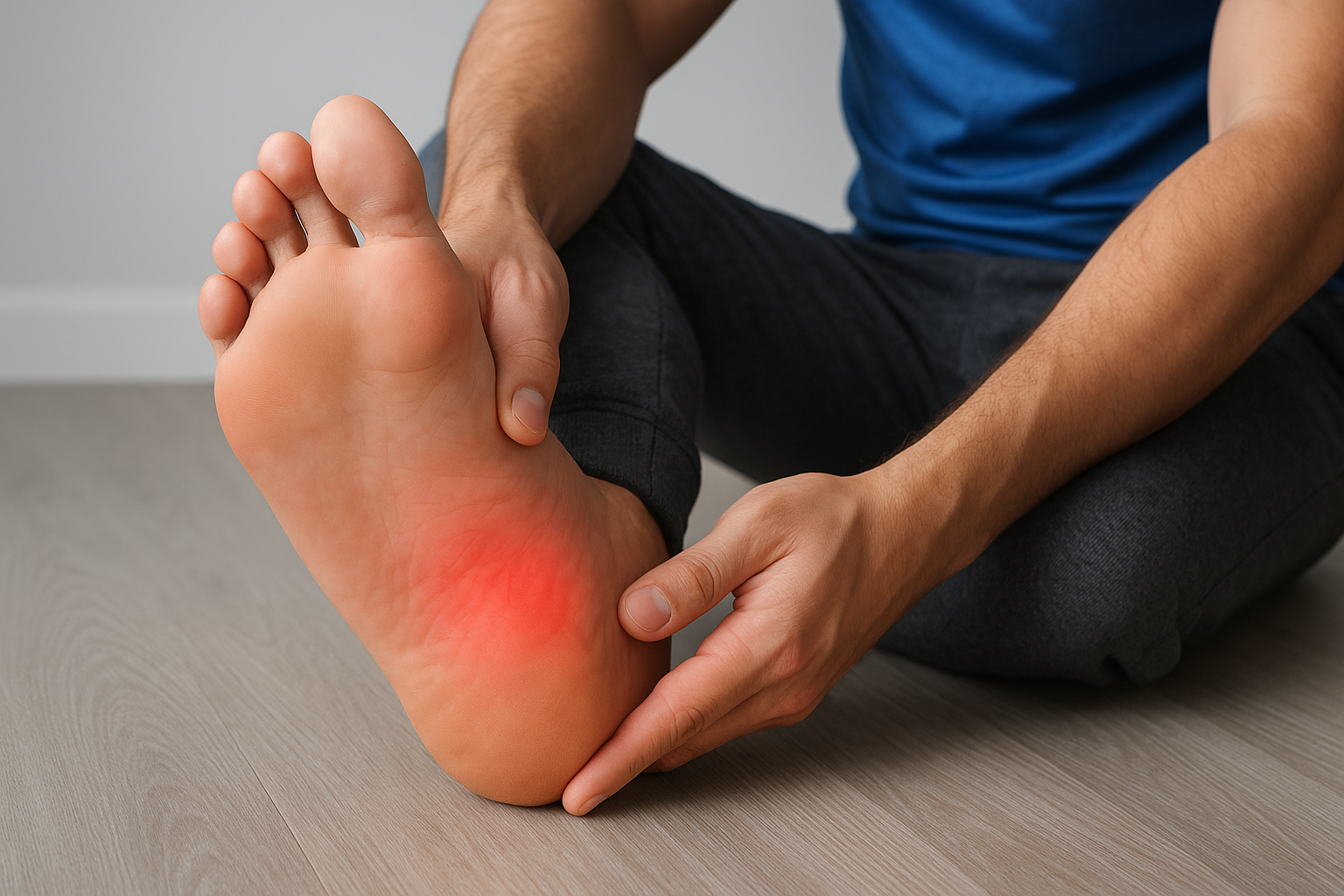
Pain from plantar fasciitis centers at the inside bottom of the heel, right where the fascia attaches to the bone. Most runners notice it most sharply with the first few steps after waking up or after any extended period of sitting. The pain often eases slightly once you warm up, then returns with more intensity later in a long run.
Why runners get plantar fascia pain
Running places repetitive tension through the plantar fascia with every stride, and that load accumulates quickly over miles. Risk factors include tight calf muscles, low arches, worn-out shoes, or a sudden jump in weekly mileage that the tissue cannot adapt to in time.
Increasing your training volume by more than 10 percent per week is one of the most consistent triggers for plantar fasciitis in runners.
At-home steps that calm heel and arch pain
Stretching your calves and the plantar fascia itself each morning before your first step helps reduce morning pain significantly. Wearing supportive shoes with solid arch cushioning throughout the entire day, not only during runs, removes excess load from the fascia between sessions.
When you need medical treatment
If rest and consistent stretching have not produced meaningful improvement within two to three weeks, a podiatrist visit makes sense. Persistent cases respond well to custom orthotics, corticosteroid injections, or a targeted physical therapy program when home care stops working.
3. Metatarsalgia
Metatarsalgia refers to pain and inflammation in the ball of the foot, specifically around the metatarsal heads, the five long bones that connect your toes to the rest of your foot. If you’re still wondering why does my foot hurt when running, and the discomfort sits in the front of your foot rather than the heel, metatarsalgia may be the reason.
Signs you have pain in the ball of the foot
The pain typically feels like a burning, aching, or sharp sensation concentrated just behind your toes, particularly under the second, third, and fourth metatarsal heads. Many runners describe the sensation as walking or running on small pebbles, and it usually worsens during push-off or when running on harder surfaces.
Pain in the ball of the foot that intensifies during push-off and eases with rest is one of the clearest signs of metatarsalgia.
Common running-related causes and risk factors
High training volume, running on hard pavement, and wearing shoes with minimal forefoot cushioning all increase pressure across the metatarsal heads. Foot structure also plays a role: a high arch or a longer second metatarsal concentrates ground forces into a smaller area with each stride.
Shoe and training changes that reduce forefoot pressure
Switch to a shoe with more forefoot cushioning and a wider toe box to spread load more evenly. Adding metatarsal pads inside your current shoes can also shift pressure away from the inflamed area immediately.
When to rule out a fracture or neuroma
Persistent or pinpoint pain in the forefoot needs imaging to exclude a stress fracture. Sharp, shooting pain between the toes may indicate Morton’s neuroma, a separate condition that warrants its own targeted treatment.
4. Stress fracture
A stress fracture is a small crack in a bone caused by repetitive mechanical load rather than a single traumatic event. If you keep asking yourself why does my foot hurt when running and nothing eases the discomfort between sessions, a stress fracture is one of the most serious possibilities to rule out.
Symptoms that set stress fractures apart from soreness
Stress fracture pain is specific and pinpoint, meaning you can usually press one small spot on the bone and reproduce the exact pain. Unlike general muscle soreness, the discomfort intensifies as your run continues and often persists during normal walking afterward. The second and third metatarsals along the top of the foot are among the most common sites.
Why stress fractures happen in runners
Rapid mileage increases and insufficient recovery time are the two most consistent contributors. Bones adapt to load more slowly than muscles do, so when training volume jumps faster than bone remodeling can keep pace, small cracks develop. Low bone density, poor nutrition, and worn-out footwear compound the risk considerably.
Running through suspected stress fracture pain can convert a minor crack into a complete fracture, extending recovery from weeks into months.
What to do now and what to avoid
Stop running immediately and avoid any weight-bearing activity that reproduces the pain. Do not rely on over-the-counter pain relievers to mask symptoms so you can keep training.
Why early diagnosis matters for healing time
Catching a stress fracture early through X-ray or MRI imaging lets your podiatrist prescribe the right level of offloading before the injury worsens. Earlier treatment consistently shortens recovery and reduces the risk of the fracture displacing or requiring surgical fixation.
5. Tendon overload and tendonitis
Tendons connect muscle to bone, and runners put them through repeated stress with every stride. When load accumulates faster than the tissue can recover, tendonitis develops as inflammation and irritation within the tendon itself. If you are still figuring out why does my foot hurt when running, and the discomfort feels like a dull ache or burning along the back or sides of the foot, tendon overload belongs on your list of suspects.
Which tendons commonly hurt in runners
The Achilles tendon at the back of the heel is the most frequently irritated tendon in runners, but it’s far from the only one. The peroneal tendons travel along the outer ankle, while the posterior tibial tendon supports the arch along the inside of the foot, and both can become inflamed under high training loads.
How overuse and mechanics irritate tendons
Tendons respond poorly to sudden jumps in mileage or intensity without adequate recovery between sessions. Poor foot mechanics, such as excessive pronation or supination, force individual tendons to absorb loads they were not designed to handle stride after stride.
Tendons heal more slowly than muscles, so pain that persists more than a week after reducing your training almost always needs professional attention.
Self-care that supports tendon recovery
Cut your running volume immediately when tendon pain appears. Eccentric calf strengthening exercises and gentle, consistent stretching of the affected tendon support tissue repair without adding excessive mechanical stress.
When tendon pain needs targeted treatment
If pain continues beyond two weeks of reduced activity, schedule a podiatry visit. Custom orthotics or a structured physical therapy program can address the underlying mechanics driving the problem, and ultrasound-guided treatment may be recommended for tendons that do not respond to rest alone.
6. Poor footwear fit and lacing pressure
Your shoes are one of the most overlooked answers when you keep asking yourself why does my foot hurt when running after every workout. A poor fit creates pressure points, friction, and uneven compression that build into real pain across the foot over miles.
How shoes can trigger top-of-foot and midfoot pain
Shoes that are too tight across the forefoot or midfoot press directly on tendons and bones with every stride. A low toe box forces your toes together and shifts your foot into an unnatural position, driving pain across the top of the foot well before you finish your run.
A thumb’s width of space between your longest toe and the end of the shoe is the standard fit guideline for running footwear.
Fit issues that cause rubbing, bruising, and numbness
Running in shoes that are too small or too narrow leads to bruising under the toenails and hot spots along the sides of the foot. Shoes that are too large let the foot slide forward with each stride, generating friction that causes blisters and numbness from repeated contact with seams and edges.
A heel that slips in an oversized shoe also forces your Achilles tendon to overwork just to maintain forward propulsion, adding strain well beyond the skin surface.
Quick fixes for laces, sizing, and socks
Loosen the top two lacing loops to relieve midfoot pressure without losing heel stability. Pair your shoes with moisture-wicking, seamless-toe socks to reduce friction on longer runs.

When shoe problems hide a bigger injury
Persistent pain that continues even after switching to properly fitted footwear may point to a structural problem underneath. Do not assume a new shoe purchase will fix a stress fracture or tendon injury that requires a clinical diagnosis.
7. Nerve irritation including Morton’s neuroma and jogger’s foot
Nerve pain is one of the more misunderstood answers to why does my foot hurt when running, because it can mimic other conditions and appear without obvious structural damage. Two common nerve-related problems in runners are Morton’s neuroma, a thickening of tissue around a nerve between the toes, and jogger’s foot, which involves compression of the medial plantar nerve along the inside arch.
What nerve pain feels like in the foot
The sensation tends to feel burning, electric, or sharp, often radiating into the toes rather than staying in one concentrated spot. Many runners describe numbness, tingling, or a feeling like something is bunched up inside the shoe, which temporarily eases when they stop and remove their footwear.
Why running can compress or irritate nerves
Repetitive impact and tight footwear create direct pressure around nerve tissue with every stride. Biomechanical problems like excessive pronation or a narrow forefoot squeeze the nerve further, especially during longer runs when natural foot swelling increases compression.
Nerve symptoms that ease immediately after removing your shoes point strongly toward compression rather than a structural injury.
Footwear and activity changes that relieve symptoms
Switching to a wider toe box reduces direct pressure on the affected nerve. Metatarsal pads placed just behind the irritated area redistribute load away from the nerve without requiring an entirely new shoe.
Red flags that need a podiatry evaluation
If burning, numbness, or shooting pain persists through rest or spreads beyond the foot, get a clinical evaluation promptly. Untreated nerve compression risks permanent nerve damage that becomes far harder to reverse the longer it goes unaddressed.
8. Arthritis including hallux rigidus
Arthritis in the foot is not only a concern for older adults who have stopped exercising. If joint stiffness and deep aching are part of why does my foot hurt when running, arthritis and hallux rigidus, a progressive form of big toe joint arthritis, may be driving the problem. Hallux rigidus develops when cartilage inside the metatarsophalangeal joint breaks down, leaving bone surfaces without enough cushioning to move smoothly under load.
How joint pain feels during push-off
The sharpest pain typically arrives at push-off, the moment your big toe must bend upward as your foot propels you forward. With hallux rigidus, that range of motion becomes painful and progressively more limited, creating a hard stop in your stride that strains surrounding muscles.
A grinding or catching sensation at the big toe joint during push-off is a reliable sign that cartilage damage needs professional evaluation.
Why big toe and midfoot arthritis flares with running
Running repeats push-off through the same joint hundreds of times per mile, and that cumulative load inflames already degraded cartilage. Previous toe injuries, structural foot mechanics, and years of high training volume all accelerate the breakdown.
Ways to reduce joint stress without quitting activity
Rocker-bottom or stiff-soled footwear limits how far the joint must bend during push-off, which directly reduces pain. Custom orthotics with a Morton’s extension plate can further offload the joint across your entire run.
When you should consider medical or surgical options
If footwear changes and orthotics no longer manage your pain, a podiatrist can evaluate you for corticosteroid injections, joint mobilization, or surgical options including fusion or joint replacement to restore long-term function.
When to get care
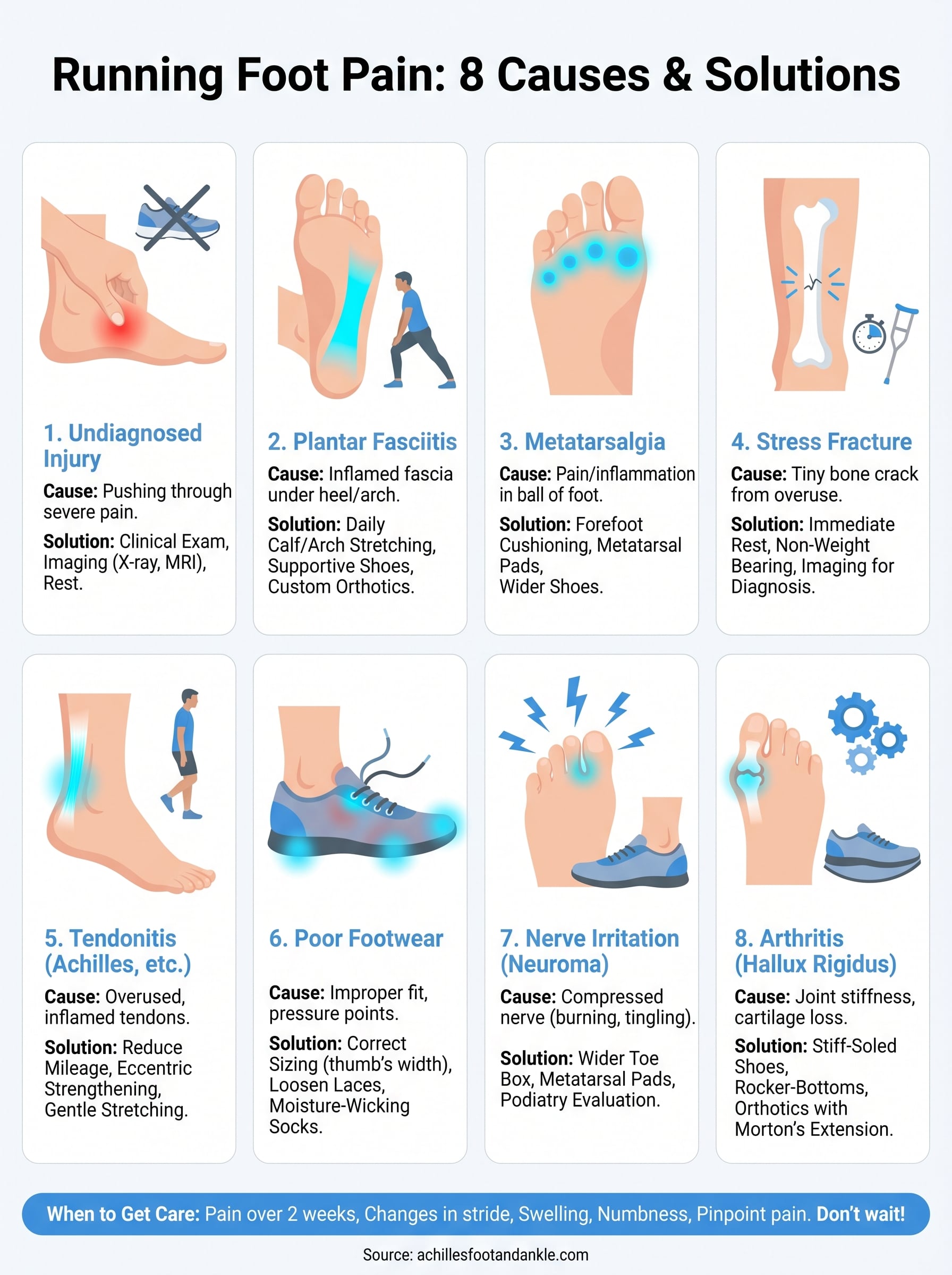
The answer to why does my foot hurt when running is rarely simple, but the decision to act does not have to be complicated. If your pain has lasted more than two weeks, changes how you walk, or returns after every run without improving, waiting it out is not a strategy that works in your favor.
Rest, better shoes, and stretching handle a lot of early-stage problems, but pinpoint bone pain, persistent numbness, swelling that does not resolve, or any symptom that forces you to alter your stride all require a professional evaluation before you run another step. Catching these conditions early consistently shortens recovery time and lowers the chance of a more serious injury developing.
At Achilles Foot and Ankle Center, our podiatry team across Central Virginia is ready to help you get a clear diagnosis and a plan that keeps you moving. Book a same-day appointment and get the answers your foot needs today.