A collapsed arch changes the way your entire foot hits the ground, and when that happens, pain rarely stays in one place. It can radiate into your ankles, knees, hips, and lower back, making everyday activities like walking or standing feel like a chore. The good news: collapsed arch foot treatment has come a long way, and most people find relief without ever needing an operating room. But knowing which option fits your situation matters more than picking the most popular one.
Treatment ranges from targeted exercises and stretches you can do at home to custom orthotics, supportive footwear, and surgical reconstruction for severe cases. The right path depends on how far the arch has fallen, what’s causing it, and how much it limits your daily life. At Achilles Foot and Ankle Center, our podiatrists evaluate collapsed arches across thirteen Central Virginia locations every week, using digital imaging and hands-on assessment to match each patient with a treatment plan that actually addresses the root problem.
This article breaks down your options step by step, from the most conservative approaches to advanced surgical procedures, so you can walk into your next appointment (or start at home) with a clear understanding of what’s available and what to expect.
Why arches collapse and why it matters
The arch of your foot acts as a natural shock absorber, distributing your body weight evenly across the foot with every step you take. When the tendons and ligaments that support the arch weaken or tear, that structure gives way and your foot flattens out against the ground. Understanding what drives this process is the first step toward choosing the right collapsed arch foot treatment for your specific situation, rather than guessing with generic remedies.
The most common causes of arch collapse
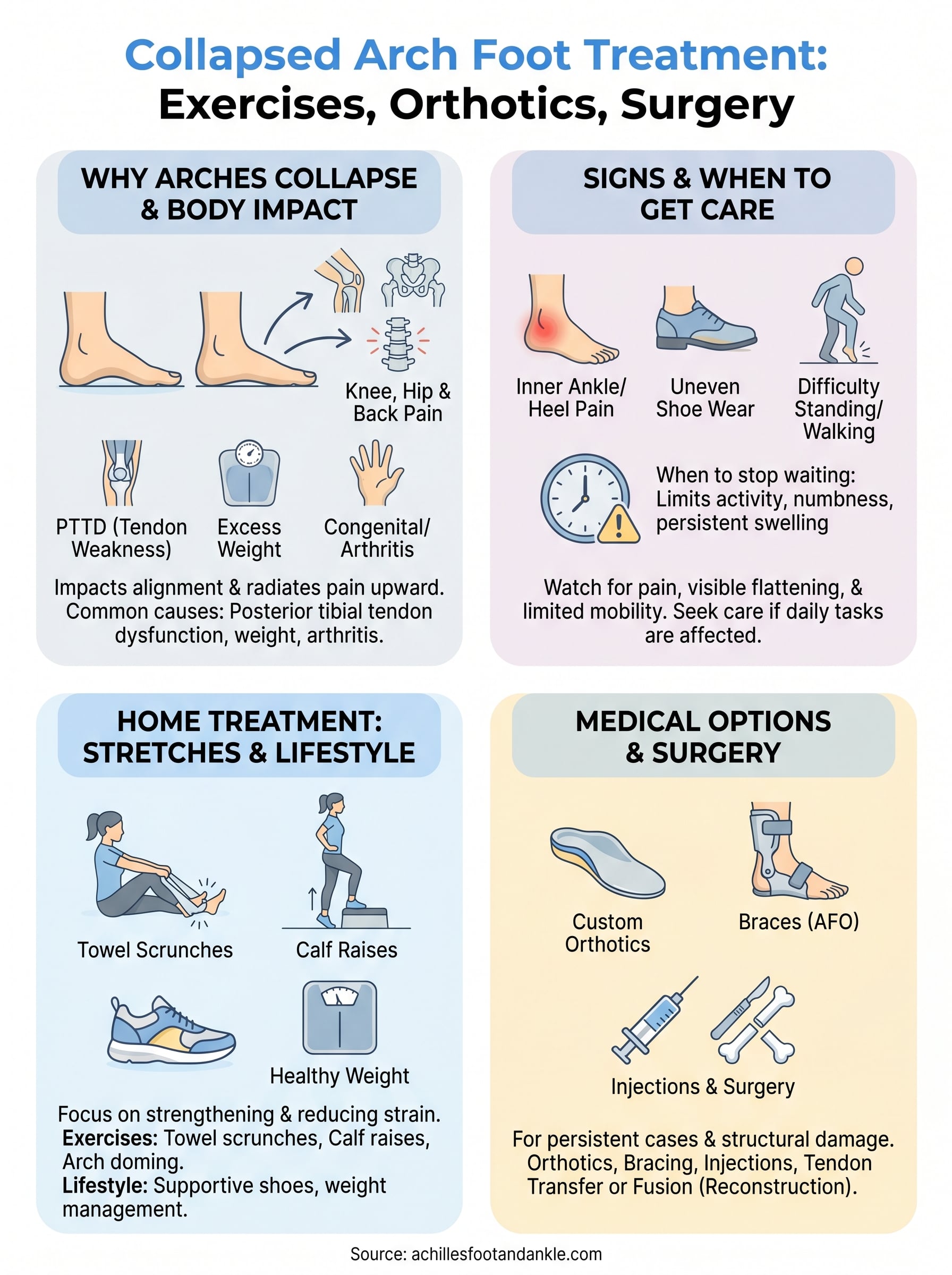
Several factors break down the arch over time, and they do not always involve an obvious injury. Posterior tibial tendon dysfunction (PTTD) is the most frequent culprit in adults; this tendon runs along the inside of your ankle and holds the arch up, so when it weakens or tears, the arch drops progressively. Excess body weight adds compressive stress to the tendons and connective tissue with every step, accelerating that breakdown faster than most people expect. Other common drivers include:
- Congenital flatfoot, where the arch never fully developed during childhood
- Rheumatoid arthritis, which damages the joints and soft tissue that maintain arch height
- Ligament injuries from ankle sprains that were never fully rehabilitated
- Peripheral neuropathy related to diabetes, which reduces muscle and tendon function in the foot
The posterior tibial tendon is the primary stabilizer of your arch, and once it is compromised, the collapse tends to progress unless you treat the underlying cause directly.
What happens to the rest of your body when an arch falls
When your arch flattens, your foot rolls inward in a motion called overpronation, and that shift changes the alignment of everything above it. Your ankle tilts inward, your knee tracks abnormally, and your hip and lower back compensate by absorbing stress they were not built to handle on a long-term basis. Over time, this chain reaction produces chronic knee pain, hip tightness, and lumbar strain that can feel completely unrelated to your foot at first.
Treating only the downstream symptom, such as knee pain, without addressing the flattened arch underneath rarely produces lasting results. Your foot is the structural foundation of your entire lower body, and problems at that base travel upward whether you connect them to your foot or not.
Signs of a collapsed arch and when to get care
A collapsed arch does not always announce itself with sharp, sudden pain. Many people first notice a dull ache along the inner ankle or heel that shows up after long walks or prolonged standing, then slowly becomes more persistent. Recognizing these early warning signs gives you the best chance to start collapsed arch foot treatment before the condition progresses and creates problems higher up the leg.
Common signs to watch for
Your foot and body give clear signals when the arch is losing structural support. Paying attention to these patterns early helps you act before alignment problems travel upward into your knees, hips, and lower back:
- Inner ankle or heel pain that worsens with activity
- Visible flattening of the foot when you stand
- Swelling along the inside of the ankle
- Shoes that wear down faster on the inner edge
- Difficulty standing on one foot and rising onto your toes
- Knee, hip, or lower back pain with no obvious cause
When to stop waiting and see a doctor
If your symptoms limit normal activities like walking, climbing stairs, or standing for more than 20 minutes, that is a clear threshold for professional evaluation. Home remedies can ease mild discomfort, but they will not reverse tendon damage or halt structural joint changes already in progress.
Waiting too long to seek care often turns a condition manageable with orthotics and physical therapy into one that requires surgical intervention.
You should also seek care promptly if your foot feels noticeably weaker or numb, or if swelling does not subside after a few days of rest, since those symptoms may indicate nerve involvement or a significant tendon tear requiring imaging to assess.
How to treat a collapsed arch at home
Home-based collapsed arch foot treatment works best in the early stages, when the arch has dropped but the tendon has not sustained significant damage. Your goal at this stage is to strengthen the muscles that support the arch, reduce inflammation, and take pressure off the affected tendon before the condition progresses further.
Stretches and exercises that support the arch
Strengthening the intrinsic muscles of your foot and the calf complex gives your arch the support it needs to hold its position through daily activity. Consistency matters more than intensity here; performing these movements daily produces better results than sporadic, aggressive sessions.
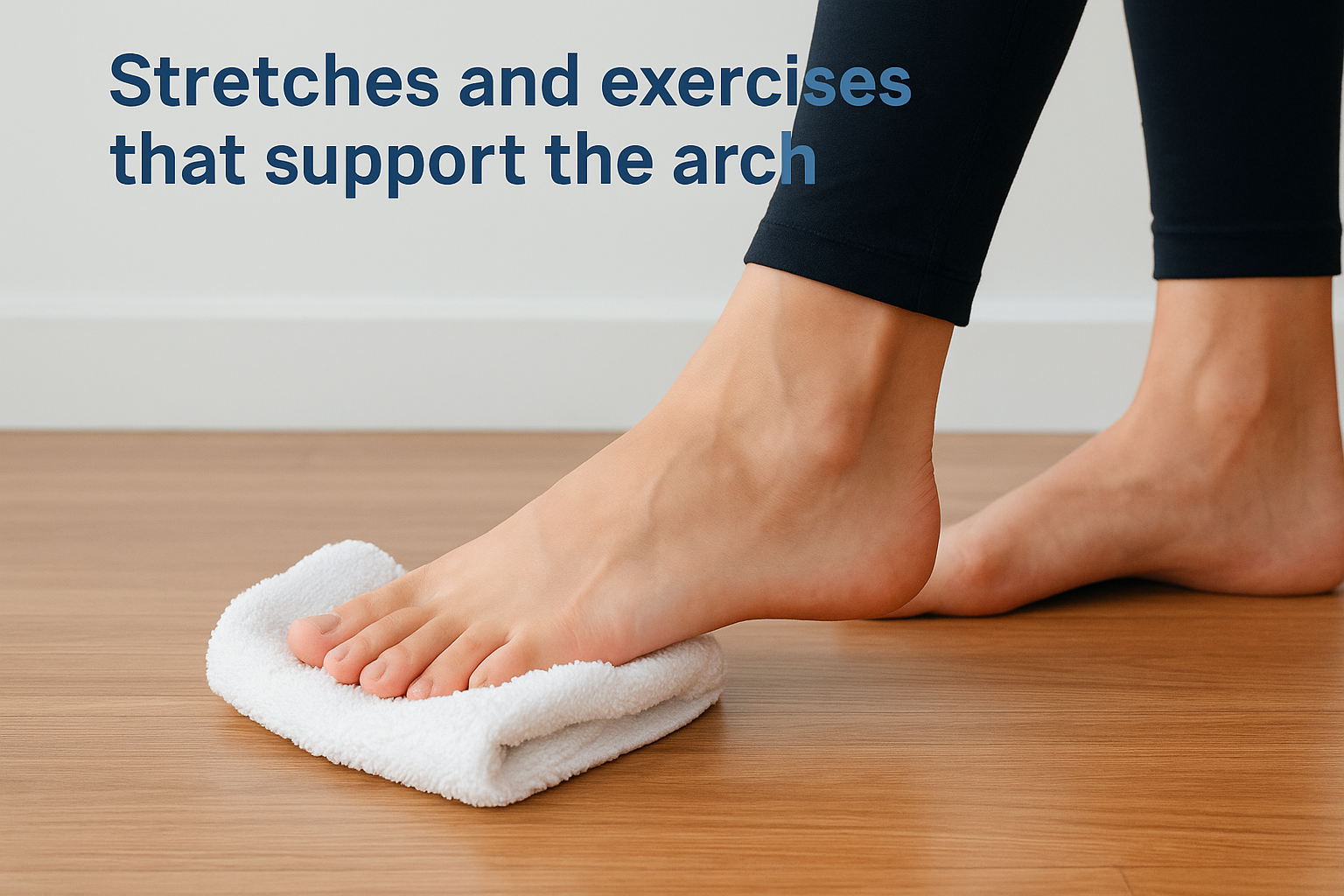
Start with these targeted exercises:
- Towel scrunches: Place a small towel flat on the floor and use your toes to scrunch it toward you, building intrinsic foot strength
- Calf raises: Stand on both feet, rise onto your toes, then lower slowly; progress to single-leg raises as strength improves
- Arch doming: Press your toes into the floor while pulling your arch upward without curling your toes, activating the small stabilizing muscles beneath your foot
- Calf and plantar fascia stretches: Hold each stretch for 30 seconds, repeating three times per session
Strong calf muscles reduce the load on the posterior tibial tendon, which directly slows arch collapse.
Lifestyle adjustments that reduce strain
Reducing prolonged standing and switching to supportive footwear immediately cuts the daily stress on a weakened arch. Avoid walking barefoot on hard surfaces, as flat floors with no cushioning accelerate tendon fatigue. Maintaining a healthy body weight also significantly reduces the compressive load your tendons absorb with each step.
Orthotics, shoes, and braces that actually help
When exercises and lifestyle changes are not enough on their own, supportive devices fill the gap by controlling the mechanics of your foot during every step. The right combination of orthotics, footwear, and bracing is often the most effective non-surgical collapsed arch foot treatment available, and for many patients it provides long-term relief without further intervention.
Custom orthotics vs. over-the-counter insoles
Over-the-counter insoles offer cushioning and mild arch support, but they are designed for average foot shapes, not yours. Custom orthotics, fabricated from a precise mold of your foot, reposition the arch and control overpronation in a way a generic product cannot replicate. For moderate to advanced arch collapse, custom orthotics distribute load more evenly across the foot and reduce the daily strain on your posterior tibial tendon.
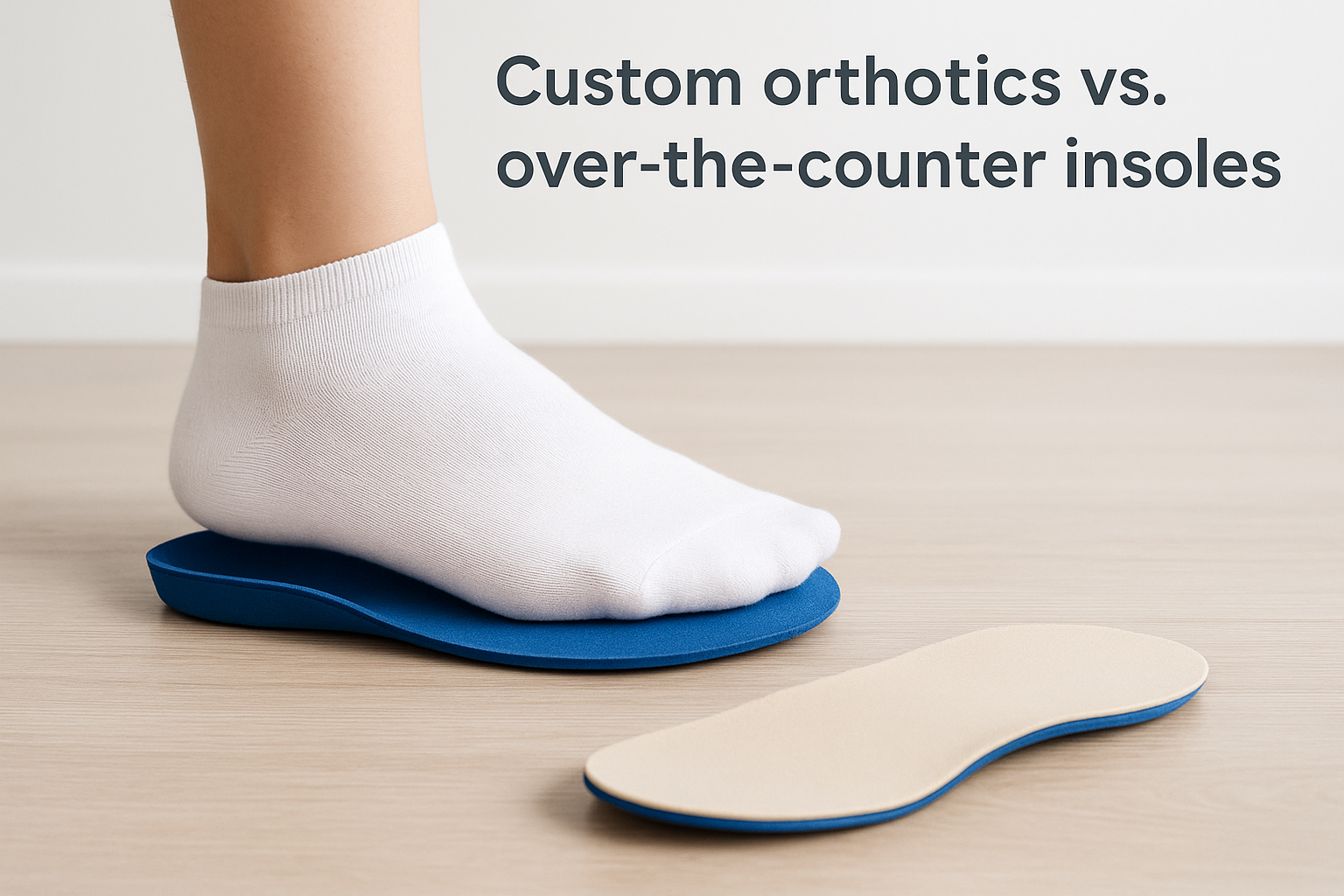
A custom orthotic worn consistently in supportive footwear can slow arch collapse significantly and delay or prevent the need for surgery.
Footwear and ankle bracing
Motion-control or stability shoes provide a firm heel counter and structured midsole that prevent your foot from rolling inward, which reduces stress on the arch with every step. Avoid flexible, minimalist shoes or worn-down footwear that offers no lateral support. For more advanced cases, your podiatrist may recommend an ankle foot orthosis (AFO), a rigid or semi-rigid brace that holds the ankle and arch in proper alignment during weight-bearing activities. Bracing is particularly useful when tendon weakness makes standing or walking painful even with orthotics alone.
Medical treatments and surgery options
When orthotics and home exercises fail to provide adequate relief, your podiatrist has several clinical and surgical tools available to address the underlying structural damage directly. These options become relevant when tendon degeneration is confirmed on imaging, when pain persists through conservative care, or when your arch has dropped to the point where normal function is significantly compromised.
Injections and physical therapy
Corticosteroid injections can reduce inflammation around the posterior tibial tendon and surrounding tissue, giving you a window of reduced pain during which physical therapy can be most effective. Your podiatrist may combine injections with a structured physical therapy program targeting calf strengthening, tendon loading, and neuromuscular control to rebuild the support system around a weakened arch. This combination works well for patients with early to moderate tendon dysfunction who have not yet developed rigid joint deformity.
Injections reduce pain, but physical therapy builds the strength that keeps the pain from returning.
Surgical reconstruction
Surgery becomes the appropriate collapsed arch foot treatment when the tendon is severely torn, the joint has become arthritic, or conservative care over several months has not produced meaningful improvement. Your surgeon may perform a tendon transfer, where a healthy nearby tendon is repositioned to replace the damaged posterior tibial tendon, often combined with a calcaneal osteotomy to realign the heel bone. In advanced cases with rigid flatfoot deformity, joint fusion stabilizes the affected joints permanently and eliminates the painful motion driving your symptoms. Recovery from reconstruction typically spans several months and requires a structured rehabilitation protocol to restore strength and function.
Next steps
Collapsed arch foot treatment works best when you act before the tendon sustains serious damage or the joint develops rigid deformity. If your symptoms are mild, start with the exercises and footwear changes outlined above and give them four to six weeks of consistent effort. Track whether your pain improves, stays the same, or gets worse, because that progression tells you exactly how much the arch needs professional support.
If you are already dealing with persistent pain, visible flattening, or difficulty with basic activities, skip the waiting period and get a proper evaluation. A podiatrist can confirm the extent of tendon involvement with imaging, fit you with custom orthotics, or recommend a clinical treatment plan tailored to your specific foot structure. At Achilles Foot and Ankle Center, we offer same-day appointments across thirteen Central Virginia locations so you do not have to put care off. Schedule your appointment today and get a clear answer about what your arch actually needs.