

Running puts repetitive stress on your feet, and over time, that stress can trigger your body to build extra bone right where your heel meets the plantar fascia. That bony growth is a heel spur, and for runners, it often shows up alongside stubborn heel pain that makes every stride feel like a negotiation. Heel spurs in runners are common enough that most podiatrists see them regularly, yet many runners still confuse them with plantar fasciitis or brush off early warning signs until the pain starts changing how they train.
You don’t necessarily have to stop running if you develop a heel spur, but you do need to understand what’s happening in your foot and how to respond. The right combination of footwear adjustments, targeted exercises, and professional treatment can make a real difference in whether you keep logging miles or end up sidelined. At Achilles Foot and Ankle Center, our podiatrists work with runners across Central Virginia who are dealing with exactly this problem, using advanced diagnostic imaging and individualized treatment plans to get them back on track.
This article breaks down what causes heel spurs in runners, how to recognize the symptoms early, and what you can do, both on your own and with professional guidance, to manage the condition without giving up the sport you love. We’ll also cover when conservative care is enough and when it’s time to consider more advanced options.
What heel spurs in runners really are
A heel spur is a calcium deposit that forms on the underside of the heel bone, typically right where the plantar fascia attaches to the calcaneus. Over time, repeated pulling and micro-tearing at that attachment site triggers an inflammatory response, and your body responds by laying down extra calcium. The result is a bony projection that can extend forward by as much as half an inch. Most heel spurs develop slowly over several months or even years before you notice any problem at all.
The anatomy behind the growth
Your plantar fascia is a thick band of tissue that runs along the bottom of your foot, connecting your heel to your toes. Every time you push off during a run, that fascia absorbs a significant load and then springs back as your foot lifts. At the heel attachment point, this repeated tension is highest, and that is exactly where calcium tends to accumulate. The spur itself is not always the direct source of pain. In many cases, the inflammation in the surrounding soft tissue is what actually hurts, not the bony growth itself.
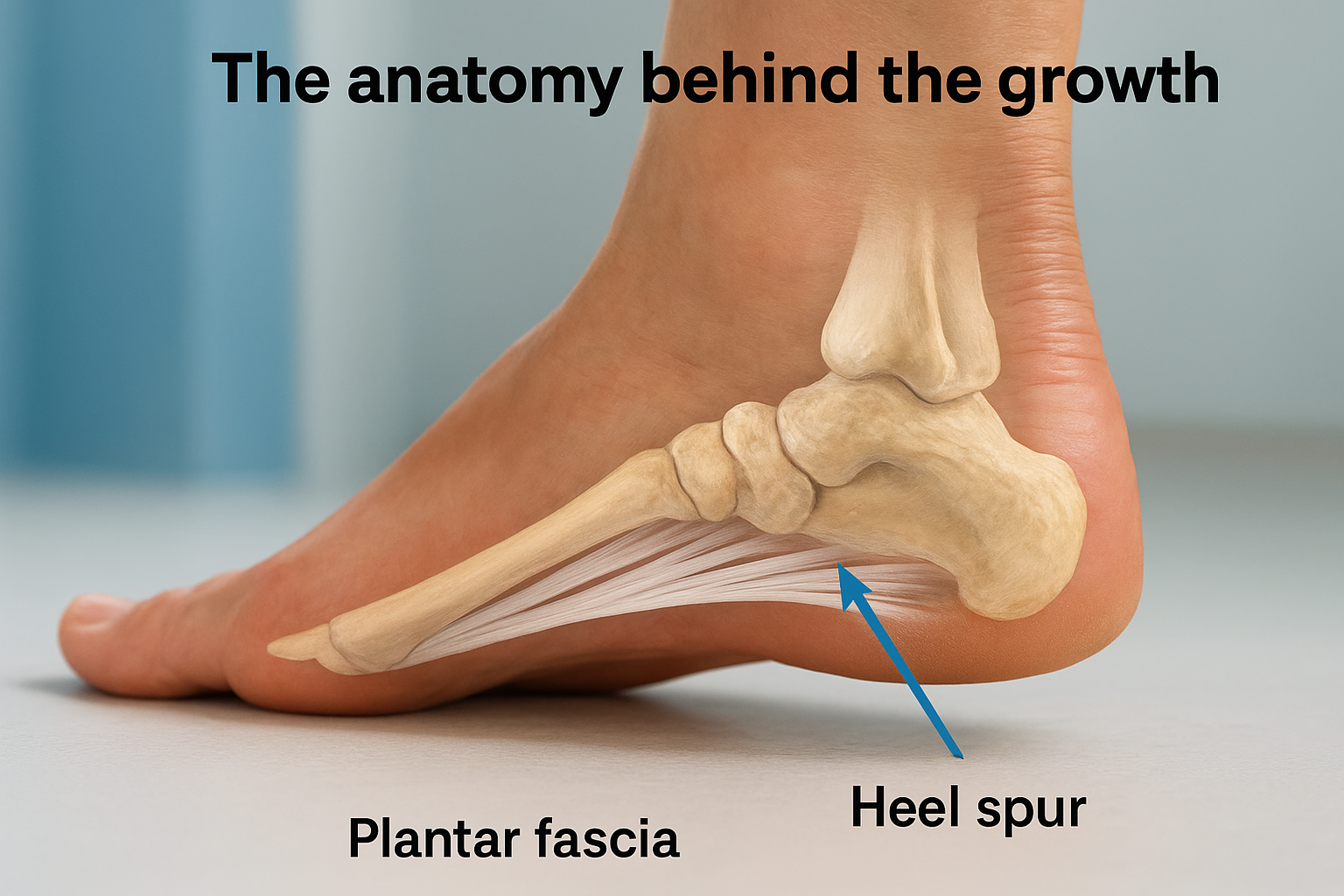
The spur is often a sign that your foot has been under prolonged mechanical stress, not a sudden injury.
Imaging such as an X-ray can confirm the presence of a spur, but a spur visible on an image does not automatically mean you will feel pain. Some runners have visible spurs with no symptoms at all, while others experience significant discomfort without a large spur being present. That distinction shapes how your podiatrist approaches diagnosis and treatment.
Heel spurs vs. plantar fasciitis
Many runners arrive at a clinic convinced they have one or the other, but heel spurs and plantar fasciitis frequently occur together and share overlapping symptoms. Plantar fasciitis refers to the inflammation of the plantar fascia itself, while a heel spur is the bony structure that can develop as a result of long-term plantar fascia stress. You can have plantar fasciitis without a spur, and you can have a spur without active plantar fascia inflammation.
Understanding the difference matters because treatment needs to target the correct problem. Heel spurs in runners often require a combined approach that addresses both the bony growth and the soft tissue irritation around it. Your podiatrist will assess which component is driving your symptoms and build your plan around that specific finding.
Why runners develop heel pain and spurs
Running creates repetitive impact that few other activities match. Each foot strike sends a force equal to roughly two to three times your body weight through your heel, and over weeks and months of training, that cumulative stress takes a toll on the structures in your foot. When your body cannot absorb that load efficiently, the plantar fascia begins to pull away from the heel bone at a microscopic level, setting the stage for both inflammation and eventual bone spur formation.
Training habits that increase your risk
High weekly mileage and sudden jumps in training volume are two of the most common triggers for heel problems in runners. When you ramp up your distance too quickly, your soft tissue does not have enough time to adapt, which means the plantar fascia stays under constant tension without adequate recovery. Running on hard surfaces like concrete intensifies ground reaction forces compared to softer terrain, compounding the stress your heel absorbs on every stride.
Common high-risk training patterns include:
- Increasing weekly mileage by more than 10% in a single week
- Skipping rest days and running through early heel soreness
- Repeatedly training on concrete or asphalt without variation
Biomechanics and footwear factors
Your foot mechanics play a significant role in whether you develop heel spurs in runners specifically. Overpronation, or excessive inward rolling of the foot, increases tension along the plantar fascia, directing more force toward the heel attachment point. Runners with flat arches or very high arches are both at elevated risk because neither foot type distributes load evenly across the foot.
Worn-out running shoes remove the cushioning and support your heel depends on, making mechanical problems significantly worse.
Shoes that lack adequate heel cushioning or arch support accelerate the breakdown of the plantar fascia attachment, making bony spur formation far more likely over time.
Symptoms and red flags to watch for
The symptoms of heel spurs in runners tend to follow a recognizable pattern, which makes early identification easier once you know what to look for. Sharp, stabbing pain at the base of the heel is the most reported complaint, and it often catches runners off guard with its intensity after a period of rest.
The pain pattern that stands out
Most runners describe the worst pain during the first few steps after getting out of bed in the morning or after sitting for an extended period. Your plantar fascia tightens during rest, and the moment you put weight on your foot, that stiffened tissue pulls hard against the inflamed attachment site. The pain often eases somewhat once you start moving, but it tends to return at full force after a long run or when you stand for several hours.
If your heel pain warms up during a run but worsens noticeably the next morning, that cycle is a strong signal that your foot needs attention before the condition progresses.
Red flags that signal a bigger problem
Some symptoms go beyond typical training soreness and suggest you need professional evaluation rather than more rest and stretching. Recognizing these early gives you the best chance of avoiding a longer recovery.
Watch for the following warning signs:
- Pain that persists throughout your entire run rather than easing after warm-up
- Swelling or visible puffiness around the heel that does not go down overnight
- Pain that spreads into your arch or up your ankle
- Any change in the way you walk or run to avoid loading your heel
Compensating for heel pain by shifting your gait creates secondary problems in your knees, hips, and lower back, so these red flags are not something to push through on your own.
How to run while healing your heel
Running through heel pain without a plan will slow your recovery and increase your risk of making things worse. The good news is that many runners dealing with heel spurs in runners can continue training at a modified level while their tissue heals, as long as they make the right adjustments before every single run.
Adjust your load and footwear before you go out
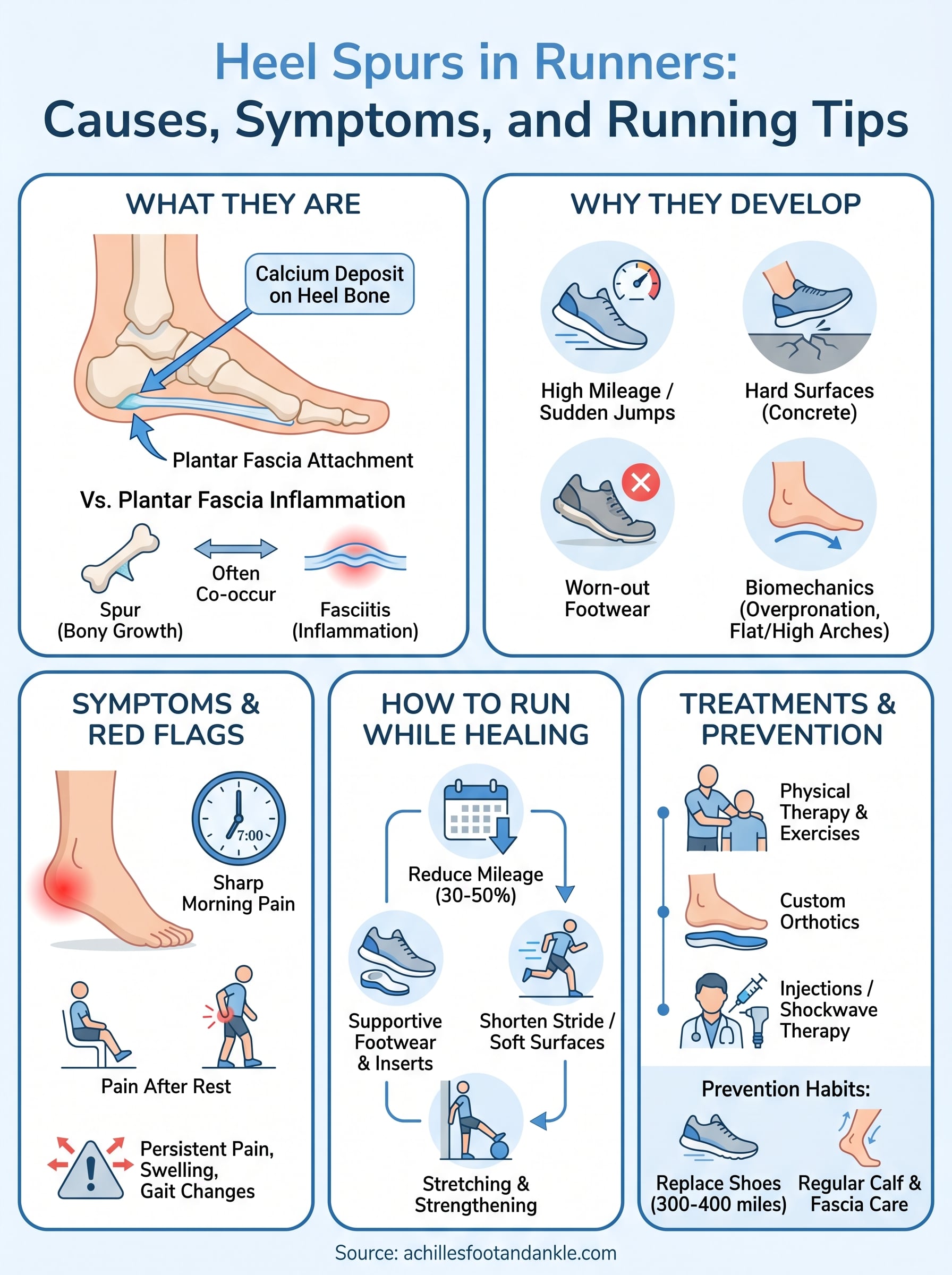
Your first step is to cut your weekly mileage by 30 to 50 percent and eliminate speed work or hill repeats until your heel tolerates flat, easy running without lingering pain the next morning. Running in shoes with firm heel cushioning and adequate arch support reduces the load on your plantar fascia attachment with every step. If your current shoes have more than 300 to 400 miles on them, replace them before you expect any improvement.

Running in worn-out shoes while trying to heal a heel spur is like trying to fix a leak while leaving the faucet running.
Supportive additions that help during this phase:
- Silicone heel cups to absorb impact at ground contact
- Over-the-counter orthotic insoles to correct excessive pronation
- Low-drop shoes on softer surfaces like packed trails or rubberized tracks
Modify your form and surface choices
Shortening your stride slightly reduces the braking force your heel absorbs on each foot strike, which gives the inflamed tissue more time to recover between sessions. Switching some runs to softer surfaces like grass or synthetic tracks can meaningfully reduce cumulative stress compared to concrete or asphalt. Stretch your calves and plantar fascia thoroughly before and after every run to keep the attachment point from tightening during rest periods.
Treatments and prevention that work
Most cases of heel spurs in runners respond well to conservative, non-surgical treatment when you start early and stay consistent. The goal is to reduce inflammation around the spur, restore flexibility in your calf and plantar fascia, and correct the mechanical factors that caused the problem in the first place. Jumping straight to rest without addressing the root cause leads to the same injury cycling back.
Conservative treatments that ease symptoms
Physical therapy targets the tight calf muscles and weakened intrinsic foot muscles that increase load on your heel attachment. Your therapist will typically combine stretching protocols with eccentric strengthening exercises, which have strong clinical support for resolving plantar fascia-related pain. Custom orthotics, prescribed by a podiatrist, correct your specific biomechanical issues rather than just cushioning the problem temporarily.
Custom orthotics address the underlying mechanics of your foot, while off-the-shelf insoles only provide short-term comfort.
When inflammation is significant, your podiatrist may recommend corticosteroid injections to calm the tissue or shockwave therapy to stimulate blood flow to a region that naturally receives limited circulation, accelerating recovery in stubborn cases that do not respond to stretching alone.
Prevention habits that protect your heel
Replacing your running shoes every 300 to 400 miles is one of the simplest preventive steps you can take. Pair that with a consistent warm-up routine that includes calf stretches and plantar fascia rolls before each run to keep the attachment point from tightening between sessions.
Keeping your weekly mileage increases under 10 percent per week gives your tissue enough time to adapt between training loads. That single habit, combined with regular foot strengthening work, cuts your risk of this problem returning significantly.
When to see a foot and ankle specialist
Conservative care handles most cases of heel spurs in runners, but some situations require professional evaluation before you keep training. If your heel pain has lasted more than two to three weeks despite rest, new footwear, and consistent stretching, continuing to self-manage is likely to extend your recovery rather than shorten it. A podiatrist can confirm the diagnosis with imaging, identify whether soft tissue inflammation or the spur itself is driving your pain, and prescribe a treatment plan built around your specific foot mechanics rather than generic advice.
Persistent swelling, pain that stays sharp throughout a full run, or any noticeable change in how you walk are clear signals that your foot needs more than a new pair of insoles. Getting the right diagnosis early means less time off the road and a lower chance of developing a chronic problem. The team at Achilles Foot and Ankle Center is ready to help you get back to running with confidence. Schedule a same-day appointment today.