

A diabetic foot ulcer doesn’t heal like a normal cut, and treating it like one is how small wounds turn into infections, hospital stays, or worse. Choosing the right diabetic wound care dressings matters just as much as any medication your doctor prescribes, because the wrong dressing can trap moisture, feed bacteria, or stick to fragile tissue and tear it open again at every change. If you’re standing in the pharmacy aisle staring at foam pads, hydrogels, and alginates with no idea which one fits your situation, you’re not alone.
This guide breaks down exactly which dressing types work for which wound conditions, whether you’re dealing with a dry, shallow sore or a deep, heavily draining diabetic ulcer wound care dressings situation that needs something more absorbent. We match product categories to wound stages so you can stop guessing.
You’ll also find a rundown of the everyday diabetic wound care supplies worth keeping on hand, from cleansers to tape, plus guidance on when a dressing change at home is enough and when it’s time to get a specialist involved. At Achilles Foot and Ankle Center, we treat diabetic wounds every day, and this list reflects what actually works in practice, not just what’s on the label.
1. Professional wound care from a podiatrist
Before you buy a single box of dressings, get the wound looked at by a doctor trained in chronic wound treatment and diabetic feet. A podiatrist doesn’t just slap on a bandage. They assess blood flow, infection risk, and tissue depth, then build a treatment plan around what your wound actually needs, not a generic label on a package. This is the step most people skip, and it’s the one that determines whether every other dressing on this list will even work.
A dressing only works as well as the wound underneath it has been properly cleaned, measured, and debrided.
How it works
At a clinic visit, the podiatrist typically performs sharp debridement, removing dead or infected tissue with a scalpel or curette so healthy tissue is exposed. They’ll measure and photograph the wound to track healing over time, check for signs of osteomyelitis (bone infection) with imaging if needed, and evaluate circulation with tools like a Doppler or ankle-brachial index test. From there, they choose or adjust your dressing protocol, often combining it with offloading devices to take pressure off the wound while it heals. Our Advanced Wound Care & Limb Salvage program at Achilles Foot and Ankle Center follows this exact approach for patients across Central Virginia.
Best for this type of wound
Professional care is non-negotiable for any wound that shows redness spreading outward, foul odor, drainage that’s increasing rather than slowing, black or dark tissue, exposed bone or tendon, or a wound that hasn’t improved in two weeks of home care. Diabetic neuropathy often masks pain, so a wound can worsen significantly before it feels serious. If you have diabetes, treat any open sore on the foot as a reason to call a diabetic wound care clinic, not a wait-and-see situation.
Pros and cons
| Pros | Cons |
|---|---|
| Accurate diagnosis and staging of the wound | Requires scheduling and travel to a clinic |
| Debridement removes tissue home care can’t | May involve out-of-pocket costs depending on insurance |
| Access to advanced options like grafts or negative pressure therapy | Follow-up visits needed to track progress |
| Reduces risk of amputation from untreated infection | Not instant; healing still takes weeks to months |
How to use it safely
Don’t try to manage a worsening wound on your own timeline. Follow these steps:
- Book an appointment as soon as you notice any break in the skin, not after it’s been open for days.
- Keep every follow-up visit, even if the wound looks better, since healing can stall without warning.
- Ask your podiatrist to show you exactly how to change the dressing they’ve prescribed between visits.
- Watch for fever, chills, or spreading redness and call the office immediately if these appear.
- Bring your blood sugar logs to appointments, since poor glucose control slows healing regardless of the dressing used.
Once a podiatrist has evaluated the wound and set a care plan, the specific dressing types below make a lot more sense, and you’ll know exactly why one was chosen over another.
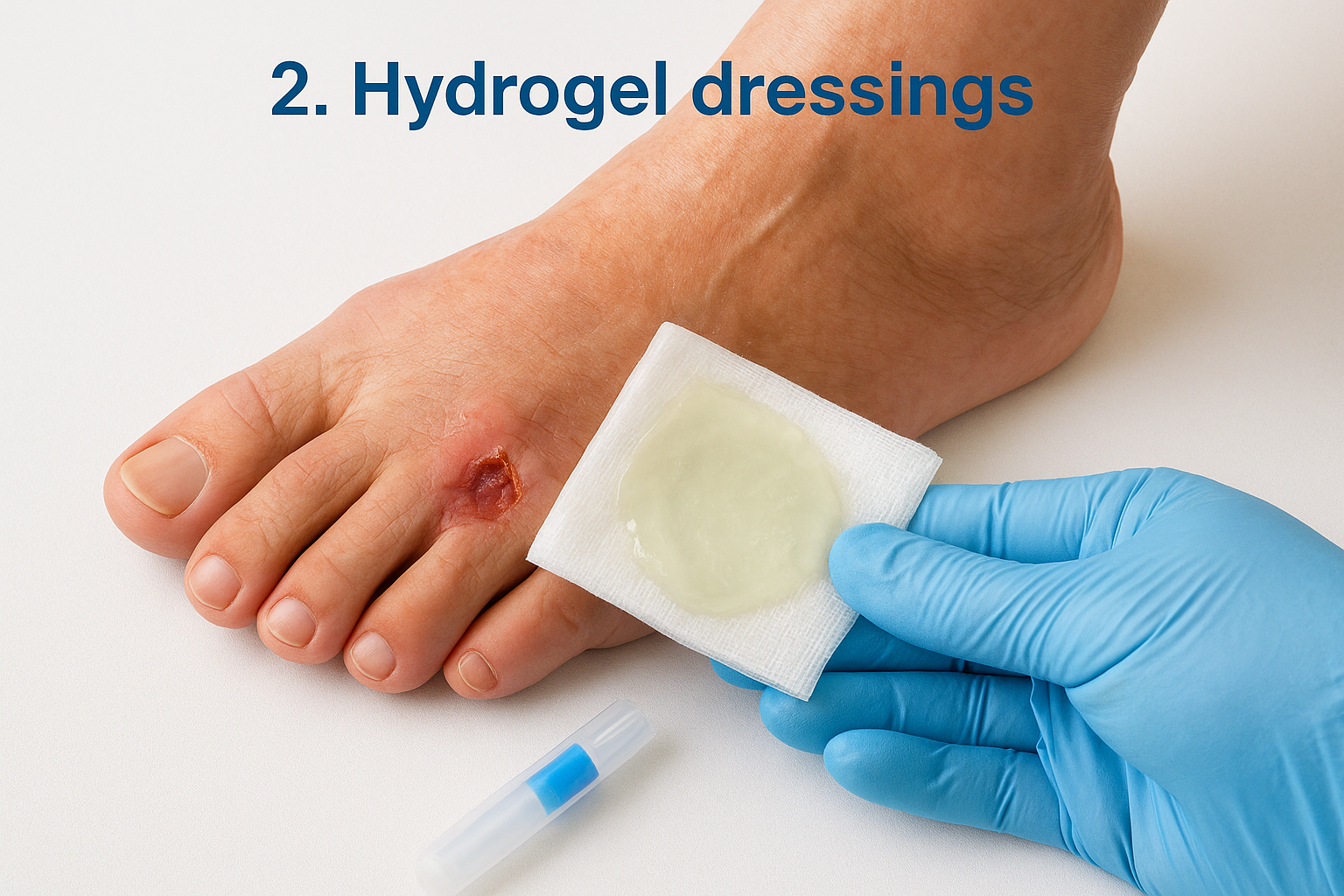
2. Hydrogel dressings
Hydrogel dressings are the go-to choice when a diabetic wound is dry, has minimal drainage, or contains dead tissue that needs softening before removal. Made mostly of water or glycerin-based gel, they add moisture to a wound bed that’s too dry to heal on its own. This matters because diabetic ulcers often stall out in a dry, cracked skin state where new skin cells simply can’t migrate across the surface.
How it works
Gel formulations sit directly on the wound and donate moisture into the tissue, creating a moist wound environment that speeds up the body’s natural healing process. Many hydrogels also support autolytic debridement, meaning the wound’s own enzymes soften and break down dead tissue instead of a clinician cutting it away. Some come as an amorphous gel you spread on with a swab, while others arrive pre-soaked into a gauze pad or sheet for easier placement.
A dry, stalled ulcer often just needs moisture, not more medication.
Best for this type of wound
Hydrogels work best on shallow diabetic ulcers with low to no drainage, dry wound beds, and partial-thickness tissue loss. They’re also useful for wounds with some necrotic tissue that a podiatrist wants softened before debridement. Skip them on wounds that are already heavily draining, since added moisture can quickly oversaturate the surrounding skin.
Pros and cons
| Pros | Cons |
|---|---|
| Rehydrates dry wound beds effectively | Not suitable for heavily draining wounds |
| Gentle, low-trauma removal at dressing changes | Requires a secondary dressing to hold it in place |
| Supports natural debridement | Can macerate healthy skin if overused |
| Comfortable and reduces pain during changes | Needs frequent changes, often every 1-3 days |
How to use it safely
Getting hydrogel application right protects fragile skin around the wound:
- Clean the wound with saline before applying gel, never tap water alone.
- Apply a thin, even layer rather than packing it in thick.
- Cover with a secondary dressing, such as foam or gauze, to hold moisture in and keep the gel from drying out too fast.
- Change every one to three days, or sooner if drainage increases.
- Watch the surrounding skin for softening or whitening, a sign of too much moisture reaching healthy tissue.
3. Foam dressings
Foam dressings step in once a diabetic wound moves past the dry stage and starts producing moderate to heavy drainage. Made from soft, absorbent polyurethane material, they pull excess fluid away from the wound bed while still keeping enough moisture at the surface to support healing. If hydrogel is for a wound that’s too dry, foam is for one that’s finally producing too much fluid to leave uncovered.
How it works
The foam layer works like a sponge, drawing wound exudate up and away from the skin through capillary action so it doesn’t pool against fragile tissue. Some versions include an adhesive border for direct application, while others are non-adhesive and need tape or wrap to stay put. Many foam dressings also have a waterproof outer layer, which blocks bacteria and moisture from the outside while still letting the wound breathe.
Once a wound starts draining heavily, the dressing’s job shifts from adding moisture to managing it.
Best for this type of wound
Foam dressings suit moderate to heavily draining ulcers, including wounds healing after debridement or those around a healing surgical site. They also cushion the wound area, which helps on wounds located over pressure points on the foot. Diabetic wounds with a mix of granulation tissue and steady drainage tend to respond well here, though very dry or minimally draining wounds don’t need this level of absorption.
Pros and cons
| Pros | Cons |
|---|---|
| Absorbs moderate to heavy drainage effectively | Can dry out low-drainage wounds if used too long |
| Cushions the wound against pressure | Costs more per unit than basic gauze |
| Can stay on for several days, reducing changes | Adhesive borders may irritate fragile skin |
| Comes in various shapes for hard-to-cover areas | Needs monitoring for leakage around the edges |
How to use it safely
Getting foam changes right keeps drainage from becoming a problem:
- Check the dressing daily for leakage, even if the schedule says every three to five days.
- Trim non-adhesive foam to fit the wound shape rather than folding it.
- Remove gently, since foam can stick slightly to drying exudate at the edges.
- Watch for a sour smell or increased warmth, both signs of possible infection under the dressing.
- Report any skin breakdown from adhesive borders to your podiatrist right away.
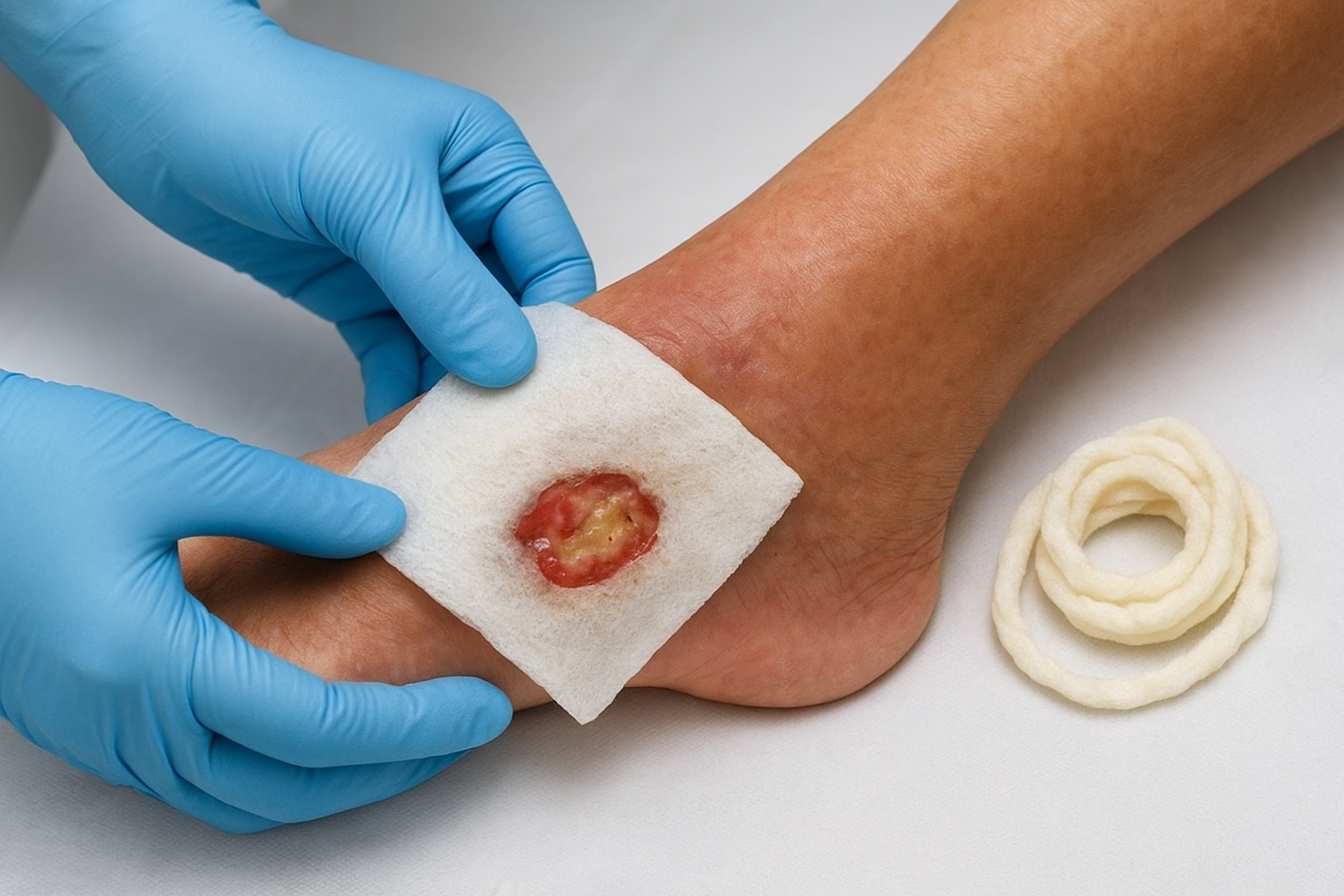
4. Alginate dressings
Alginate dressings step in when a diabetic wound is producing heavy drainage, more than foam can comfortably handle on its own. Derived from seaweed extract, these dressings turn into a soft gel on contact with wound fluid, locking in moisture management while pulling excess exudate away from fragile tissue. Anyone managing a deep, heavily draining ulcer needs this category of diabetic ulcer wound care dressings in their supply kit, since leaving that much fluid against the skin invites maceration and infection.
How it works
Calcium and sodium ions in the alginate fibers react with the sodium in wound exudate, converting the dry fibers into a gel-like matrix right on the wound surface. That gel traps bacteria and debris while keeping the wound bed moist enough for healing, without letting fluid pool underneath. Alginates come as flat sheets or loose rope-style fibers, which makes them useful for packing deep or tunneling wounds that flat dressings can’t reach into.
When a wound is too wet for foam, alginate gels take over the job of absorption without drying the tissue out.
Best for this type of wound
Alginates work best on deep ulcers with heavy drainage, including wounds with tunneling, undermining, or cavities that need packing rather than covering. They’re also a strong fit after surgical debridement when drainage spikes temporarily. Skip them on dry or lightly draining wounds, since without enough fluid to activate the gel, the fibers can stick to the wound bed and cause pain on removal.
Pros and cons
| Pros | Cons |
|---|---|
| Absorbs large volumes of drainage | Not suitable for dry or low-exudate wounds |
| Fills deep or irregular wound cavities well | Requires a secondary dressing to hold it in place |
| Reduces bacterial load in the gel matrix | Can dry out and adhere if left too long |
| Available in rope form for tunneling wounds | May cause a stinging sensation on some patients |
How to use it safely
Proper technique keeps alginate dressings working as intended:
- Pack loosely into cavities, never tightly, since the fibers expand as they absorb fluid.
- Cover with foam or a secondary dressing to secure and add extra absorption.
- Change every one to three days, sooner if drainage soaks through.
- Irrigate gently with saline before removal if any fibers stick to the wound.
- Stop use and call your podiatrist if drainage decreases suddenly, since the wound may no longer need this much absorption.
5. Hydrocolloid dressings
Hydrocolloid dressings sit somewhere between hydrogel and foam, making them a practical everyday choice for diabetic wounds with light to moderate drainage that need protection without daily fuss. Made from a gel-forming polymer layer sealed under a waterproof film, they’re one of the most common diabetic wound care dressings found in home care kits because they’re easy to apply and forgiving for patients managing their own dressing changes. Once a wound has moved past the raw, heavily draining stage, hydrocolloids often become the maintenance dressing that carries it the rest of the way to closure.
How it works
Gelling agents inside the dressing, usually pectin or gelatin, absorb wound fluid and swell into a soft, moist gel that stays in contact with the wound bed. The outer film layer is waterproof and blocks bacteria from getting in, which lets patients shower without exposing the wound. As the gel forms, it also supports mild autolytic debridement on any lingering dead tissue, similar to hydrogel but with far less need for a secondary cover.
A hydrocolloid dressing does its best work when you leave it alone for a few days instead of checking it constantly.
Best for this type of wound
These dressings suit shallow to moderate diabetic ulcers with light to moderate drainage and clean, granulating wound beds. They also work well on wounds in areas that need waterproof protection, like the heel or side of the foot exposed to shoes. Avoid them on infected wounds or ones with heavy drainage, since the sealed environment can trap bacteria if the wound isn’t ready for it.
Pros and cons
| Pros | Cons |
|---|---|
| Waterproof, allows normal showering | Not for infected or heavily draining wounds |
| Can stay on three to seven days | Can develop an odor that mimics infection |
| Self-adhesive, no secondary dressing needed | Opaque, hides wound progress between changes |
| Comfortable and flexible on foot contours | Removal can pull fragile new skin if rushed |
How to use it safely
Hydrocolloids reward patience, but only if you’re watching for the right signs:
- Check under the dressing every three days even if the schedule allows longer.
- Warm the edges gently before peeling to avoid tearing new tissue.
- Note that a yellowish, gel-like smell at removal is normal, not necessarily infection.
- Stop use immediately if drainage increases sharply or the surrounding skin reddens.
- Confirm with your podiatrist that hydrocolloid is still appropriate at each follow-up, since wound needs change fast.
6. Antimicrobial dressings with silver, iodine, or honey
Antimicrobial dressings earn a spot in your kit the moment a wound shows signs of bacterial overgrowth or sits at high risk of infection, which describes most diabetic foot ulcers at some point. These products embed silver, iodine, or medical-grade honey into a base material, often foam or alginate, so the dressing fights bacteria while it also manages drainage. Reaching for one of these instead of a plain gauze pad can be the difference between a wound that stays controlled and one that turns septic.
How it works
Silver ions disrupt bacterial cell walls and interfere with the enzymes bacteria need to survive, working across a broad range of organisms without needing a lab culture first. Iodine, usually in a slow-release cadexomer form, works similarly while also absorbing moderate drainage as it breaks down. Medical-grade honey, most commonly Manuka, creates a high-sugar, low-pH environment that bacteria can’t tolerate, and it also draws fluid out of the wound through osmosis. All three formats typically layer the antimicrobial agent into foam, alginate, or gel carriers, so the dressing still handles moisture the way its base material normally would.
A wound with a high bacterial load needs an antimicrobial agent working alongside the dressing, not a bandage waiting for infection to show up.
Best for this type of wound
These dressings fit diabetic ulcers with signs of critical colonization, such as increased odor, cloudy drainage, delayed healing, or a wound bed that looks unhealthy without full-blown infection. They’re also a smart choice for wounds in patients with a history of recurrent infections or poor circulation. Skip them for clean, healing wounds with no infection risk, since routine antimicrobial use can slow healing and encourage resistance.
Pros and cons
| Pros | Cons |
|---|---|
| Reduces bacterial load without oral antibiotics | Not a substitute for treating a confirmed infection |
| Available in multiple base materials for different drainage levels | Silver products can cause temporary skin discoloration |
| Honey-based options soothe and debride mildly | Iodine unsuitable for patients with thyroid conditions |
| Lowers infection risk during healing | Overuse can lead to reduced effectiveness over time |
How to use it safely
Antimicrobial dressings work best under supervision, not as a set-and-forget fix:
- Use for a defined period, typically two to four weeks, then reassess with your podiatrist.
- Watch for allergic reactions, especially with iodine or honey-based products.
- Don’t combine multiple antimicrobial agents at once without medical guidance.
- Report any wound that worsens despite antimicrobial use, since it may need oral or IV antibiotics instead.
- Confirm thyroid history before using iodine dressings, since iodine can be absorbed systemically.
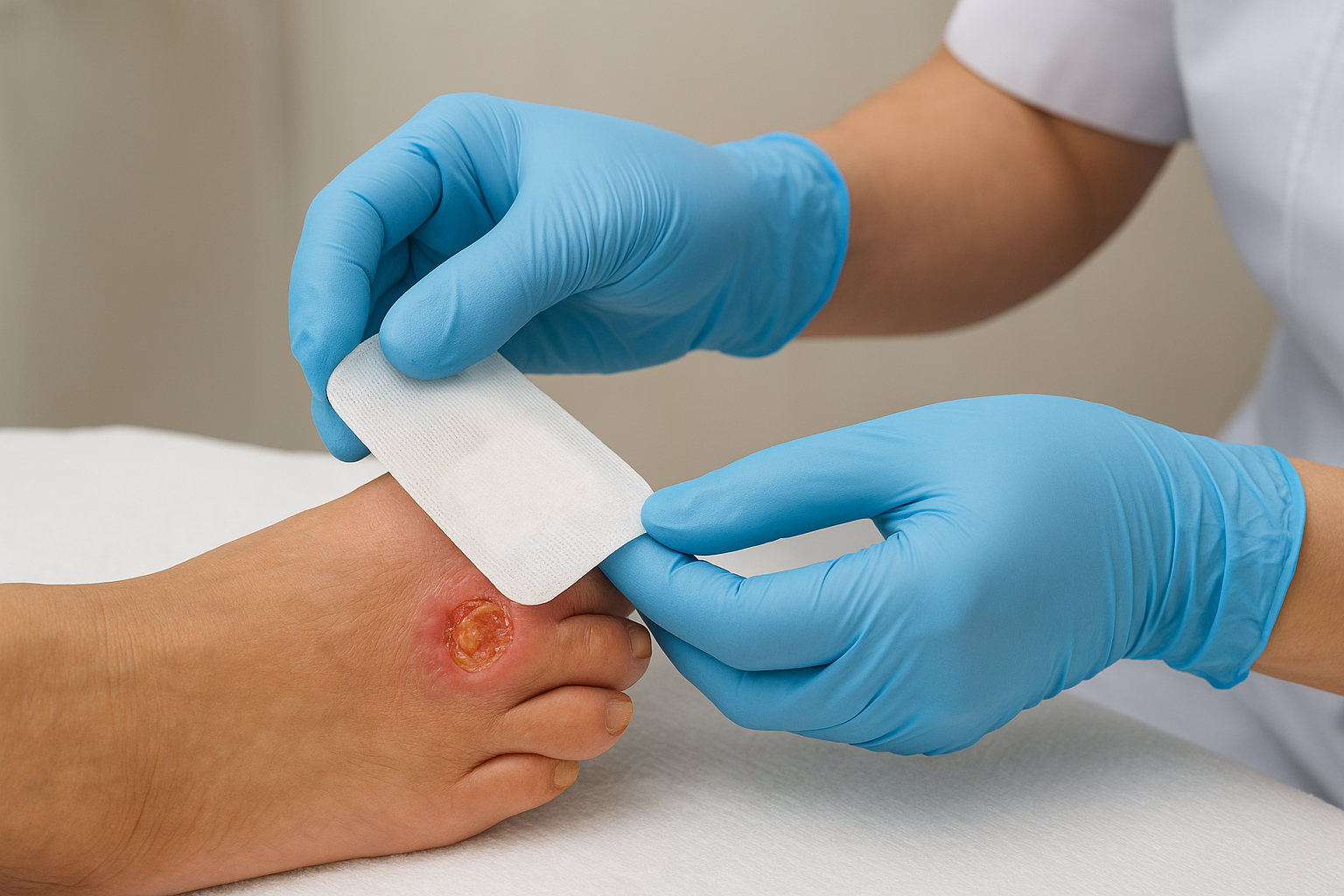
7. Collagen and growth factor dressings
Collagen and growth factor dressings target wounds that have stopped progressing despite good drainage control and infection management. Diabetic ulcers can stall in the mid-healing stage because chronic wounds burn through the body’s own collagen and growth factors faster than the body can replace them. These dressings supply that missing material directly, giving stalled tissue a reason to start rebuilding again.
How it works
Collagen dressings, made from bovine, porcine, or avian sources, provide a scaffold of protein fibers that attracts new cells and encourages granulation tissue to form across the wound bed. Some formulations also bind to excess enzymes called matrix metalloproteinases, which chronic wounds overproduce and which otherwise break down the body’s own healing tissue. Growth factor products go a step further, delivering concentrated proteins like platelet-derived growth factor directly to the wound to trigger cell growth and blood vessel formation. Both come as gels, powders, or sheets depending on the wound shape and depth.
A wound that’s clean but not closing usually needs a biological push, not another round of the same dressing.
Best for this type of wound
These products suit clean, non-infected diabetic ulcers that have plateaued after four weeks or more of standard care, particularly full-thickness wounds with good blood flow. They’re commonly used on plantar ulcers that have responded to debridement and offloading but still aren’t closing on schedule. Skip them on infected or heavily draining wounds, since bacteria and excess fluid break down the collagen before it can do any good.
Pros and cons
| Pros | Cons |
|---|---|
| Restarts stalled healing in chronic wounds | Expensive compared to standard dressings |
| Reduces damaging enzyme activity | Requires a clean, non-infected wound bed |
| Available in gel, sheet, or powder forms | Often needs prior authorization from insurance |
| Backed by strong clinical evidence for diabetic ulcers | Not effective without proper offloading alongside it |
How to use it safely
Collagen and growth factor products need a controlled environment to actually work:
- Confirm with your podiatrist that the wound is infection-free before starting.
- Apply exactly as directed, since some products need reapplication every visit rather than daily.
- Keep offloading devices in place throughout treatment, or the pressure will undo the biological benefit.
- Track wound measurements weekly to confirm the stalled healing has actually resumed.
- Stop and reassess if no measurable progress appears after four weeks of consistent use.
8. Non-adherent and gauze dressings
Non-adherent and gauze dressings sit at the basic, everyday end of the spectrum, but that doesn’t make them optional in a diabetic wound care kit. Non-adherent pads have a special coating that keeps the material from sticking to raw or healing tissue, while traditional gauze remains the workhorse for securing, padding, or wrapping other dressings in place. Every diabetic patient managing a wound at home needs some of both, even if the primary dressing is something more advanced like foam or alginate.
How it works
A non-adherent pad usually has a fine mesh or perforated plastic layer bonded to an absorbent core, so fluid passes through into the pad while the surface stays smooth against the wound. Gauze, by contrast, works through simple absorption and coverage, wicking fluid into its woven fibers and protecting the wound from friction, debris, and outside contamination. Neither material actively manages moisture the way hydrogel or alginate does, which is why they’re most often paired with a primary dressing rather than used alone on a healing ulcer.
Plain gauze protects a wound, but it won’t manage moisture the way a purpose-built dressing does.
Best for this type of wound
Non-adherent pads suit minor, shallow wounds with light drainage, post-surgical incisions, and skin that’s too fragile for adhesive-based dressings. Gauze works well as a secondary layer over almost any primary dressing, or for holding a limb dressing in place with wrap. Neither is ideal as the sole treatment for a deep or heavily draining diabetic ulcer.
Pros and cons
| Pros | Cons |
|---|---|
| Inexpensive and widely available | Limited moisture management on its own |
| Gentle removal reduces tissue trauma | Needs frequent changes with heavy drainage |
| Useful as secondary layer over other dressings | Can dry out and stick if left too long |
| Simple to apply for home caregivers | Not a standalone treatment for chronic ulcers |
How to use it safely
Getting the basics right prevents a simple dressing from becoming a source of complications:
- Change gauze at least once daily, or sooner if it becomes saturated.
- Moisten dried gauze with saline before removal to avoid pulling healthy tissue.
- Use non-adherent pads directly on the wound bed before adding gauze or wrap for padding.
- Secure wraps loosely enough to avoid restricting circulation to the foot.
- Switch to an advanced dressing if drainage or wound depth exceeds what gauze can reasonably absorb.
9. Offloading devices and secondary wound care supplies
No dressing, no matter how advanced, closes a diabetic ulcer if the foot keeps pounding pressure into it with every step. Offloading devices redistribute weight away from the wound site, while everyday diabetic foot care products like skin barrier wipes, medical tape, and compression wraps hold everything else in place and protect the surrounding skin. Together, these round out the practical side of diabetic wound care supplies that patients need alongside whatever primary dressing their podiatrist prescribes.
How it works
Devices like total contact casts, removable walking boots, and custom felt padding shift pressure off the ulcer and onto surrounding tissue that can handle load. Total contact casting wraps the entire foot and lower leg in a rigid shell, forcing the patient to walk without pressure ever reaching the wound directly. Secondary supplies work differently: hypoallergenic tape and self-adherent wrap secure primary dressings without adhesive burns, while skin barrier wipes protect the skin at dressing edges from moisture and repeated tape removal.
A perfect dressing on a wound that still bears full body weight will heal slower than a mediocre dressing on a wound that’s properly offloaded.
Best for this type of wound
Offloading matters most for plantar ulcers on the bottom of the foot, where standing and walking put direct pressure on the wound with every step. Secondary supplies benefit nearly any dressing type, especially on patients with fragile or thin skin from long-term diabetes.
Pros and cons
| Pros | Cons |
|---|---|
| Dramatically improves healing rates on plantar ulcers | Total contact casts require professional fitting |
| Reduces recurrence after the wound closes | Removable boots depend on patient compliance |
| Secondary supplies prevent skin damage from tape | Adds bulk that can affect balance or footwear |
| Works with any primary dressing choice | Casts must be changed weekly by a specialist |
How to use it safely
- Wear offloading devices exactly as prescribed, including during short trips around the house.
- Check skin daily for redness from boot straps or cast edges.
- Replace tape and wraps at each dressing change rather than reusing them.
- Report any new pressure sores forming from the device itself immediately.
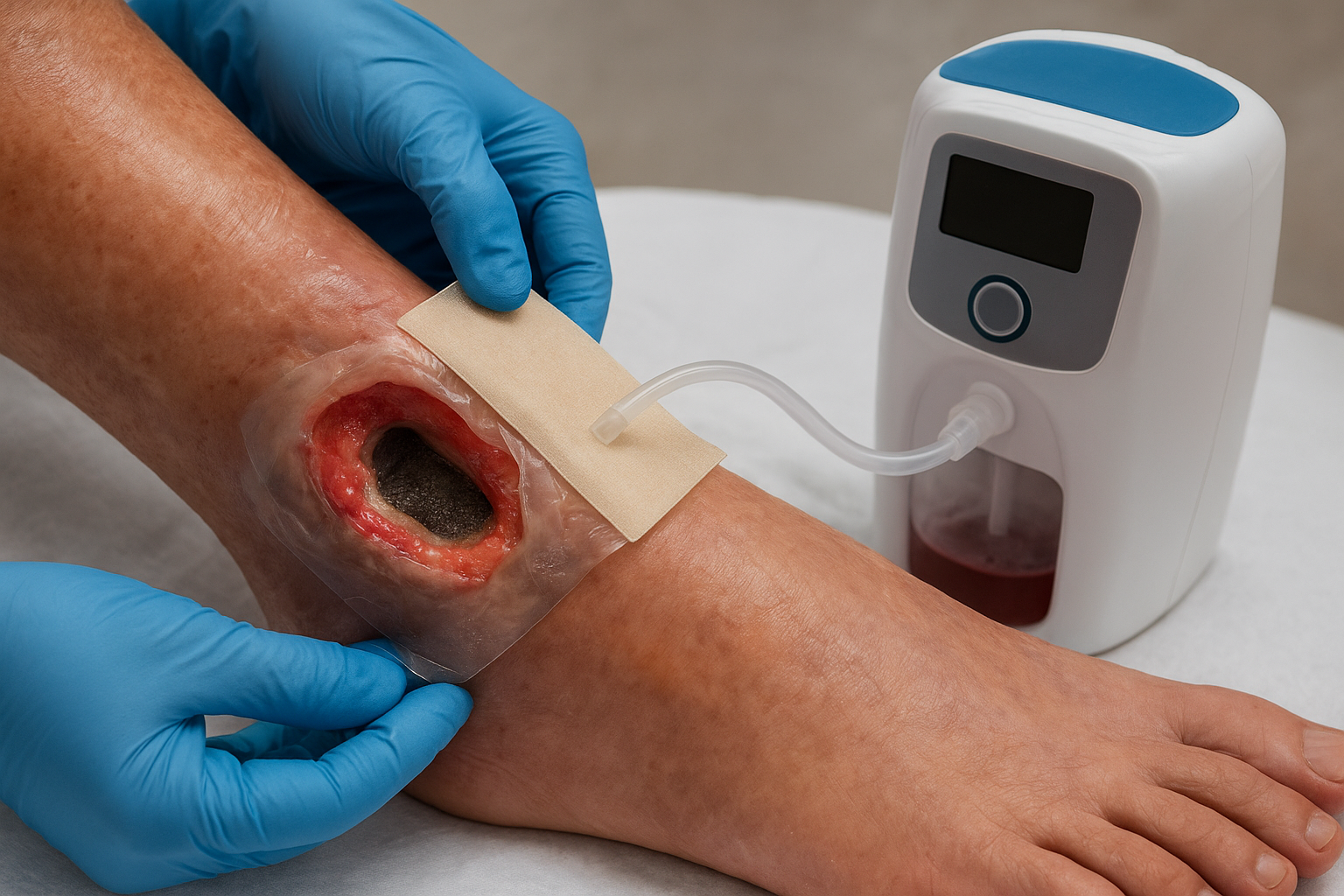
10. Negative pressure therapy and skin substitutes
When a diabetic ulcer is large, deep, or simply refuses to close despite everything else on this list, negative pressure wound therapy (NPWT) and skin substitutes step in as the advanced end of treatment. NPWT uses a vacuum-sealed foam dressing connected to a pump that continuously draws fluid away from the wound, while skin substitutes are lab-grown or donor-derived tissue grafts that give a stalled wound a biological jump start. Both require oversight from a podiatrist experienced in diabetic ulcer wound care dressings at this level of complexity, which is exactly the kind of case our advanced surgical services team handles regularly.
How it works
NPWT places an open-cell foam dressing directly in the wound, seals it with an adhesive film, and connects it to a pump that applies steady or intermittent suction. That suction pulls exudate into a canister, reduces swelling, and mechanically stretches the wound bed to encourage new blood vessel growth. Skin substitutes, by contrast, are applied like a graft, either sheets of collagen matrix or cultured cells, and integrate into the wound to replace tissue the body isn’t producing fast enough on its own.
A wound that isn’t responding to standard dressings often needs mechanical or biological help, not a stronger version of the same bandage.
Best for this type of wound
These options suit large, full-thickness ulcers that haven’t closed after weeks of conservative treatment, wounds following extensive debridement, or cases where amputation is being weighed against procedures that save the limb. They’re not first-line treatments for shallow or newly discovered wounds.
Pros and cons
| Pros | Cons |
|---|---|
| Speeds healing on complex, non-healing wounds | Requires specialized equipment and training |
| Reduces swelling and bacterial load simultaneously | Higher cost, often needs insurance pre-approval |
| Skin substitutes can close wounds unlikely to heal otherwise | Not appropriate for infected or heavily contaminated wounds |
| Closely monitored, reducing surprise setbacks | Requires frequent clinic visits for pump checks or grafts |
How to use it safely
- Never attempt NPWT setup or troubleshooting at home without direct training from your care team.
- Watch the tubing and seal daily for leaks, since a broken seal stops the therapy from working.
- Keep every scheduled follow-up for skin substitute applications, since timing between grafts affects success.
- Report any pump alarms, foul odor, or sudden pain increase immediately rather than waiting for the next visit.
Keeping your wound healing on track
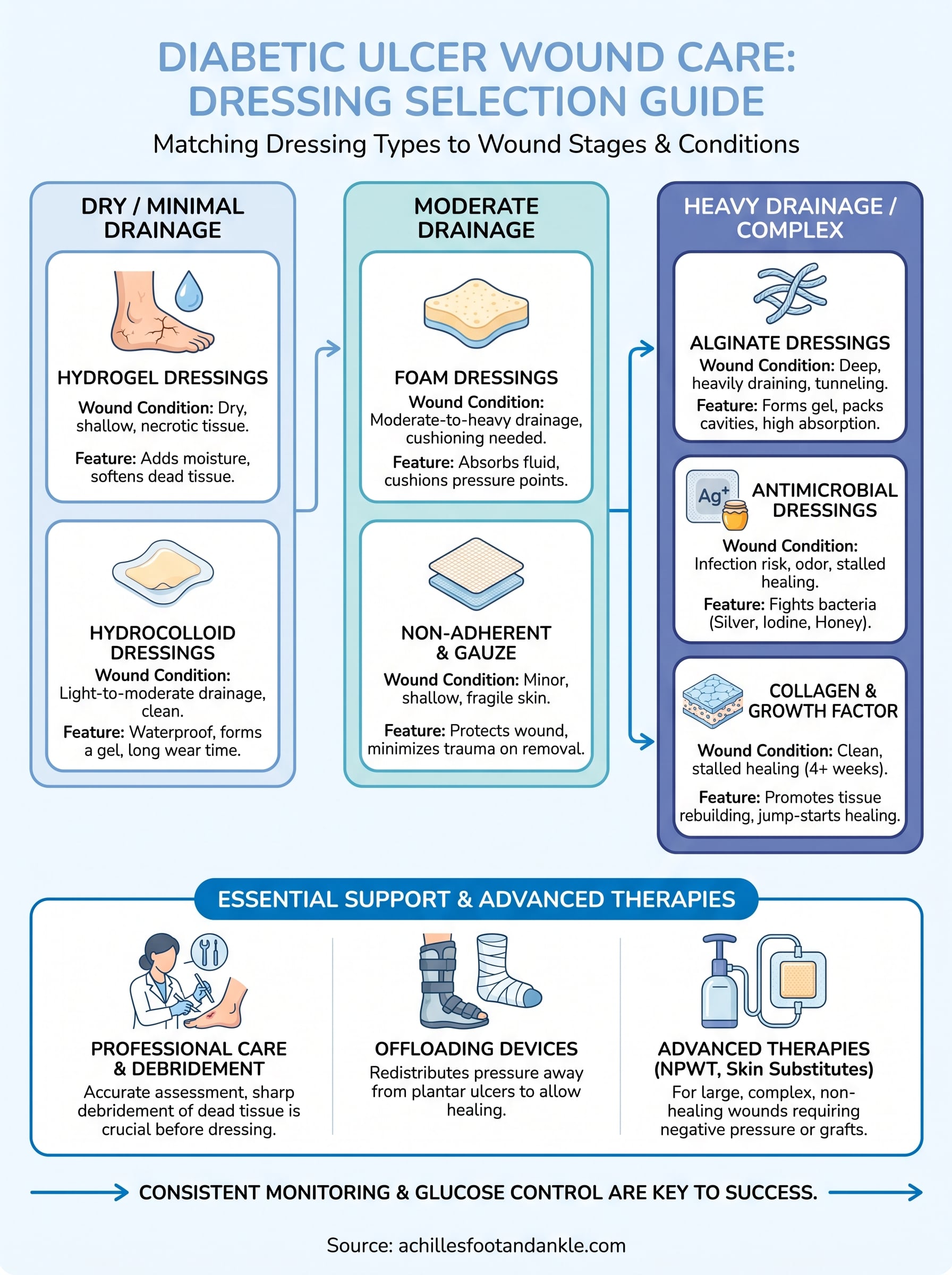
No single dressing on this list works in isolation. The right diabetic wound care dressings only do their job when they’re matched to the wound’s stage, backed by good glucose control, and paired with proper offloading so pressure doesn’t undo the progress. A dry ulcer needs hydrogel, a draining one needs foam or alginate, and a stalled wound needs collagen or advanced therapy, but none of that matters if the wound goes unmonitored. Guessing at diabetic ulcer wound care dressings from a pharmacy shelf is how minor sores become limb-threatening emergencies.
Trust your gut if something looks off, and don’t wait out a wound that isn’t visibly improving week over week. Diabetic feet can’t afford a wait-and-see approach, and early professional care is what keeps a small ulcer from becoming a surgical case. If you’re noticing a new sore or one that isn’t healing the way it should, get a same-day evaluation with our podiatrists and have it checked before it worsens.