You finished your run, cooled down, and now there’s a nagging ache right through the middle of your foot. Foot arch pain after running is one of the most common complaints we hear from patients at our Central Virginia clinics, and it’s not something you should just push through. Left unaddressed, that post-run soreness can progress into a chronic issue that sidelines you for weeks or months.
The arch of your foot absorbs and distributes force with every stride. When something in that system breaks down, whether it’s a muscle, a tendon, or the way your foot hits the ground, pain follows. The good news is that most causes are identifiable and treatable, especially when you know what to look for. At Achilles Foot and Ankle Center, our podiatrists diagnose and treat these conditions daily across thirteen locations in Central Virginia.
This article covers nine common reasons your arch hurts after a run, what you can do for relief at home, and when it’s time to see a specialist.
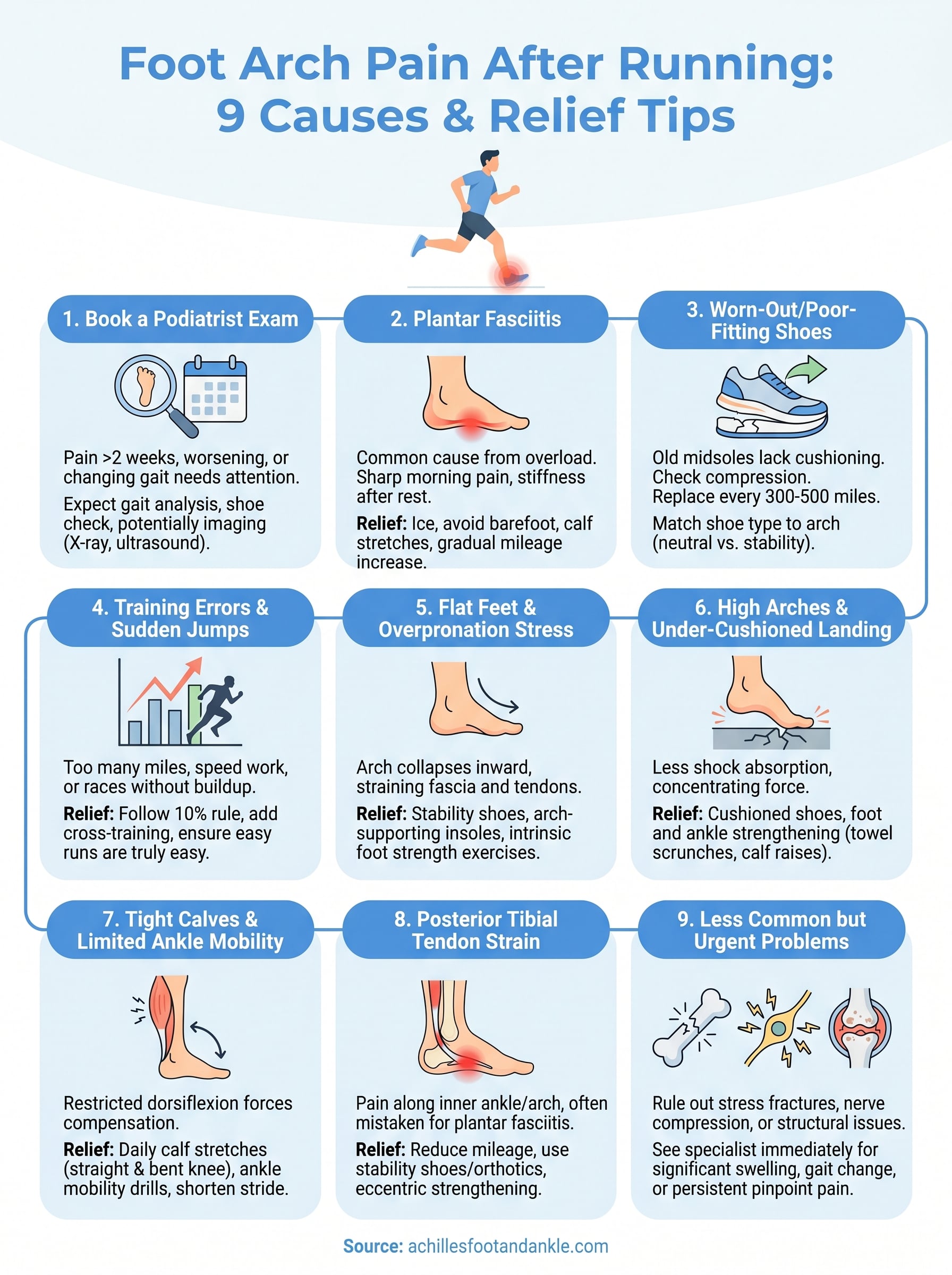
1. Book a podiatrist exam to pinpoint the cause
When foot arch pain after running keeps returning despite rest, stretching alone rarely solves the problem. The arch involves multiple tendons, ligaments, and small joints working together, and treating the wrong structure while the real issue progresses can turn a minor irritation into a long-term injury.
Signs your pain needs an exam, not more stretching
Some arch soreness responds to a few easy days, but certain warning signs point to something that needs professional attention. If your pain has lasted more than two weeks, worsens during a run rather than easing up, or causes you to shift your stride to compensate, schedule an appointment rather than waiting it out.
Pain that forces a change in your gait is your body signaling structural stress, not ordinary muscle fatigue.
Additional red flags include swelling or visible bruising along the arch, sharp pain on your first steps in the morning, and discomfort that persists on rest days without a clear reason.
What a running-focused foot exam looks like
A podiatrist evaluates your gait, foot alignment, and range of motion rather than just the area that hurts. Expect the clinician to watch how you stand and walk, test ankle and toe flexibility, and apply targeted pressure along key tendons to locate the exact pain source. Bringing your current running shoes to the appointment is worth doing, since wear patterns on the outsole reveal a lot about how your foot functions under load.
When imaging helps and what it can rule out
Not every visit requires imaging, but X-rays and diagnostic ultrasound become valuable when the physical exam suggests a possible stress fracture, tendon tear, or structural deformity. Ultrasound lets your podiatrist evaluate soft tissue in real time without radiation exposure, making it a practical first imaging choice for many running-related arch complaints.
First-line treatments a podiatrist may recommend
Initial treatment typically centers on activity modification, structured stretching protocols, and footwear corrections matched to your specific diagnosis. Many runners also benefit from custom or prefabricated orthotics to address mechanical imbalances, while more acute cases may involve anti-inflammatory treatments such as guided corticosteroid injections or physical therapy referrals.
2. Plantar fasciitis from overload or stiffness
Plantar fasciitis is the most frequent cause of foot arch pain after running, and it develops when the plantar fascia, a thick band of tissue running from your heel to your toes, gets overloaded beyond its tolerance.
Common symptoms and where the arch hurts
Pain typically concentrates at the bottom of the heel or along the inner arch, and the first few steps in the morning are often the sharpest. Stiffness after sitting for long periods is another consistent sign that the fascia is inflamed rather than just fatigued.
Why running irritates the plantar fascia
Every running stride places repetitive tensile stress on the plantar fascia, and when your training volume spikes or your calf flexibility drops, that stress exceeds what the tissue can handle. Stiff ankles reduce your ability to absorb impact efficiently, shifting more load directly onto the fascia.
Inadequate ankle dorsiflexion is one of the most overlooked contributors to plantar fascia overload in runners.
What to do in the first 72 hours
Reduce your running volume immediately and apply ice for 10 to 15 minutes after activity to limit inflammation. Avoid walking barefoot on hard floors, since unsupported steps keep the fascia under load when it needs rest.
Rehab steps that help pain stop coming back
Consistent calf stretching and plantar fascia-specific stretching done before your first steps in the morning significantly lowers recurrence rates. Pairing this with gradual mileage increases of no more than 10 percent per week gives the tissue time to adapt without re-injury.
3. Worn-out or poor-fitting running shoes
Your shoes play a bigger role in foot arch pain after running than most people realize. When the midsole breaks down or the fit doesn’t match your foot shape, your arch absorbs excessive stress with every stride, and pain follows quickly.
How shoe fit problems trigger arch pain
A shoe that’s too narrow compresses the midfoot, while one that’s too wide lets your foot slide and pronate excessively. Both scenarios force the plantar fascia and supporting tendons to compensate, creating cumulative strain that builds into arch pain over time.
Quick at-home checks for worn-out shoes
Press your thumb into the midsole beneath the arch. If it feels compressed or offers little resistance, the cushioning is spent. Most running shoes last 300 to 500 miles, so tracking your mileage in a simple log helps you replace them before breakdown causes injury.
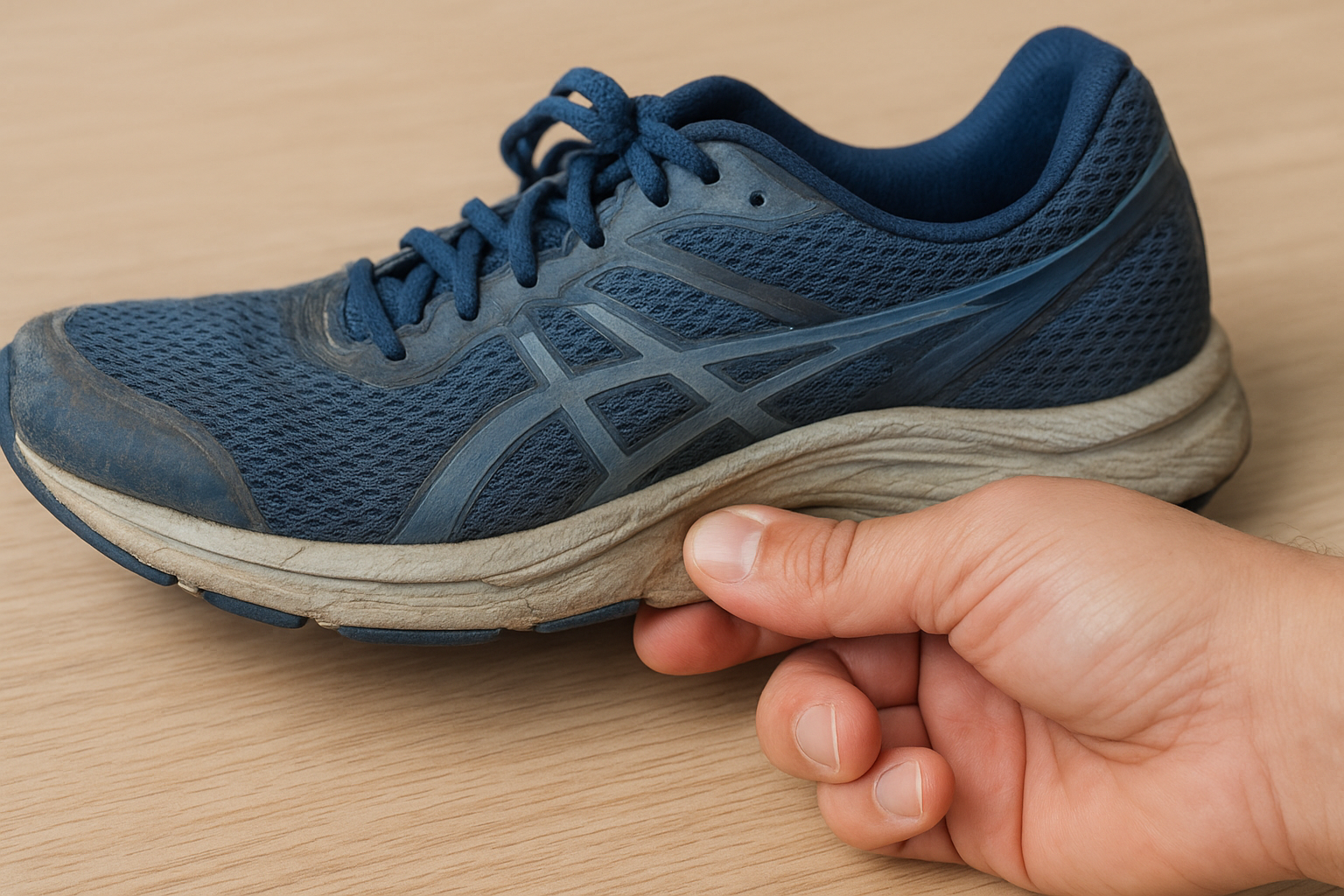
Worn-out shoes are a surprisingly common trigger for arch pain that runners overlook because the upper still looks intact.
How to choose the right level of support
Runners with low arches generally need motion control or stability shoes, while high-arch runners do better with neutral, well-cushioned models. Getting a proper gait analysis at a running specialty store removes the guesswork from shoe selection.
When insoles or custom orthotics help most
Off-the-shelf insoles add a layer of cushioning and basic arch support that can bridge the gap between a good shoe and a great fit. Custom orthotics become the better option when structural foot mechanics drive your pain, since they are built specifically for your foot.
4. Training errors and sudden mileage jumps
Training errors are one of the most preventable triggers of foot arch pain after running, yet they remain extremely common. When you ask your feet to handle more load than they are conditioned for, the soft tissue in your arch absorbs the excess stress until something gives.
How overuse shows up in the arch
Overuse injuries tend to build gradually rather than strike suddenly. You may notice a dull ache mid-run that fades after you stop, then returns sooner with each subsequent session. That pattern means your arch tissues are accumulating damage faster than they can repair between runs.
Common patterns that cause flare-ups
The most frequent culprits are adding too many miles in a single week, doubling down on back-to-back hard days, and jumping into speed work before your foot has adapted to steady base mileage. Racing a new distance without a structured build-up puts the same kind of sudden spike load on the arch.
Your connective tissue adapts more slowly than your cardiovascular fitness, so your lungs may feel ready long before your arch does.
How to modify runs without losing fitness
Swap one or two weekly runs for low-impact cross-training, such as pool running or cycling, to maintain aerobic capacity while reducing arch stress. Keeping your easy runs truly easy also cuts the cumulative load without sacrificing fitness gains.
A simple return-to-running progression
Follow the 10 percent rule and increase weekly mileage by no more than that amount each week. Insert a cutback week every third or fourth week where you drop volume by 20 to 30 percent before building again.
5. Flat feet and overpronation stress
Flat feet cause the arch to collapse inward with each step, and that collapse amplifies significantly when you run. The result is increased strain on the plantar fascia and tibial tendons, which creates a direct path to foot arch pain after running.
What overpronation does to the arch
Overpronation means your foot rolls excessively inward through the push-off phase of your stride. This motion stretches the arch tissues beyond their normal range on every single step, generating repetitive microtrauma that accumulates quickly under running loads. Over time, that repeated stress breaks down the supporting structures faster than they can recover.
Clues your mechanics drive the pain
Check the inner heel and forefoot area of your current running shoes. Heavy wear along the inner edge is a reliable indicator that overpronation is loading your arch with each stride. Pain that travels up toward your shin or inner knee alongside arch soreness also points to a mechanics-driven problem rather than an isolated soft tissue issue.
Uneven wear on your outsole often tells the same story a full gait analysis would.
Support options that usually help
Stability or motion-control shoes limit excessive inward roll, and many runners with flat feet notice meaningful pain reduction after switching models. Adding arch-supporting insoles provides an extra layer of control and is a practical starting point before pursuing custom orthotics.
Strength work that protects the arch
Building intrinsic foot strength reduces how much you depend on footwear alone for support. Short-foot exercises and single-leg calf raises train the small muscles that actively hold your arch up during the stance phase of each stride.
6. High arches and under-cushioned landing
High arches create the opposite mechanical problem from flat feet, but they produce foot arch pain after running just as reliably. A rigid, high-arched foot lacks the flexibility to absorb shock efficiently, so impact forces concentrate through the arch and connective tissue with every stride.
Why high arches can feel sore after runs
A high arch distributes your body weight across a smaller contact surface, concentrating pressure on the heel and ball of your foot. This leaves the midfoot tissues under sustained tensile load during each stride, and that load accumulates fast over distance.
Rigid high arches transfer more ground impact force into bone and connective tissue because they flex less to absorb each footstrike.
Running on hard surfaces like concrete makes this considerably worse because the ground returns no cushioning to your foot at all.
Shoe features that tend to reduce stress
Look for running shoes with generous heel and forefoot cushioning paired with a moderate heel-to-toe drop of 8 to 10 millimeters. That combination reduces midfoot strain by spreading load more evenly across your foot rather than funneling it through the arch.
Foot and ankle strengthening priorities
Strengthening your intrinsic foot muscles and peroneal tendons creates more active shock absorption capacity so your arch handles load better between footsteps. Adding towel scrunches, toe spreads, and single-leg calf raises to your routine on non-running days builds that capacity without adding impact stress.
When you should avoid minimalist footwear
Minimalist shoes feature zero-drop platforms and very thin midsoles, which force a high-arched foot to absorb all ground impact directly. Switching to a minimalist model significantly raises your injury risk if your arch lacks the strength and flexibility to handle that extra demand, so hold off until a podiatrist confirms your foot is ready for that transition.
7. Tight calves and limited ankle mobility
Tight calves are a frequently overlooked driver of foot arch pain after running, yet the connection is direct. When your calf muscles and Achilles tendon restrict ankle movement, your foot compensates by flattening and rolling inward to complete each stride, placing extra load on the arch structures.
How calf tightness loads the arch
When your ankle lacks sufficient dorsiflexion, your foot pronates earlier and more aggressively during the push-off phase to make up for the lost range. That compensation transfers stress directly into the plantar fascia and arch tendons with every step you take.
Restricted ankle dorsiflexion is one of the most direct mechanical links between calf tightness and arch pain in runners.
Self-checks for ankle mobility limits
Stand facing a wall and place your foot about four inches from the base. Drive your knee toward the wall without lifting your heel. If your knee cannot reach the wall cleanly, you have a meaningful mobility restriction worth addressing before your next run.
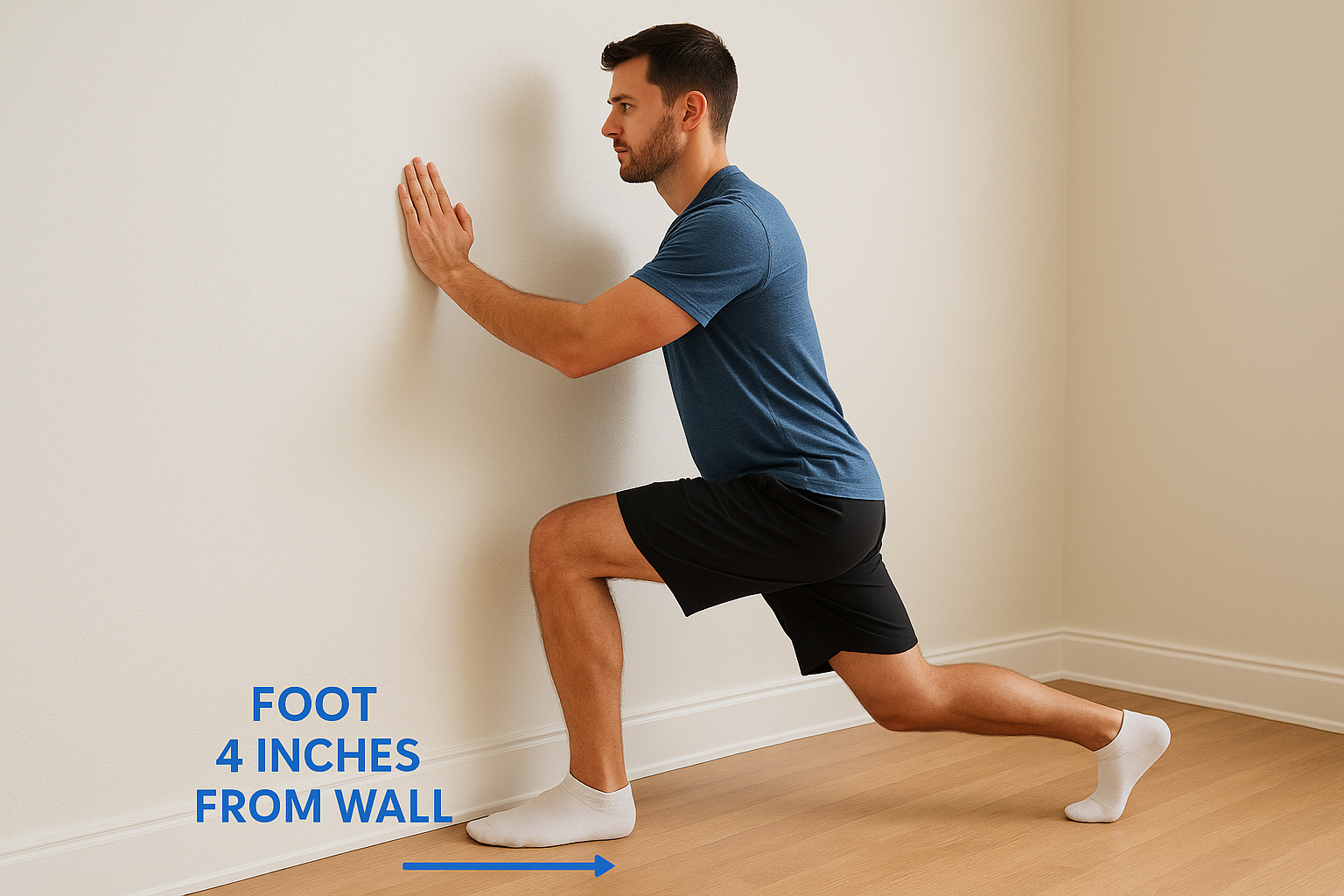
Stretches and mobility drills that work
Perform bent-knee and straight-knee calf stretches daily, holding each position for 30 to 45 seconds on both sides. Adding ankle circles and banded dorsiflexion drills before runs primes the joint and reduces the compensation that overloads your arch.
Form cues that reduce strain on the foot
Shortening your stride slightly and increasing your cadence reduces the braking force your arch absorbs on each landing. Focusing on striking with your foot beneath your hips rather than out in front distributes impact more efficiently through your lower leg and away from the arch.
8. Posterior tibial tendon strain
The posterior tibial tendon runs along the inside of your ankle and holds your arch up during every stride. When this tendon gets strained, it produces foot arch pain after running that often gets confused with plantar fasciitis, which means the real problem can go untreated longer than it should.
How this pain feels and where it shows up
Pain from a posterior tibial tendon strain typically runs along the inner ankle and into the arch, rather than sitting directly at the heel. You may notice swelling along the inner ankle and a deepening ache that worsens as your run continues rather than settling down with warmup.
Why the tendon gets overloaded in runners
The posterior tibial tendon fires repeatedly during the push-off phase of your stride to prevent your arch from collapsing. Runners with flat feet or overpronation place this tendon under significantly higher load with each step, and increasing mileage too fast compounds that stress before the tendon can adapt.
Posterior tibial tendon strain left untreated can progress to full tendon dysfunction, which causes permanent arch collapse.
What to change right away in training and shoes
Reduce your weekly mileage immediately and switch to stability shoes with firm arch support to limit inward rolling. Three quick adjustments that reduce tendon load:
- Drop weekly mileage by 30 to 50 percent
- Avoid cambered road surfaces that tilt your foot inward during runs
- Replace your shoes if the midsole has compressed unevenly
When bracing, physical therapy, or orthotics help
An ankle brace or custom orthotic offloads the tendon by controlling pronation through each stride. Physical therapy adds targeted eccentric strengthening exercises that rebuild tendon resilience and lower your re-injury risk during your return to full training.
9. Less common but urgent problems to rule out
Not every case of foot arch pain after running comes from overuse or mechanics. Some conditions require prompt diagnosis because delaying care leads to outcomes that are harder to reverse.
Stress fractures and why they can mimic arch pain
A stress fracture in the navicular or metatarsal bones produces localized arch pain that worsens during a run and often doesn’t settle with rest. Unlike soft tissue soreness, stress fracture pain tends to pinpoint to one specific spot when you press on it. X-rays may miss early fractures, so your podiatrist may order an MRI to confirm the diagnosis.
Running through a stress fracture significantly raises the risk of complete fracture and surgical repair.
Nerve irritation that can cause burning or tingling
Tarsal tunnel syndrome compresses the tibial nerve along the inner ankle, producing burning, tingling, or shooting pain into the arch. These nerve-driven symptoms often feel distinctly different from the mechanical ache of plantar fasciitis and may flare even without running.
Midfoot joint arthritis and other structural causes
Degeneration in the midfoot joints creates stiffness and deep aching that worsens after prolonged activity. Structural problems like accessory navicular bones or Lisfranc injuries fall into this category and require imaging to identify correctly.
Red flags that mean stop running and get seen
Stop running immediately and schedule an appointment if you notice significant swelling after a run, pain that locks or catches in the midfoot, or any sharp pain that changes your gait after a single session.
Your next step
Foot arch pain after running has a long list of potential causes, and the nine covered in this article represent the most common ones our podiatrists see across Central Virginia every week. Some cases resolve with better shoes, smarter training, and consistent stretching, but others involve tendon damage, stress fractures, or nerve compression that require a proper diagnosis to treat correctly.
Guessing at the cause and trying random fixes costs you time and can let a manageable problem worsen into something that keeps you off the road for months. Getting an accurate diagnosis early is the fastest path back to running without pain. Our team at Achilles Foot and Ankle Center has thirteen convenient locations and same-day availability for patients who need to be seen quickly. If your arch has been hurting after runs, take the next step and book a same-day appointment so we can find out exactly what’s going on and get you back on track.