That sharp pain under the ball of your foot isn’t something you can just run through. If every push-off sends a jolt beneath your big toe, you may be dealing with sesamoiditis, and ignoring it will only make things worse. Sesamoiditis treatment for runners requires a specific approach because the sesamoid bones sit right where your foot absorbs the most force during a stride. Left untreated, this condition can sideline you for months or, in severe cases, lead to a stress fracture of the sesamoid itself.
The good news: most runners recover fully without surgery. The key is knowing which treatments actually work, when to modify your training, and how to protect the sesamoids as you rebuild mileage. Getting that balance wrong, returning too soon or relying on the wrong footwear, is the most common reason runners end up back at square one. A structured recovery plan makes all the difference.
At Achilles Foot and Ankle Center, our podiatrists treat runners with sesamoiditis across our thirteen Central Virginia locations, using everything from custom orthotics and advanced imaging to biomechanical assessments that identify why the problem started. This guide walks you through proven treatment options, recovery timelines, footwear strategies, and a step-by-step plan to get you back on the road safely.
What sesamoiditis is and why runners get it
Your foot contains two small bones buried within the tendons beneath your big toe joint. These are your sesamoid bones, and unlike most bones in the body, they don’t connect to other bones directly. Instead, they sit embedded in the flexor hallucis brevis tendon, acting as a pulley system that helps your big toe push off the ground with every step. When those bones become irritated and inflamed, the result is sesamoiditis, one of the most stubborn forefoot conditions in running medicine.
The anatomy behind the pain
The medial sesamoid (the one closer to the inside of your foot) takes more load than the lateral one and is the more commonly affected bone. Both bones sit right at the first metatarsophalangeal joint, which is the ball of your foot just behind the big toe. This joint bends every single time you push off during a stride, meaning your sesamoids work on every step you run.
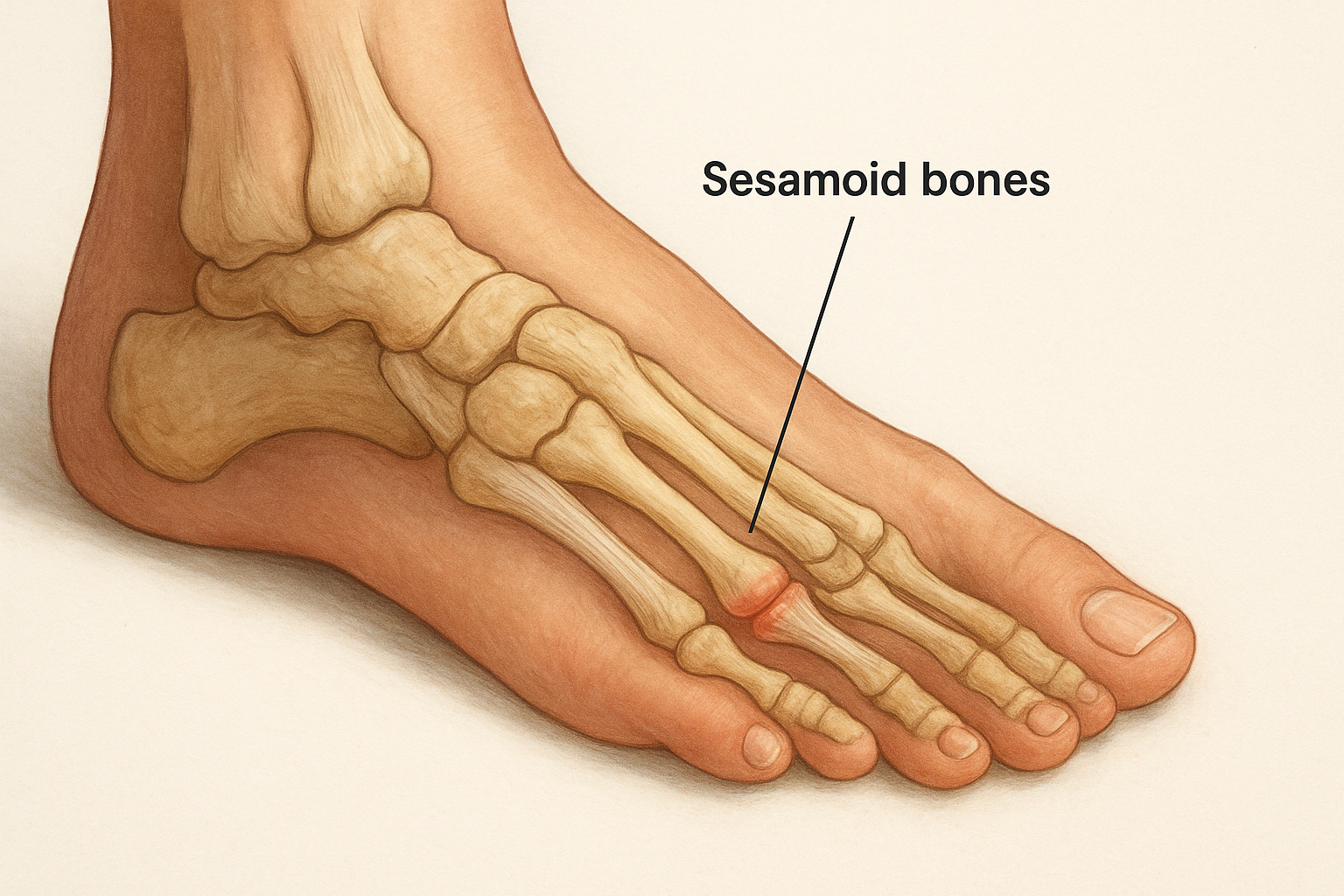
The sesamoids absorb up to three times your body weight with each push-off during running, which is why this joint is so vulnerable to overuse.
When inflammation builds up in the tissue surrounding these bones, pain, swelling, and tenderness develop directly under the ball of the foot. The pain typically comes on gradually rather than all at once, which is one of the features that distinguishes sesamoiditis from an acute fracture. You might notice it as a dull ache after a long run that slowly sharpens into something that makes each step uncomfortable.
Why running loads the sesamoids more than other activities
Running does something that walking doesn’t: it creates a propulsion phase where all of your body weight transfers through the front of your foot at high speed. During a normal walking step, your sesamoids absorb load gradually. During a running stride, especially when you accelerate or run uphill, that load spikes sharply and repeatedly. A runner logging 40 miles per week may take 60,000 or more steps, and each one asks those two small bones to do their job.
Certain running mechanics increase risk significantly. Runners who forefoot-strike, meaning they land on the ball of the foot rather than the heel, place their sesamoids under load for longer during each contact phase. Runners who pronate excessively shift more stress onto the medial sesamoid specifically. A tight calf or limited ankle dorsiflexion can also force the forefoot to compensate, adding pressure to the sesamoid region with every stride.
Common contributing factors
Understanding why you developed sesamoiditis is a core part of any effective sesamoiditis treatment for runners, because removing the cause is just as important as reducing the current inflammation. Several factors commonly contribute:
- Sudden mileage increases: Adding distance or intensity faster than your tendons and bones can adapt is the most frequent trigger.
- Hard or minimalist footwear: Shoes with thin soles and poor cushioning under the metatarsal heads give the sesamoids no buffer.
- High-arched (cavus) feet: A rigid, high arch concentrates ground reaction forces on the ball of the foot rather than distributing them across the whole foot.
- Hill running and speed work: Both activities dramatically increase forefoot loading compared to flat, easy pacing.
- Returning to training too quickly: After time off, even a few weeks, your bones need time to rebuild their tolerance to load.
Your sesamoids don’t have a strong blood supply compared to other bones, which is part of why this condition heals slowly and why repeated stress without adequate recovery turns mild inflammation into a chronic problem.
How to tell sesamoiditis from a fracture
Getting the diagnosis right matters because the two conditions call for different treatment timelines and approaches. Both a sesamoid stress fracture and sesamoiditis produce pain in the same location under the ball of the foot, which makes the distinction easy to miss without a proper evaluation.
Signs that point to sesamoiditis
The defining feature of sesamoiditis is a gradual onset of pain that builds over days or weeks rather than appearing suddenly after a specific incident. You’ll typically feel a dull ache under your big toe joint that worsens during activity, particularly during push-off, and improves with rest. The tenderness is diffuse, meaning when a clinician presses on the area, the soreness spreads across the sesamoid region rather than concentrating on one exact spot. Swelling is usually mild, and you may notice stiffness in the big toe joint after sitting for long periods.
Signs that point to a fracture
A sesamoid stress fracture shares several features with sesamoiditis but has key distinguishing characteristics. Sudden, sharp pain during a specific run or jump, rather than a gradual build-up, often signals a fracture. You may also notice that the pain is more precisely localized, with one pinpoint spot that feels acutely tender when pressed directly.
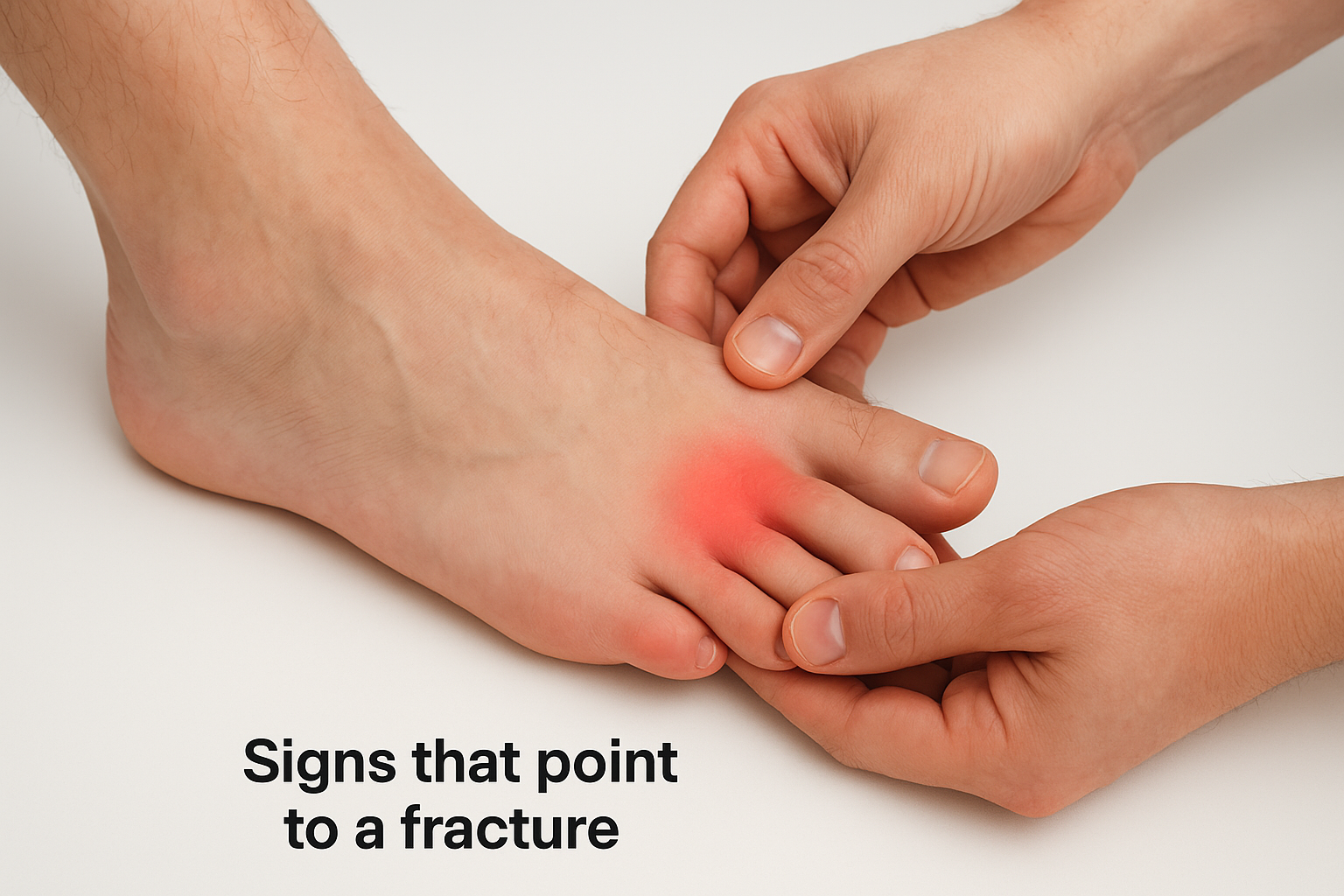
If your pain came on suddenly during a single workout and hasn’t improved with a week of rest, treat it as a fracture until imaging proves otherwise.
Fracture symptoms also tend to be more severe and persistent, meaning rest alone doesn’t provide much relief between sessions. Weight-bearing can become difficult enough that you find yourself limping or shifting your weight to the outer edge of your foot to avoid loading that spot at all.
Getting a definitive answer
No symptom checklist replaces proper imaging, and this is where sesamoiditis treatment for runners can go wrong when people self-diagnose and skip professional evaluation. Standard X-rays can identify fractures in many cases, but because some people naturally have a bipartite sesamoid (a sesamoid that developed in two separate pieces), X-rays sometimes create confusion. An MRI or bone scan gives a clearer picture of bone stress and soft tissue inflammation, helping your podiatrist distinguish between a fracture, a bipartite sesamoid, and inflammatory sesamoiditis so your treatment plan actually targets the correct problem from the start.
Step 1. Calm pain and inflammation fast
The first priority in sesamoiditis treatment for runners is bringing the acute inflammation under control before anything else. Continuing to run on an inflamed sesamoid compounds the irritation with every stride, turning a manageable flare-up into a prolonged setback. Your goal during the first one to two weeks is to reduce swelling, lower pain levels, and create conditions where the tissue around the sesamoids can start to recover properly.
Cut the load immediately
The single most effective thing you can do right now is remove the repetitive stress that caused the inflammation in the first place. This doesn’t automatically mean zero activity, but it does mean stopping any running or high-impact movement that reproduces your pain. Cross-training options like swimming and pool running keep your cardiovascular fitness intact without loading the forefoot at all. Cycling can work too, provided you shift your contact point on the pedal so the ball of your foot isn’t bearing the pressure during each rotation.
If walking at a normal pace triggers noticeable pain, switch to a stiff-soled shoe or a post-op sandal for daily movement until the acute phase settles.
Apply ice consistently in the early days
Icing the sesamoid region for 15-20 minutes after any weight-bearing activity reduces blood flow to the inflamed tissue and helps control swelling. Place a thin cloth between the ice pack and your skin to avoid frostbite, and repeat two to three times per day during the first week. Don’t skip icing just because the pain feels manageable at rest, because consistent application during this phase moves you out of the acute stage faster and reduces the chance of chronic inflammation taking hold.
Use NSAIDs as a short-term tool
Over-the-counter anti-inflammatory medications like ibuprofen or naproxen sodium can reduce pain and swelling during the first 7-10 days when used as directed on the label. Treat them as a short-term bridge, not a long-term solution, and pair them with actual load reduction rather than using them to keep training through discomfort. Masking pain with medication while continuing to run damages the tissue further and extends your recovery timeline significantly. If you have a history of gastrointestinal issues, kidney problems, or are currently taking other medications, speak with your doctor before starting any NSAID regimen.
Step 2. Offload with shoes, pads, and orthotics
Reducing inflammation alone won’t keep the pain away if your footwear continues to concentrate force directly on the sesamoids with every step you take. Mechanical offloading is the second pillar of sesamoiditis treatment for runners, and it means physically redirecting pressure away from the ball of your foot through shoes, padding, and orthotic devices chosen with the sesamoid bones in mind.
Choose the right footwear
Your shoe selection during recovery has a direct impact on how quickly the sesamoids calm down. Maximalist or well-cushioned shoes with a thick, firm midsole under the forefoot reduce peak ground reaction forces on every step. Look for shoes with a rocker-bottom sole geometry, where the forefoot curves upward slightly, because this design reduces the degree to which your big toe joint bends during push-off, which is exactly the motion that aggravates the sesamoids most. Avoid flat, minimal, or flexible shoes entirely during the recovery period, and put any barefoot-style training on hold until your symptoms are fully resolved.
A shoe that feels soft underfoot isn’t the same as one that mechanically offloads the sesamoid region, so prioritize sole geometry over cushioning feel alone.
Use sesamoid pads strategically
Sesamoid padding redirects pressure by creating a slightly raised area around the sesamoid bones rather than under them. You can purchase felt or gel dancer’s pads at most pharmacies, and the correct placement matters more than the pad material itself. Follow this placement approach for the best result:
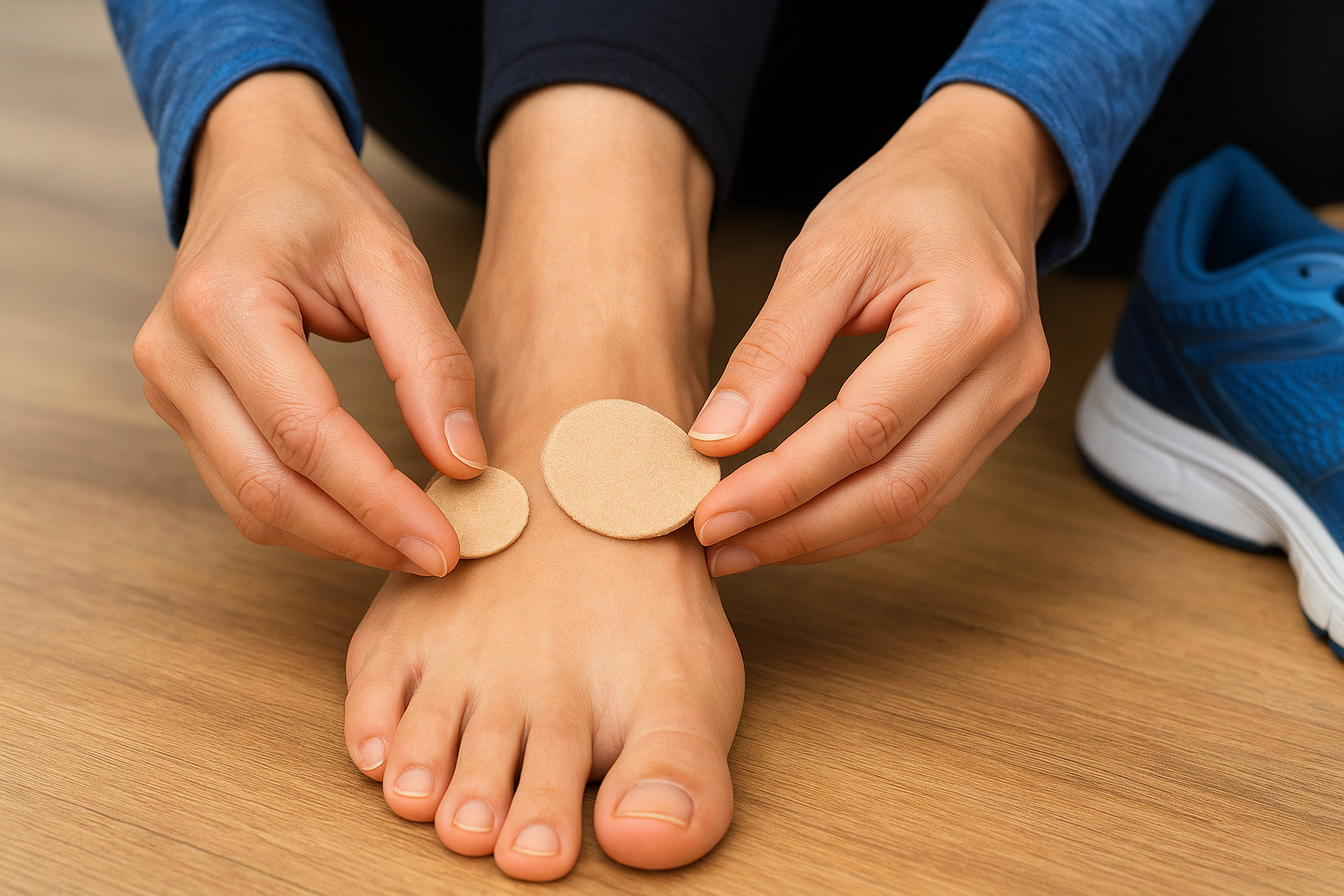
- Locate the tender spot by pressing gently under your big toe joint until you find the most sensitive point.
- Position the pad so it sits just behind and slightly to the side of that spot, not directly on top of it.
- Secure the pad to your foot with athletic tape before putting your sock on, or use a pad with an adhesive backing designed to stay in place inside the shoe.
- Check daily that the pad hasn’t shifted, because a misaligned pad can increase pressure rather than reduce it.
Custom orthotics for long-term offloading
Over-the-counter pads work well in the early stages, but custom orthotics provide a more precise and durable solution for runners dealing with recurring or persistent sesamoid pain. A podiatrist can design an orthotic with a sesamoid cutout or metatarsal bar built directly into the device, which reliably shifts load away from the affected area across every shoe you wear. Custom orthotics also address the underlying biomechanical issues, such as excessive pronation or a high-arched foot type, that made your sesamoids vulnerable in the first place.
Step 3. Restore toe motion and foot strength
Once pain and swelling are under control, the next phase of sesamoiditis treatment for runners focuses on rebuilding what the injury took away: full range of motion in the big toe joint and enough strength in the foot’s intrinsic muscles to protect the sesamoids under load. Skipping this step and jumping straight back to running is the most common reason runners experience repeated flare-ups, because weak, stiff tissue cannot absorb the forces that running demands.
Regain big toe joint mobility
The big toe joint stiffens quickly when you’ve been guarding it through pain, and limited dorsiflexion, meaning the upward bend of the big toe, creates a mechanical problem that puts more stress on the sesamoids as you return to activity. You need to restore that range of motion actively and gradually before you start loading the joint again with full bodyweight exercise.
Start with this simple seated toe mobilization routine once daily:
- Sit in a chair with your foot flat on the floor.
- Gently grip your big toe with your fingers and slowly pull it upward toward your shin, holding for 5 seconds at the point where you feel a mild stretch but no sharp pain.
- Release, then gently press the toe downward toward the floor, holding for 5 seconds.
- Complete 10 repetitions in each direction.
Move through pain-free range only. If the mobilization triggers sharp or shooting pain at the sesamoid site, reduce the range and check with your podiatrist before progressing.
Strengthen the intrinsic foot muscles
Your foot contains small muscles that control how force distributes across the forefoot, and strengthening these muscles reduces the direct load that the sesamoids experience during push-off. Two exercises work particularly well for runners rebuilding from this injury:
Towel scrunches: Place a thin towel flat on the floor and use only your toes to scrunch it toward your heel repeatedly for 30 seconds. Perform 3 sets. This targets the flexor muscles without aggressively loading the sesamoid region.
Short foot exercise: While seated, keep your heel on the floor and try to shorten your arch by drawing the ball of your foot toward your heel without curling your toes. Hold for 5 seconds and release. Build to 3 sets of 15 repetitions before progressing to standing.
Practice both exercises pain-free on flat ground before adding any standing or single-leg progression to the routine.
Step 4. Return to running without a flare-up
Returning to running too soon is the single fastest way to extend a sesamoiditis recovery into a multi-month ordeal. Your sesamoids need progressive loading to adapt back to running’s demands, and that means rebuilding mileage on a structured schedule rather than picking up where you left off. Sesamoiditis treatment for runners isn’t complete until you’ve moved through a careful comeback phase that tests the tissue before committing to full training loads.
Follow a graded return-to-run protocol
Start your return only when you can walk for 30 minutes on flat ground without pain during or after the session. If walking still triggers discomfort, you’re not ready to run, and pushing through that threshold will restart the inflammatory cycle.

Use this walk-to-run progression over four weeks, running on flat, soft surfaces like grass or a rubberized track throughout:
| Week | Session Structure | Frequency |
|---|---|---|
| 1 | 1 min run / 4 min walk x 6 rounds | 3 sessions |
| 2 | 2 min run / 3 min walk x 6 rounds | 3 sessions |
| 3 | 3 min run / 2 min walk x 6 rounds | 3-4 sessions |
| 4 | 5 min run / 1 min walk x 6 rounds | 3-4 sessions |
Avoid hills, speed work, and trail running until you’ve completed the entire protocol without symptoms. Both hill running and fast pacing spike forefoot loading well beyond what flat easy running requires, so they belong later in the process, not during your first weeks back.
If pain rises above a 2 out of 10 during any run segment, stop the session, return to the previous week’s structure, and hold that level for another three sessions before advancing.
Watch for warning signs during your comeback
Post-run soreness that lingers beyond 24 hours is the most reliable signal that you’ve loaded the sesamoid region beyond what it can currently handle. Track your pain level before each session, immediately after, and the next morning so you have an accurate picture of how your foot is responding rather than relying on how you feel mid-run.
Swelling that returns under the ball of your foot after a session is a hard stop signal. Rest for two full days, apply ice consistently, and cut your next run segment length by 50 percent before building back up. Ignoring post-run swelling turns a minor setback into a full regression.
When to see a podiatrist and what to expect
Self-managed sesamoiditis treatment for runners works well for mild to moderate cases, but some situations require professional evaluation to avoid turning a manageable injury into a long-term problem. Knowing when to stop managing this on your own and book an appointment can save you weeks of unnecessary downtime.
Signs you need professional evaluation
Most runners wait too long before seeking care, which typically means the injury is deeper than it first appeared. Book an appointment with a podiatrist if any of the following apply to your situation:
- Pain persists beyond three weeks of consistent rest, icing, and offloading without meaningful improvement
- You can’t walk a full city block without noticeable pain under the ball of your foot
- Swelling under the big toe joint returns the morning after a rest day
- You felt a sudden sharp snap or pop during a run followed by immediate, severe pain
- Your pain worsens at rest or wakes you at night, which suggests a stress fracture rather than simple inflammation
- You’ve had two or more recurrences of sesamoid pain in the same foot within a single year
Waiting until the pain becomes unbearable before getting an imaging study means you may have been running on a fracture for weeks, which extends your total recovery time significantly.
What your podiatrist appointment will involve
Your first visit will include a thorough clinical examination of the big toe joint, surrounding tendons, and the sesamoid bones themselves. Your podiatrist will press directly on the sesamoid region to localize tenderness, assess your range of motion and foot posture, and review how you walk and how your weight distributes across your forefoot.
Imaging typically follows the physical exam. Weight-bearing X-rays are usually the first step because they show bone alignment and can reveal obvious fractures or joint changes. If your X-ray results are inconclusive or your symptoms are severe, your podiatrist may order an MRI, which provides detail on bone stress reactions, soft tissue inflammation, and the condition of the sesamoid’s blood supply, all of which influence your treatment direction.
Based on the findings, your treatment plan may include custom orthotics with a sesamoid relief cutout, corticosteroid injections to reduce persistent inflammation, immobilization in a walking boot for stress fractures, or a referral to physical therapy for a structured strength and mobility program. Surgical intervention is rare but remains an option for fractures that fail to heal with conservative care over six or more months.
How to prevent sesamoid pain from coming back
Once you’ve worked through sesamoiditis treatment for runners and returned to training pain-free, the real challenge begins: keeping the sesamoids healthy under the full demands of your running schedule. Most recurrences happen because runners remove the protections that helped them recover, too early or all at once. Prevention requires consistent habits, not just the absence of pain.
Manage your training load deliberately
The most controllable risk factor for recurrence is how quickly you increase your training volume and intensity. Your sesamoids adapt to load over time, but they need gradual progression to do so without breaking down again. Apply the 10 percent rule as a baseline: don’t increase your weekly mileage by more than 10 percent from one week to the next. More importantly, keep your hardest sessions, hill repeats, track workouts, and long runs, spaced far enough apart that your forefoot recovers between them.
Your sesamoids have limited blood supply, which means they adapt and recover more slowly than your muscles do. Build your training schedule around bone adaptation timelines, not just cardiovascular readiness.
Use this simple weekly structure to balance load and recovery:
- Monday: Easy run or rest
- Tuesday: Moderate effort run
- Wednesday: Cross-training (swim, bike, or pool run)
- Thursday: Quality session (tempo or intervals) only after 6+ weeks back
- Friday: Rest or easy movement
- Saturday: Long run on flat, soft surface
- Sunday: Full rest
Choose footwear and surfaces wisely
Your shoes are your first line of defense against repeat sesamoid stress. Retire shoes as soon as they lose forefoot cushioning, which typically happens between 300 and 500 miles of running, and never run in shoes that flex easily under the ball of your foot. Rocker-sole geometry should be a permanent feature of your running shoes going forward, not just a recovery tool.
Soft surfaces reduce peak impact forces significantly. Shifting at least two of your weekly runs to grass, packed dirt, or a rubberized track lowers cumulative stress on the sesamoid region compared to running the same miles entirely on pavement.
Address biomechanical risk factors early
Tight calves and limited ankle dorsiflexion remain two of the most overlooked drivers of recurrent sesamoid pain. When your ankle can’t flex far enough during a stride, your foot compensates by loading the forefoot harder and earlier. Add daily calf stretching and ankle mobility work to your warm-up routine to keep this movement available under fatigue. If you’ve been prescribed custom orthotics, wear them in every training shoe, not just the ones you used during recovery.
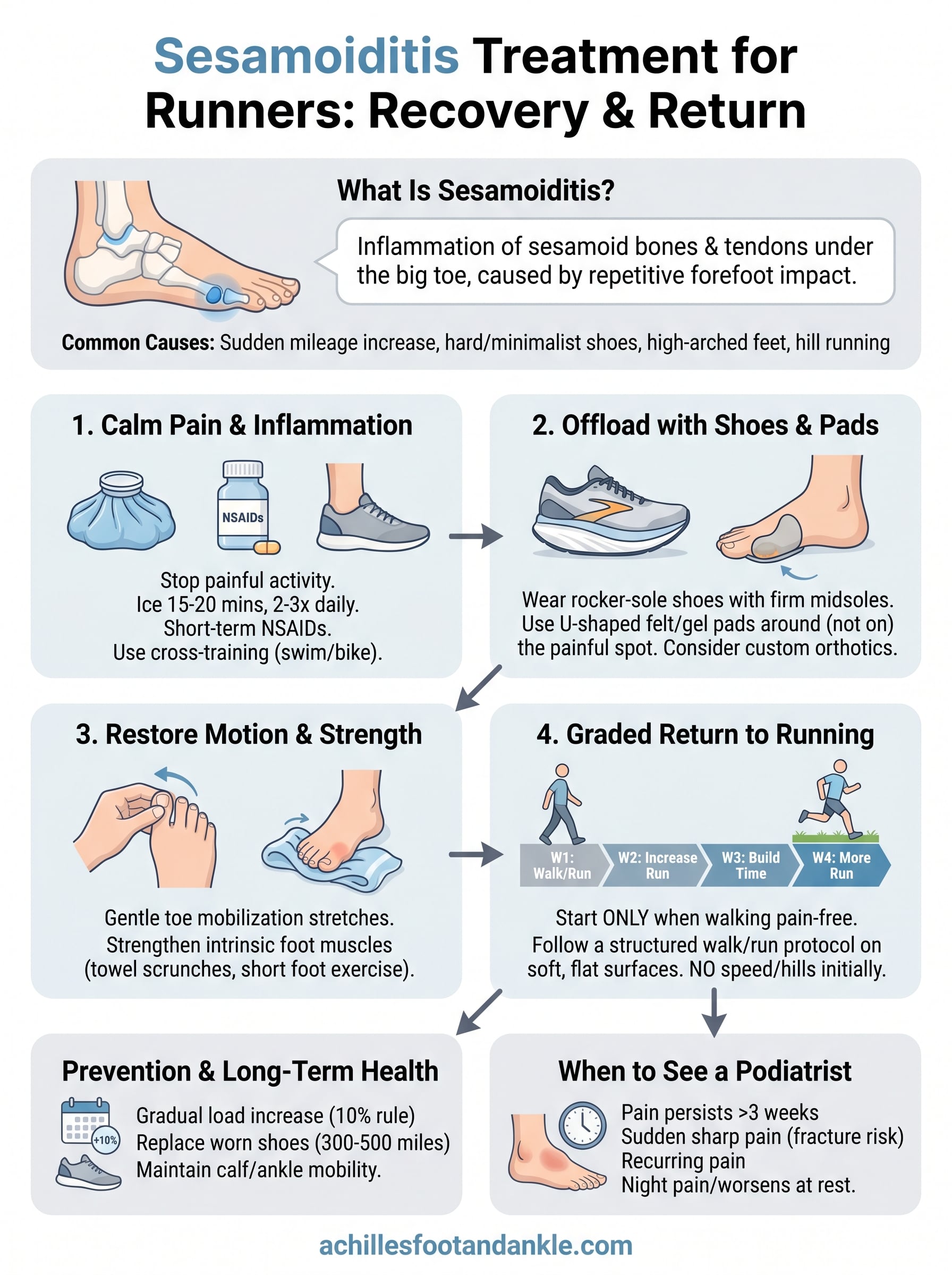
Back to running safely
Sesamoiditis stops being a recurring problem when you treat the cause rather than just the symptoms. Every step in this guide, from offloading with the right footwear to rebuilding strength before returning to mileage, addresses a specific reason runners end up back at square one. Follow the progression, respect the warning signs your foot sends during your comeback, and keep the protective habits in place long after the pain has gone.
Your foot is asking you to train smarter, not harder. Consistent load management, proper shoes, and a graded return protocol form the foundation of lasting recovery, and none of those require you to stop running permanently. Sesamoiditis treatment for runners works best when you combine good self-care at home with expert guidance from a podiatrist who understands running mechanics. If your pain isn’t improving or you want a clear diagnosis before you return to training, book a same-day appointment at Achilles Foot and Ankle Center today.